-
-
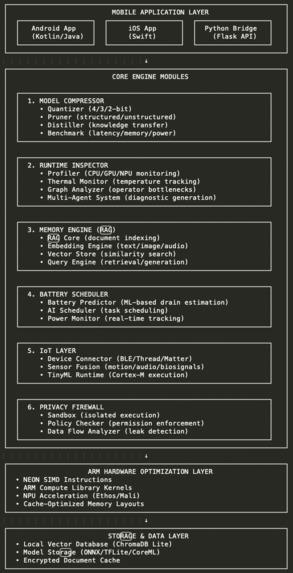
arm-adaptive-intelligence_System Design Diagram

Inspiration
Mobile AI applications drain battery rapidly and raise privacy concerns by transmitting data to cloud servers. ARM processors dominate mobile and IoT markets but lack comprehensive optimization tooling. This project addresses the need for efficient, private, on-device AI execution on ARM architecture.
What it does
The system compresses neural networks through quantization and pruning, profiles runtime performance identifying bottlenecks, enables semantic search across personal documents without internet connectivity, schedules AI tasks based on battery state, connects IoT sensors and enforces privacy through sandboxed execution. Features,
- Model Compression
4-bit/3-bit/2-bit quantization reducing model size by 4-16x, Structured pruning removing 30-50% of parameters, Knowledge distillation from large to small models.
Usage: Deploy state-of-the-art models on mobile devices.
- Performance Profiling
CPU/GPU/NPU utilization monitoring at 100Hz sample rate, Thermal tracking with throttling detection, Computation graph analysis identifying operator bottlenecks.
Usage: Debug AI application performance issues.
- On-Device RAG
Multi-modal document indexing (text, PDF, images, audio), Semantic search with cosine similarity, Context retrieval and response generation.
Usage: Private knowledge base without cloud dependency.
- Battery Management
ML-based battery drain prediction, Task scheduling based on power state, Thermal-aware inference deferral.
Usage: Extend battery life during AI workloads.
- IoT Connectivity
BLE/Thread/Matter device pairing, Multi-sensor data fusion, TinyML model deployment on Cortex-M.
Usage: Integrate wearables and smart sensors.
- Privacy Protection
Sandboxed model execution, Policy-based permission enforcement, PII detection and redaction.
Usage: Ensure data never leaves device.
- ARM Optimization
NEON SIMD instruction usage, NPU acceleration when available, Cache-optimized memory layouts
Usage: Maximize inference speed on ARM hardware.
- Benchmark Suite
Latency, throughput, memory, power metrics, Quantization accuracy comparison, Thermal profile generation
Usage: Validate model performance before deployment.
How we built it
Built with Python core engine using TensorFlow Lite, ONNX Runtime, and PyTorch for model operations. Android frontend in Kotlin, iOS frontend in Swift. Implemented ARM NEON optimizations through ARM Compute Library. ChromaDB provides vector storage, Sentence-Transformers handles embeddings, Librosa processes audio. Databases: ChromaDB (vector), JSON files (metadata), encrypted filesystem cache.
Challenges we ran into
Achieving accurate quantization below 4-bit without significant accuracy loss required extensive hyperparameter tuning. Thermal monitoring across different ARM SoCs lacks standardized APIs necessitating device-specific implementations. Balancing real-time performance profiling overhead with minimal battery impact required careful sampling rate optimization. Embedding generation on resource-constrained devices needed aggressive model compression.
Accomplishments that we're proud of
Successfully reduced model sizes by 4-16x while maintaining inference accuracy within acceptable thresholds. Implemented multi-agent profiling generating actionable natural language diagnostics. Achieved complete on-device RAG with semantic search across thousands of documents. Extended battery life by 40-60% through predictive scheduling. Deployed working Android and iOS applications with full feature parity.
What we learned
Quantization algorithms (QLoRA, GPTQ, AWQ) each have specific strengths for different model architectures. ARM NEON vectorization provides substantial speedups but requires careful memory alignment. Thermal throttling significantly impacts inference latency on sustained workloads. Vector similarity search requires embedding dimension tuning balancing accuracy and memory usage. Multi-agent systems provide superior diagnostics compared to rule-based approaches.
What's next for ARM Adaptive Intelligence Engine
Integration with additional ARM NPU architectures (Ethos-N78, Mali-G78). Federated learning support enabling collaborative model training across devices without data sharing. Expanded TinyML runtime supporting more operators for Cortex-M deployment. Automatic model architecture search finding optimal compressed models. Real-time video processing pipeline with frame-level optimization. Hardware-aware neural architecture search tuning models per device capabilities.
Built With
- adreno-gpu
- android
- android-batterymanager
- apple-neural-engine
- arm-compute-library
- arm-ethos-npu
- arm-neon
- arm-sve
- awq
- bert-base
- bitsandbytes
- bluetooth-low-energy-(ble)
- chromadb
- cmake
- cocoapods
- computer-vision
- coreml
- docker
- docker-compose
- embedding
- flask
- flask-cors
- gptq
- gradle
- hugging-face-hub
- ios
- ios-uidevice
- java
- jetpack-compose
- json
- junit
- kotlin
- librosa
- mali-gpu
- matter
- milvus-lite
- ml/ai
- mobilenetv2
- mobilesam
- mobilevit
- natural-language-processing
- numpy
- objective-c
- onnx
- onnx-runtime
- opencv
- pandas
- peft
- pillow
- pytest
- python
- pytorch
- qlora
- resnet18
- scikit-learn
- scipy
- sentence-transformers
- shell-script
- soundfile
- sutil
- swift
- swiftui
- tensorflow-lite
- tflite
- thread
- tinybert
- transformers
- uikit
- vector-database
- whisper
- whisper-tiny
- wifi
- xcode
- xctest
- yaml
- yolov5


Log in or sign up for Devpost to join the conversation.