-
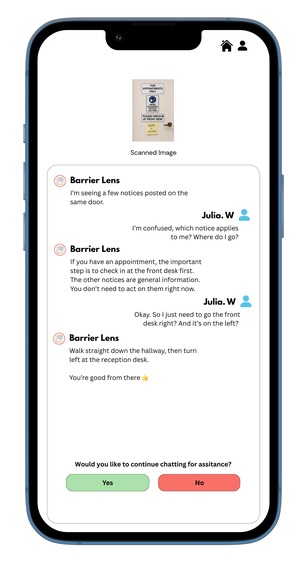
Sample assistance with Barrier Lens chatbot

Inspiration
Barrier Lens was inspired by everyday moments where unclear design creates unnecessary stress for neurodivergent people. Seeing my younger brother struggle with confusing signage (and hearing similar experiences from autistic peers and adults) made it clear that many environments fail not because people can’t navigate them, but because information is poorly communicated. Unwanted to design a solution that corrects the system, not the user.
What it does
Barrier Lens helps users navigate confusing public spaces by interpreting unclear visual information and translating it into simple, actionable guidance. Users can scan signage, ask clarification questions, and receive step-by-step instructions that reduce guesswork and external assitance
How we built it
We designed Barrier Lens as a concept MVP using user interviews, real-world examples of confusing signage, and low-fidelity prototypes created in Canva/Figma. We focused on one core function, clarifying the most relevant instruction from cluttered signs, and used AI tools to help refine language for clarity and accessibility.
Challenges we ran into
One challenge was defining what “clear” means, since different users interpret information differently. Another was balancing simplicity with accuracy, ensuring that instructions were easy to follow without removing important details. With a clear back and forth chat between the user and Barrier Lens, the user will receive straightforward instructions in 1-2 sentences, and have the opportunity to ask questions or clarification
Accomplishments that we're proud of
I'm proud of grounding BarrierLens in real user experiences rather than abstract assumptions. We also successfully narrowed a complex problem into a realistic MVP that demonstrates clear value without overengineering the solution.
What we learned
I learned that poor design often creates barriers that are invisible to those not affected by them. Small changes in how information is presented can significantly reduce confusion, stress, and dependence on others, especially for neurodivergent users.
What's next for Barrier Lens
Next, we plan to test BarrierLens with a larger group of neurodivergent users, expand to additional environments like transit systems, and refine clarification responses based on consistent feedback patterns. Longer term, we aim to collaborate with institutions to improve signage at the design level.


Log in or sign up for Devpost to join the conversation.