-
-

logo
-
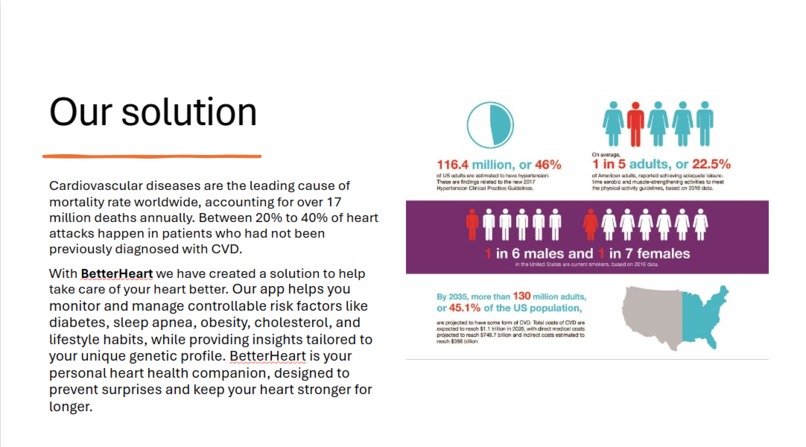
mission
-
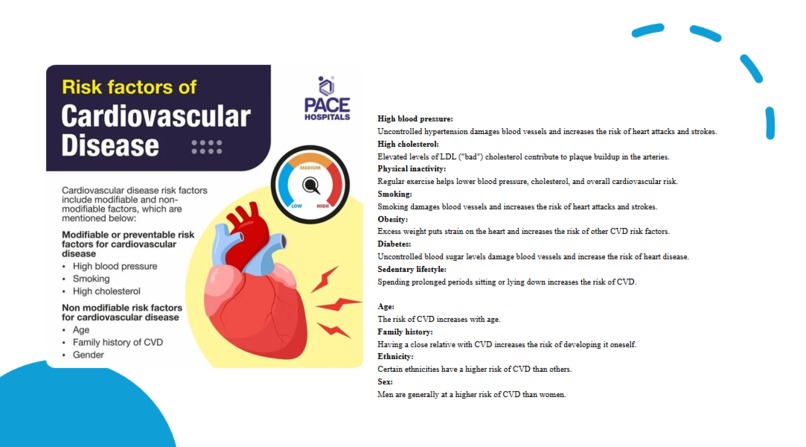
Modifiable unmodifiable
-
-
-

-


Inspiration
We all have family history with cardiovascular diseases. Harman from our team is a Biomedical Engineer working at AtriCure, a company dedicated to heart health. After a recent lunch-and-learn about heart anatomy, Harman had a mini heart scare (don’t worry, she’s fine!) and realized how little we actively monitor our hearts. That sparked the idea: why not build something that helps everyone take care of their heart better?
What it does
BetterHeart is your personal heart health companion. It monitors controllable risk factors like diabetes, sleep apnea, obesity, cholesterol, and lifestyle habits, while providing insights tailored to your genetic profile. Our goal? Predict and prevent surprises before they happen.
How we built it
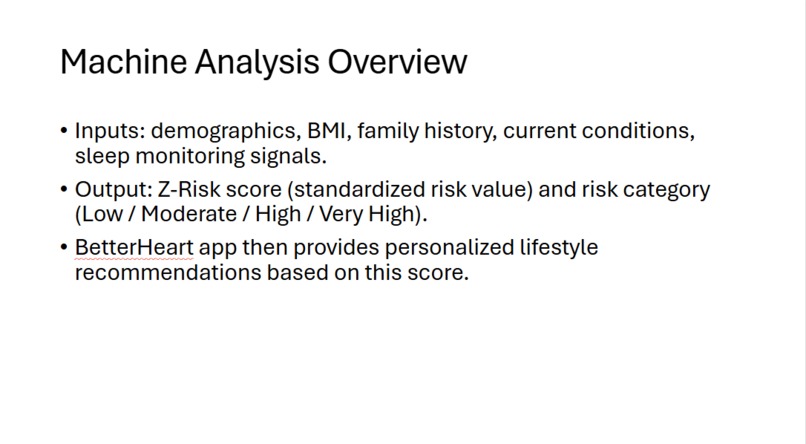
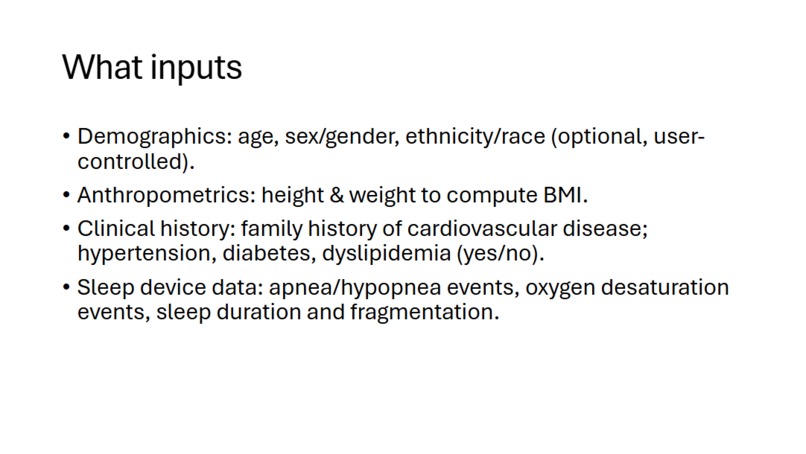
we built BetterHeart around a clear, end-to-end pipeline that connects hardware sensing, data processing, and a risk-scoring model. On the input side, the system collects user data such as age, sex/gender, height and weight (to compute BMI), ethnicity, family history of cardiovascular disease, and current conditions like hypertension, diabetes, and dyslipidemia, along with continuous sleep data from our Arduino-based sensor setup (analog signal acting as a proxy for breathing/sleep-apnea activity). On top of this data pipeline, we implemented a Z-score–based risk model: each feature (e.g., age, BMI, apnea index, SpO₂, number of conditions) is standardized against a healthy baseline to produce a z-score, and a weighted sum of these z-scores yields a single Z-risk value. This Z-risk is then mapped into categories (Low, Moderate, High, Very High) and tied back into our BetterHeart app concept, which uses the score to show a simple risk label and provide personalized lifestyle recommendations.
Challenges we ran into
We faced several challenges during the project. We originally planned to use gel electrode pads and proper ECG/heart-beat sensors, but due to hardware availability and cost, we couldn’t obtain those components in time. To still demonstrate our full pipeline, we repurposed a simple 3-pin humidity sensor and used its analog output as a dummy breathing/sleep-apnea signal, feeding that into our Arduino → Python → Excel → Z-risk model flow. On top of the hardware issues, one team member quit mid-way through the project, which meant we had to redistribute responsibilities, cut some stretch features, and focus on delivering a working end-to-end demo instead of perfect sensor accuracy or a fully polished UI.
Accomplishments that we're proud of
Built a working end-to-end demo in record time. Created a Z-risk model that actually makes sense. Survived hardware chaos and still delivered something cool.
What we learned
Heart health is complex, but tech can simplify it. Data preprocessing is 80% of the battle. Live better to love better
What's next for BetterHeart
Real-time wearable integration (bye-bye humidity sensor). Smarter predictive analytics for early warnings. Partnerships with healthcare providers to scale impact.


Log in or sign up for Devpost to join the conversation.