-
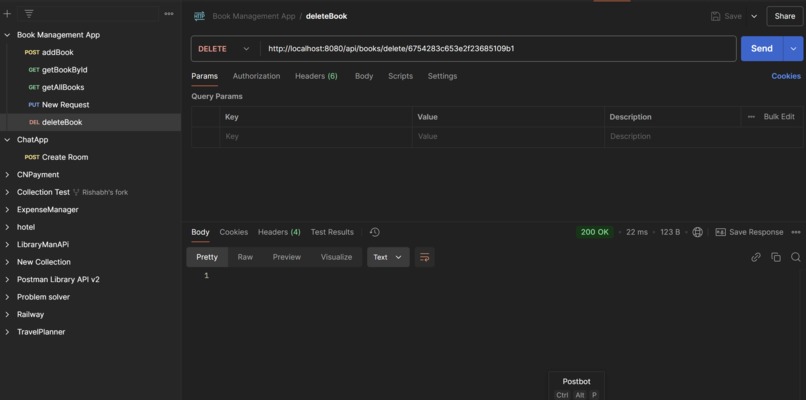
delete book api
-
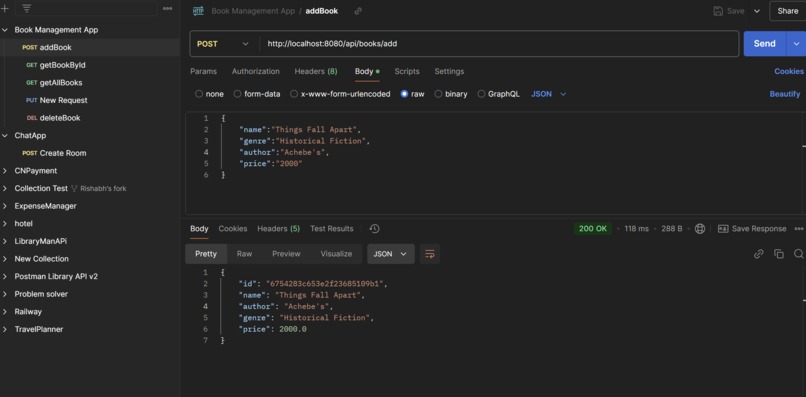
add book api
-
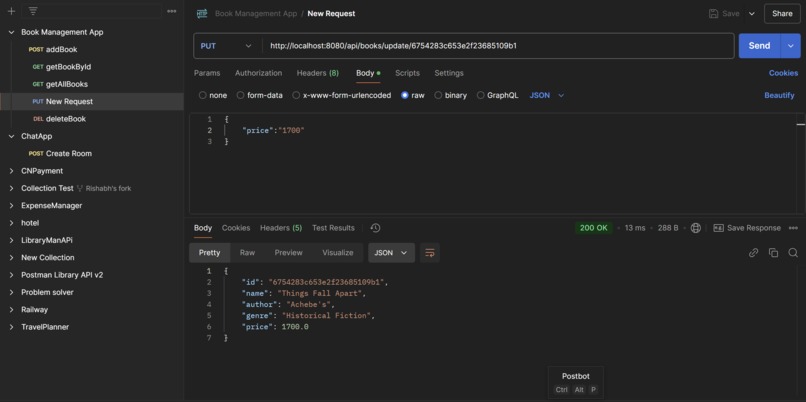
update book api
-
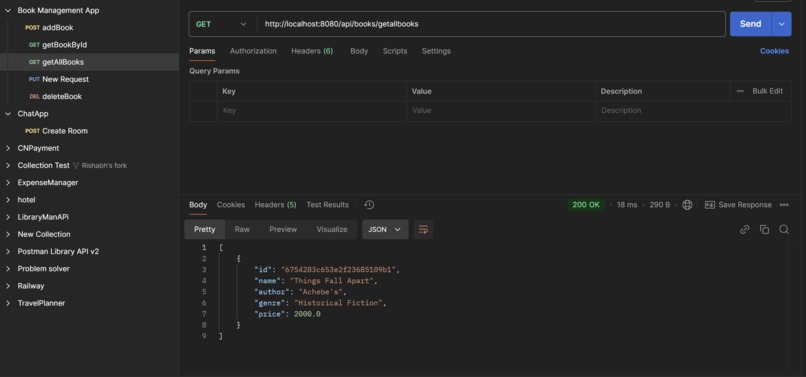
get all book api
-
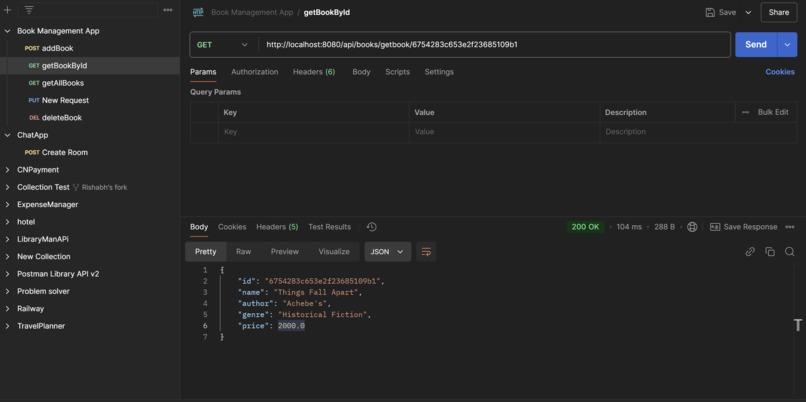
get book api


Inspiration
The Book Management Application was inspired by the need to efficiently manage books in libraries, bookstores, or personal collections. By providing a streamlined way to perform CRUD (Create, Read, Update, Delete) operations, the application empowers users to keep their book data organized and accessible.
What it does
The Book Management Application allows users to:
- Add new books with title, author, genre, and price details.
- View a list of all books stored in the database.
- Update details of an existing book.
- Delete books from the collection.
- Handle exceptions gracefully, such as when a book is not found.
How we built it
- Backend: Built with Spring Boot to handle RESTful API endpoints and implement CRUD functionality. The application uses Spring Data MongoDB for seamless integration with the MongoDB database.
- Database: MongoDB, a NoSQL database, was used to store and retrieve book information. The application utilizes MongoDB's flexible document model for storing dynamic book data.
- Tools: Developed using Eclipse IDE for backend coding and Postman for API testing and debugging.
Challenges we ran into
Configuring the MongoDB URI in the Spring Boot application and ensuring compatibility between MongoDB and Spring Data. Handling ID generation for MongoDB, as it doesn't natively support Long IDs. We updated the entity to use String IDs and implemented error handling. Ensuring robust exception handling, such as throwing a BookNotFoundException for invalid operations. Optimizing the update logic to ensure only non-null and valid fields are updated.
Accomplishments that we're proud of
- Successfully implemented a fully functional backend with CRUD operations in Spring Boot.
- Seamless integration with MongoDB, ensuring high performance and scalability.
- Designed robust exception handling to improve user experience and error clarity.
- Optimized the code for maintainability and scalability, using modern Java features like Optional and lambda expressions.
What we learned
- How to work with Spring Boot and MongoDB to build RESTful APIs.
- The importance of proper database design for NoSQL systems.
- Best practices for writing clean, maintainable, and efficient code in Java.
- Exception handling techniques for improving API reliability. ## What's Next for Book Management Application
- Frontend Integration: Develop a user-friendly frontend using React.js or Angular to provide a complete user experience.
Advanced Features:
- Add search and filtering functionality to find books by title, author, or genre.
- Implement sorting by price or other fields.
- Authentication: Secure the application with JWT-based user authentication and role-based access control.
- Real-Time Features: Integrate WebSocket for real-time updates when book details are modified.
- Data Analytics: Add insights like the most popular genres or the average price of books in the collection.


Log in or sign up for Devpost to join the conversation.