-

Treatment screen
-

Home Screen
-
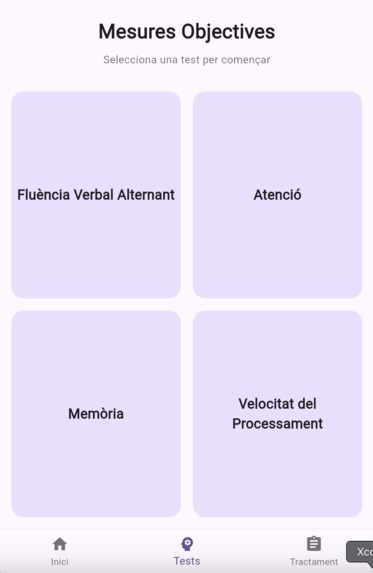
Tests screen
-

Processing Speed Test
-

Attention / Memory Test 1
-

Attention / Memory Test 2
-

Subjective Measurement Questionnaire


Inspiration
Cancer patients frequently experience cognitive changes that affect memory, attention, processing speed, and verbal fluency. These difficulties are often underreported, inconsistently measured, or underestimated in clinical settings. BrainMate was inspired by the need for a reliable, patient-centered tool that captures both objective cognitive performance and subjective daily experience, enabling more accurate monitoring and meaningful clinical insight.
What it does
BrainMate is a multiplatform application designed to evaluate and support cognitive functioning in cancer patients. It assesses four key cognitive domains—memory, attention, processing speed, and verbal fluency—through:
- Objective measurements: short, game-based cognitive tests providing point-in-time performance data.
- Subjective measurements: a daily self-reported questionnaire capturing perceived cognitive difficulties. By combining these two data sources, BrainMate identifies patterns over time and generates personalized recommendations aimed at supporting cognitive well-being.
How we built it
BrainMate was built as a cross-platform application using Flutter, ensuring accessibility across devices. Key components include:
- Custom-designed cognitive tasks grounded in neuropsychological principles.
- Local persistent storage to ensure privacy-first data handling.
- A modular architecture allowing separation of cognitive domains and analytics.
- UI/UX designed for clarity, accessibility, and reduced cognitive load. The app was designed to be clinically meaningful while remaining intuitive and non-intrusive for daily use.
Challenges we ran into
One of the main challenges was balancing clinical validity with usability, ensuring the cognitive tasks were meaningful without becoming exhausting or frustrating for patients. Additional challenges included:
- Designing tests sensitive enough to detect subtle changes.
- Ensuring consistency between subjective and objective measures.
- Managing local data persistence while simulating real-world longitudinal use.
- Creating an interface suitable for users experiencing cognitive fatigue.
Accomplishments that we're proud of
- Successfully integrating objective and subjective cognitive assessments into a single coherent experience.
- Designing tasks that are engaging yet clinically relevant.
- Building a privacy-conscious solution that works offline.
- Creating a scalable architecture suitable for future clinical expansion.
- Delivering a polished, functional prototype within a limited timeframe
What we learned
We learned that cognitive health cannot be accurately assessed through a single lens. Combining performance-based data with patient perception provides a richer and more realistic understanding of cognitive functioning. We also gained valuable insights into designing technology for vulnerable users, where clarity, pacing, and emotional safety are just as important as technical accuracy.
What's next for BrainMate
Future developments include:
- Longitudinal analytics and trend visualization over extended periods.
- Clinician dashboards for remote monitoring.
- Adaptive difficulty and personalized cognitive training.
- Validation studies in collaboration with healthcare professionals. BrainMate aims to evolve from a monitoring tool into a trusted companion for cognitive health in oncology care.


Log in or sign up for Devpost to join the conversation.