-
-
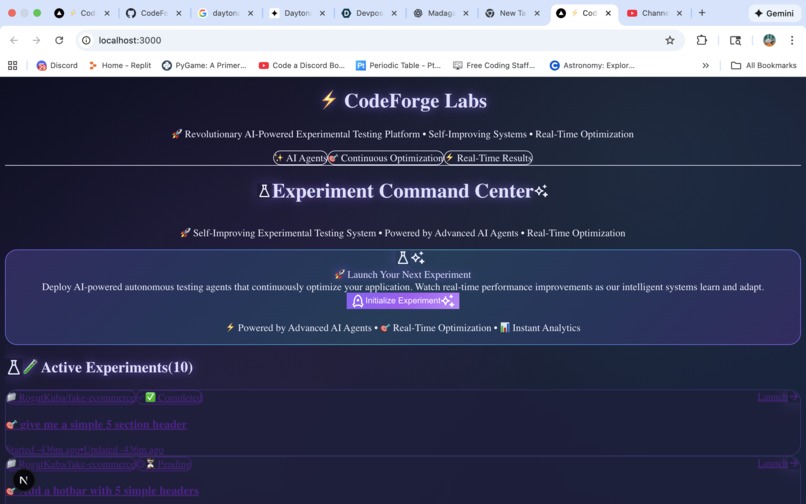
CodeForge Labs

🧠 About the Project
*Autonomous UX Experimentation
🌱 Inspiration
The project was inspired by a recurring pattern in modern development: UX problems are usually discovered late, diagnosed manually, and fixed reactively. Teams rely on guesswork, scattered feedback, and slow iteration cycles.
I wanted to explore a world where UX improvement could be proactive and autonomous — where agents could experience an interface the way a human would, understand what feels confusing or inefficient, and then repair the issues directly in code.
Instead of “testing variants,” the system acts more like an AI-powered UX engineer that continuously explores a product, identifies friction points, and generates improved versions in isolated environments.
🚀 What It Does
The platform introduces an entirely new workflow:
- Browser-use agents interact with your application as if they were real users, discovering friction and surfacing usability gaps.
- Anthropic Claude Code autonomously implements UX improvements inside isolated workspaces.
- Daytona sandboxes spin up clean, ephemeral environments for every improvement idea.
- Gemini evaluates behaviors and analyzes agent logs to produce structured insight.
- Inngest orchestrates the multi-step pipeline reliably and in parallel.
The end result is a system that transforms a GitHub repository and a UX problem into multiple improved, auto-implemented versions of your application, each fully deployed and tested.
🧩 How It Was Built
Building this required combining several complex technologies into one pipeline:
- Daytona SDK for on-demand cloud developer environments
- Claude Code Agent SDK for autonomous codebase modifications
- Browser-use SDK for realistic, task-based agent sessions
- Google Gemini for log analysis and insight extraction
- Inngest for orchestrating asynchronous jobs and multi-agent workflows
- Next.js + Bun + Elysia + PostgreSQL for the control plane, API, and frontend
The biggest challenge was ensuring that all three agents — the browser explorer, the code engineer, and the orchestrator — communicated cleanly and could operate in parallel without interfering with each other.
🔍 What I Learned
Building an autonomous UX engineering system taught me:
- How to design multi-agent workflows where each agent contributes a different layer of reasoning or capability
- How to use Daytona effectively for large-scale, parallel sandbox creation
- How to guide Claude Code to make reliable, traceable, and reversible code changes
- How to extract actionable insight from unstructured browser logs using Gemini
- How to handle state, orchestration, and error recovery using Inngest
- How to produce a workflow that feels like a new type of intelligence layer on top of a codebase
🔧 Technical Innovation
This is a self-improving UX engineering system, capable of:
- Understanding UX problems through autonomous exploration
- Generating multiple possible improvements
- Implementing and deploying each improvement without human intervention
- Verifying that each improvement actually works through agent-based testing
- Producing isolated previews for developers to inspect
The innovation lies in closing the loop: exploration → insight → code change → deployment → evaluation.
Most tools solve one piece of that loop; this platform solves the entire chain end-to-end.
🏆 Challenges
- Coordinating asynchronous agent activity with consistent state
- Keeping sandboxed development servers alive using PM2 inside Daytona
- Building a bi-directional webhook system for Claude Code to report back
- Ensuring browser agents behaved naturally and not like brittle scripts
- Designing an audit trail so every agent action is transparent and traceable
🔮 Future Directions
- Continuous “watch mode” where agents re-check UX after every commit
- Automatic PR creation for improvements that pass evaluation
- Visual regression and accessibility scanning
- Cross-browser automatic comparison
- Multi-step user journey evaluation (e.g., onboarding → checkout → review)
Built by SATHVIK VEMPATI Powered by Daytona, Claude Code, Browser-use, Gemini, and Inngest
Built With
- anthropic
- daytona
- gemini
- react
- typescript


Log in or sign up for Devpost to join the conversation.