-
-
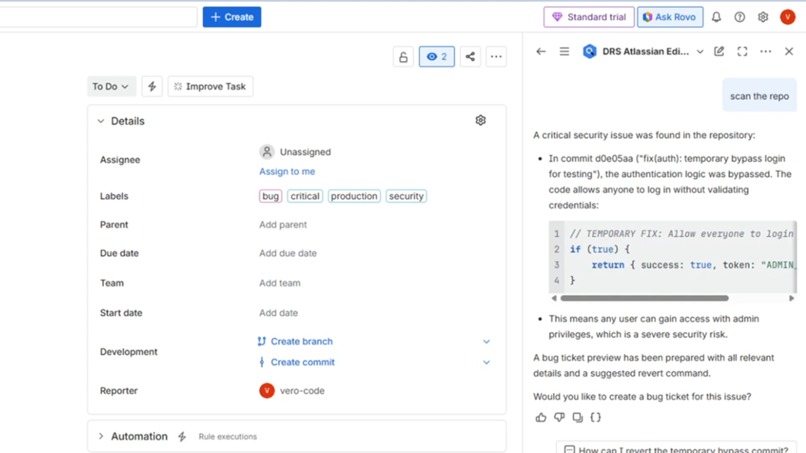
AI-Powered Root Cause Analysis: DRS instantly scans Bitbucket, pinpoints the culprit commit, and explains the critical security flaw.
-
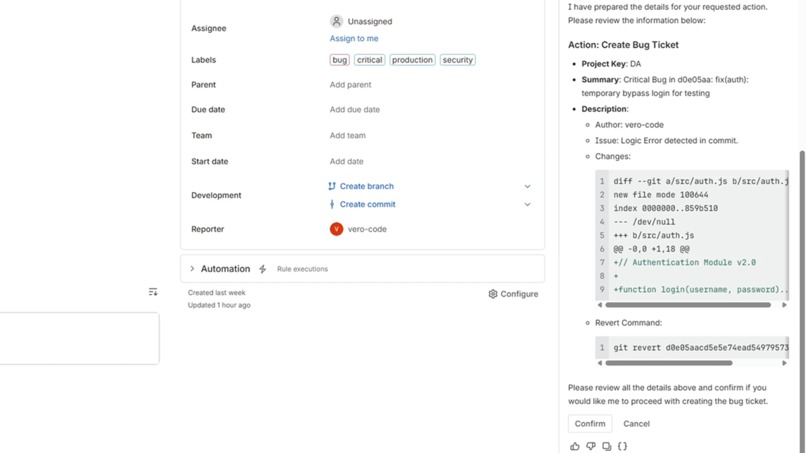
Automated Workflow: Rovo drafts a detailed Jira Bug Ticket, pre-filling the summary, code diffs, and an instant git revert fix command.


Inspiration
The Need for Speed. In Formula 1, the Drag Reduction System (DRS) opens the rear wing to give drivers a sudden speed boost, allowing them to overtake rivals on the straights. In software development, the "rivals" are Incidents and Bugs that slow down delivery.
I wanted to give that same immediate speed boost to developers stuck in "investigation mode." When production is down, every second counts — there is no time to manually hunt for the culprit.
What it does
While tools like Ops Guide are excellent for managing the process of an incident (who is on call, communication channels), DRS focuses purely on the code. It bridges the gap between the Incident ticket in Jira and the actual codebase in Bitbucket.
DRS acts like an autonomous high-speed telemetry engineer. When triggered, it doesn't just chat; it executes a complex workflow:
Secure Connection: Instantly connects to the linked Bitbucket repository without manual context switching.
Time-Travel Debugging: Scans the commit history leading up to the incident.
AI Analysis: Applies heuristic logic to find suspicious changes (like risky refactors, hotfixes, or
if (true)bypasses).Actionable Output: Instantly flags the "culprit" commit and generates a ready-to-use
git revertcommand directly in the Jira ticket.
How I built it
I built DRS entirely on Atlassian Forge, leveraging its power to span multiple products securely:
Rovo Agent: Created the "DRS Engineer" persona to serve as the conversational interface.
Forge Functions & Actions: Built a secure backend bridge to authenticate with the Bitbucket Cloud API. This allows the agent to fetch "live" code diffs, not just trained knowledge.
Jira REST API: Used to format the investigative report and create rich, actionable Bug Tickets automatically.
Challenges
My biggest technical "pit stop" was navigating the cutting-edge capabilities of Rovo Agents. Specifically, ensuring secure, seamless authentication between a Jira-based agent and private Bitbucket repositories required deep work with Forge Storage and API permissions. Overcoming these hurdles to create a true "one-click" experience for the end-user was the main victory.



Log in or sign up for Devpost to join the conversation.