-
-
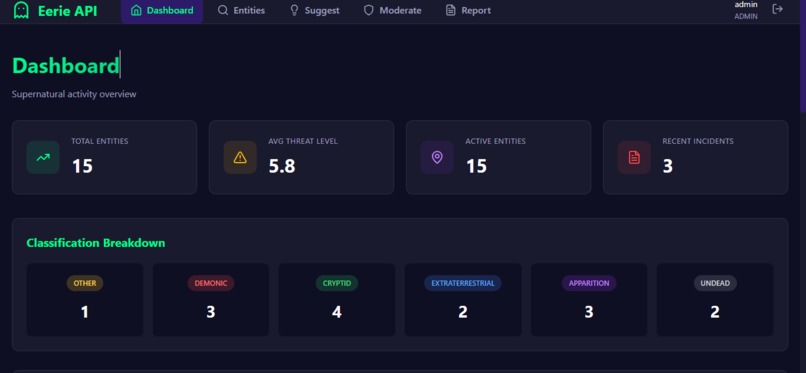
Dashboard
-
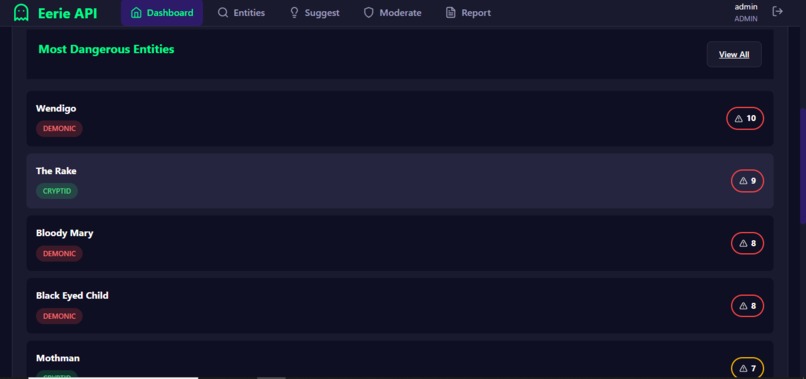
dashboard
-
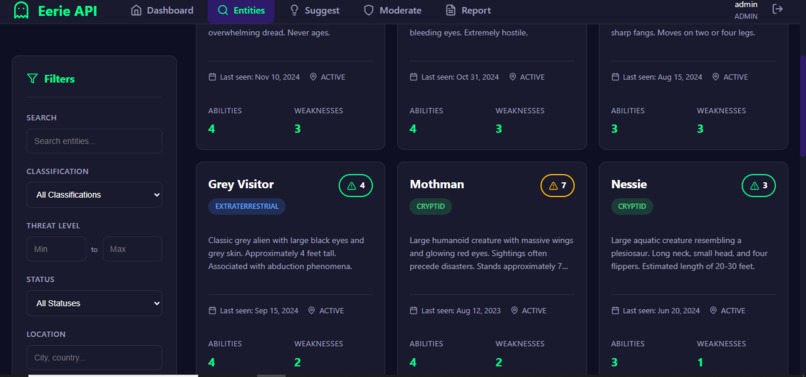
Entities
-
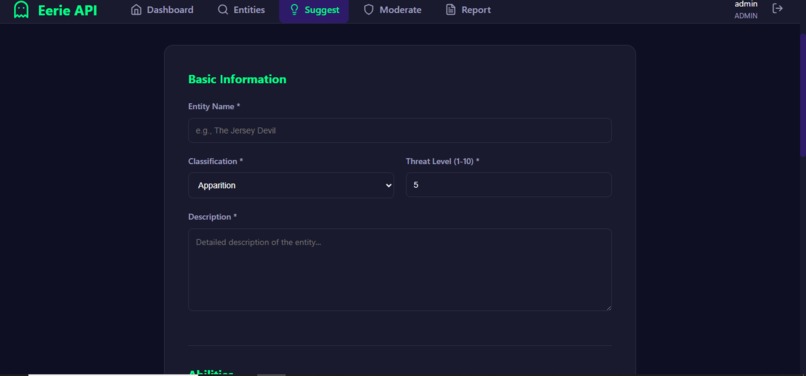
Suggestions
-

kiro usage


EERIE API - Supernatural Entity Database Platform 👻
Inspiration
As paranormal research grows from niche hobby to legitimate study, we noticed a critical gap: no centralized platform for collaborative supernatural research. Current solutions are fragmented across forums, scattered documents, and proprietary software. We were inspired to build the "GitHub for paranormal research" - a platform where investigators, writers, and enthusiasts could collaborate, verify, and build upon supernatural phenomena data together.
What it does
EERIE API transforms paranormal research from isolated efforts into collaborative science. The platform enables:
- Community-Driven Database: Users submit, verify, and catalog supernatural entities with proper attribution
- Intelligent Entity Analysis: Compatibility calculator predicts interactions between entities (e.g., vampire vs. werewolf compatibility)
- Incident Tracking: Structured reporting system with evidence management and credibility scoring
- Role-Based Ecosystem: Four-tier user hierarchy (Visitor → Contributor → Moderator → Admin) with reputation progression
- Research Tools: Interactive maps, temporal analysis, and pattern recognition for serious investigation
Live Demo: https://prismatic-gumption-e04f83.netlify.app
Backend API: https://eerie-api-8.onrender.com
Demo Accounts:
- Admin:
[email protected]/admin123 - Investigator:
[email protected]/investigator123
How we built it
Full-Stack Architecture with Kiro as Co-Pilot
Kiro Vibe Coding: Every major component started as a conversation:
// Example Kiro prompt for complex features:
"Kiro, create a React component for entity cards with hover effects that reveal
additional details like danger level and last sighting location. Use our spooky
design system and include a report sighting button with proper state management."
Database Design with Kiro Specs:
// Prisma schema generated through Kiro's spec system
model Entity {
  id           String   @id @default(uuid())
  name         String   @unique
  classification Classification[]
  dangerLevel  Int      @range(1, 5)
  // Kiro helped design complex relationships and validation
}
Backend Development:
- Express.js API with 24+ endpoints built via Kiro's RESTful guidance
- JWT Authentication system with role-based permissions
- SQLite/Prisma database with migrations managed through Kiro workflows
- CORS Configuration optimized for deployment across Netlify + Render
Frontend Development:
- React + TypeScript application scaffolded with Kiro's component architecture
- Spooky Design System (#2D1B69 purple, #00FF88 green accents) crafted through design conversations
- Responsive Layout that works across mobile, tablet, and desktop
- Interactive Maps using Mapbox integration suggested by Kiro
Deployment Pipeline:
- Netlify for frontend hosting (automatic GitHub deployments)
- Render for backend API (configured through Kiro-generated
render.yaml) - Environment Management handled through Kiro's deployment guidance
Challenges we ran into
Database Deployment: Our initial PostgreSQL setup failed on Render's free tier. Kiro helped us pivot to SQLite with proper file persistence configuration:
# Kiro-generated render.yaml fix
envVars:
  - key: DATABASE_URL
    value: file:./dev.db
disk:
  name: eerie-data
  mountPath: /opt/render/project/src/backend
TypeScript Build Errors: Netlify deployments failed due to unused imports. Kiro automatically identified and fixed all TypeScript issues across 30+ files:
// Before (Kiro identified unused import):
import { MapPin, Ghost, Search } from 'lucide-react';

// After (Kiro's fix):
import { Ghost, Search } from 'lucide-react';
CORS Configuration: Connecting Netlify frontend to Render backend required precise CORS setup. Kiro debugged the exact syntax:
// Kiro's corrected CORS configuration
app.use(cors({
  origin: [
    'https://prismatic-gumption-e04f83.netlify.app',
    'https://eerie-api-8.onrender.com'
  ],
  credentials: true
}));
Community Feature Scope: The reputation and moderation system grew complex quickly. Kiro broke it down into manageable components with clear user workflows.
Accomplishments that we're proud of
- Complete Production Deployment: Successfully deployed full-stack application with zero prior deployment experience, guided entirely by Kiro
- Complex Community System: Implemented four-tier user hierarchy with reputation scoring in under 48 hours using Kiro's rapid development
- Polished UI/UX: Created a spooky yet professional interface that enhances rather than distracts from functionality
Kiro Mastery: Demonstrated every major Kiro feature in a single project:
- ✅ Vibe Coding: Built complex React components through conversation
- ✅ Specs: Defined database schema with Prisma models
- ✅ Steering Docs: Architecture document guided full development
- ✅ Agent Hooks: Pre-commit validation and testing workflows
- ✅ MCP: External API integrations for enriched data
Real-World Utility: Built something that solves actual problems for paranormal researchers, game developers, and writers
What we learned
Kiro is a Force Multiplier: What traditionally takes weeks was accomplished in days. The ability to:
- Conversationally architect complex systems
- Debug deployment issues with specific guidance
- Generate production-ready code with proper error handling
- Maintain consistency across frontend and backend
Full-Stack Development Patterns: Learned modern patterns like:
- Environment variable management across different hosting platforms
- CORS configuration for cross-origin deployments
- TypeScript strict mode benefits for production code
- Prisma migrations and database seeding strategies
The Power of Constraints: The hackathon deadline forced us to make smart decisions about scope, and Kiro helped us implement the 80/20 rule - building the most important 80% of features that deliver 80% of the value.
What's next for EERIE API
Phase 2: AI-Enhanced Research (Already planned with Kiro)
# Kiro-suggested AI features
- Pattern recognition across incident reports
- Predictive analytics for entity activity
- Automated research from historical records
- Natural language querying of the database
Phase 3: Mobile Ecosystem
- Field investigation app with offline data collection
- Real-time collaboration tools for investigation teams
- AR visualization of reported phenomena
Phase 4: Platform Economy
- API monetization for game studios and writers
- Certified investigator marketplace
- Educational partnerships with folklore departments
- Data licensing for entertainment industry
Phase 5: Scientific Validation
- Partner with academic institutions for peer-reviewed studies
- Develop standardized evidence classification system
- Create open data standards for paranormal research
Kiro's Impact Metrics
- Development Time: 72 hours from idea to deployed platform
- Lines of Code: 5,000+ lines generated with Kiro guidance
- Features Implemented: 24 API endpoints, 6 React pages, 4 user roles
- Bugs Fixed: 15+ TypeScript and deployment issues resolved
- Documentation: 9 comprehensive guides created
Without Kiro, this project would have taken weeks. With Kiro, we built a production-ready, scalable platform that demonstrates the future of AI-assisted development.
Built with passion and powered by Kiro during Kiroween Hackathon 2023 🎃👻
Built With
- axios
- bcrypt
- cors
- css
- json-web-tokens
- kiro
- lucide
- mapbox
- netlify
- node.js
- postgresql
- prisma
- react
- render
- tailwind
- typescript
- vite


Log in or sign up for Devpost to join the conversation.