-
-
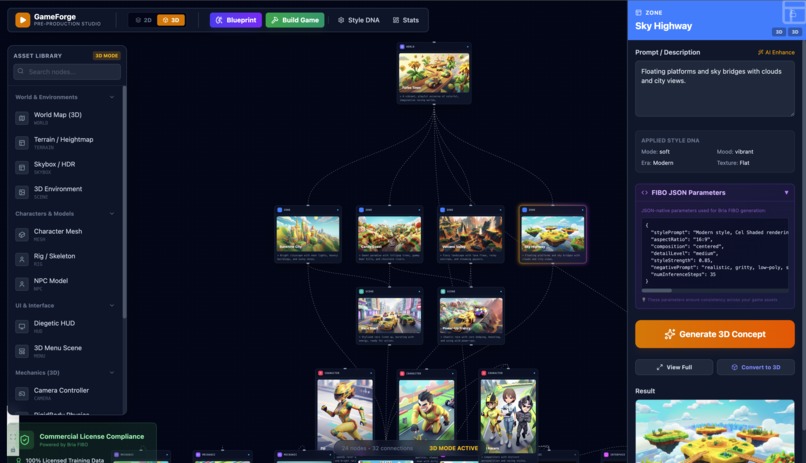
Game Forge App Layout
-

Setting Parameter to build individual Generation
-
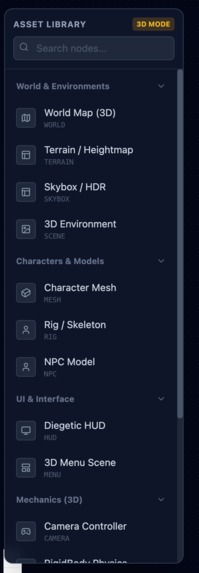
Asset Library to generate characters, assets etc.
-
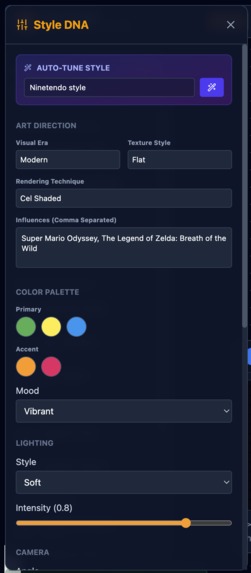
Style DNA
-
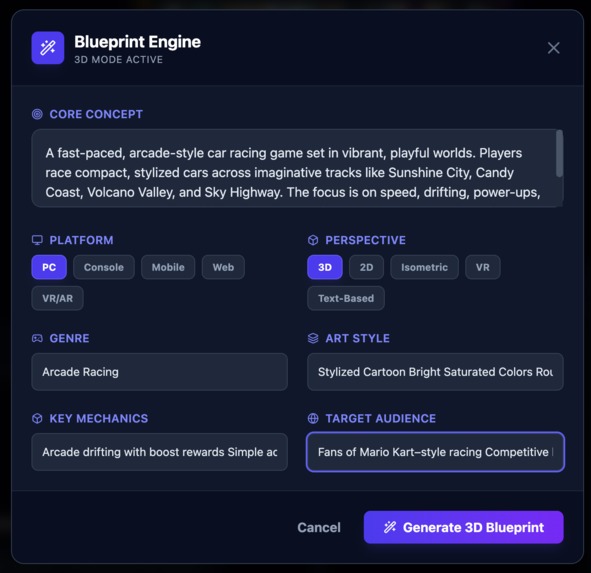
BluePrint Engine for one click BluePrint Generation
-
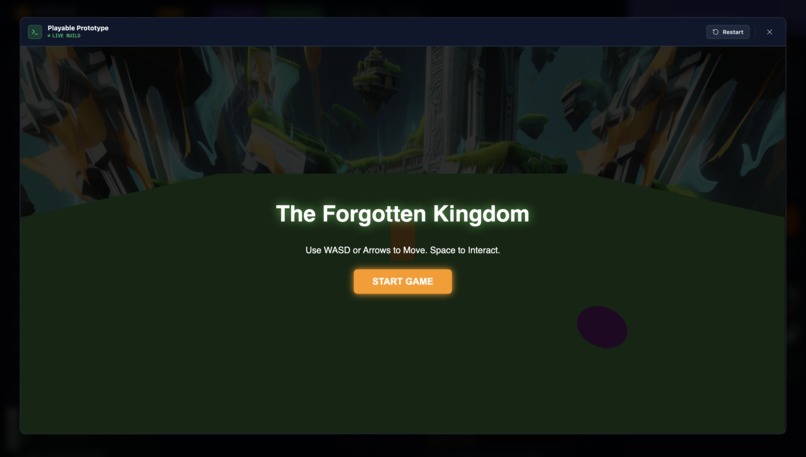
Game Build with one button from the generated images
-
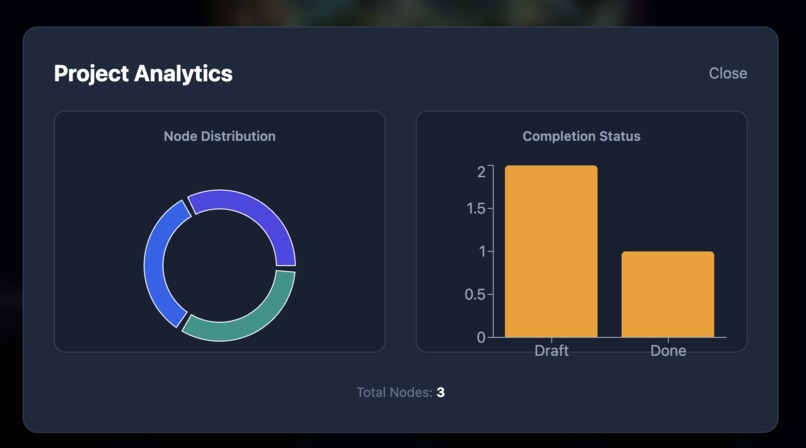
Project Analysis


Inspiration
Game developers face a major bottleneck during pre-production. Generating hundreds of concept art assets takes weeks, maintaining a consistent visual style across those assets is extremely difficult, and licensing uncertainty creates real risk for commercial releases. Most AI image tools generate isolated images with no understanding of workflows, hierarchy, or long-term consistency, forcing developers to manually manage assets that should be systematic.
Bria’s FIBO presented a fundamentally different opportunity. Its JSON-native controllability and training on over one billion fully licensed images made it possible to build a professional, production-safe asset generation pipeline, rather than another prompt-based image generator.
What it does
GameForge is an AI-powered game pre-production studio that transforms a high-level game concept into a coherent, production-ready asset library and playable prototype using Bria’s FIBO model.
Instead of generating disconnected images, GameForge creates structured game worlds through a controlled, agentic workflow.
Key capabilities • Style DNA System A JSON-native style definition layer that maps directly to FIBO parameters such as composition, guidance scale, detail level, and style strength, ensuring visual consistency across all generated assets. • Agentic Pipeline Multi-step workflow: Blueprint Generation → Style Adaptation → Asset Generation → Playable Prototype. • 40+ Asset Types Specialized generation for characters, environments, props, UI, mechanics, and systems across both 2D and 3D games. • Node-Based World Graph Visual hierarchy editor (World → Zone → Scene → Character) where parent context influences child generation, enabling coherent worlds instead of isolated assets. • Context-Aware Generation Each node inherits style, narrative, and visual constraints from its parent, allowing large worlds to stay consistent while still supporting customization. • Commercial-Safe Outputs All assets are generated using FIBO’s licensed training data, with clear messaging around commercial safety. • Cloud Asset Management Generated assets are stored and organized via Cloudflare R2 for professional workflows.
Example workflow 1. User enters a concept like “Cyberpunk roguelike with neon aesthetics” 2. AI generates a structured blueprint with interconnected nodes 3. Style DNA adapts FIBO parameters to match the concept 4. Assets are generated with consistent JSON-controlled parameters 5. A playable HTML5 prototype is automatically assembled 6. All assets are stored with clear licensing context
How we built it
Architecture highlights • Bria FIBO Integration A dedicated service layer maps our Style DNA configuration into FIBO’s JSON-native API calls, enabling deterministic control over generation. • Style DNA → FIBO Compiler High-level creative intent (lighting, palette, era, camera style) is compiled into structured FIBO parameters optimized per asset type. • Aspect Ratio Optimization Each asset type maps to an optimal ratio environments 16:9 characters 3:4 props and sprites 1:1 • Type-Specific Guidance Asset-aware prompt generation adjusts parameters based on context, game genre, and 2D vs 3D mode. • Agentic Workflow Google Gemini generates structured blueprints and descriptions Bria FIBO generates all visual assets • Node Graph Interface Built with ReactFlow to allow hierarchical asset planning and context propagation. • Edge Infrastructure Cloudflare Workers handle secure uploads and R2 storage with low latency.
JSON-native consistency
The core innovation is treating Style DNA as a compiler, not a prompt. When a user selects stylistic traits, GameForge produces deterministic FIBO requests like: { "prompt": "...", "aspect_ratio": "16:9", "steps_num": 30, "guidance_scale": 5, "negative_prompt": "blurry, low quality" } This enables generating dozens of assets with identical visual parameters, something manual prompting cannot reliably achieve.
Challenges we ran into
1.  Identifying optimal FIBO parameter combinations for different asset types
2.  Maintaining style consistency across heterogeneous assets
3.  Mapping game-specific aspect ratios to FIBO’s generation constraints
4.  Propagating context through a node graph while allowing local overrides
5.  Communicating commercial licensing advantages clearly without cluttering the UI
Accomplishments that we're proud of
I’m proud that I transformed Bria FIBO from a powerful image model into a production-grade game pre-production system, not just an image generator.
My biggest accomplishment was designing the Style DNA compiler, which translates high-level game design intent into deterministic, JSON-native FIBO parameters. This made it possible to generate large asset libraries with consistent composition, lighting, and visual identity, something that is extremely difficult to achieve with prompt-based tools.
I also built a hierarchical, context-aware generation workflow, where assets inherit style and narrative constraints from parent nodes. This allowed me to generate coherent game worlds instead of isolated images, closely reflecting how real studios approach pre-production.
Finally, I designed the entire system around professional and commercial requirements, leveraging FIBO’s licensed training data and structured API to create a workflow that could realistically be used by game studios.
Rather than showcasing isolated AI outputs, I focused on building a repeatable, controllable, production-ready workflow for AI-assisted game pre-production.
What we learned
• JSON-native APIs unlock real workflows
Structured control enables systematic, repeatable pipelines impossible with text-only prompting. • Licensed training data is essential for professional tools Commercial safety is not optional for studios; it is foundational. • Agentic pipelines multiply value Coordinating multiple AI systems creates far more impact than single-step generation. • Game developers are underserved by current AI tools Their needs differ fundamentally from general creative users. • Edge infrastructure pairs well with AI pipelines Cloudflare Workers and R2 proved effective for scalable, low-latency asset workflows.
What's next for Game Forge
Near-term • Animation and sprite-sheet generation • Unity and Unreal Engine plugins • Team collaboration and shared Style DNA libraries • Asset versioning and iteration tracking
Long-term • Community marketplace for Style DNA and blueprints • Real-time parameter tuning with live regeneration • Style extraction from existing games • Enterprise batch pipelines and API access
Built With
- bria-fibo-(via-fal.ai)
- cloudflare-r2
- cloudflare-workers
- fal-ai/serverless-client
- google-gemini-2.5-(via-openrouter)
- lucide-icons
- react-19
- reactflow
- recharts
- tailwind-css-4
- three.js
- typescript
- vite


Log in or sign up for Devpost to join the conversation.