-
-
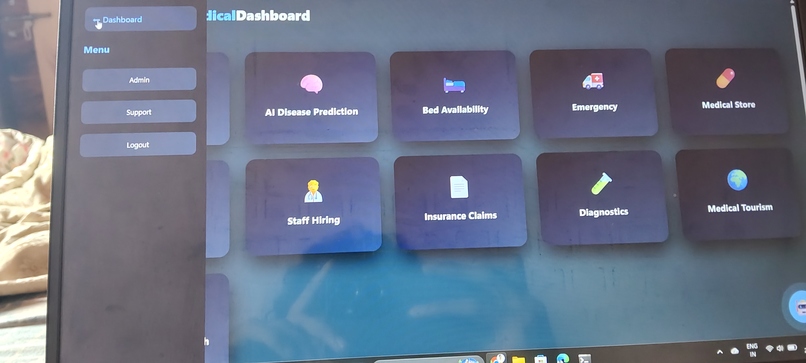
Admin panel and help pannel
-
-
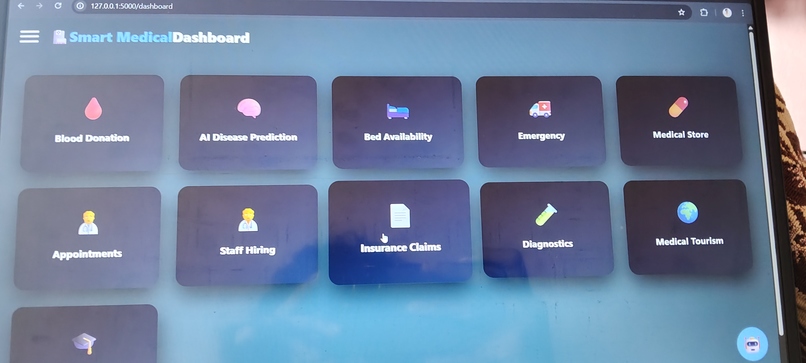


Medi360 is an AI-powered, all-in-one healthcare management platform designed to solve critical inefficiencies in modern healthcare systems. It integrates machine learning disease prediction, real-time hospital bed and resource availability, doctor appointment booking, emergency services, blood donation management, and an AI health assistant into a single smart dashboard.
Today, healthcare data is fragmented across multiple systems—patients struggle with delayed diagnosis, hospitals face poor resource allocation, and emergency responses are often uncoordinated. Medi360 bridges these gaps by using AI, data analytics, and automation to enable faster decision-making, better patient outcomes, and efficient hospital operations. The platform is built with real ML models, Flask backend, SQL databases, and an interactive frontend, making it scalable, modular, and deployable in real-world healthcare environments.Inspiration
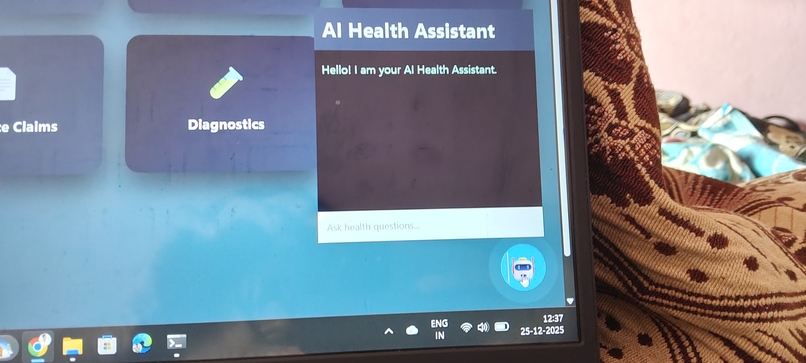
Medi360 is an AI-powered healthcare platform that brings multiple hospital and patient services into one unified system. It provides AI-based disease prediction using real medical data, real-time hospital bed and ICU availability tracking, doctor appointment booking, emergency support, blood donation management, and an AI health assistant.
The platform helps patients make faster and smarter healthcare decisions, while enabling hospitals to manage resources efficiently. Medi360 reduces delays in diagnosis, improves emergency response, and simplifies access to essential healthcare services through a single intelligent dashboard.
How we built it
Medi360 was built using a full-stack approach with AI and machine learning integration. The backend is developed using Python and Flask, which handles routing, APIs, database operations, and communication with ML models. Machine learning models were trained using real datasets with Scikit-learn to predict disease risks based on user inputs. The frontend was built using HTML, CSS, and JavaScript with an animated and responsive UI to improve user experience. SQLite/SQL databases were used to store hospital data, user details, and resource availability. An AI-based assistant module was integrated to answer healthcare-related queries and guide users. The system architecture is modular, making it scalable and deployable in real-world scenarios
Challenges we ran into
One of the major challenges was integrating machine learning models seamlessly with the Flask backend while maintaining performance. Designing a unified dashboard that connects multiple healthcare modules was complex due to data flow and UI consistency. Handling real-time resource data and ensuring smooth communication between AI, ML, and database layers also required careful optimization. Additionally, balancing functionality with usability under hackathon time constraints was a key challenge.
Accomplishments that we're proud of
Successfully building a working end-to-end healthcare platform that combines AI, machine learning, and full-stack development is a major achievement. Medi360 demonstrates real disease prediction, centralized hospital resource management, and multiple healthcare services within a single system. Delivering a scalable and practical solution within limited time and resources is something I am particularly proud of.
What we learned
Through this project, I gained hands-on experience in integrating machine learning models into real-world applications, building scalable backend systems with Flask, and designing user-centric dashboards. I also learned how to balance technical complexity with usability and how to structure a large project efficiently under tight deadlines.
What's next for Medi360
Future improvements include role-based authentication for patients, doctors, and administrators, advanced deep learning models for diagnosis, real-time hospital data integration, mobile application support, cloud deployment, and integration with map-based hospital locators and government healthcare systems.


Log in or sign up for Devpost to join the conversation.