-
-
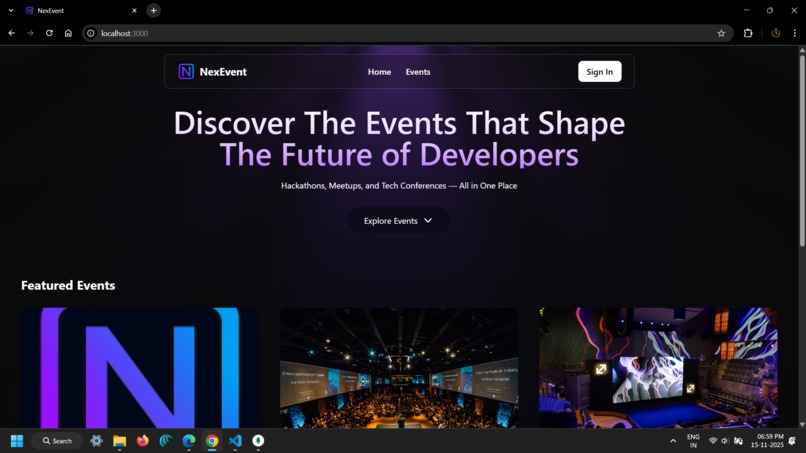
Home Page
-
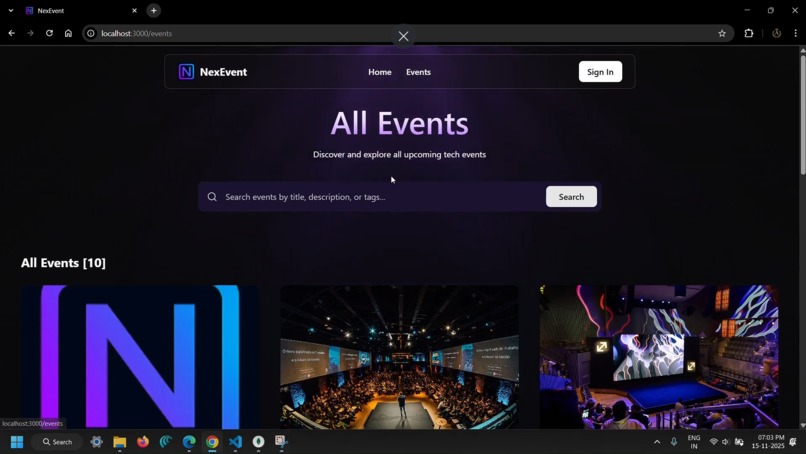
All Events Page with seach filter
-
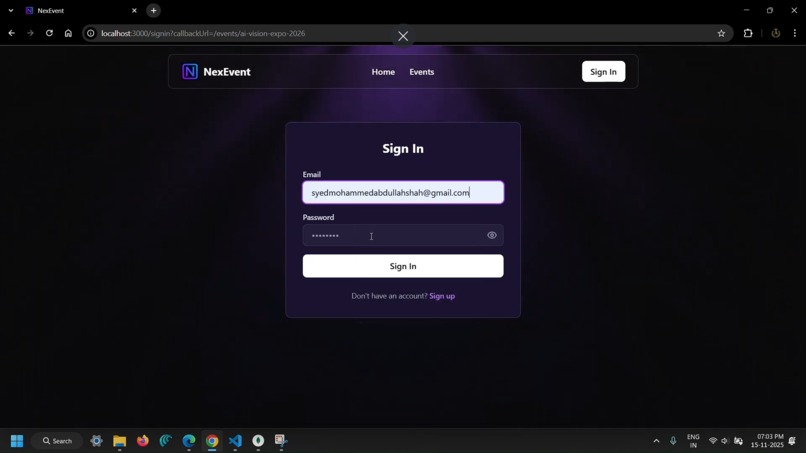
SignIn Page
-
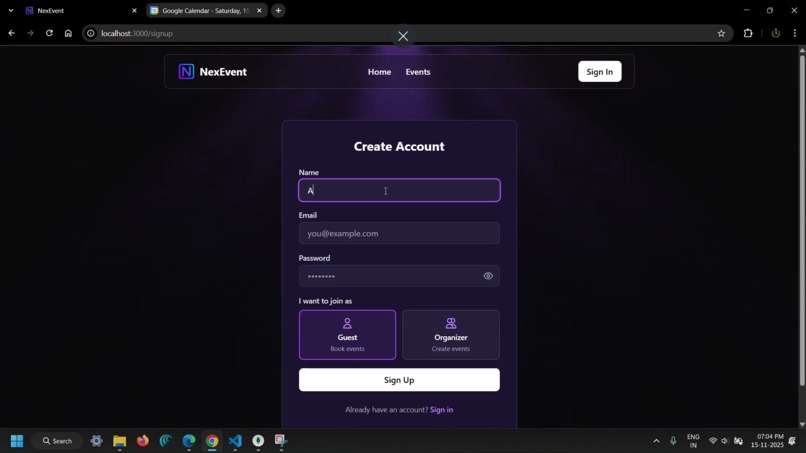
SignUp Page
-
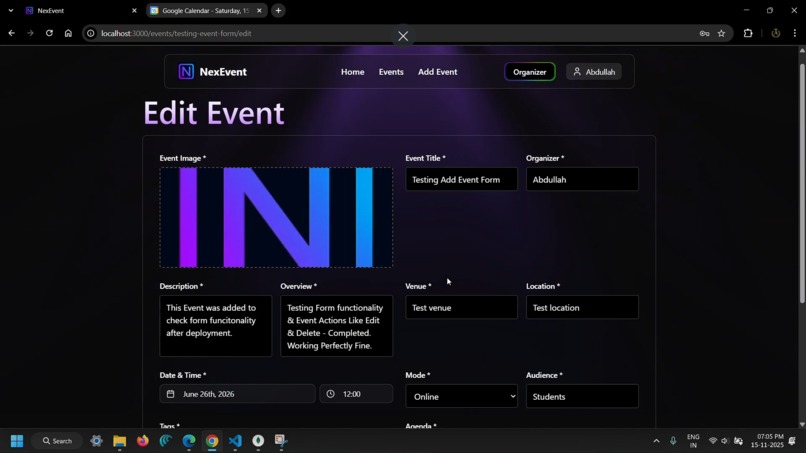
Oraganizer Form
-
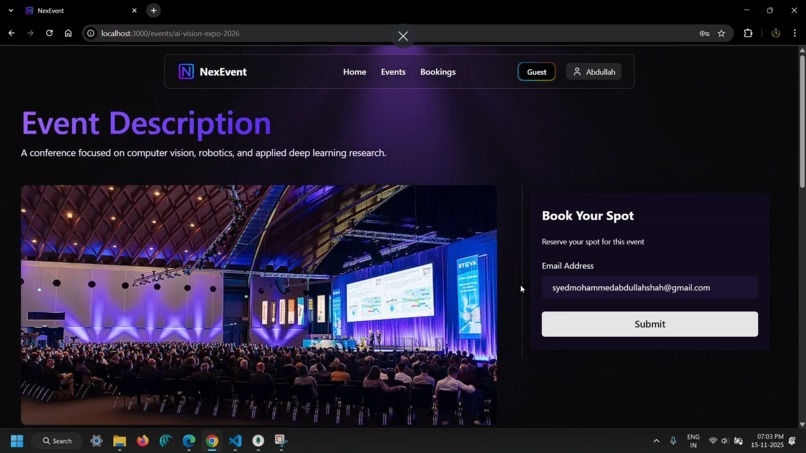
Event Description Page
-
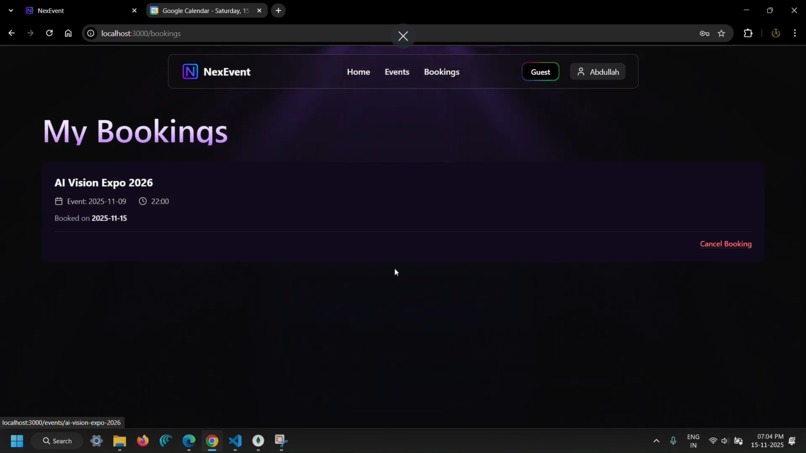
Bookings Page (Guest) - Attendee of Hackthon


💡 Inspiration
As a solo builder attending hackathons and developer meetups, I kept noticing the same issue: platforms like Devpost, Devfolio, and Unstop are powerful, but the experience often feels heavy, cluttered, and not optimized for simple discovery. Finding good dev events should feel exciting, not overwhelming.
I wanted a platform that:
- looks clean and modern
- feels fast and intuitive
- focuses specifically on developers and tech events
- removes friction for both attendees and organizers
That's why I built NexEvent — a minimal, polished, developer-centric event platform created from scratch in a short time by a solo developer. This is the MVP, and the UI/UX will scale aggressively from here.
🎯 What It Does
🎟️ Attendee Experience
- Browse hackathons, meetups, workshops
- Filter by tags, track, & location
- One-tap booking using verified email
- Add directly to Google Calendar
- Save favourite events for later (new!)
- Manage all bookings and favourites in one place
- AI chatbot assistant to answer questions about events instantly (new!)
🛠️ Organizer Experience
- Create events with banners, tags, schedule, and full details
- Edit/update/share events anytime
(Organizer booking analytics coming soon)
🧩 Core Platform Features
- Secure authentication via NextAuth.js
- Role-based access (Guest / Organizer)
- Google Gemini AI-powered chatbot for event discovery
- Server Components for fast performance
- Cloudinary upload pipeline
- Zod-validated forms across client + server
- Clean UI + subtle animations
🛠️ How I Built It (Solo)
Tech Stack
- Next.js 16 (App Router) + React 19 + TypeScript
- MongoDB + Mongoose
- NextAuth.js v5 (JWT sessions)
- Google Gemini AI for intelligent chatbot
- Cloudinary CDN
- Tailwind CSS v4, Radix UI, shadcn/ui
- ReactBits + MotionPrimitives for animations
- Zod for validation
- date-fns + React Day Picker
- Sonner for toast notifications
Architecture Highlights
- React Server Components → minimal client JS, instant rendering
- AI-powered chat → context-aware event recommendations
- Connection pooling → stable serverless DB performance
- Middleware guards → authenticated routing
- Unique slug generation → SEO-safe + collision-proof
- Shared Zod schemas → strong type safety across the stack
- Modular UI architecture → scalable component system
🚧 Challenges I Faced (as a solo developer)
1. NextAuth v5 Beta Behavior
Had to dive into source code to implement role-based JWT callbacks since docs are still evolving.
2. Serverless Database Stability
Next.js API routes spawn multiple instances. I wrote a global cached connection layer to prevent MongoDB from hitting connection limits.
3. Cloudinary Upload Pipeline
Handling File → Buffer → server-side FormData inside the new App Router required multiple redesigns.
4. Slug Collision System
Events often share names. I implemented a Mongoose pre-save hook to auto-generate unique slugs like:
devconf-2025, devconf-2025-1, devconf-2025-2, etc.
5. AI Integration with Gemini
Integrating Google's Gemini AI to provide context-aware responses about events required careful prompt engineering and database query optimization.
6. Full-Stack Type Safety
Keeping DB models, server actions, and UI aligned required tight Zod + TypeScript integration.
🤖 AI Assistance
Being a solo builder, I used AI assistance from Kiro to handle repetitive setup and styling work, which helped me allocate more time to design, logic, and performance.
🏆 What I Learned
Building this solo taught me:
- Deep App Router + Server Component patterns
- Advanced session and JWT flows in NextAuth
- Integrating AI APIs (Google Gemini) for intelligent features
- Serverless database connection engineering
- Structuring a scalable Next.js monorepo-style architecture
- TypeScript best practices using shared schemas
- Designing UX intentionally for a developer audience
- The huge impact of validation + error handling on reliability
This project heavily leveled up my full-stack engineering skills under real constraints.
🚀 What's Next
v1.1 ✅ (Completed)
- ✅ AI chatbot assistant for event queries
- ✅ Favourite events system
- Full-text search + advanced filters
- Multiple login options (Google, GitHub, Facebook) + handling WebHooks
- Reminder emails
- Event capacity + waitlist
v2.0
- Smart event recommendations based on user history
- Comments and reviews system
- QR-based event check-ins
- Multi-image event galleries
- Ticketing + payments
- User profiles + following
- Public API
- Multi-language support
v3.0
- Mobile app for iOS + Android
- Community polls for trending events
- Advanced sorting: Most Attended, Fan Favourite, Cash Prize, etc.
🎛️ Long-Term Vision (Ambitious but achievable with support)
🤖 AI-Powered Attendee Dashboard
A dedicated AI dashboard that:
- Analyzes user skills, interests, and project history
- Predicts ideal hackathons or meetups for them
- Scores events by difficulty, team size, prizes, relevance, personality, tech stack
- Learns user preferences over time with a lightweight ML model
This shifts NexEvent from "event listing" → personalized dev event intelligence.
🗣️ Voice-Enabled Event Forms
- Text-to-speech + voice-based form filling
- Faster event creation
- Accessibility-friendly workflow
💬 Enhanced Chat-Based Event Assistant
- Expand current chatbot with multi-turn conversations
- Smart suggestions while browsing
- Instant event insights and comparisons
- Natural language event search
🎮 Gamification Layer
- XP for attending events
- Badges for categories (AI, Web, Cloud, Hardware, etc.)
- Seasonal leaderboards
- Event streaks and consistency rewards
🎯 Goal
With proper support, NexEvent aims to grow from an MVP into a complete developer event ecosystem — combining clean UI, intelligent AI recommendations, voice assistance, and gamification to make tech event discovery genuinely fun and personalized.
Built end-to-end by a solo developer, aiming to push the UX of developer events to the next level — powered by my favorite framework, Next.js.
Built With
- cloudinary
- data-fns
- lucid-react
- mongodb
- mongoose
- next
- nextauth
- posthog
- radix-ui**
- react
- reactbits
- shadcn
- sonner
- typescript
- vercel
- zod


Log in or sign up for Devpost to join the conversation.