-
-
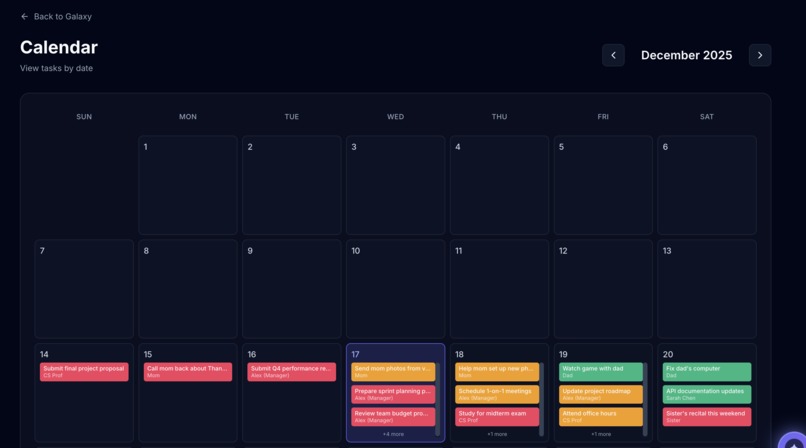
Calendar
-
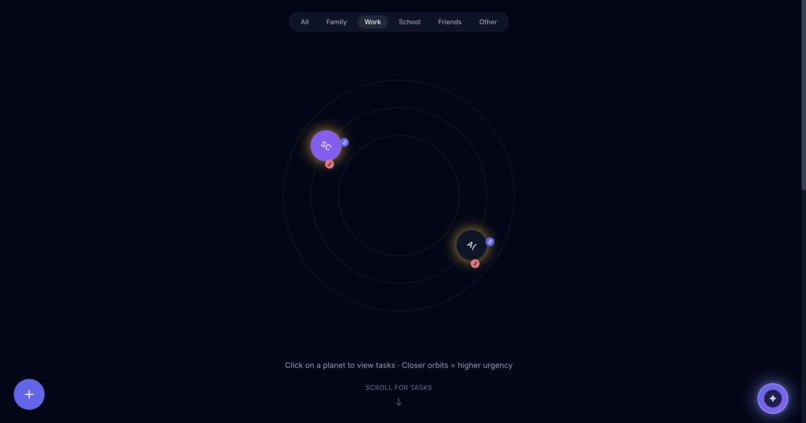
Orbit Map
-
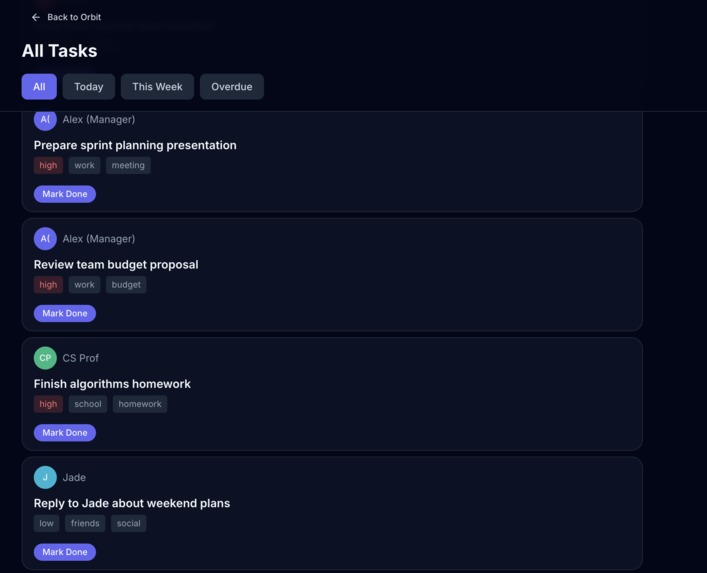
All Task List
-
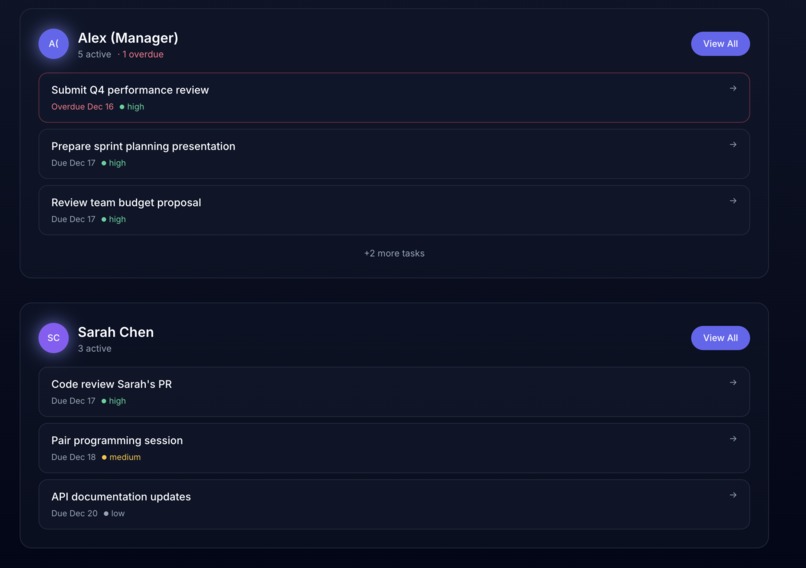
Task


Inspiration
Most task apps treat work like a flat list, but in real life we think in terms of people. We wanted a calmer, more visual way to manage responsibilities that reflects how your brain actually works, while still feeling polished enough to use every day.
What it does
Orbit organizes tasks around people, visualizing them as planets in a galaxy where distance to the center represents urgency and orbits group by context like Work, Family, or School. An AI companion “Nova” lives across the app, helping you plan your day, summarize tasks for a person, and clean up vague to-dos into clear next actions.
How we built it
We built Orbit as a modern web app using React, TypeScript, and Tailwind, with Framer Motion powering the galaxy animations, orbit transitions, and microinteractions. Under the hood, a simple data model for people, tasks, urgency, and categories drives both the visual layout (rings, distances) and the AI prompts Nova uses for planning and summaries.
Challenges we ran into
Getting the galaxy to feel balanced while mapping urgency to orbit radius and speed without visual chaos took a lot of iteration. We also had to carefully scope the AI features so Nova felt integrated into the experience rather than just another generic chat box bolted onto the UI.
Accomplishments that we're proud of
We’re proud that Orbit feels like a production-level experience. We’re also excited that Nova can actually understand your current context (category, person, tasks) and give useful, personalized planning suggestions instead of canned responses.
What we learned
We learned how powerful it is to design around a clear mental model first and let the technology follow, rather than the other way around. We also deepened our understanding of how animation, empty states, and small feedback moments can make a complex interface feel simple and approachable.
What's next for Orbit
Next, we’d like to connect Orbit to real data sources like calendars, email, and Slack so tasks can be created and prioritized automatically from your existing workflows. We’re also exploring collaboration features (shared orbits for teams or families) and a mobile-first version so Orbit can live where real-life coordination actually happens.
Built With
- framer
- javascript
- lucide
- node.js
- openai
- react
- shadcn
- tailwind
- typescript
- vercel
- vite
- zustand


Log in or sign up for Devpost to join the conversation.