-
-
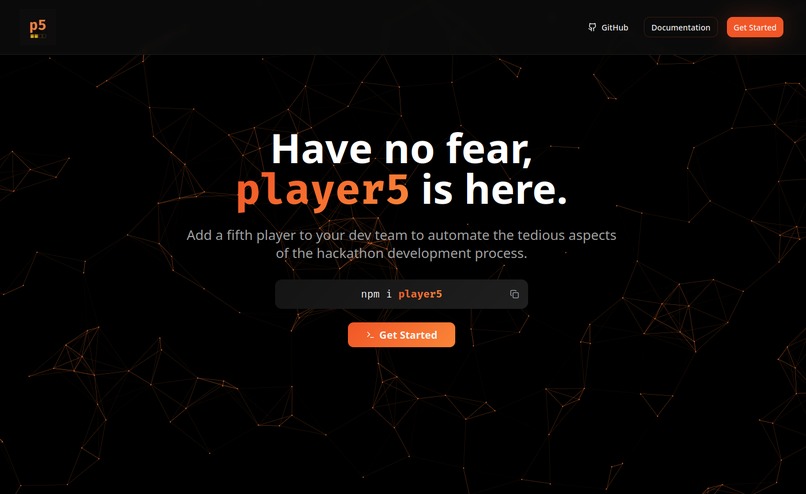
main menu
-

statistics page
-

issues page
-

tasks page


Player5 - The Ultimate Hackathon OS
GitHub Repository: Player5 - The Ultimate Hackathon OS
Generated: 9/28/2025
Inspiration
We've all been there: the frantic initial setup, the struggle to keep documentation fresh, the panic of deployment, all while the clock ticks down in a hackathon. It's a cruel irony that in a high-pressure, creative sprint, so much precious time is often spent on administrative overhead rather than innovative creation. This deep-seated frustration, exacerbated by countless hours wrestling with boilerplate and fragmented team workflows, sparked the vision for Player5. We dared to imagine a world where the mundane vanished, where developers could focus purely on the creative spark of hacking, liberated from the tedious and empowered to build truly amazing projects. Player5 was born from the desire to turn that vision into a tangible reality, streamlining every aspect of the hackathon journey.
What It Does
Player5 transforms the chaotic sprint of a hackathon into a streamlined, highly productive flow, offering a comprehensive development platform that automates the most time-consuming tasks. Imagine a team member simply typing p5 init, and within moments, their entire project is scaffolded, connected to a real-time analytics dashboard, and ready for collaborative development. From there, the platform intelligently generates polished Devpost submissions and up-to-date READMEs with p5 devpost gen and p5 readme sync, pulling insights directly from the codebase and Git history. Crucially, Player5 provides a centralized hub for project management with its web dashboard, accessible via a unique {owner}.{repo}.player5.vercel.app subdomain, allowing teams to effortlessly track bugs, manage tasks, and monitor project health in real-time, all while freeing them to focus on what truly matters: building revolutionary solutions.
How We Built It
Crafting Player5 required a meticulously planned, full-stack architectural approach, integrating a powerful CLI, a robust server API, and a dynamic web dashboard. We leveraged TypeScript across all three layers, a deliberate choice to ensure type safety, enhance maintainability, and provide an unparalleled developer experience as the project scaled. The CLI, built with Node.js and Yargs, was engineered for intuitive command-line interaction and sophisticated project scaffolding, serving as the primary interface for developers. Our server API, powered by Node.js and Express.js, acts as the intelligent backbone, orchestrating complex operations like GitHub API integrations, repository analysis, and content generation, persisting data reliably with MongoDB. Finally, the web dashboard, meticulously crafted with Next.js, React, and Tailwind CSS, delivers a blazing-fast, server-rendered, and highly responsive user interface, critical for real-time updates and an intuitive project management experience. The modular design, while introducing challenges in inter-component communication, ultimately allowed for parallel development and a highly resilient, extensible system.
Challenges We Ran Into
Developing a platform as ambitious as Player5 presented several fascinating technical hurdles that pushed our limits. One significant challenge emerged during the implementation of the p5 devpost gen command; ensuring it could intelligently parse repository data, extract meaningful insights, and then articulate them into a coherent, compelling Devpost submission was deceptively complex, requiring numerous iterations to refine the content generation logic. We also encountered friction in creating a truly universal CLI experience, evident in the commit 'add npx bc allen sucks', which highlighted the intricate dance between global and local npm installations and the necessity of enforcing npx for consistent execution across diverse developer environments. Furthermore, integrating deeply with the GitHub API meant constantly navigating rate limits, demanding sophisticated caching strategies and intelligent request throttling on the server to maintain responsiveness and prevent service interruptions, especially when analyzing multiple repositories simultaneously. Finally, achieving seamless, real-time synchronization between local CLI actions and the remote web dashboard required meticulous state management and a robust API design to ensure data consistency across the distributed system.
Accomplishments that We're Proud Of
Player5 represents a suite of significant technical accomplishments, fundamentally reshaping the hackathon development paradigm. The most striking achievement is the sophisticated content generation engine behind p5 devpost gen and p5 readme sync, which programmatically analyzes a GitHub repository and distills its essence into high-quality, relevant documentation, a feature that dramatically reduces developer burden. Another engineering marvel is the automated project-specific subdomain system, where every registered project instantly receives its own dedicated dashboard at {owner}.{repo}.player5.vercel.app, providing a uniquely personalized and zero-configuration workspace. We successfully engineered a seamless full-stack integration, uniting a powerful, type-safe TypeScript CLI with a scalable Node.js/Express backend and a dynamic Next.js/React dashboard into a cohesive, high-performance platform. The robust architecture also boasts intelligent GitHub API integration, meticulous rate limit handling, and a highly responsive user interface, culminating in a product that genuinely empowers hackathon teams to maximize their creative output.
What We Learned
Throughout the intensive development cycle of Player5, we gained invaluable insights into building complex, distributed systems. One of the most profound lessons was the indispensable value of TypeScript; its static typing proved crucial for managing the inherent complexity across the CLI, server, and dashboard, catching errors early and significantly improving code quality and maintainability. We deepened our understanding of designing resilient APIs that could gracefully handle external service rate limits and network inconsistencies, a critical aspect for a platform heavily reliant on the GitHub API. The iterative refinement of features, particularly the devpostGen command, underscored the importance of continuous testing and the necessity of anticipating diverse user inputs and project structures. This journey also refined our appreciation for modular architecture, allowing distinct components to evolve independently while maintaining a cohesive overall system, an approach vital for rapid development in a hackathon context.
What's next for Player5 - The Ultimate Hackathon OS
Looking ahead, Player5 is poised for even greater innovation, with several exciting features planned to further empower hackathon teams. Our immediate focus involves enhancing the content generation capabilities by integrating more advanced AI models, allowing p5 devpost gen and p5 readme sync to produce even more nuanced, persuasive, and context-aware documentation, perhaps even suggesting project names or taglines. We plan to expand the p5 test command suite, offering deeper integration with popular testing frameworks for automated end-to-end and unit testing directly from the CLI, complete with real-time feedback on the dashboard. Furthermore, we envision a robust plugin architecture for the CLI, enabling the community to develop and share custom commands that extend Player5's functionality for niche tech stacks or specific hackathon challenges. Ultimately, we aim to evolve Player5 into an even more intelligent and adaptable hackathon operating system, providing unparalleled support from idea inception to final submission.
Built With
• TypeScript • Node.js • Yargs (CLI Framework) • Express.js (Web Framework) • MongoDB (Database) • Mongoose (ODM for MongoDB) • Next.js (React Framework) • React (Frontend Library) • Tailwind CSS (Styling Framework) • GitHub API • Vercel (Deployment Platform) • Axios (HTTP Client) • Zod (Schema Validation)
🔗 Links
- GitHub Repository: https://github.com/IshaanBansal2006/p5
- Built With: TypeScript • Node.js • Yargs (CLI Framework) • Express.js (Web Framework) • MongoDB (Database) • Mongoose (ODM for MongoDB) • Next.js (React Framework) • React (Frontend Library) • Tailwind CSS (Styling Framework) • GitHub API • Vercel (Deployment Platform) • Axios (HTTP Client) • Zod (Schema Validation)
This devpost was automatically generated from the repository analysis.
Built With
- gemini
- nextjs
- puppeteer
- redis
- typescript


Log in or sign up for Devpost to join the conversation.