-
-

Our Team
-
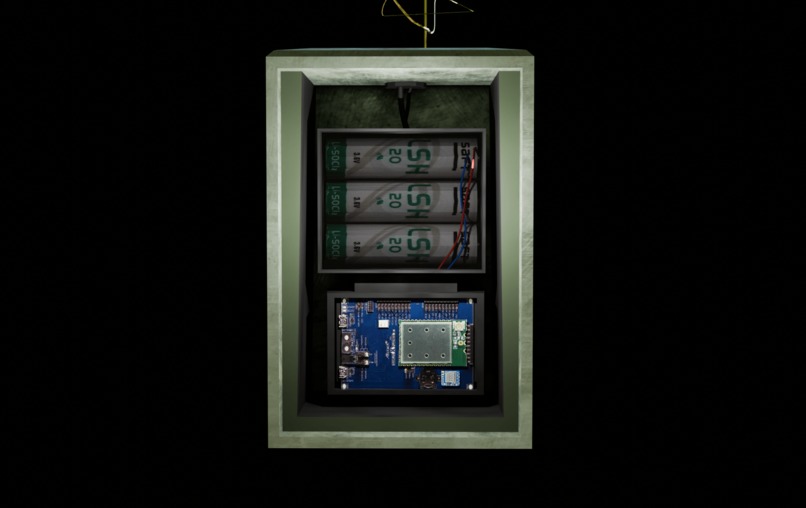
Prototype Render (without box cover)


Inspiration
Our primary motivation for developing our own RF-based drone project stemmed from the limitations and vulnerabilities inherent in traditional drone communication systems. Traditional methods often suffer from insecure communication channels, elevated operational costs, and the necessity for more frequent deployment of personnel, which in turn increases the risk of casualties. This is why we drew significant inspiration from Phantom Mesh, a system designed for mobile surface drones that effectively challenges implications such as signal jamming, communication breakdowns, and related operational inefficiencies.
What it does
Our idea provides an alternative navigation source for drones when GPS is unavailable or jammed. By producing small, inexpensive beacons that can be mass‑manufactured and scattered across an area, drones can regain trustworthy local position information. When a drone detects GNSS anomalies, it switches to an autonomous mode and searches for nearby beacons. After authenticating with a beacon, the drone receives the beacon’s own coordinates and a list of neighboring beacons; using that information it selects a route through neighboring beacons and continues along that path.
How we built it
After studying drone architectures, we realized a dedicated antenna and radio path are needed for reliable beacon communication. We chose sub‑GHz (around 900 MHz) for beacon–drone links because it provides better range and penetration than 5.8 GHz, and offers flexible options for frequency hopping. Selecting a radio module, estimating power consumption, and choosing a microcontroller to handle the data exchange proved straightforward once the antenna and frequency were fixed.
Challenges we ran into
Our main challenges were cost and deployability: we wanted beacons that are inexpensive to produce and easy to distribute in large numbers, with the mindset that lost or damaged units can be simply replaced. Initially we considered 5.8 GHz, but found it inefficient for long ranges and text‑style data in many environments. Another significant challenge is device compromise or capture: we need methods to prevent unauthorized use of a beacon if it is found by others.
Accomplishments that we're proud of
Without deep prior knowledge of RF engineering or electronics, we calculated the required components and produced a theoretical parts list for the beacon. That rapid progress and practical technical understanding are major achievements for our first hackathon.
What we learned
We learned a lot about radio frequency behavior — not just the math, but practical trade‑offs between frequency, range, and data rate. Teamwork was also a big win: we successfully split tasks, coordinated effectively, and finished a solid prototype concept. For a first hackathon, this is a strong foundation for future work.
What's next for RF Dream
To ensure our project is suitable for large-scale military defense operations, extensive testing is essential. We propose starting with small-scale, civilian-based mesh node systems. These pilot projects will allow us to evaluate technical aspects and generate more accurate predictions for the final product. After thorough and repeated testing—along with potential improvements to both the technology and its applications—we believe our project could serve as an effective defense measure within Latvian territory. Such a network would provide a significant advantage in defense applications.
Built With
- blender
- blockscheme
- business
- canva
- chatgpt
- cryptography
- discord
- drones
- excel
- figma
- html5
- javascript
- microcontrollers
- product-design
- rf
- vue.js
- youtube


Log in or sign up for Devpost to join the conversation.