-
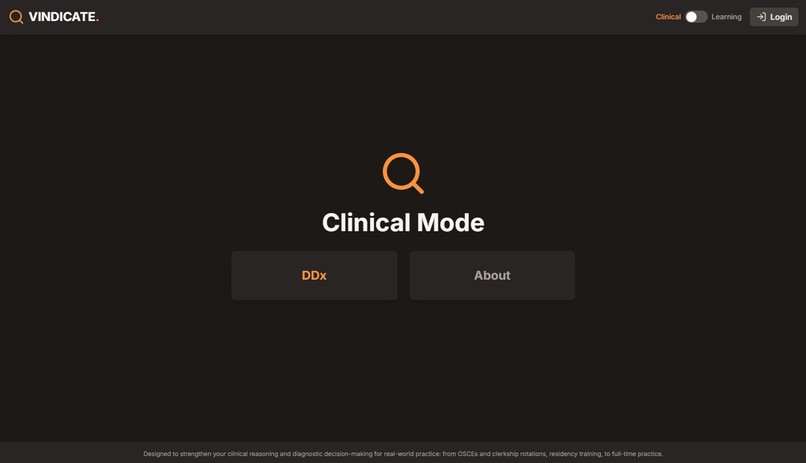
This screen shows VINDICATE in Clinical Mode, where users can enter real-world patient presentations.
-
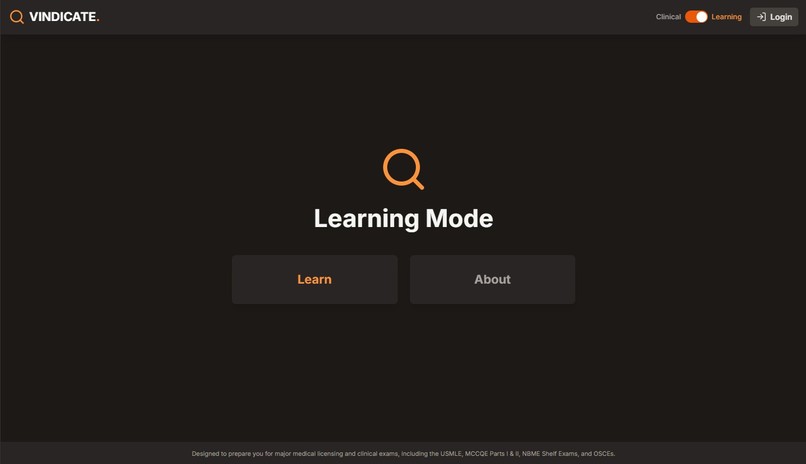
This view displays Learning Mode, which focuses on exam preparation and medical education, and uses active recall flashcard method.
-

A group photo of the VINDICATE Hack4Health team.
-
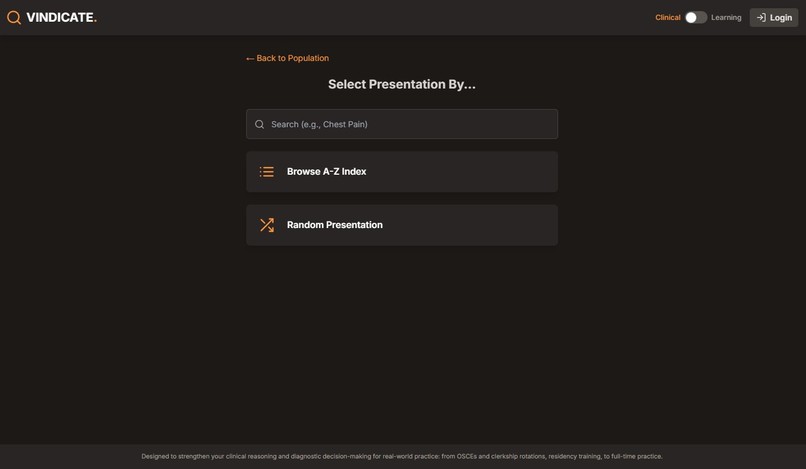
This interface allows users to select a patient presentation by searching or using randomized cases for active recall and spaced repetition.
-
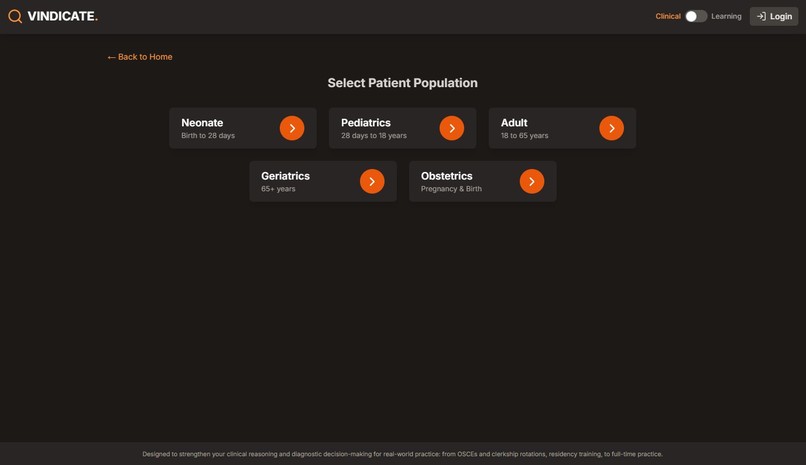
Patient Population Selection This screen lets users choose the appropriate patient population.
-
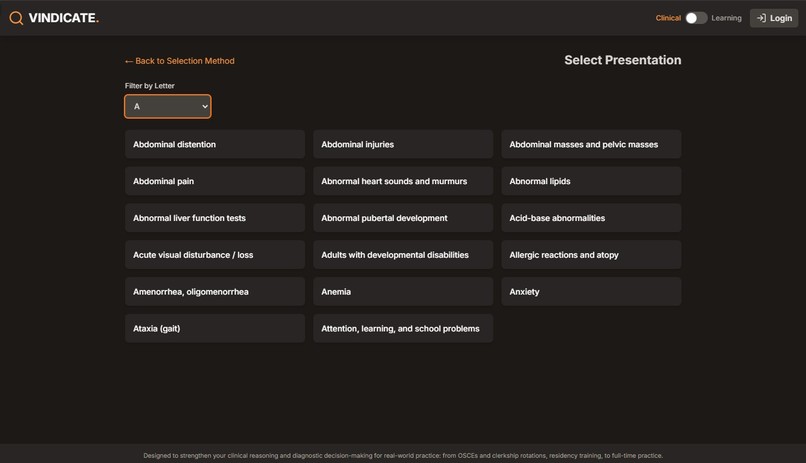
A–Z Symptom Index An indexed list of hundreds of real patient presentations, allowing users to browse conditions alphabetically.
-
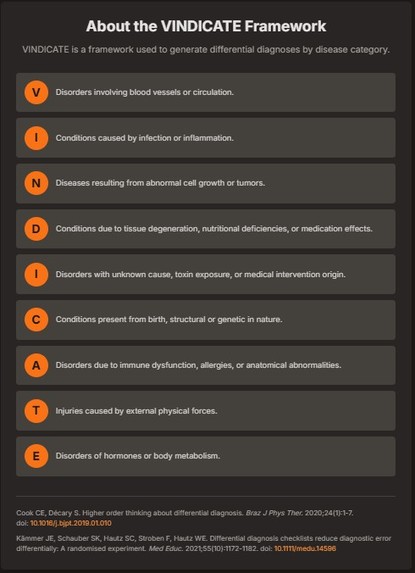
VINDICATE Framework View This screen shows the VINDICATE diagnostic framework.


VINDICATE
🥉 3rd Place at Hack4Health Hackathon hosted by the Artificial Intelligence in Medicine Society (AIMS) and supported by the Alberta Medical Association (AMA) and the Centre for Artificial Intelligence Ethics, Literacy and Integrity (CAIELI).
UCalgary Article on Hack4Health: Hack4Health Hackathon Challenges Students to Design Solutions for Health Systems
Inspiration
Diagnostic errors are one of the leading causes of preventable patient harm. The single most common cognitive error is premature closure — when clinicians stop considering reasonable alternatives after an initial diagnosis is made.
A patient with chest pain could have a heart attack, pulmonary embolism, pneumonia, or something benign — but missing the wrong one can be fatal. Patient safety depends on thinking broadly.
Medical students are the future of medicine. When they are trained properly, you are safer as a patient.
What it does
VINDICATE is an AI-powered clinical reasoning tool that helps medical students build complete differential diagnoses using the VINDICATE framework.
VINDICATE stands for:
Vascular Infectious Neoplastic Degenerative Iatrogenic Congenital Autoimmune Traumatic Endocrine
Students enter a patient presentation (for example: chest pain, fever, shortness of breath), and VINDICATE generates a structured, safe list of possible diagnoses across all nine categories, ensuring nothing dangerous is missed.
How it works
Current medical studying relies on:
- Manually written cue cards
- Passive reading
- Incomplete or non–fact-checked resources
- Memorization instead of reasoning
VINDICATE replaces this with:
- Validated differentials
- Active recall
- Spaced repetition
- Fact-checked medical knowledge
- Structured VINDICATE framework
This trains students to think the way real doctors must think — systematically and safely.
Technical Stack & AI Integration
VINDICATE was built using TypeScript across the frontend and backend, enabling strong type safety, scalable architecture, and rapid iteration during the hackathon. The platform included an optional AI assistant powered by the Gemini API, allowing clinicians to ask free-text clinical questions and receive timely, context-aware responses during case review. All symptoms, diagnoses, and clinical pathways were validated against DynaMed differential diagnosis references and a curated MCQ-based list of patient presentations, ensuring that every output was medically accurate, evidence-based, and aligned with real exam and clinical standards.
What we achieved
At the Hack4Health Hackathon, over 100 students formed interdisciplinary teams to build digital health tools.
Our project, VINDICATE, placed:
🥉 3rd Place Overall
We were recognized for:
- Strong patient-safety impact
- Clinical relevance
- Educational innovation
- Clear real-world application
Team
Muhammad Saim, Ramya Sridhar, Palak Patel, Sumaiya Rizwan, Evezi Esiehor, Tinashe Chigwida
Why this matters
Studies show that diagnostic error affects 10–15% of patients, and premature closure is the #1 cause of those errors.
VINDICATE directly targets this failure point by forcing future doctors to consider all major disease categories before committing to a diagnosis, improving safety, accuracy, and patient outcomes.
Disclaimer
The VINDICATE framework is an educational tool designed solely for the purpose of helping medical learners practice and strengthen their recall of differential diagnoses. It is not intended to replace professional medical judgment, clinical experience, or institutional guidelines. While every effort has been made to include a wide range of possible differentials, the lists provided may not be exhaustive or applicable to every clinical scenario.
Users must always apply independent clinical reasoning, verify information against current evidence-based sources, and prioritize patient safety when making diagnostic or management decisions. The creators of this material assume no liability for decisions made based on its content.
References
Cook CE, Décary S. Higher order thinking about differential diagnosis. Braz J Phys Ther. 2020;24(1):1-7. doi:10.1016/j.bjpt.2019.01.010
Kämmer JE, Schauber SK, Hautz SC, Stroben F, Hautz WE. Differential diagnosis checklists reduce diagnostic error differentially: A randomised experiment. Med Educ. 2021;55(10):1172-1182. doi:10.1111/medu.14596
What We Learned
One of the biggest takeaways from Hack4Health was that VINDICATE should be evaluated as a clinical education tool, not just a tech demo. Our next step is to run a pilot research study with medical students to measure whether using VINDICATE actually improves diagnostic breadth, retention, and clinical reasoning. If successful, this would support integrating VINDICATE into the Canadian medical curriculum as a formal learning and assessment tool.
We also learned that the most sustainable funding model is institutional licensing — selling VINDICATE directly to medical schools, residency programs, and teaching hospitals. These institutions already pay for clinical decision tools, exam prep platforms, and digital curricula, making this a natural fit for adoption and scale.
Why Not Just Use ChatGPT?
Large language models like ChatGPT are powerful, but they are not designed for safe clinical reasoning:
- They hallucinate and may fabricate facts
- Their sources are opaque and cannot be controlled
- They decide what is important, which can cause clinically critical diagnoses to be omitted
- They do not follow a systematic diagnostic framework
VINDICATE solves this by:
- Using a fixed medical framework (VINDICATE mnemonic)
- Constraining AI output to validated differential categories
- Having content reviewed by medical students → residents → physicians
- Ensuring outputs remain structured, complete, and safety-focused
This turns AI from a risky black box into a controlled clinical reasoning engine.
How We Compare to Existing Tools
We respect and build upon existing clinical tools — but VINDICATE fills a unique gap.
Diagnosaurus DDx
Diagnosaurus is an excellent quick-lookup differential list, but it is:
- Static
- Not personalized by age or population
- Not designed for learning or cognitive training
VINDICATE is interactive, structured, and educational, helping users practice how to think, not just what to look up.
Anki
Anki is powerful for memorization, but:
- Requires users to manually create or find cards
- Does not enforce clinical frameworks
- Does not adapt to real patient presentations
VINDICATE automatically generates case-based, framework-driven differentials, turning real clinical reasoning into an active learning system.
UpToDate
UpToDate is the gold standard for expert-authored clinical reference, but it is:
- Designed for reading, not thinking
- Not built to train diagnostic breadth
- Not optimized for students or exams
VINDICATE complements UpToDate by acting as the diagnostic thinking layer
What Makes VINDICATE Different
- Evidence-based differential sources
- Exam- and clinic-aligned patient cases
- Human-reviewed medical content
- A safety-first design philosophy


Log in or sign up for Devpost to join the conversation.