-
-
Logo
-
Splash Screen
-
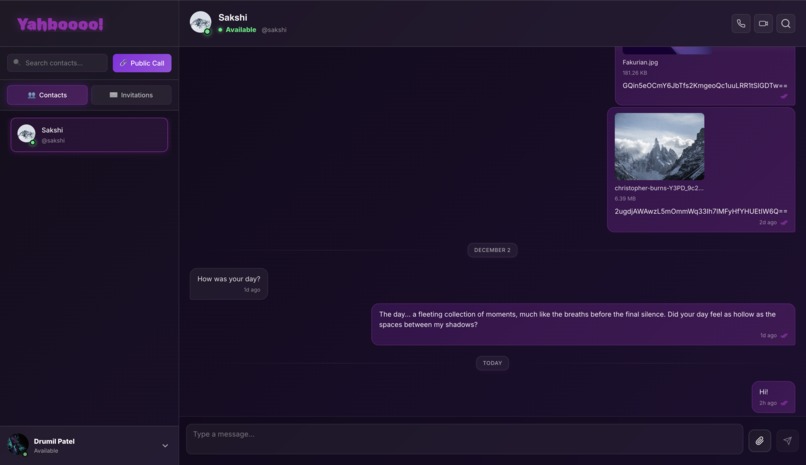
Chat Screen
-
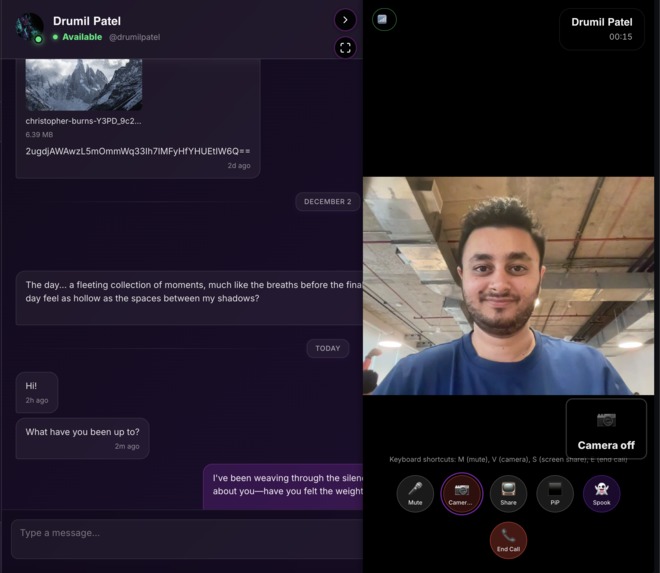
Video Call Drawer
-
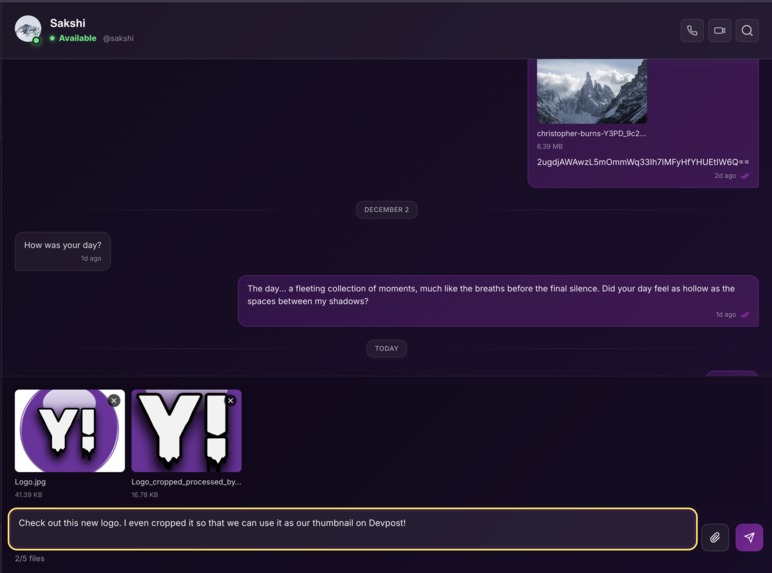
Share media and files
-

AI generated spooky message responses


Inspiration
The inspiration for Yahboo! came from how bland and repetitive video calling has become. Everything today feels utilitarian, open an app, join a call, talk, leave. We wanted to turn a call into an experience again. Since this was a Halloween hackathon, we leaned fully into the idea of making social interaction playful, eerie, and immersive. We weren’t trying to build “another meeting app”. We wanted to build a space where people actually feel something when they join with a revived user interface whilst ensuring true privacy.
What it does
Yahboo! is a real-time Halloween-themed social video platform that transforms normal video calls into immersive spooky experiences. Users can sign up, create profiles, chat with each other using end-to-end encrypted messages, join peer-to-peer video calls, and interact inside haunted environments using spooky visuals, effects, and AI-generated eerie responses. It blends live communication with horror aesthetics, making conversations feel like an experience rather than just a utility.
How we built it
We built Yahboo! fully using Kiro end-to-end for both the frontend and backend. The frontend is built with Vue 3, Vite, and Electron (for the desktop app), while the backend runs on FastAPI with MongoDB and Redis. Major systems were built using Spec-Driven Development, while Vibe Coding was used for fast iteration, UI polishing, and targeted feature work. We also used agent hooks for automated code quality checks, dependency governance, and performance regression blocking. MCPs like Sequential Thinking and Context7 were used selectively for complex real-time functionality, backend flows and access to the latest documentation .
Challenges we ran into
The biggest challenges were real-time performance, media handling, peer-to-peer communication stability as well as implementing e2e encrypted messaging. Electron performance tuning was non-trivial, especially with animations and live video. On the backend, managing async behavior, rate limits for AI responses, and preventing runaway background tasks took careful tuning. Another major challenge was maintaining development velocity without breaking things . This is where hooks and spec mode saved us from accumulating silent technical debt.
Accomplishments that we're proud of
We’re extremely proud that we built a fully working real-time platform from scratch within the hackathon timeline. Infact, we actually begun development on the 24th of November! The haunted Halloween UI for login, signup, and profile creation was entirely generated through vibe coding and now defines Yahboo!’s identity. We also successfully implemented p2p communication, real-time video calling, guest calls and and AI-generated spooky interactions, all while staying under 1200 Kiro credits out of the 2000 provided.
What we learned
We learned that spec-driven development dramatically reduces chaos in fast-paced builds. Writing proper requirements before touching code saved us from endless rework. We also learned that guardrails like performance hooks and dependency governance are absolutely brutal, but in a good way. They force you to build correctly from day one. Finally, we learned that vibe coding is insanely powerful when used surgically, not blindly.
What's next for Yahboo!
Next, we want to turn Yahboo! into a full-fledged social experience, not just seasonal. We plan to add themed rooms beyond Halloween, multiplayer party modes, creator-driven environments, hybrid mobile apps using technologies such as Ionic and add support for group messaging and calls. Long-term, we see Yahboo! evolving into a platform where video communication feels more like a shared world than a flat screen.


Log in or sign up for Devpost to join the conversation.