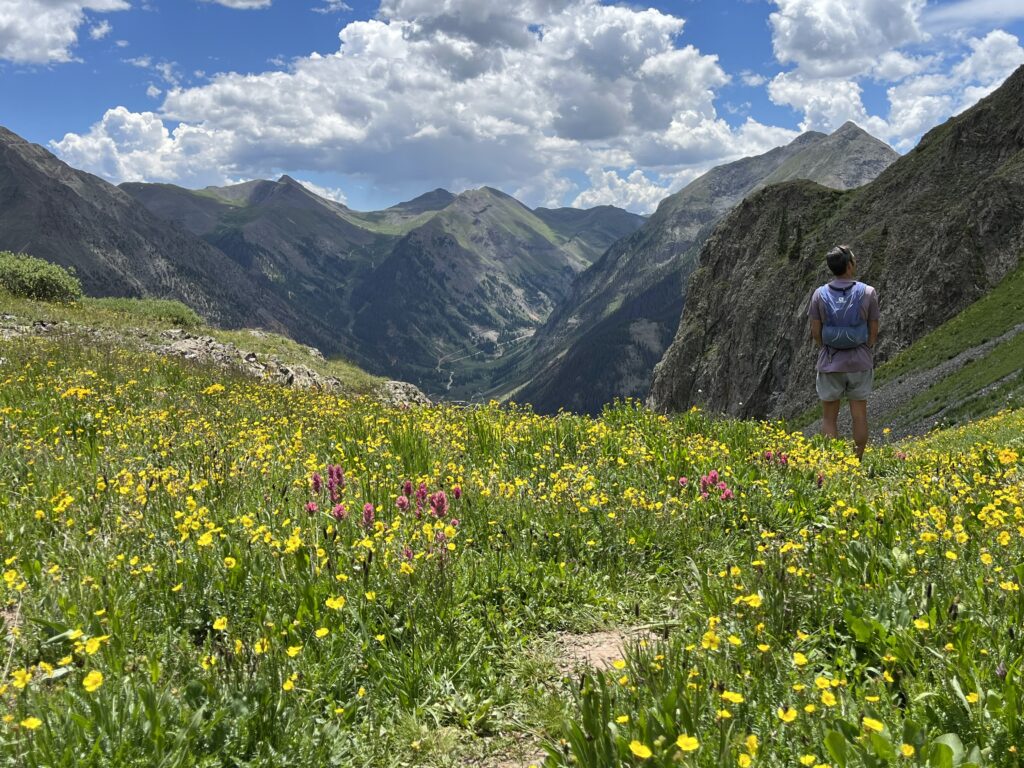
2025 Dark Divide 100km, Revisiting the Cascades

The last time I ran a race in the Cascades my emotional and mental state were in a dark place, and I hadn’t fully accepted the toll losing one of my best friends was having on me on so many levels. What started out optimistic about a sub-24h finish at the 2023 Cascade Crest 100, turned into a mental and emotional meltdown and slog into the finish. Glad to have completed it, but far from what I’d consider a successful race, and what continued to be a challenging grieving process. 2024 found me battling back from severe sciatic nerve pain, and after 6months of not running, just being happy to be back on trails again, racing being far from a focus.

Image
Dark Divide Roadless Area in full fall colors.

Flashforward, spring of 2025 Abby pitched the idea of the Dark Divide 100km in Washington and it piqued my interest, but not quite enough to get me to pull the trigger right away. The idea of a remote, super low key, adventurous wilderness run was what I was searching for. As Spring turned into early Summer and the calendar got packed full of running adventures; Big Bend NP, Hawaii, Four Pass Loop, Great Basin NP, Hardrock and High Lonesome pacing, I realized I was actually in pretty decent shape and with a 6week training block would feel ready to race again. So, Abby and I started talking logistics for Dark Divide (of which there were many). Plans were in motion, Airbnb options were being researched, flights booked, rental cars reserved but many more questions remained.

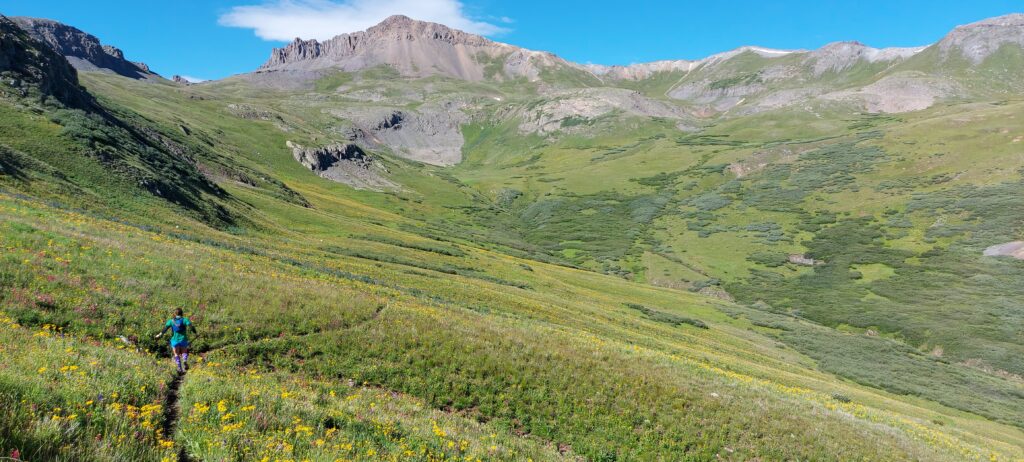
The Dark Divide Roadless area is a remote region of Southern Washington, sitting right between Mt Rainier, Mt St Helens and Mt Adams. The 76,000acres of wilderness is definitely one of the lesser-known areas of the Cascades, but boasts the same lush deep forests, craggy volcanic summits and sweeping ridgeline views that make the rest of the Cascades so magical. Long remote sections of rugged trail, steep climbs, technical descents, gratuitous summit tags, and lots of amazing views were promised to all runners. The 100mi race was in it’s 4th year, while the point-to-point 100km race was to make its debut in 2025. Being a point-to-point (>2h drive end to end) the pre-race logistics were a challenge, especially since there was no lodging at the finish. It quickly became evident that RD hadn’t fully considered this challenge after he was unable to secure a race shuttle service, so it left Abby and myself (along with many other racers) stressing the week before the race trying to cobble together a plan. Thankfully we were able to get it all sorted out, thanks to some amazing pacers/crew. After a smooth flight and drive down to Randall, things were in motion (more on logistics at the end).

Image
Sunset at camp the night before the race.

On Friday before the race we deposited our drop bags at the finish as the Cispus Learning Center and hopped in with our “chauffeur” Korrine for a 2h ride to the 100km start line at Wright Meadows, the nearest ‘city’ being Cougar, WA and it’s 113 people, 75min away. We arrived at Wright Meadow a little before sunset, set up our camp and chowed down on the cold dinner we’d packed. I caught up with James Varner for a bit as he manned the Aid Station for the 100mile runners (we started at their mm52). The RD rolled in a little after 7p for the ‘race briefing’, which was truly brief and a little all over the place, but very much encapsulated the low-key homegrown nature of the race. We crashed out soon after, Korrine and I in our tents, Abby and Stephanie in the car, ready for our 4am wake-up alarm.

I slept better than expected, and when the alarm went off, was up and straight into my pre-race preparation and routine. Get dressed, eat 2 poptarts, drink some water, sunscreen, get the muscles moving and spend some time recentering myself. The race wasn’t about redemption or proving anything to myself, it was about soaking in the experience, treasuring the reasons I started running (adventure and joy) and embodying the lessons Bailee had taught me over many years of friendship; approach everything with love, embrace every experience (good and bad) and don’t take any of it for granted. Just after 5am the RD counted down 3-2-1 GO and we jogged off into the warm early morning hours, four of us forming a lead pack from the start as we cruised down 2000ft to the Lewis River below. The downhill was quite pleasant, and we quickly found ourselves popping out of the forest onto a dirt road with signage pointing in two directions. Instinctually we continued straight ahead, but quickly realized this was not where we needed to be going, and a check of the map showed up doubling back along the road to the Aid Station, BEFORE continuing on the single track. After the Lewis River AS (mm5.4, 0:55) we continued on in the early twilight hours as the trail rolled upwards, until we abruptly hit the 1000ft climb to the Quartz Butte AS (mm14.2, 3:00).

Image
Single track along the Lewis River.

From Quartz Butte AS it was up to the ridgeline, where we’d stay for the next 28mi. I pushed the climb to the top of Quartz Creek Ridge, then continued to roll the forested section over to Prairie Summit AS well ahead of schedule (mm20.4, 4:40). I stocked up on food and filled my bottles for the long 11.4mi stretch over to Sunrise, though I made a critical error not filling my third water bottle. The trail rolled from deep sweltering forest to sunbaked alpine terrain as we traversed our way towards the Sunrise AS. The heat of the day started to take its toll, and I very much regretted only taking 2 water bottles with me for the long stretch. The final uphill before the Sunrise AS was the somewhat ridiculous mini climb up Jumbo Peak, where we were told to climb the stupid steep avalanche slope until we hit an ‘obvious sign’ to turn around, but not summit. Alex and I slogged our way up the 40degree dirt slope along with two other 100mi runners, reaching a confusing sign that only said “Futility”, unsure if we were supposed to stop, we continued upwards into the blueberry bushes. After another few minutes we saw no other signs of a course, so three of us flipped, while Alex decided to top out because he was only 100ft from the summit. So back down the steep dusty slope we went, sliding in “Futility” down the 4-6” of dust that covered our “Trail”. I plodded onwards, rapidly dehydrating in the midday sun, finally reaching the 1mi descent into the AS. I rolled into the Sunrise AS fully cooked, very dehydrated and needing to refuel (mm31.8, 7:40).

Image
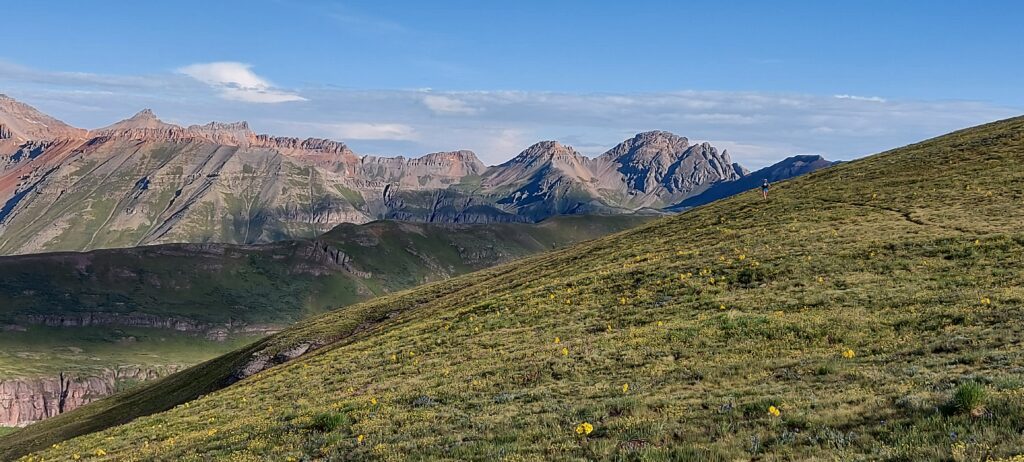
Traversing the high ridgelines of the Dark Divide.

After chugging several cups of Tailwind, eating a piece of salted watermelon and half a quesadilla, I started back uphill, again forgetting to fill my 3rd bottle, DOH. The climb to Sunrise Peak was a slog, as the exposed sunbaked alpine terrain started to wear on me, made more challenging by the deeply rutted and overgrowth trail up to the summit. I plopped down on the summit for a quick breather and to have my first mini-pity party of the day. Then, back down the trail, passing Alex and Ian on the out and back, continuing on the high traverse toward Juniper Peak. The skies were hazy from all the West Coast smoke, but the views were still spectacular along the ridge, making the death march go by a bit easier. After a quick side trip up Juniper Peak, still in death march mode, I pushed myself downhill to the Juniper Aid Station, set on taking a few minutes to rebalance (mm41.1, 10:05).

Image
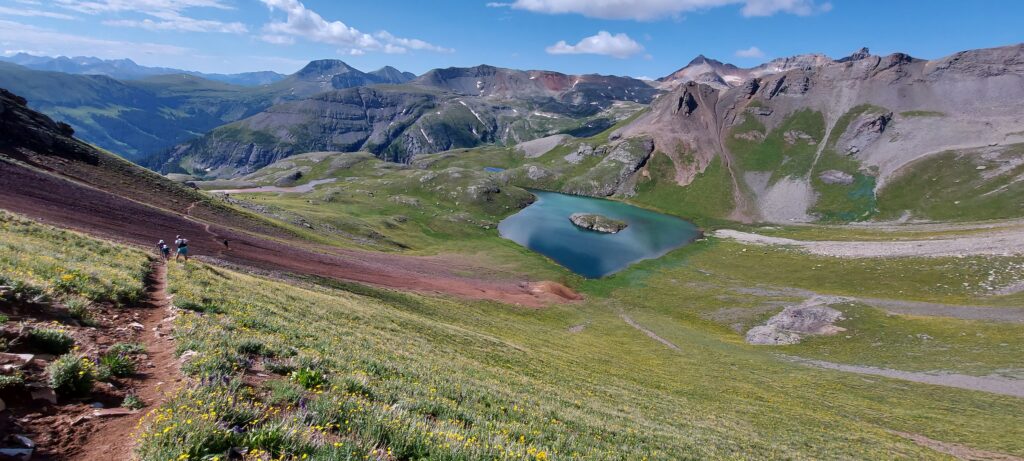
Alpine section of the Dark Divide.
Image
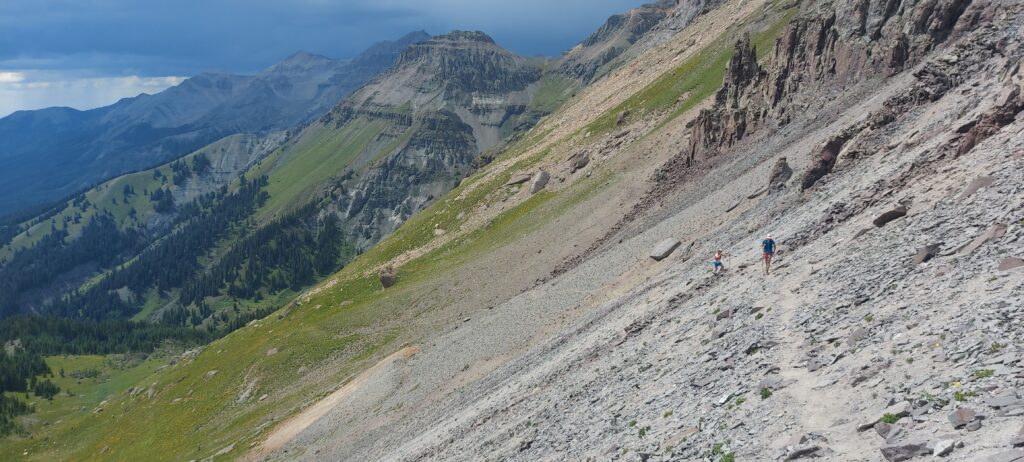
Descending from Sunrise Peak down some ‘lovely’ chewed up dirt bike trail. Not a majority of the route, but definitely several miles worth.

I sunk into a chair at the Juniper AS, chowed down on a bowl of heavily salted watermelon as I chugged Tailwind. After consuming my delicious meal, I started the power hike up Tongue Peak. I hiked along at a steady pace as my body started to rehydrated and rebalance. I topped out on Tongue Peak (mm42.7, 10:55), still a bit lethargic, but starting to pep up. So, I stashed my poles and started the 3300ft descent to the Yellow Jacket AS, losing 2500ft in the initial 2.2mi! My legs were slowly gaining strength and I was able to hold a steady yog down the insanely steep, loose and rutted trail. It was actually a relief when the trail finally ended at the gravel road and I could just turn over the legs for a bit without worrying about footing. I forced myself to jog the final 1/2mi up to the Yellow Jacket AS (mm49.1, 12:10) where Ruth greeted me with my drop bag and the offer of food before the final big climb.

Image
Plush forest trail near the Juniper Peak AS.

I drank some ginger ale, ate half a piece of white bread and started the long 4000ft slog up Burly Mountain right as 3rd place (Ian) rolled into the AS. I pushed up the climb to the best of my ability, but my legs were sluggish this late in the race. The climb was a steep grind up through the forest, at one point gaining 2000ft in 2mi. Ian caught me about halfway up the climb and put a gap on me to the summit. Though steep, the single track was mostly smooth, promising a speedy downhill. Finally, at 4000ft elev I popped out on the dirt road, the final 3mi to the summit only gaining 1300ft. My legs found their extra gear and I was able to crank out 15-16min/mi all the way to the summit. I passed John (1st place) coming down about 1mi from the top and Ian (2nd place) a few minutes from the AS, cranked my way to the lookout, allowing myself to pause to take in the breathtaking view. The sun was just setting, the smoke-filled air glowed orange and red, the valleys were filled with low clouds and expansive views greeted us in all directions. It was quite a scene to finish with, but I could only pause for a minute, rushing back to the aid station to grab some coke and water, turning down all solid food and rushing downhill to give chase to Ian, who was only 5-10min ahead.

Image
Burly Mountain Lookout sunset at mile56.

I took off down the road at a steady clip, trying to click off miles as fast as my legs would move. As I descended into the trees the evening light waned and I flipped on my waist light. I passed 4th and 5th place far down into the trees, so knew it was only a race for 2nd/3rd. I dropped onto the single track and started to hammer down the 1000ft/mi descent giving chase to the lights far below. I blew past Abby and Ruth, gave a quick right-on, only later realizing she was first woman! I pushed the pace as much as I could, but once we got onto the Curtain Falls trail, the footing became quite technical and I had to slow WAY down. I passed behind the falls, hiked up the short hill and continued to casually jog the final mile to the finish, knowing Ian was too far ahead to catch. I popped out of the woods, rounded the pavement and cruised across the finish line, finishing in 15h42min, about 7min back of Ian in 2nd (but 1st Masters). My quads were sore, my knee was tight, feet beat up, but I felt good about the adventure, the effort and the experience the Dark Divide 100km had brought. I swapped war stories with fellow Coloradans Jon, Kevin and David who had all finished the 100mi Saturday evening. Abby finished several hours later in 18h 30min, 1st female, 7th OA and new course record holder, totally stoked on the accomplishment!

After chowing down on some soup, chili and snacks we stiffly limped our way back to the car and the Airbnb to get some sleep. Reflecting back, it was exactly what I needed in a race; remote, wild, more adventure run than race, alpine ridges, summits, deep lush forests, waterfalls, smooth rolling forest dirt, steep technical descents, some logistics to be improved, a home growth local event, with a passionate RD who was simply stoked to have new people experience an area he loved dearly. If this type of race vibes with your spirit and style, I highly recommend any of their distances; 50k, 100k, 100mi, just don’t expect crowds, big elaborate aid stations, beer gardens or a party, just beautifully rugged trails and good community all around.

Image
Recovery, eating our way through downtown Seattle. Highly recommended post-race activity.

Race Logistics and Thoughts: The race takes place in a remote region of the South Cascades between Mt Rainier, Mt Adams and Mt St Helens. The nearest towns are Randall and Packwood, with a population of just over 1000, a few restaurants and markets and a handful of lodging places. As of 2025 the race finish line, drop bags and head quarters for all races are at the Cispus Learning Center near Randall. The start line for the 100km race is >2h away near the Craggy Peak TH off NF-9328, with race briefing the night before the start, basically requiring one to camp out at the trailhead the night before the race in the large dirt field near the aid station (there is NOTHING nearby). Pre-race information, meetings and communication is minimal, though the RD Sean was very responsive when we emailed him. Course markings were mostly adequate, though with minimal differentiation between races and some confusing intersections, having the route on your phone and watch is basically mandatory. The trails themselves were all very easy to follow; with some being smooth dirt, others being steep dusty dirt bike trails and some steep loamy PNW dirt. Aid stations were generally well stocked with all the basic amenities; fruit, candy, sandwiches/wraps, quesadillas, ramen, walking tamales(?!?), Spring Energy and Tailwind. This year there was no live runner tracking due to inadequate tracker service/connection, so they were scrapped at the last minute, the RD hopes to have them for future races. For those wanting pacers and crew, the remoteness of the race makes times between aid stations long, driving slow and mostly on bumpy dirt roads, so be prepared to do a lot of slow driving, away from a comfy house and a cross-over/SUV is highly recommended though not necessary. Overall, if you treat Dark Divide as a remote wilderness race with small but very adequate support you won’t be surprised.

Big Bend National Park Outer Mountain Loop Ultra, 5/17/25

Image
Chisos Mountains in Big Bend National Park.

WAY down on the US/Mexico border, Big Bend is probably one of the most remote National Parks in the Lower 48; 5h from El Paso, 6h from Lubbock and 6.5h from San Antonio with a whole lot of nothing in between (stock up on food and gas before heading down). Big Bend gets it name from the large bend in the Rio Grande River that forms the Southern border of the park, but the River is only a very small portion of the diverse ecosystems that make up Big Bend National Park. The lush green banks of the Rio Grande, to the vast Chihuahuan desert, to the high summits of the Chisos Mountains.

Timing wasn’t perfect, but with a free weekend in mid-May, I was able to convince Maddie to join me for the long road trip down to Southern Texas. It’s a LONG way from Boulder to Southern Texas, with a whole lot of nothing after leaving Northern New Mexico, other than oil fields and the extraterrestrial vibes of Roswell. Our intended goal was a popular backpacking loop known as the Outer Mountain Loop that spanned the low Chihuahuan Desert to the top of the highest point in the Chisos Mountains, Emory Peak. We were able to secure a campsite along Grapevine Rd, and after setting up camp, headed up into the Chisos Mountains to poke around a bit and drop some water for the following day’s run. After dropping almost 2gallons of water we headed back to camp to eat and get some rest before our early morning start.

Image
Early morning glow along the Dodson trail in the lower Chihuahuan desert.

Our alarms went off at 430a and we rolled down to the Blue Creek Trailhead, the lower trailhead for the Outer Mountain Loop, with the goal of getting through the low elevation portion of the route before the 90F heat set in. We headed out just after 5am by headlamp into the cool pre-sunrise desert. The trail started out fairly smooth and easy to follow as we climbed and descended through the lower foothills of the Chisos Mountains. As we neared the top of our first major climb the trail dropped into a wash and started to become overgrown and scratchy, Maddie was NOT a fan of the catclaw and agave. As the sun began to warm the morning sky, we were treated to exquisite views of the towering Chisos mountains to our North and the expansive Chihuahuan Desert in every other direction. The trails were dotted with succulents, cacti, blooming prickly pear and claret cup and razor-sharp ocotillo.

Image
Sunrise over the Chihuahuan desert.

We made quick work of our pre-sunrise section, reaching the junction with the Juniper Canyon Trail (mm11.6) in the early morning hours, beating the heat of the day. From here we started our 4000ft climb to the top of the Chisos Mountains, Emory Peak. As the day warmed I felt pretty decent, but Maddie was feeling the heat, and her stomach started to turn (it might have been the maple syrup drink). We trudged our way upwards into the mountains, longing for a little shade and a cool breeze. Around 5000ft we finally turned our way into the woodland forests of the Chisos Mountains and a little shady reprieve from the cloud filtered sun. After what felt like endless switchbacks we finally hit the saddle to Emory Peak, the high point of the day.

Image
Headed up the Juniper Canyon trail to the Chisos Mountains.
Image
Looking down from the summit of Emory Peak into the Chisos Mountains.

The final class 3 scramble to the summit was a pleasant change of pace, leading to expansive views and a great spot for a snack (mm21.1). This was the first time all day we’d encountered large groups of people. The clouds were burning off and the midday heat was starting to set in as we jogged downhill into Chisos Basin. After refilling our bottles and chugging a bunch of water from our water cache in Chisos Basin, we set off back up the trail to the Laguna Meadow saddle (mm25). This was my roughest section, as the hot sun baked our core and shade came at a premium. When we finally reached the Laguna Meadow saddle and jct with South Rim trail I sat down to have a little pity party (mm28.9).

Image
Ascending our way out of Chisos Basin.
Image
Pity Party time at the Laguna Meadow saddle.

I told Maddie to continue on without me, and that I’d slowly trudge my way in, but she wasn’t having any of it. “We started this together, we’re going to finish this together”. In an attempt to revive myself, I popped two salt tablets, chugged some water, and we started the LONG 2600ft downhill back to the Blue Creek trailhead. We both found a little more bounce heading downhill in the 90F+ heat, both bent on getting back to the car for cold beverages and to escape the heat. The canyon slowly mellowed out and the rocky switchbacks gave way to gravelly wash. We spent the last few miles slowly cruising through the wash, chatting about the highs and lows of the day and commiserating about how ready both of us were to get out of the sun. Finally, the Homer Wilson Ranch came back into site and we knew the car was CLOSE! One last little hill and we plopped ourselves down in the shade of the car, cracked open a cold soda and relished the day’s accomplishments.

Image
Lower Blue Creek Canyon, almost back to our car.

In total we’d completed the 34.6mi/8000ft Outer Mountain Loop (+Emory Peak) in just over 12hours car to car in temperatures ranging from 70F to 97F! Our journey covered the high desert, deep canyons, woodland forests and summit of the highest peaks. For most of the year there are no natural water sources along the route, so planning water resupplies is key. The three access points are Chisos Basin (will be closed for construction through 2026), Blue Creek TH near Homer Wilson Ranch, and Juniper Canyon 4×4 Rd TH. On the day we each carried about 1.5-2gal of water, but could have used even more. Outside of Emory Peak and Chisos Basin we mostly had the trail to ourselves, so got to truly experience the solitude the desert can offer. Big Bend National Park is a wonderfully diverse array of ecosystems, tucked a long way from anything along the US/Mexico border. For anyone looking to visit I’d highly recommend late November through March, unless you really like it HOT.

Image
Big Bend National Park Hot Springs along the Rio Grande River.

The following day we took a little road trip to the far SE side of the park, first for a soak in the Rio Grande Hot Springs. The old bathhouses were built in the early 1900s right along the border and all that remains are the old pools along the river, frequented by the wild horses that live in the area.  After a nice soak, alternating between the warm spring and the cool Rio Grande river, we headed off for the Boquillas Port of Entry into Mexico. Because, how often do you get to wade through a river into another country? After a short visit with the single US Border Patrol Officer in the small office, we popped off our shoes and waded our way across the Rio Grande (you can also take a boat for $5). Once in Boquillas we checked in with the Mexican authorities, paid the small tourist fee and went for a stroll. The town of Boquillas is more of a small hamlet with a few restaurants, a couple of shops and a LONG drive to anywhere else. We grabbed lunch, took a quick stroll across town, then headed back to the US. Other sites within the park worth visiting are Boquillas Canyon, Santa Elena Canyon, 4wd River Rd, Chisos Mt South Rim trail, Dog Canyon/Devil’s Den.

Image
US Border Patrol Station at Boquillas Crossing in Big Bend National Park.
Image
Maddie getting ready to walk across the Rio Grande into Mexico during low water (May).

Napali Coast and Kalalau Day Run, 10/27/24

Image
Start of the Kalalau Trail along the Napali Coast.

Kauai is known for its luscious jungles, rugged peaks and towering waterfalls, all fed and carved by the >450” of rain that fall annually. The pinnacle of Kauai is the Napali Coast along the North Shore of the island, accessed only by boat, helicopter and the 12mile Kalalau trail. Each mode offers a unique perspective on the iconic rugged coastline. While a helicopter ride allows one to see deep into the valleys and to view waterfalls not easily accessed, and a boat offers an at a distance view of the coast, the hike/run along the Kalalau is the only way to get up close and personal with the Napali coast.

Image
Looking back down at Ke’e Beach around sunrise at the start of the Kalalau Trail.

The first hurdle for anyone who wants to hike/run the Kalalau trail is the permit and reservation system. There are two separate systems that one needs to navigate when setting up a trip, parking/shuttle reservations to access the park AND an overnight backpacking/camping permit for the trail. The backpacking/camping permit is needed even if you want to hike/run the trail in a single day (anywhere beyond the first 2.5mi). First you need to access the State of Hawaii website to read about the regulations and check the availability for the trail and determine what potential dates are open. Camping reservations typically open 3-4months out from your date of interest. Winter campsite availability is typically more open, though will book out over a month in advance, while the summer months are even busier. The second step is reserving either a parking spot or shuttle spot (includes park entry fee) on the Hāʻena State Park website. Reservations open about a month ahead of time, with the parking spots selling out very fast. There are typically ample shuttle spots available starting as early as 620am, with the final pickup from the park at 540pm. Even if you’re unable to secure a backpacking/camping permit, the park entry fee allows you to hike to Hanakāpīʻai Falls. Once the admin work is taken care of, it’s on to actually planning your trip!

Image
Early morning along the Kalalau Trail, soaking in the views.

Once you arrive at the park (either park or shuttle), you’ll receive a short tutorial from a local about the park, safety and respecting the history. The trail starts with a 0.25mi flat path through the jungle to Ke’e beach, which is a lovely spot to have a picnic or take a swim on a nice day. This is where the Kalalau trail officially starts, quickly taking off uphill into the jungle. The first two and a half miles are often wet, slippery and muddy as the trail undulates high above the coastline before dropping to Hanakāpīʻai stream and beach. This is where the trail to Hanakāpīʻai falls splits off up valley and the boundary where you can hike without a backpacking/camping permit.

Image
Rugged and lush coastline of the Napali Coast.

As the trail leaves Hanakāpīʻai it again climbs high up onto the cliffside, where it will stay for the duration of the journey. The trail undulates in and out of numerous valleys, crossing small streams, ducking into dense jungle before popping out to expansive coastal views. As the trail continues to traverse towards the east side of the island, the trail begins to dry out a bit more and the jungle gives way to slightly less dense vegetation, the trail also becomes more runnable. After about 7mi you reach the Hanakoa falls trail and campground. For people looking to break up the trip this is the only intermediate spot where camping is allowed before reaching Kalalau beach. Just beyond Hanakoa the trail enters a gravely and exposed cliffside area that includes crawler’s ledge. The trail is loose, a little more narrow (2-4ft wide) and the hill side steepens as it drops precipitously into the ocean below. The trail is easily navigated by those experienced with hiking/running on rugged terrain, but for those less experienced this could be a fairly uncomfortable area (see photos).

Image
Taking a break along Hanakoa stream to refill water and splash off.
Image
Aash along part of the infamous crawler’s ledge section of the Kalalau trail.

After crawler’s ledge the trail smooths out again as it weaves in and out of various small canyons, water can be a little harder to find in this section, with only a few small trickles available. At the 10.5mi mark the trail reaches its apex high above the ocean, and the foliage drops away revealing sweeping views into the Kalalau valley and down towards Kalalau beach far below, you’ve reached the heart of the Napali Coast. Aash and I bombed down the hill back towards the ocean, jogging the last mile through the temperate forest to Kalalau Beach. Sweeping white sand with waves crashing on shore, fringed by steep jungle laden cliffs on three sides and a waterfall plunging onto the far end of the beach. About as idyllic and movie picturesque as one could imagine. We took some time to splash in the waves, soak in the sunny afternoon and enjoy the fact that we had the beach all to ourselves. Other than a few helicopters circling overhead and a few passing boats, there was no one else at the beach, a rare pleasure at such a popular destination.

Image
Beautiful sweeping singletrack along the Eastern portion of the Kalalau trail.
Image
Looking down into the Kalalau Valley, Kalalau beach is located at the surf break.
Image
Kalalau Beach in all it’s magnificence. A perfect destination.

After 45min, we dried off, packed up our bags and slowly strolled away from Kalalau beach, back the way we’d come. It had been a fantastically beautiful day, no one around and everything I had asked for so far, though we still had 11-12miles back the way we’d come before reaching the shuttle. My legs still had a surprising amount of pop, so I took off at a brisk hike back uphill in the afternoon sun. The fact that we were running in the tropics started to hit us; hot, humid, sweaty and sticky. I took advantage of every small stream to splash off and soak my arm sleeves. We made steady and consistent progress back to Hanakoa, where we took a longer snack break to soak our feet and refill water. Since I was feeling good I pushed ahead the last 6miles, cruising through the slipping sections of trail and a few passing rain showers. I gingerly hopped my way down the final set of rocky stairs back to Ke’e beach. There are fresh water showers, bathrooms and benches here. After rinsing some of the mud off my shoes and legs, I jogged back to the shuttle stop, very satisfied and happy with how the day had gone. Other than a few passing rain showers, the weather had been spectacular, the trail stunning, and the final destination (Kalalau beach) was just as idyllic as I could have imagined.

Image
The view from Kalalau beach back up into the cliffs and waterfalls that guard it’s inland side.
Image
A sample of the muddy and slippery trail along the Western portion of the Kalalau.

24.1miles and just over 8hours round-trip for the entire journey. Though I would love to go back and do the trip as a single overnight at Kalalau beach and would highly recommend most people doing it this way. Stopping at Hanakoa part way would make for very short days, and the campsites in the jungle aren’t very appealing. Start planning your trip early, book as far in advance as you can, and don’t be dissuaded by the weather, because you never know what will actually happen, and often rain means passing showers with some sunshine.

Yosemite High Country Ultra, 8/25/20

Image
Yosemite High Country!

Yosemite National Park is really divided up into two zones, the Valley, which garners most of the notoriety and the High Country, with its towering granite spires, domes and sweeping views. The two areas are so different that I felt I needed to create a unique ultra in each to truly do the park the justice it deserves. After a long and epic day in Kings Canyon two days before, we made our way to Yosemite to explore the trails and bask in the warm California sunshine. For Adler and Erika it would be their first trip EVER to the park, while Flan hadn’t been in many years. With the fatigue of the 16h day still in our legs, the other three opted for a shorter route up to Clouds rest, while I set out on yet another 39mile adventure solo.

Upper Lyell Fork at sunrise along the JMT.
Image
Ireland Lake perched high in the alpine.

We parked at the Cathedral Pass trailhead and I set out along the JMT for Lyell Canyon. The trails were quiet, frost coated the ground as steam rose off the Lyell fork. My legs felt surprisingly good as I slowly jogged up the canyon towards the Ireland Lake cutoff. My legs felt a bit heavy on the climb up towards Ireland Lake through the forest, but it felt so good to be back in Yosemite. It was a breezy morning at Ireland Lake, too cold for a swim, so I took in the view and had a snack before setting off for Vogelsang Pass. The Yosemite High Sierra camps and many campgrounds were still shutdown because of the Covid Pandemic, so I had the trails all to myself, even though this section would typically be very busy.

Image
Alpine tarn in the Yosemite High Country
Image
Vogelsang Lake from near Vogelsang Pass.

It was a nearly perfect day in the alpine, light breeze, lots of sunshine, perfectly technical singletrack, the euphoria was definitely on high. The final climb from Vogelsang Camp to the Pass was a trudge, but it felt so good to finally crest the pass and to take in expansive high country views in all directions. The run down into the Merced River canyon was 3300ft of technical trail bliss, bouncing from rock to rock, hopping over an occasional log, grinning from ear to ear. The August heat was starting to radiate off the canyon walls, so the Merced was a very welcome site, and when I found a beautifully granite lined pool I couldn’t turn down a mid-run dip. I still hold that the Sierra have some of the best swimming holes/lakes anywhere.

Image
View from Vogelsang Pass deep into the heart of the Yosemite High Country.
Image
Merced River swimming hole, great place to cool off.

From there I loaded up on water and began the long, hot, dry trudge back towards Cathedral Pass. The climb, while pretty, was scorching hot, dry and my legs were extremely heavy. With sparse water sources, I took every opportunity to soak in the few small streams I found (it had been a dry year). Once I finally hit the downhill, my legs perked back up, and from Cathedral Lake to the end was a blur. The final steps to the trailhead were a welcome site, a cold drink and a bag of chips awaited me. About 45min later the other 3 returned from their jaunt over to Clouds rest, the day had been a wild success for all.

Image
Cathedral Peaks (left), Echo Peaks (middle) and Matthes Crest (right) from near Cathedral Pass.

In total my Yosemite High Country Loop totaled 39.4mi, 6900ft and had taken me 10:31 to complete. While there are so many amazing trails in the Yosemite High Country, this loop encompasses several of the iconic sites and gets deep into the heart of the backcountry. For those looking to break the loop up, it would make a fantastic multi-day backpacking trip including potential backcountry camping sites and the Vogelsang (mm15) and Merced (mm24) High Sierra camps. Yosemite is definitely a place worth exploring beyond the trailheads and iconic viewpoints, because only by diving deep into its backcountry can one get a feel for the magnificence John Muir spoke of.

Olympic National Park: Hurricane Ridge to Sol Duc

Olympic National Park was founded in 1938, connecting the coastline to the temperate rainforest to the glacier lined high peaks of the Olympic peninsula. With over 900,000 acres of land and 600miles of trails, selecting a single day’s worth to visit as part of my National Parks project was a tall task. After combing through maps, talking to people with more experience in the park, I settled on connecting the sweeping alpine views of Hurricane Ridge to the deep forest of the Sol Duc valley. After a year of dealing with a chronic injury and rehabbing my way back to mostly functional, I decided to give the 39mi route a go, even though I was greatly undertrained, so the wheels started turning…

Image
Sunrise from Hurricane Ridge in Olympic National Park

After landing in Seattle, I stocked up on supplies, grabbed my rental car, and headed straight to the Olympic Peninsula to meet up with my friend Jason, who had graciously (and excitedly) agreed to join for the long day ahead. We dropped a car shuttle at the bustling Sol Duc trailhead and headed back to Port Angeles to pack our gear and rest up for the long run. Sunday morning (8/25/24) we followed the Hurricane Ridge Rd to it’s end, parked our car, shouldered our packs and off we went. The clouds were swirling in the valleys below as the sun’s early morning glow illuminated the mountains, the whole scene felt very apt for a PNW adventure. We chatted as we cruised along the paved path to it’s end near Hurricane Hill, where our 5000ft descent to the Elwha River began.

Image
Alpine ridge running along Hurricane Ridge.

The first several miles of alpine tundra cruised by as we descended down the endless switchbacks into the dense forest below. Soft forest dirt, swooping switchbacks, calm and quiet trails, about as serene as we could have imagined. After about 1:45 we reached the decommissioned Elwha River Rd. In 2012 the Elwha River project began, removing the two dams along the river, returning the river back to its original channel, allowing the salmon to swim upstream, the silt to flow downstream and the valley to heal. With only foot traffic and bike traffic allowed, the 6.5mi on the road was incredibly quiet and pleasant as we quickly made our way to our next destination, Olympic Hot Springs.

Image
Gline Canyon Dam, decommissioned in 2014.
Image
Soaking our legs in Olympic Hot Springs.

Olympic Hot Springs was long used by the Klallam Tribe, who introduced the first Europeans to the springs in 1907. A resort was then built to service the growing number of tourists visiting the area but was finally closed in 1966. This formerly busy hiking destination has now become quiet since the Elwha River project began in 2012, which turned the 1.5mi approach, into an 11mi haul. We stopped for quick soak in one of the toasty hot springs before continuing our 4500ft climb to Appleton Pass, it felt really nice to get our shoes off for a bit. Several miles after leaving the Hot Springs the trail finally kicked up as we pushed towards the pass. As we climbed over the pass, the trail changed from open grassland and tundra to deep dark forest as we descended into the fog that enshrouded the Western peninsula temperate rainforest.

Image
Lush green forest on the way to Appleton Pass.
Image
Land of big trees along the Sol Duc river.

Back down we went to the Sol Duc river 2000ft below. Rain and dew dripped off the trees and bushes, while the spongy duff underfoot sunk with each footstep. From the Sol Duc river we climbed steadily back to Heart Lake, which marked the transition back into the alpine. It also marked the furthest I’d run in over a year (>29mi), since Cascade Crest 2023. Low clouds danced around the ridgelines, enveloping the surroundings mountains and lakes, only to just as suddenly part and reveal their secrets. Most of our run along the High Divide trail was in the clouds, a bit of a bummer as we were hoping for views, but enjoyable in its own right.

Image
Climbing up towards Heart Lake as the clouds drop in.
Image
Seven Lakes Basin in Olympic National Park.

After a short wrong turn near Bogachiel Peak, we started our descent towards Deer Lake. As we descended the clouds began to part, and we got one final glimpse of the surrounding mountains before dropping back into the dense forest below. Now 32mi and 10:30 in to our day, my lack of training was starting to show. My legs were shelled, I was totally exhausted and it took all my remaining strength to just stay upright as we descended the rocky trail back to the Sol Duc River. We kept plodding along down, down, down, finally reaching the bridge across Sol Duc Falls. It was this spot 20 years ago, in a rainstorm, where I first fell in love with Olympic National Park. The calming thundering of the water, the beautiful contrast of the water, greenery and black rocks and the liveliness of the surrounding rain forest.

Image
High Divide trail in Olympic National Park. A+ trail running.
Image
Sol Duc Falls in Olympic National Park.

We jogged the last 1/2mi back to the trailhead, soaking in the soft smooth trail through the rain forest, finally reaching the Sol Duc trailhead 39.9mi and 12h30min after we’d left the cars at Hurricane Ridge. I was elated to have been able to complete the adventure after such a challenging year, but at the same time utterly shelled after pushing my body further than it was trained for. The traverse had provided everything I could have hoped for from the day, even though we’d barely scratched the surface of what Olympic National Park has to offer. Olympic doesn’t have the hype of it’s more well known brothers and sisters (it’s 10th on the visitation list), but it has all the majesty, beauty and diversity to inspire endless wonder.

Image
Jade Lake in the Alpine Lakes Wilderness (not Olympic National Park)

Kings Canyon National Park Ultra, 8/23/2020

Erika, Adler and Flan crossing the river on the way to Echo Lake from Lake Sabrina.

I grew up backpacking the deep canyons and rivers of Kings Canyon National Park, then later in life honed my mountaineering skills and scrambling head on the high peaks of the Range of Light. The remove alpine meadows, rugged peaks, crystal blue lakes and abundance of lonely places are all reasons that Kings Canyon National Park holds a special place in my heart. From the John Muir Trail to Mt Whitney, there are numerous well known landmarks that draw outdoor enthusiasts to the area, and rightfully so. In all of my exploring, one area that had eluded me was the infamous but remote valley of Ionian Basin. A high alpine granite playground, guarded by the hulking figures of the Black Giant, Charybdis, the Three Sirens, Scylla and Mt Gottard, containing numerous crystal blue alpine lakes and seen only by a handful of eyes each year, it’s a destination only for the most dedicated, hardy and adventurous. A place I’d only seen from the summit of Mt Solomon in 2004 while hiking the John Muir Trail.

Image
Early morning light on Lake Sabrina.
Image
Sierras we have arrived. Taking in the early morning light enroute to Kings Canyon NP.

With the Covid pandemic raging throughout the US, Flannery, Adler, Erika and I decided to plan a trip to the California mountains to explore a little not too far from home nature. The wheels went in motion to do some trail running, hot spring exploring, Whoa Nellie chowing, capped by two epic runs in Kings Canyon NP and the Yosemite NP High Country, ticking off two of my National Park Ultra Marathon project runs. I was excited to share a little of my former backyard and old stomping grounds with several of my best friends and craving a little new adventure. After quickly getting settled in to our Eastern Sierras campground outside of Bishop the night before our Kings Canyon adventure, we began to pour over maps for the proposed route.
Flan and Adler: “So how much of this route is off trail?”
Me: “Maybe 50%? It’s all fine.”
Flan: “Wait, what?”
Woops, I guess I had underplayed the amount of off trail navigation, talus and challenging terrain the run would entail, a lesson we’d all be learning the next day.

Image
The beautiful reflection of Echo Lake with the SE ridge of Mt Wallace in the background.

We started out at sunrise from our car at the North Lake Trailhead, jogging the road across to Lake Sabrina, then on up the trail towards Echo Lake. The early morning light was hazy with all the smoke hanging in the air, but the scenery was stunning, and our spirits were running incredibly high. Our trail started to thin out as we neared Echo Lake, one of the most stunning turquoise blue granite lined lakes I’ve ever seen. From Echo Lake the fun began, with a loose talus scramble up to the elusive Echo Col, we missed the correct notch on our first try, getting cliffed out, but found easier passage through the cliff bands and down towards the JMT. Our route from Echo Col down to the JMT was some of the loosest and most heinous talus I’ve encountered, and the group was not too pleased (understandably so). Finally we stepped off the alpine tundra and back on to the well constructed trail of the JMT, now deep within the heart of Kings Canyon…. But our adventure was only beginning.

Image
Navigating the complex landscape below Echo Col (back Right) on our way to the JMT.

With a realization that the day was already quickly passing by, the travel had been tough and slow, the other three opted to follow the JMT directly over to Evolution Basin and Darwin Canyon, while I made a mad dash from the JMT southward up and over the divide and into Ionian Basin. We bid our farewells for the moment, and I powered up the hill as the others took a dip in the icy water of Helen Lake. As I crested the western saddle of the Black Giant and descended the talus into Ionian Basin I was greeted by a dozen beautiful shimmering alpine lakes and the imposing North face of Charybdis. I rocked hopped across the talus West through the basin towards the low point on the Goddard Divide that would drop me back to Wanda Lake. As I climbed away from Lake 11592 towards the saddle, taking in the expansively stunning views, dark clouds began to roll over head…. then a clap of thunder…. all of it way to close for comfort.

Image
Looking back at Helen Lake as I climb towards Ionian Basin.
Image
Ionian Basin in all it’s glory with Charybdis and The Three Sisters guarding it’s entrance.

I put my head down and began to power up towards the saddle, cresting just in time to see the sky explode behind me as bolts of lightning hit the peaks directly across Ionian Basin, oh shit, must go faster, must go faster. The rain began to fall, thunder rolled overhead, and I was still miles from any significant amount of tree cover and safety. My heart raced and all the hairs on my arm stood on end as I raced down the now rain-soaked talus towards Wanda Lake. When I reached the lake shore at 11400ft, a bolt of lightning struck the ridge behind me and pea sized hail began to fall. I ducked under the nearest large boulder, which only provided marginal protection from the elements in the mostly barren landscape surrounding Muir Pass. Outside of my attempt on the Colorado 14ers in 2015, it was the most terrified I’ve been in the outdoors in my entire life. I donned all my clothing, rain jacket, rain pants and beanie, then crouched down under the small overhang, praying that it would provide me enough protection from the massive storm raging directly overhead.

I sat wondering if this was going to be the day where my hubris got the better of me, how long was I going to be stuck under this rock, praying that my friends (who were ahead of me down valley) were faring better than I was, and that I’d get to see them again later that day. Finally, after what seemed like hours (probably was 40-50min) the storm passed on down Evolution Basin, and dissipated North as it cleared Mt Darwin. In it’s wake it had left everything coated in two inches of hail, my teeth chattering but an immense amount of gratitude that I had survived the ordeal. I jogged down the hail and rain soaked trail into Evolution Basin, one of the crown jewels of the John Muir Trail. At last I reached the climbers trail turn off into Darwin Basin that would take me to Lamarck Col, and eventually back to the car.

Image
Flan’s view and Adler’s “Unhappy with Eric” face as they ride out the storm.
Image
I was stuck in this landscape for almost an hour as the storm raged. It’s aftermath, clear skies and hail strewn boulder fields.

The challenging terrain, emotional distress of the storm and the long day were already wearing on me, but I soldiered onward with a single purpose, to get it done. As I rounded the first lake in Darwin Canyon I saw three figures on the far side of the lake: it was Adler, Flannery and Erika and we all let out cries of joy at seeing each other and being reunited after so many hours and the harrowing ordeal we’d all endured. They too had gotten ravaged by the storm and had been forced to hide under a few boulders for an hour as it passed directly overhead. We slogged our way up canyon, finally hitting the final 1300ft climb to Lamarck Col. By this point we were all pretty toasted, and it took all of our strength to navigate our way through the boulders upward to the pass. We crested the pass just as the sun’s final rays were illuminating the Western sky, and took that moment to express a little gratitude for the beauty of where we were and what we had experienced, despite the hardships of the day.

Image
Sapphire Lake along the JMT in the heart of Evolution Basin.
Image
Sunset from the top of Lamarck Col looking back into Darwin Basin. What an epic day, and what an epic journey.

We descended down the endless gravel and sand towards North Lake, finally collapsing at our car, 16hours after we had started. We were all exhausted, starving but ecstatic to be done running for the day. The day had been anything by smooth, but we had all come out of it, learning more about ourselves, our friends and with a profound respect for the unforgiving power of Mother Nature. Because along with her beauty, comes a sometimes uncontrollable fury that reminds us all, we are not in control and we are but guests in her amazing landscape. Kings Canyon still holds an incredibly special place in my heart, a place filled with so many wonderful memories, stunning vistas and unforgettable experiences at all levels. Being able to share it with my friends meant a lot, though I think we all could have done with a little less death talus and without the violent thunderstorm that soaked and shook us all. Kings Canyon National Park Ultra Run, 33mi, 8600ft vertical gain, 15h17min. From Lake Sabrina, over Echo Col, over Muir Pass, into Ionian Basin, through Evolution Basin, into Darwin Basin over Lamarck Col and back down.
Strava Segment #1
Strava Segment #2

Great Sand Dunes NP Ultra, 5/1/21

Nestled along the Western edge of the Sangre de Cristo Mt range is a wind-swept area of the San Luis Valley where the winds push the sand from Medano Creek into towering dunes.

Image
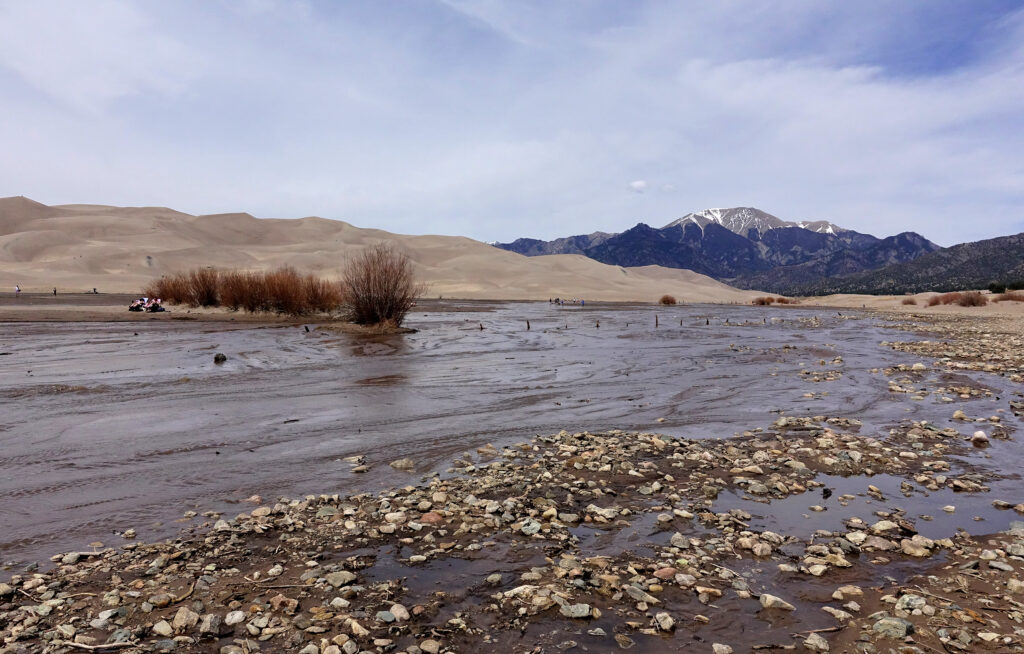
Medano Creek in full flow in May at Great Sand Dunes NP.

Who knows what a pulse flow is? Unless you’ve been to Great Sand Dunes in the spring/early summer you’ve probably never heard of this term. A pulse flow is a phenomenon that happens when the river flowing through the dunes, dams itself up with sand, eventually breaking those dams, so you get pulses of increased flow (or mini floods) working their way down stream in a wave like pattern.

Great Sand Dunes National Park was established as a National Monument in 1932, and upgraded to a National Park in 2004 to protect the unique sand dunes forming at the base of the Sangre de Cristo Mts as Medano Creek flowed down. This ecosystem brings in a variety of flora and fauna not typically seen together and creating 500ft tall sand dunes! Most people come to this National Park to play in the river, climb the dunes and some to sandboard down. Very few get to experience the heart of the dunes or the mountains surrounding them. When I hatches the plan to do a Great Sand Dunes crossing (7mi of sand), I got lots of “Hell No” from friends, but not my friend Ben. Ben loves anything novel, and this sure was going to be a novel experience.

Image
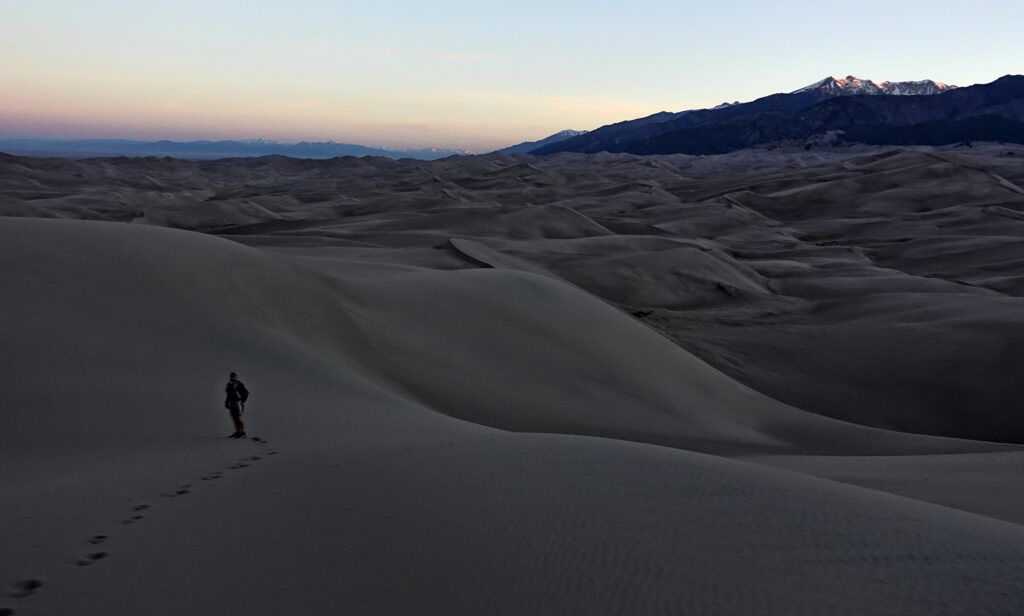
Sunrise over Great Sand Dunes NP with the Sangre de Cristos in the background.

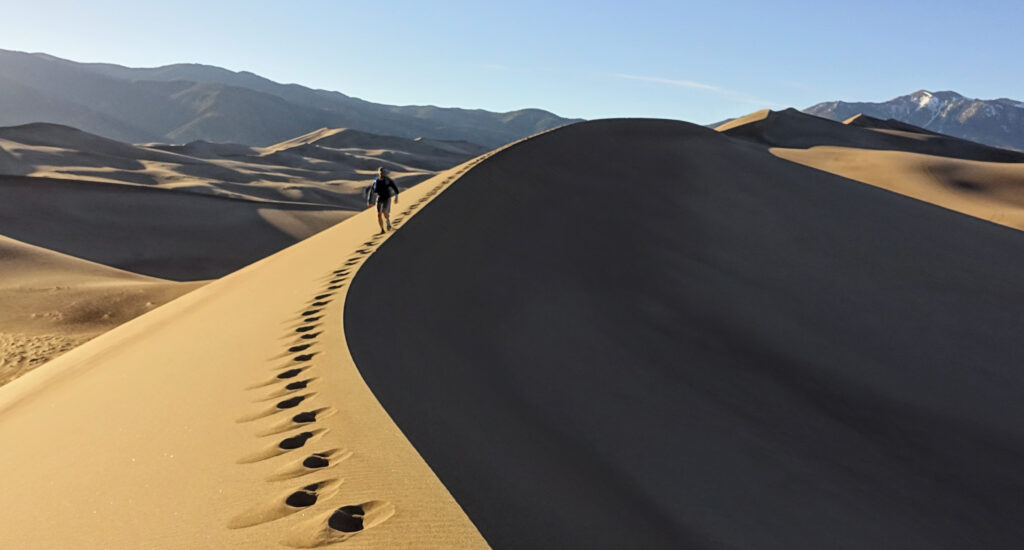
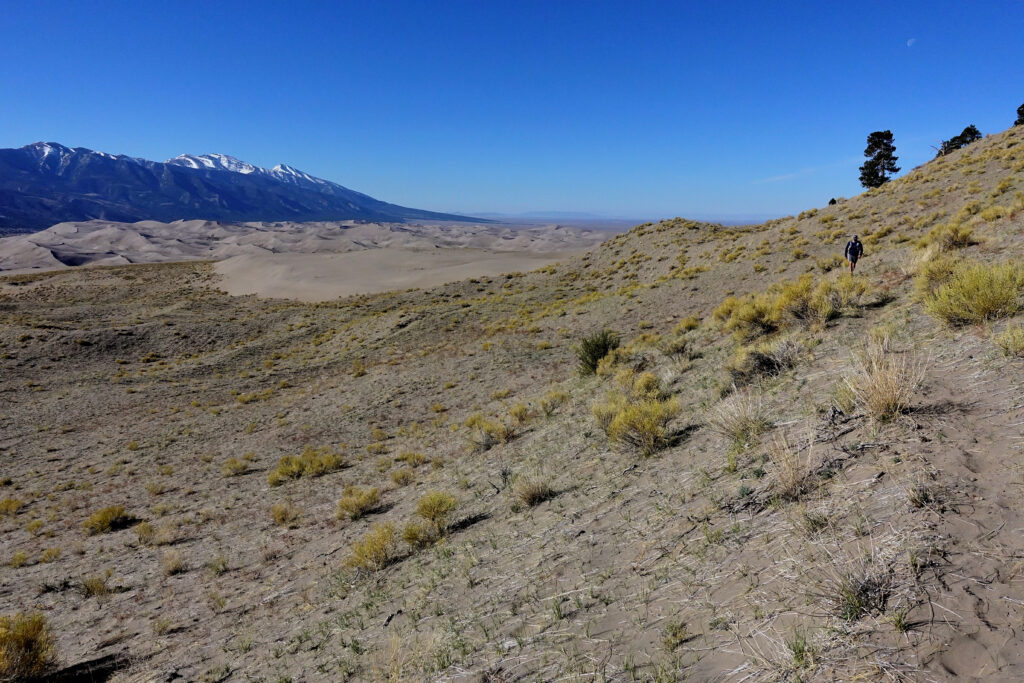
We set out just before sunrise, hopping across the sandy shallows of Medano Creek and on up Star Dune, the tallest in the park at 741ft. We quickly found if one stuck to the ridges and valleys the sand was actually not bad to walk on. As we crested the high dunes, the first rays of sun were lighting up the sky above the Sangres, leaving us far below in shadow. We cruised across the dune tops and through the massive valleys, slowly making our way North to the Sand Ramp trail. We made quick time across the dunes (3h for 7mi), reaching the ‘trail’, which was really more of a sandy path. We jogged/walked back to the Medano Pass 4×4 Rd, where Ben and I would part ways. After dumping a pound of sand out of our shoes, I continued up to Medano Pass, while Ben headed back to the visitor center.

Image
Ben traversing the dune tops in the morning sunlight.
Image
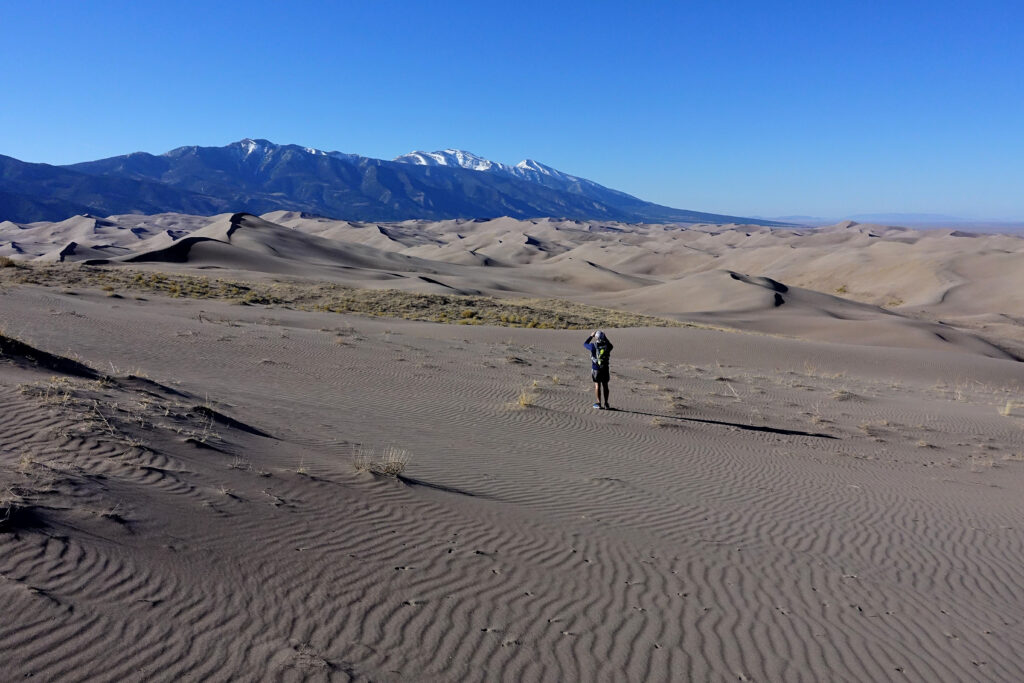
Sand dunes and snowy mountain tops.

The road was smooth and went by quickly until about 500ft from the pass, where I started to hit patchy snow. Small at first, but they slowly grew bigger and deeper as I neared the pass. I reached the top of Medano Pass without too much difficulty, marked only by a sign describing the early pioneer’s efforts to get over the pass. It was early enough in the year that no cars were allowed up to the pass, so I had a quiet run down back to the Sand Ramp trail. From there it was the final grind back around the East side of the dunes, with a quick stop at the overlook to take in the immensity of the dunes. Then on back to the visitor center for a dip in the creek and a soda.

Image
Making our way across the Sand Ramp ‘trail’.
Image
Medano Pass Rd, climbing high into the Sangre de Cristo Mts. The source of Medano Creek and all the sand that makes up the dunes.

29mi and 4300ft later I pushed through the reeds growing along Medano Creek, arriving back at the beach party, closing my loop. I found the rest of our gang hanging out in Medano Creek: building sandcastles, dams and splashing in the water. It’s truly the closest thing Colorado gets to a beach day, and it’s such a unique way to experience it. I wouldn’t classify the Sand Dunes as a great running destination, but it is a unique place, especially in the late spring/early summer when the water flows and the days are warm. If you’re feeling bold, wander beyond the first 1/2mi into the heart of the dunes where you’ll have the park almost entirely to yourself. I promise you won’t be disappointed.

Image
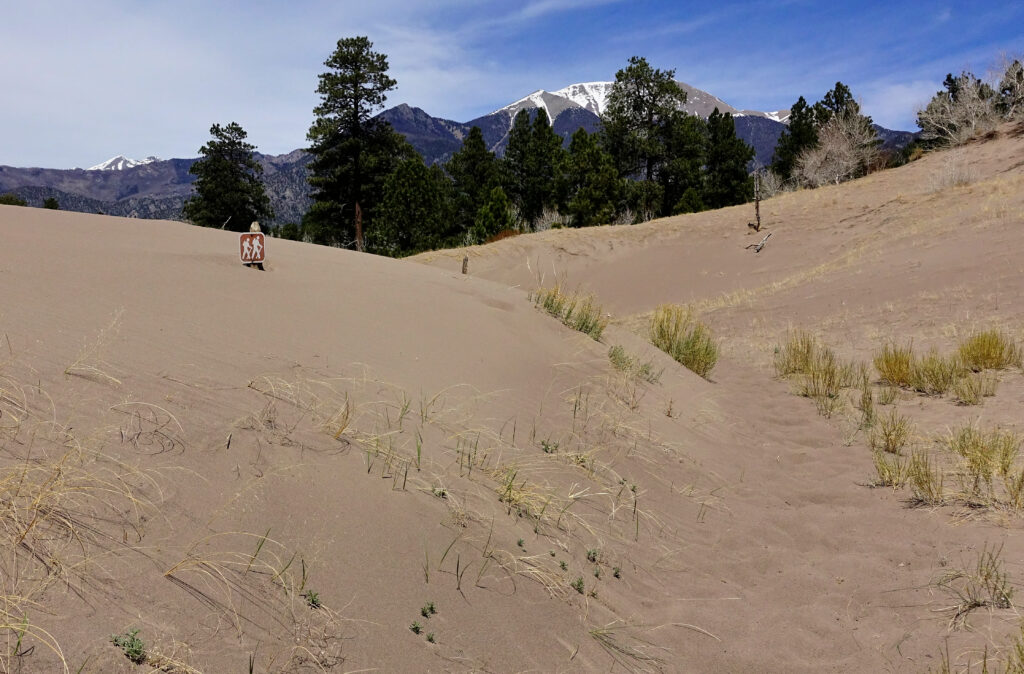
Reminder…sand dunes can move and cover the trail and bury signage.
Image
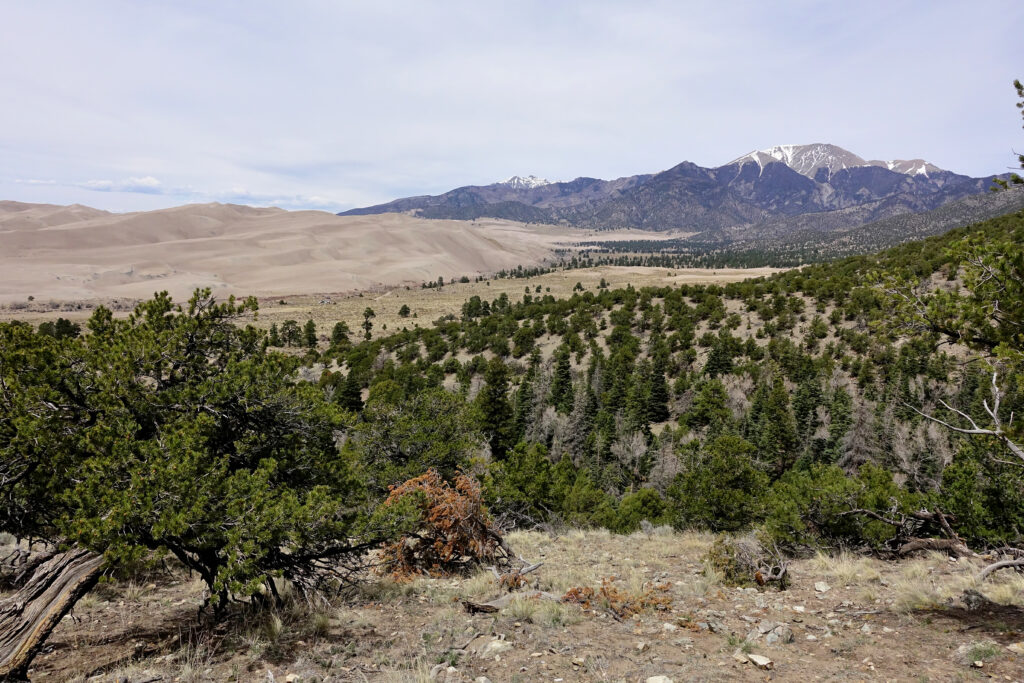
View of the Sand Dunes from viewpoint near the end of the run.

Capitol Reef Ultra, 3/27/21

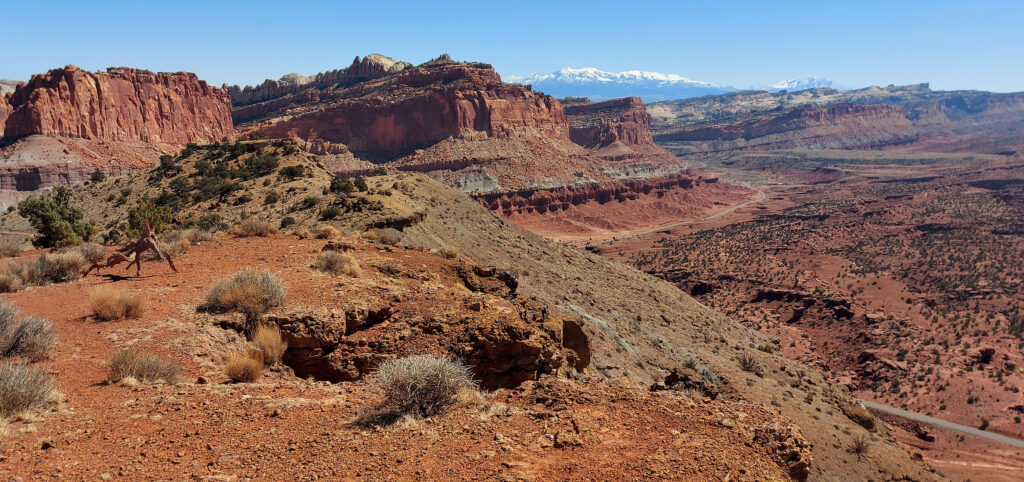
Capitol Reef from near Torrey with the Henry Mts in the background.

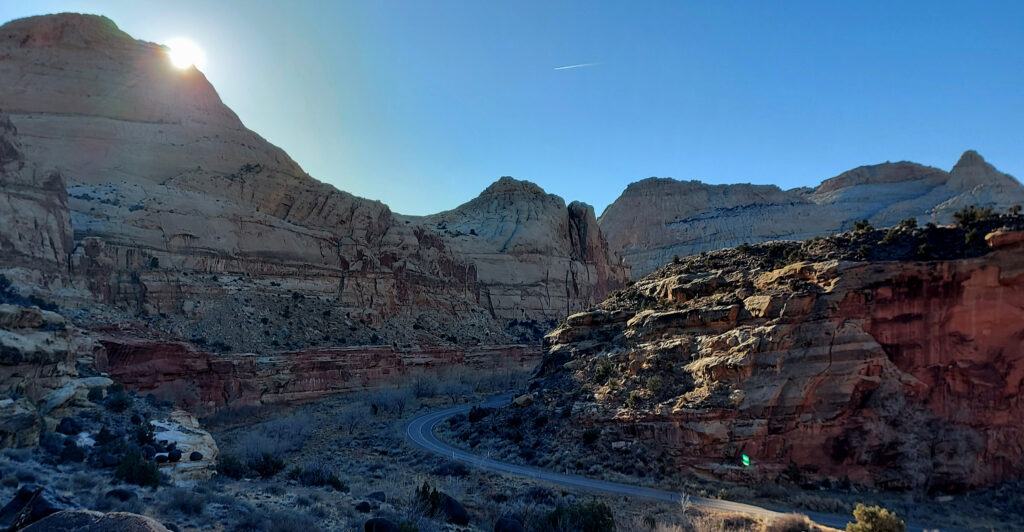
Utah has 5 National Parks, each encompassing a unique and amazing landscape. Of those 5, Capitol Reef definitely gets the least attention, and so many people are missing out. Take the slot canyons and washes of Zion, throw in a few arches and the cherry on top is the amazing geology of the 100mi long Waterpocket fold and you’ve got a slickrock wonderland, full of hidden passages and deep and narrow canyons. Capitol Reef National Park may not have just one thing that wows people or that draws tourist from around the world, but spend a little time there and you’ll start to unravel the mystery and magic that makes this National Park so spectacular.

Image
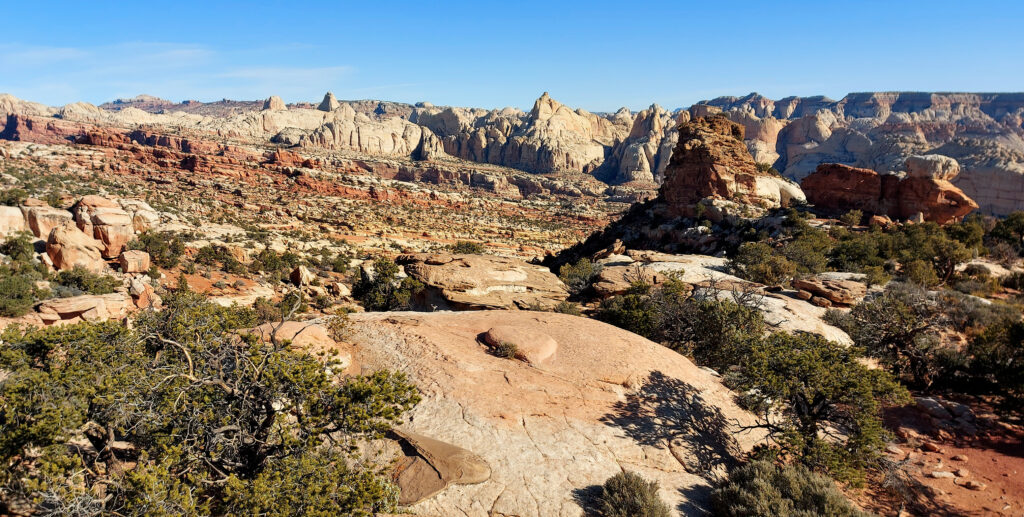
The heart of Capitol Reef in the middle of all the canyons.

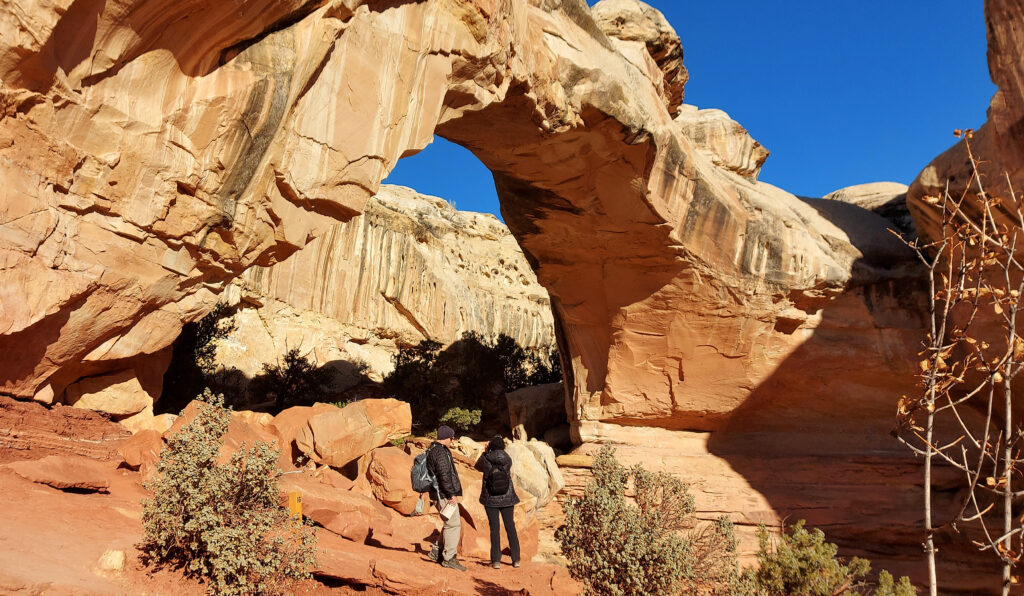
I started my Capitol Reef NP run from the Visitor Center along Sulphur Creek, jogging South along the park road, across the Fremont River and starting up the Cohab Canyon trail. The trail quickly climbs along the cliffside, breaking a gap in the wall the trail enters a high canyon cutting into the heart of the reef. My first destination was Hickman Bridge, a well known natural bridge the trail passes right under. Looping back to Cohab Canyon, I quickly turned off onto Fryingpan Trail, climbing up to the top of the reef. The Fryingpan Trail undulates along the top of the reefs, rims of the slot canyons and across the top of the reef. Eventually dropping down to the iconic Cassidy Arch and into Grand Wash.

Image
Hickman Bridge in Capitol Reef NP.
Image
Views along the Frying Pan Trail in Capitol Reef.

Grand Wash’s massive walls rise hundreds of feet above the 20ft wash, terminating at the Fremont River. After a quick water and food resupply at the road crossing, I setup for the first technical obstacle, the ford of the Fremont River into Spring Canyon. The water was very chilly, about thigh deep and moving with some speed. Once across I bushwacked my way into Spring Canyon, and started the slow ascent up the 25mile long Spring Canyon. Trapped deep within the canyon, with no easy exit for 10mi, it’s a very quiet and isolated place in the heart of Capitol Reef, only a few miles from the park road. Soaring white and red sandstone walls, massive spires, narrow slot canyons and lots of hidden nooks. The canyon finally opens up after 10mi near Chimney Rock Canyon, and the trail splits up and over Chimney Rock, which offers fantastic views of the back side of Capitol Reef and towards the Aquarius Plateau.

Image
Grand Wash far below, driveable to the Cassidy Arch TH, then foot traffic only beyond that.
Image
Spring Canyon’s long twisting hallways are seldom visited, but easily accessed from several sides.
Image
The view from Chimney Rock back down towards Spring Canyon.

At the Chimney Rock TH my route crossed the highway, and the next section of the Capitol Reef adventure loop began, descending into Sulphur Creek. Sulphur Creek is carved by a cold water natural spring, deep into the eroding mudstone. After passing through the wide portion of the upper canyon, the creek bottom begins to narrow and takes on a more slot like appearance. As the canyon slots up, the options for travel become fewer, and one finds themselves splashing alongside the creek and scrambling on the cliff edges. All of a sudden I rounded a corner and came face to face with the swim, a 8-10ft wide, 50ft long chest deep pool. I undressed, packed all my gear into my drybag and waded into the chilly water. I cruised through and back into the sunshine, redressed and continued down the narrow fluted heart of Sulphur Creek Canyon. After climbing down the final small waterfall the canyon widens back out and terminates back at the Visitor Center.

Image
Entering the narrows of Sulphur Creek. The water starts out avoidable…for a bit.
Image
The final obstacle in Sulphur Creek, a short 4ft downclimb around this waterfall.

30mi and 7h later, I’d completed my ultramarathon loop of the Central Capitol Reef region. A fantastic mix of trail running, adventure, solitude and stunning scenery. With short car shuttles one could easily break the run into three distinct pieces. The Visitor Center to Grand Wash, Grand Wash through Spring Creek to Chimney Rock TH, and Chimney Rock TH through Sulphur Creek. Each section offers a unique, yet stunning view of Capitol Reef’s beauty; the lonely canyons, massive arches/bridges, sculpted walls, and intricate uplift of the reef formation.

Image
After going for a little swim through the narrows of Sulphur Creek. The water is chest deep and chilly.
Image

2022 Hardrock 100; Acceptance

Image
The best crew and some of the best humans around.

Going into the 2022 Hardrock 100 I had grand aspirations and goals (which included a sub-30h finish). The quick answer is things went about as well as it could have, but not as well a I dreamed it would. I’ve always set big goals for myself, many of them born out of insufficiency and insecurities from past lives; You’re too slow, you’re not strong enough, you’re too short, too awkward, not smart enough…
Every person who steps foot on the line at Hardrock has dealt with their own challenges to get there and most likely still carries some of those challenges through the race and life in general. To claim we are all equal is a lie, we all are unique and none of us will ever have the same experience and that’s perfectly ok. Something I’ve struggled with for a long time is the idea that if I worked hard enough I could achieve some of the lofty aspirations, maybe not Killian level, but pretty high. 16 years after I started ultrarunning, I’m finally accepting that’s just not the case. To be clear, I’m not looking for a pity party, but rather through a recognition of my own weaknesses (and also my strengths), I can become the best version of that self and achieve whatever my personal limits may be.

Image
Pre-race nervous shakeout and relaxation up at Hematite Lake with Jason.

Ok, back to Hardrock. Last year (2021) I went into the race determined to push hard and really find my potential, and a new level of success (time and place). What ended up happening was out running my capabilities early and suffering through the last 1/3 of the experience. 2022 brought a much different approach, listen to my body, be grateful for every experience (good and bad) and to enjoy a much as possible. In the past what’s done me in is running to others expectations, trying to keep up with others (not myself) and not fully listening to my body. The biggest challenge was admitting that my airways and lungs are my weak point and will always limit what I can do, especially at high altitude. This is not new (Nolans, past Hardrocks, 24h 14ers, Elks and others), but it’s been a hard thing to admit that it’s not something I can train past or “overcome”. I’ve found ways to cope and build other strengths; getting faster downhill, increasing overall fitness, running longer and slower, but none of these will ever remove this weak link of mine.

Image
Cresting the Putnam Divide early in the race, mm10.
Image
The infamous Island Lake near Grant Swamp Pass, always a worthwhile visit.

I slept terribly the week before the race (another temporary challenge) and work stresses had me a bit out of sorts, not the best way to start a super hard 100mi race. But I was promised to spend a long weekend running around some is the most beautiful mountains, with a crew of great friends, I was lucky indeed. The first climb went by smoothly, as I focused on just taking in as much of the experience as possible, soon finding myself in the familiar position of leap-frogging with Darcy. Maggie soon caught up to us not too much later and the three of us would spend the next 30miles leap frogging back and forth (them on the ups, me on the downs). Every time I rolled through an Aid Station the friendly faces would provide a boost, finally getting to see my crew in Telluride (mm28). The stoke was high, I was still feeling great and just doing my own thing. As we (Darcy, Maggie and I) left Telluride a big storm dropped in and pummeled us with rain and hail for 45min, but it was fine, we were below treeline and safe, just moist. The ominous skies still threatened as we approached Kroger’s Canteen. A couple of perogies, some coke and off down to Ouray I went. I was finding my own rhythm, playing to my strengths, listening to my body and just letting the miles roll by. Ouray was a wild circus full of energy. Tons of friends, spectators and confused tourist everywhere. For the first time at Hardrock I left an Aid Station without a pacer, focusing just on myself and the mountain experience I was seeking. Darkness fell as I led a group of us up and over Engineer Pass and down into Animas Forks. The aid station was a bit of a mess and I almost ran right by my crew without either of us realizing it. After a quick change into my nighttime gear, Jason and I were off to Handies, my white whale.

Image
Nearing the summit of Virginius Pass, just after one thunderstorm had passed over, right before another one was about to hit.
Image
Crew stop and refeul in Ouray before heading up to Engineer Pass.

As we headed up the Grouse saddle the work stress and lack of sleep were catching up with me and I’d spend the next 5h a walking zombie. My lungs strained in the cold air and I knew if I didn’t slow I was at risk of damaging the rest of my race, so upwards we crawled. After much bitching and moaning on my part (Jason was great) we made it to Burroughs AS where Jesus greeted us with open arms (no I want hallucinating yet). I kept trudging forward at what felt like a slow crawl, picked up Gwen at Sherman, then slowly staggered my sleepy way to sunrise at the pole creek divide. As the sun illuminated the surrounding mountains, my spirits began to lift. Gwen commented that she knew I was back when I made some very juvenile comment that only a 12yo would make, oops. So we ran (some) and walked (a bunch), enjoying what was a mostly lovely day. I probably groaned a bit when we hit the precipitous descent into Cunningham, but that meant only 1 AS left! I did my best to keep things fun at our last crew exchange, but I was just a wee bit tired, so who knows how well that came off. Bailee and I set off at a slow trudge up Dives/Little Giant, trying to keep my breathing in check (and not set off my asthma), but also wanting to get done. As we crested the top, I took one last look back at Green Mt and finally let myself believe I was going to get it done.

Image
Full moon rising as Jason and I make our way over Handies Peak at 14000ft.
Image
Down into Maggie we go, endless wildflowers all around and Day 2 sunshine.
Image
Still kinda smiling and kinda having fun, final climb up and over Dives/Little Giant, almost done!

Whatever pain and fatigue I felt didn’t matter, all I had to do was will my way downhill to the finish. We ran as fast as I could down the technical descent, taking a few walk breaks to catch my breath. We stomped through the river and hit the final few miles into town, running into Jefferson along the way. I ran as hard as my lungs would allow, but with two miles to go I was sent into a coughing fit, diaphragm spasms and promptly threw up. This was the first time that’s ever happened during a race. Once I stopped coughing I felt fine, so we jogged it in. As we cruised through town we were greeted by many familiar faces, including my crew. It felt really good to kiss the rock for the 3rd time, but it felt even better to be in good spirits (despite puking) and to have enjoyed the experience (for the most part).

Image
Finish line vibes.

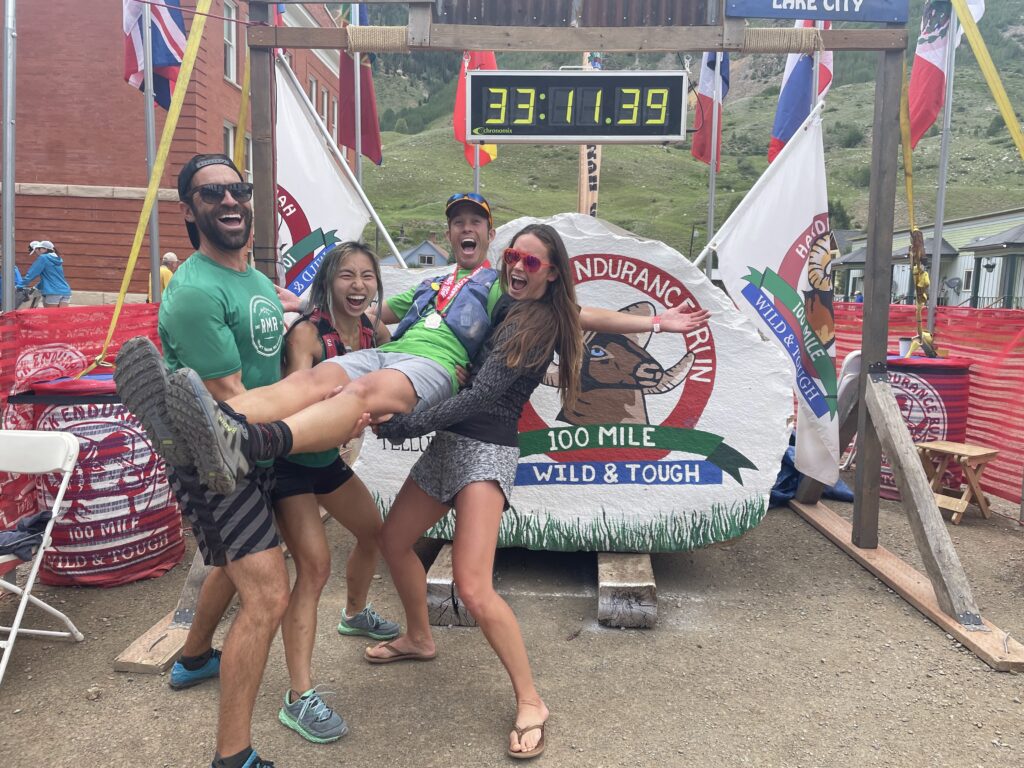
The rest of the day was spent on a quick nap, cheering on the multitude of friends finishing that afternoon/evening and eating all the food I could find (burrito, 2x burgers, cookies, soup, etc). My training had succeeded, my legs held up (my legs are never my limiting factor at elevation), and other than my 5h sleepy stretch so had my energy levels. I’ve learned that no matter how hard I train, at Hardrock I can’t outrun my lungs, so sub-30h may never be in the cards for me, and I’m ok with that. I had a great run with my good friends, and that is really what I wanted most out of the experience. Sure it would be awesome to run faster, but after 34:38, 33:52 and 33:10 finishes I’ve accepted this is who I am. On to other new adventures, different races and to enjoy crewing my friends at Hardrock in future years, where I get to eat all the food, take a few naps and not run 100miles of that crazy course all at once.
Big thanks to Vfuel for supporting my training and my Hardrock adventure, all the Rocky Mountain Runners for the training miles shared and my friends and crew for dragging my sometimes grumpy ass around the San Juans yet again.

Omicron and Endemicity? 1/24/22

The question I’ve received many times is what does Omicron mean for the end of the pandemic and the future of the vaccinated? The short answer is, anyone who tells you they know what is going to happen, when things will end or what the future holds is lying. While there are definitely signs of what the future of Omicron and the pandemic (maybe turning endemic) hold, Nature does not listen to our whims and there are biologically and epidemiologically still several paths we could travel down. The following blog is a departure from many of my previous writings in that it’s mostly my opinions and thoughts on these topics, lots of hypothesis, many of which are far from proven, but are still none the less backed up by scientific evidence and general biological principles. Welcome to the inner wanderings of my mind…..

Omicron Spread and Vaccines:
I’ll start by diving into why is Omicron spreading so fast, how might it be different and what does it mean for the future of the vaccine programs. The Omicron variant was first detected in South Africa in November 2021 (though the variant could have originate elsewhere), and what made it so unusual and worrisome was it contained 53 (!) mutations from the original founder strain, an extremely high number for a coronavirus. Hypothesis are currently that this virus must have evolved on it’s own in a long term reservoir (either immunocompromised host or animal) separate from Beta or Delta because it doesn’t closely resemble those two variants, but these are just hypothesis at the moment. What makes Omicron so successful is that these mutations appear to allow it to more efficiently bind to and enter human cells of the upper airway. This combined with the evidence that several of the mutations also interfere with the binding of some antibodies created by the vaccines (and previous infections), mean that our barrier to preventing initial infection with Omicron are torn down a bit more, but our protection is not lost!
So while vaccine detractors will point to vaccinated people becoming infected (which is true), there is a lot of real world evidence coming out that if you received a Covid vaccine (booster even better) you’re MUCH less likely to suffer severe disease or be hospitalized, which after all is what worries us the most. Part of the reason for this is that even though your immune defenses can’t prevent the initial infection, there appears to be enough cross-reactivity between existing immunity and Omicron that the body gets a jump start on fighting the infection, and as such has a much easier time controlling the disease. I attribute my current case of Omicron being mild to these advantages (in addition to being young-ish and healthy). We also have the good fortune that Omicron appears to not cause as severe disease (on average) when compared to Delta. A current working hypothesis is that what makes Omicron more infectious, may also mean it doesn’t damage the pulmonary tissue as much. After all, a virus’s main goal is to replicate and spread, and a dead host is not useful for spreading a virus. Successful viruses infect a host efficiently, replicate quickly and allow that host to spread the virus to other hosts. This is exactly what Omicron appears to be doing, and what also brings us to the next topic, Endemicity.

Endemicity?
The hope has always been we get to a place through vaccination, medications and natural immunity where we can live in more of a steady state with SARS-CoV-2. What this would include is the virus being a normal part of life, circulating within the population, not causing massive outbreaks, overflowing hospitals, killing hundreds of thousands and infecting millions each month. Obviously we’re not there yet as we still see massive numbers of new infections each day, a lot of hospitalizations and far too many dying (as of 1/24, >1000/day US). But what people are starting to allow themselves to talk about with Omicron is the potential that with how fast Omicron is spreading and the more widespread availability of vaccines, that maybe moving from the current pandemic to SARS-CoV-2 being endemic is possible.

For this to happen, enough people would have to be immune and/or refractory to severe infection that the virus is no longer a concern for most people (or our hospital system). The current variant, being less severe (on average) and far less severe (on average) in vaccinated individuals does look like it could push us in that direction. The trouble with proclaiming the end of the pandemic pre-maturely is that no one can tell you for certain that as the virus infects hundreds of millions more people in it’s push to endemicity, it won’t mutate again to become more severe/deadly. While the idea that there aren’t direct biological evolutionary pressures pushing the virus to be more effective at killing the host…mutations can be random and don’t always follow that path. But if Omicron continues on it’s current path (BIG IF) and infects much of the population in the coming months then maybe the number of new infections in each outbreak will greatly dwindle, our hospitals won’t overflow with severely ill patients and maybe we can move forward with thinking of SARS-CoV-2 as just another cold virus…..just maybe.
Our work is still not done, hundreds of millions will still get infected in the coming months/year and many will die sadly. Our job right now is to arm ourselves with as many tools to fight the virus as possible (vaccinate the world, stay healthy, wear a mask to reduce exposure, keep researching new medications) and to protect those who are still at the highest risk of severe infection.

Eric is an Immunologist and Infectious Diseases Scientist based in Boulder, CO. The thoughts in this blog are his own and are by no means proclamations of certainty, but rather musings and hypothesizing.

Image
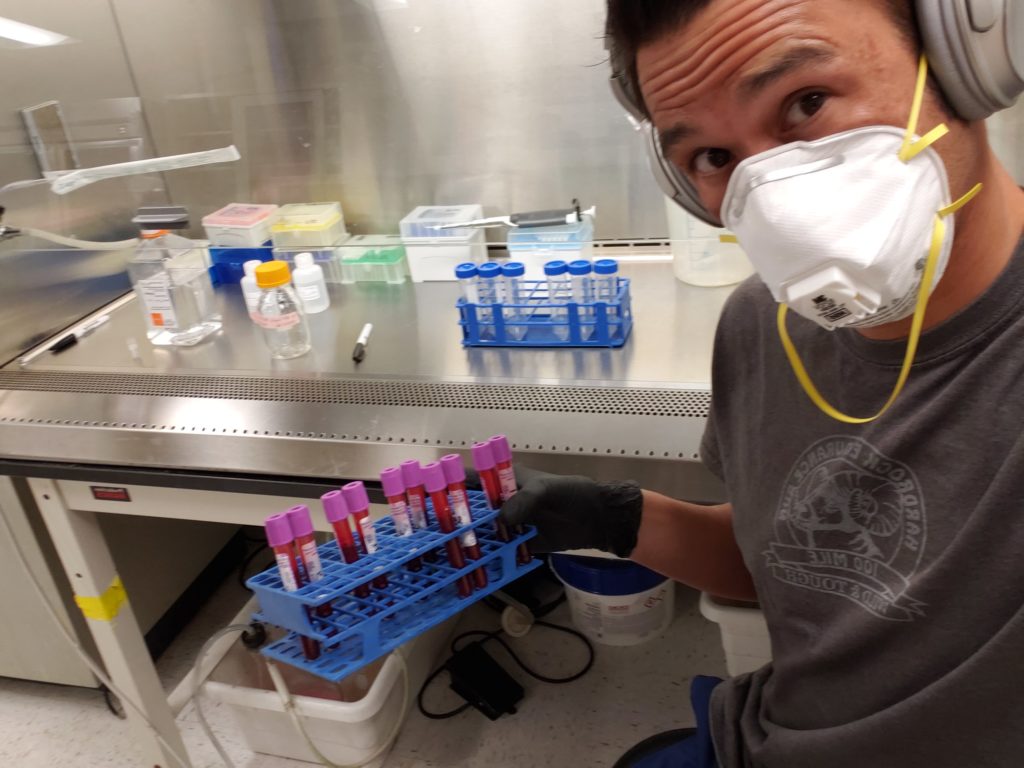
Sciencing the shit outta stuff, that’s how we do it.