(1) THE PATH TO NOW IS PAVED WITH BOOKS. Front Porch Republic takes readers “Inside the Workings of Joel J. Miller’s The Idea Machine: How Books Built Our World and Shape our Future”.
…Today, in some spheres, books are often imagined to be counter technological. A dehumanizing technological onslaught is thought to be menacing the world of books, which is tacitly conceived of as a homey yet elevated sphere analogous perhaps to Tolkien’s Shire. Thus, people sometimes call for schools to get rid of technology (meaning, in this instance, computers and AI) and to return to pencils and paper and books, as if these were not also technological.
How did books become what Joel Miller calls “the forgotten technology”? And what difference would it make to our understanding of modernity and of ourselves if we remembered? His excellent new book, The Idea Machine: How Books Built Our World and Shape Our Future, is motivated by two closely related problems. First, because books have become so familiar, we have forgotten to recognize “the book for what it is: a remarkably potent information technology, an idea machine.” Second, we have failed to appreciate the extent to which books served “as one of the most important but overlooked factors in the making of the modern world.”
Miller makes this argument via a dazzlingly wide survey of texts ranging from fourth-century BCE Greece to the present moment. The book is addressed to the educated general reader rather than a narrow audience of book historians or historians of technology….
(2) BID ON DOCTOR WHO PROPS IN FEBRUARY. “’Doctor Who’ History on the Auction Block in 2026” reports Parade. (Here’s the direct link to the “Doctor Who Online Auction 2026”.)

If you’ve ever watched Doctor Who and wanted The Doctor to materialize in your living room and drop off a Dalek, your moment is almost here. In early 2026, BBC Studios and Propstore are teaming up for an online auction that invites Whovians around the world to bid on iconic pieces of the show’s long, imaginative legacy. From historic costumes to beloved props, this is the kind of event that makes a Doctor Who fan’s heart (or hearts) skip a beat.
Scheduled to run from February 3 to February 19, this auction will feature over 200 lots, giving everyone with a passion for the Whoniverse a chance to take home a tangible piece of the longest-running sci-fi show in history. Bids start at just £100 (roughly $130), but you can bet many of the starring items will draw spirited competition. Among the highlights is a bronze Time War Dalek, the fearsome design first seen in episodes like Asylum of the Daleks….
… Any winning bids fans make will also help a charity with deep ties to the show. A full 20% of the net sale price goes to BBC Children in Need, continuing a years-long tradition of the BBC using their seminal sci-fi show to raise money for the charity.
And here’s a benchmark for just how much love the community pours into these events: at last year’s Doctor Who Propstore / BBC auction, fans and collectors raised an astonishing £245,243 (roughly $331,000) for BBC Children in Need. Those proceeds came from more than 2,000 participants around the globe, all bidding passionately on over 170 lots….
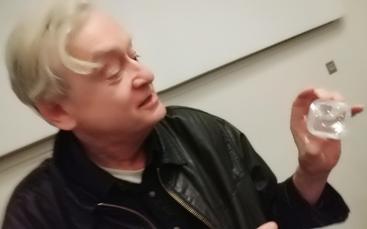
(3) ROTSLER AWARD EXHIBIT. Thanks to Kenn Bates for his photos of this year’s Rotsler Award exhibit at Loscon over Thanksgiving Weekend. The very last photo below is a close-up of something produced by this year’s award winner David Hicks. [Click for larger images.]


(4) GONE. NPR talks to Esther Estrin, publisher of Newmarket Press about the coming change: “Mass-market books are disappearing from grocery store racks”.
ESTRIN: So as you watch the era of the mass-market paperback go, are you sad?
MARGOLIS: I’m very sad about it. I’ve been sad about it for a while. Even during the ’80s, when it started to really shift, I was sad because it really – like you asked before, that you could actually establish a total unknown. Today, thank God, you have TikTok and BookTok. They could take somebody unknown and somebody can just get on a camera and say, I love this book, and next thing you know, you have Colleen Hoover or somebody. But that’s what you could have done in the past paperback that you can’t do really today. To me, Stephen King is a great example. I mean, his whole career, I don’t know what – how that might have been built otherwise, if not for the mass-market paperback.
(5) SHAUN TAN PROFILE. “’My work is often misunderstood’: Shaun Tan on his surreal Tales from Outer Suburbia” in the Guardian.
…“I’m like one of those old migrants that talks nostalgically about an old country that doesn’t even exist,” Tan says over the phone from his current home in Melbourne.
“On one hand, [that outer suburbia where I grew up] was potentially boring and a little dreary and quite artistically uninspiring. On the other hand, anything’s possible and nobody cares. You can just create or imagine something – it’s like a blank canvas.”
For a few hours a day, that blank canvas was punctuated by what Tan calls the “artform of the suburbs” – television. Only “three glorious channels” were available, but Tan would tape Doctor Who, Astro Boy and Twilight Zone reruns on the family VCR each night. It was those shows that kickstarted his interest in fantasy, science fiction, and eventually writing and illustrating his own stories.
He poured these memories and feelings into his 2008 book, Tales from Outer Suburbia – 15 illustrated short stories that reimagined those suburbs as a familiar but surreal landscape. These tales were full of memorable, unlikely characters, from a giant water buffalo in a vacant lot to a wandering deep-sea diver – an allusion to Western Australia’s history of migrant Japanese pearl divers who once braved the bends in their hundreds.
“I think my work is often misunderstood,” Tan says of Outer Suburbia’s look and feel. “I’m always at pains to say my style is not ‘quirky’, it’s not ‘weird’. It’s about normal things, normal feelings. They’re just displaced into other objects, but the displacement helps you to think about the deeper feelings and deeper meanings.”…
(6) AN EVOLVING HORROR. “‘Frankenstein’ has been endlessly rewritten, even by its author” explains the Washington Post. “Even Mary Shelley rewrote her own work; two very different versions survive today.”(Link bypasses the paywall, but registration is required to read it.) Excerpt:
…The differences between the two versions are stark. In 1818, the creature accidentally kills Victor’s younger brother, William, while trying to silence his screams. In 1831, upon learning the boy’s name, the creature declares, “You shall be my first victim,” before intentionally murdering him.
In 1818, the creature accidentally frames Justine Moritz, the Frankenstein family servant, for William’s death when he slips a locket the boy was carrying into Justine’s pocket. In 1831, he watches Justine sleep, bitter that her “smiles are bestowed on all but me,” and deliberately places the locket in her dress because “the murder I have committed because I am for ever robbed of all that she could give me, she shall atone.”
Students in my classes have commented that the 1831 monster resembles an incel. Deciding between the editions means deciding between a monster who teeters on the edge of humanity, who might, with the sympathy he seeks, be a peaceful creature, and a conniving creep, abandoned by a creator who (to mention another revision) plans to marry either his biological cousin (1818) or his adoptive “more than sister” (1831)….
(7) PIERRE BORDAGE (1955-2025). French author Pierre Bordage died December 26 of a heart attack. His publishers L’Atalante and Au Diable Vauvert, paid tribute:

A great French writer has left us, creator of stories and worlds, he pushed boundaries of creativity, inspiration and genres, that were too narrow for his unique and powerful storytelling.
As a French writer, he expanded his unique literary career while his work was translated worldwide and sold millions copies. He wrote around fifty novels and even more short stories, winner of many literary prizes, including: Grand Prix de l’Imaginaire, Prix de la SGDL Paul Féval de Littérature Populaire, Prix Bob Morane, or Prix Julia Verlanger.
His wide curiosity and inspiration led him into all literary genres, from contemporary novel to space opera, from sci-fi to dystopia, from historical novel to fantasy, tales or mythologies, always putting humanity at its core.
Offering French sci-fi new goals and new dimensions alike, he became an inspiration for many generations of readers and writers.
His literary legacy will last forever in his readers’ mind.
Our thoughts are with his children Tangy and Kevin, his grandchildren, his siblings, family and close friends.
A funeral service will be held on January 7th, at Nantes, France.
(8) MEMORY LANE.
[Written by Cat Eldridge.]
December 29, 1967 — “The Trouble with Tribbles”
My friend, 10 credits apiece is a very reasonable price. Now you can see for yourself how much the lovely little lady appreciates the finer things — Cyrano Jones
Fifty-eight years ago this evening, “The Trouble with Tribbles” first aired on NBC, as written by David Gerrold and directed by Joseph Pevney, with some of the guest cast being Charlie Brill as Arne Darvin, Stanley Adams as Cyrano Jones, Whit Bissell as Station Manager Lurry, and Michael Pataki as Korax.
Memory Alpha says “Wah Chang designed the original tribbles. Hundreds were sewn together during production, using pieces of extra-long rolls of carpet. Some of them had mechanical toys placed in them so they could walk around.” Well walk isn’t how I’d describe their movement…
Memory Alpha also notes Heinlein had Martian flat cats in The Rolling Stones that were similar to these and Roddenberry called to apologize for these being so similar. My understanding is that they brought the issue to Heinlein’s attention and asked for permission to continue. To their surprise, he granted it in exchange for a signed copy of the episode’s script.
(I know that Heinlein’s authorized biography contradicts this story. Really contradicts this story.)
It would come in second in the Hugo balloting at BayCon to “The City on the Edge of Forever” written by Harlan Ellison. All five final Hugo nominees at BayCon were Trek episodes with others being written by Jerome Bixby, Norman Spinrad and Theodore Sturgeon.
David Gerrold wrote a book on his experiences in the creation of this episode, The Trouble with Tribbles: The Birth, Sale and Final Production of One Episode. He did a children’s book as well, Too Many Tribbles! Which I’d really like to listen to.
There would be two more Trek stories done with Tribbles. “More Tribbles, More Troubles”, the fifth episode of the first season of the animated series riffed off them. And of course Deep Space Nine would revisit the story in “Trials and Tribble-ations” which blended seamlessly footage from the original episode with new video including the Charlie Brill character. It, too, would be nominated for a Hugo, this time at LoneStarCon 2. (Babylon 5’s “Severed Dreams” won.)
Tribbles also have been seen in other Trek episodes and films, including The Search for Spock and the rebooted Star Trek and Star Trek Into Darkness. They appeared in Enterprise’s “The Breach”. Phlox uses them as food for his creatures in sickbay. Which is either truly disgusting or really appropriate given how prolific they are. Or both.
Their final appearance so far is in the animated Below Decks series.
Finally, I should note the opening volume of IDW’s second Alien Spotlight series is called Tribbles. It concerns the initial discovery of the Tribbles by, errr, the Klingons. We discover why they dislike them so very much… and vice versa. Especially vice versa.

(9) COMICS SECTION.
- Saturday Morning Breakfast Cereal tells Superman’s other origin story.
- Broom Hilda tunes into a nicer culture.
- Eek! repeats a phrase.
- Eyebeam provides validation.
- MythTickle plays a trick.
- Reality Check gets a faceful of ads.
- Wallace the Brave attempts a save.
- Zach Hill is doomed.
(10) THE FOUNDER. Bitter Karella shares The Midnight Society’s dialog with Damon Knight about SFWA and AI. Starts here on Bluesky.

(11) AN INTERNET NUISANCE. “I Despise the Dudebros Purveyors of AI” declares Robin Anne Reid at Writing from Ithilien.
…I have to shut down three menu/windows every time I read a PDF. I ragequit academia.edu because first, their AI made a podcast of one of my presentations without my permission or even my knowledge that they had an AI (it’s always opt-OUT, assholes, isn’t it, never opt-IN—still failing to understand the concept of CONSENT), and then started sending me unsolicited grant opportunities.2
And since I’m still active as an independent scholar (though very glad for so many reasons not to be teaching any more, especially not to be teaching in Texas),3 I’ve been following some of the commentary and analysis of AI in general.
So in random order, some links to pieces I’ve saved: all the Substack links are ones I follow and can recommend, FYI….
These are accompanied by Reid’s own observations, for example:
…Several of us who edit and/or read for publications in Tolkien studies have had the experience of identifying submissions (essays) with AI content, specifically, citations which do not exist (in one case) or citations which exist but which are not about the claimed topic (i.e. those six articles you cited as being about Tolkien fandom do not ever mention Tolkien; I checked them all, but I also am fairly sure I know almost all the published scholarship on Tolkien fandom—it’s not very big!—and the absolute failure to cite any of it was another tell)….
(12) NOT MERE PRODUCT PLACEMENT. At Mashable, “Rhea Seehorn breaks down why ‘The Left Hand of Darkness’ is so important to ‘Pluribus’”.
Every science fiction lover jumped up and pointed at the screen, Leonardo DiCaprio style, when a certain book popped up in the Pluribus Season 1 finale.
That book is none other than Ursula K. Le Guin’s classic novel The Left Hand of Darkness, which is Carol Sturka’s (Rhea Seehorn) poolside read during her globe-trotting adventures with Zosia (Karolina Wydra).
Published in 1969, The Left Hand of Darkness introduces the frigid alien planet of Gethen, whose inhabitants are ambisexual. Every month, they undergo a period known as kemmer, during which they develop sexual characteristics. The Gethenians’ unique gender and sexuality has created a world vastly different from our own, impacting everything from war (there is none) to child-rearing (everyone chips in). The novel won both the Hugo and Nebula Awards for Best Novel, the second to do so after Frank Herbert’s Dune.
Given The Left Hand of Darkness‘ pedigree in genre fiction, it makes sense that Carol, a fantasy writer herself, would be reading it. (Although I’m sure Carol would be the first to say her Winds of Wycaro books don’t even come close to Le Guin.) According to Seehorn, choosing The Left Hand of Darkness for the finale came about through joint discussions with finale writers Alison Tatlock and Gordon Smith.
“We talked about who Carol might read in general, especially for leisure. Not that Le Guin’s books are easy, passive reading, but they definitely seem like books and a voice and a literary level that Carol would admire,” Seehorn told Mashable in a video interview.
Other options for Carol’s pool reading included Aldous Huxley’s Brave New World for a more dystopian bent. “In the end, we really liked her reading a female author,” Seehorn said.
The resonance of The Left Hand of Darkness goes beyond Carol just liking Le Guin, though.
“[The Left Hand of Darkness] holds a mirror to and has some parallels with what the audience is watching happening in this world,” Seehorn explained….
(13) BEST AND WORST (IN TERMS OF HOW IT AGED) SF/FANTASY BOOKS OR SERIES. [Item by SF Concatenation’s Jonathan Cowie.] Daniel Greene over at the Fantasy news YouTube Channel (577k subscribers) goes through the list of best top 20 SF/Fantasy books and series as well as the worst (in terms of those that don’t age well) 20 as voted for by one of the largest online fantasy communities on the planet – R/Fantasy. So, you will guess from this that this is biased markedly towards fantasy as opposed to SF. (I should perhaps say that I am a die-hard SF aficionado but fantasy you can keep. [I have always wanted for there to be a separate Hugo category for Best Fantasy Novel so we can stop fantasy novels knocking out worthy SF offerings from the Best Novel short and long-lists, but I know that many are more broadminded than I.] )
Some of the top books and series will come as no surprise with titles/series by the likes of Ursula K Le Guin, Michael Moorcock and Larry Niven in the favourite list. Similarly, some on the duds list (such as the Gor series and Narnia, will come as no surprise). There are some mild surprises such as Heinlein’s Stranger in a Strange Land being a dud: as Greene says, “good book, aged &8$£ing terribly”.
Brian Jaques’ Redwall was one of a couple that appeared on both lists!
And then there were some real surprises such as Anne McCaffrey’s Pern series being considered a dud. (I remember Anne once arriving at a Danish-venued Eurocon one day by taxi and, getting out by an outside bar area, got a standing ovation…)
The worst book or series of all voted for by this community – and with twice the number of votes for the runner-up – was… Sword of Truth by Terry Goodkind (novel 1994 that spawned a series).
Daniel then goes on to take the number ones from both lists to see if he can tease out what makes them the best and worst in terms of not aging well, at least as this is defined by this community of fans.
[Thanks to John King Tarpinian, Cat Eldridge, SF Concatenation’s Jonathan Cowie, Betsy Hanes Perry, Daniel Dern, Dan Bloch, Mark Roth-Whitworth, Kathy Sullivan, Steven French, Mike Kennedy, and Andrew Porter for some of these stories. Title credit belongs to File 770 contributing editor of the day Paul Weimer.]