In Praise of Spaceopera Punk

by Eric Del Carlo

Eric Del Carlo writes about the unique combination of influences that inspired him to write stories with post-apocalyptic themes set in deep outer space. “Mudfoots” is his latest, and you can read it in our [November/December issue, on sale now!]

The apocalypse used to be fun. I relished it. In pre-streaming, pre-cable, pre-VHS days I would wait the year round for The Omega Man to come around on broadcast television. Channel 40 out of Sacramento would run it. Our tv didn’t get the best reception for this station, but the picture was still watchable. And there was Charlton Heston, combing through a deserted LA, watching Woodstock alone in a theater, making quippy remarks to himself, all while hunting menacing characters in black robes. I imprinted on this film. I was swept up by Ron Grainer’s haunting score; I bled with Robert Neville through his every trial and tribulation; I wanted to create something like this one day. Not a movie. From a very young age I wanted to write. Could I make a story that summoned the same feelings this 1971 film aroused in me?

More post-apocalyptic movies and books followed as I consumed science fiction through grade school and high school. The Road Warrior, Niven and Pournelle’s Lucifer’s Hammer, Genesis II and the even cooler Planet Earth (those Kreegs, in steam-powered junk cars!), No Blade of Grass (film and book), Earth Abides, et cetera, et cetera. I wanted to see the fictionalized collapse of civilization, the degradation of society, a world where order was gone and barbarity ruled the day.

Why? Probably because I was forlorn adolescent and the end of the world seemed preferable to the one I was living in.

I fed this urge when I began selling my science fiction and fantasy, starting in 1990. I made small press sales, each one a triumph to me. Looking at my records, I see those stories which directly addressed my fascination with crumbled futures. It wasn’t just nuclear catastrophe which enthralled me. There were lots of ways to bring about the fall of humankind: plagues, technology gone amok, alien invasions. And then there were the dystopias. These were almost equally fascinating. Films like Escape from New York, A Clockwork Orange, Brazil, many others, all depicting near-futures where something had gone cataclysmically wrong with the underlying social structure. SF literature had mined this vein for decades: The Sheep Look Up, Fahrenheit 451, Make Room! Make Room! Hundreds more, every imaginable bleakness. I devoured all of this. And I put up my own versions, my own visions.

Then COVID-19 was loosed upon the land.

Suddenly, the end of the world wasn’t so very entertaining any longer.

I had to reset. Could I still write these grim near-futures, which had become my stock-in-trade? More to the point: did I still want to? Deaths counts rising, uncertainty creeping into every aspect of daily living. Was I living in The Stand or some other equally apocalyptic tale of a worldwide pandemic? Not quite. But this still wasn’t any place I wanted to be. When bad things befall me, I generally write about them in some altered form with the idea that someone will eventually give me money for what I’ve written, thus compensating me for the unpleasant experience. But . . . this? This was too real, too gruesome.

I recalibrated my sights. I didn’t have to write about Earthbound near-futures, after all. Science fiction provided plenty of other options. So, I looked to the stars.

This was not really my milieu. I’d sold stories set on starships and alien worlds, but these did not transpire in my comfort zone. Now I reconsidered. I had over the years identified the groove I liked to work in: tales of desperate people, under pressure, usually being chewed up by whatever societal system I had created; I didn’t often write about people in high positions, because leaders didn’t interest me, nor kings, nor Chosen Ones. I went to grittier characters, ones struggling just to survive. If I started writing earnestly about far-futures and deep space, I would have to write space opera. Wouldn’t I? Or at least brush up against it. But this wasn’t a genre which really reached me. Square-jawed captains and massive space craft, wars carried out over the yawning dark between the worlds, great attention given to technical detail. None of that was in my wheelhouse.

Yet I could see the advantage writing in this realm would give me. I could shake off the immediate horror I was living in and go tell my stories against backgrounds so removed from the present that I wouldn’t even have to acknowledge anything currently happening in the world. This was my way out.

But I still had to tell my stories, my way. Marginalized characters, people forced into perilous situations by unforgiving circumstances. I wasn’t going to write epics. I wouldn’t extol the glories of galactic warfare. I’d set my grubby folk into these glittering distant futures of world-hopping and stardrives, and let them get up to the sort of mischief I was familiar with. It wasn’t space opera, because none of it was grand or melodramatic or titanic in proportions. I have always told “small” stories, though just as often these are placed against big sweeping backdrops, so that the reader sees what epic events do to those who aren’t working the levers of power. But if it wasn’t space opera, what was it?

Spaceopera-punk. Sure. Why not? The mania for adding “punk” to any kind of subgenre was already established. It denoted a certain reckless writerly spirit, a touch of nihilism, the puncturing of stuffy traditions. Or something like that.

I took to the idea. I started writing—and selling—stories set hundreds of years in the future, when Earth is oftentimes a distant memory, and humans are up to all sorts of shenanigans in the deep black of space and upon kaleidoscopic worlds. There were ample stories to tell, I found. No surprise there. I probably shouldn’t have been so squirrely about the notion in the first place.

Here on Earth, in this particular polity in which we dwell, we are currently living in a Kurt Vonnegut novel. (Actually, it would be more accurate to say this is a Norman Spinrad story.) So the near-future dystopia, like the just-over-the-horizon apocalypse, isn’t much fun to write about currently. Not for me, anyway.

But the galaxy, fortunately, is big. So very big. I can get far away from this present reality, and yet still write about those ideas I care about. I have done just this with my current story in Asimov’s, “Mudfoots.” It was very satisfying to write; hopefully it will be a pleasant read for those who give it a look. In my mind it’s pure spaceopera-punk.


Eric Del Carlo’s fiction has appeared in AnalogClarkesworldStrange Horizons, and many other magazines and anthologies over the years. His most recent novel is The Cold, a harrowing story of “emotional apocalypse” from White Cat Publications. He returns to Asimov’s for the fourth time to bring us the tale of a man on a human-settled alien world.

Q&A With Mark D. Jacobsen

In 2001, Mark D. Jacobsen won our Dell Award for Undergraduate Excellence in Science Fiction. Now on his third story for Asimov’s, “Solemnity” in our [Nov/Dec issue, on sale now!], Mark reflects on the fraught religious background that influenced his work, the evolution of his process, and how dedication has contributed to his success as a writer

Asimov’s Editor: What is the story behind this piece?
Mark D. Jacobsen: The story began as a casual freewriting exercise. I had vague ideas about a scientist arriving on an alien world, but almost immediately I tapped into some deep pain surrounding my religious deconstruction. I realized I needed to lean into that. The story took off from there. I was nervous, because I had no idea how it would end. By the time I reached the climax, I still didn’t know—and realized that I didn’t need to. The ambiguity and uncertainty are actually essential to the story.
I am a writer who likes to plan and outline, so it’s a little embarrassing that the three stories I have sold to Asimov’s all began without any planning whatsoever. Each originated with a rare outburst of creative energy—writing for the hell of it, liberated from my usual rational guardrails.
When we write like this, the unconscious speaks through us. That power is astonishing, unnerving, and sometimes delightful. Many artists describe channeling a power that seems to reside outside themselves. The more we surrender to that power, the more it can work through us.
In many ways, that is what “Solemnity” is about. It explores a barely-understood power that dwarfs rational comprehension, speaking through human beings, touching on their deepest religious questions.

AE: Do you particularly relate to any of the characters in this story?
MDJ: I put a lot of myself into Kara, the story’s protagonist. She has built a new life as a software archaeologist after escaping a traumatic childhood in a fundamentalist religious community, but even after crossing the stars, she finds herself confronting all the religious drama she sought to escape.
This is a deeply personal story about religious trauma. I suspect a disproportionately high percentage of science fiction and fantasy readers have experiences similar to mine: raised religious, struggling to believe what we were taught, shamed for our endless inquiry after truth, and then agonizing over the slow unraveling of a faith that caused debilitating cognitive dissonance but also brought so much beauty, goodness, and belonging.
In many cases, the departure from childhood religion can leave people bitter and condescending, which I find just as unappealing as religious fundamentalism.
I wanted to write a story that explores a much more subtle and complex aspect of religion: the feeling of spiritual homelessness. Kara embodies that pain, but her experience gives her empathy for other characters in the story.

AE: How did the title for this piece come to you?
MDJ: The planet in this story is the graveyard of an entire race, so the name Solemnity seemed fitting. I’m also giving a deliberate nod to one of my influences for this story, Stanislaw Lem’s Solaris.


I suspect a disproportionately high percentage of science fiction and fantasy readers have experiences similar to mine: raised religious, struggling to believe what we were taught, shamed for our endless inquiry after truth, and then agonizing over the slow unraveling of a faith that caused debilitating cognitive dissonance but also brought so much beauty, goodness, and belonging

AE: How much or little do current events impact your writing?
MDJ: Quite a lot. Much of my work is grounded in the world we know, which is a product of my career as an Air Force officer and political scientist. I spent a decade writing a science fiction retelling of the Rwandan genocide, The Lords of Harambee. That’s hardly a recipe for commercial success, but that book encompassed everything I learned and struggled with in my first decade of military service. It grapples with hard questions about just war, humanitarian intervention, and neocolonialism.
My first professional sale, The Wasp Keepers, was rooted in the Syrian civil war and the American military experience in Iraq.
One of my favorite short stories, which I never managed to sell, was about the excruciating feelings veterans felt watching the withdrawal from Afghanistan.

AE: What is your process?
MDJ: I basically do the opposite of everything you’re supposed to do as a writer. Instead of rising early and writing 1000 words every day, I go for months without writing fiction. I have a demanding career and three kids, and although I love writing, I’ve never managed to sustain a consistent writing discipline.
But I do go through seasons when I can give writing more time and attention. I keep a big file of story and character ideas, and in these creative seasons I often engage in deliberate brainstorming sessions to develop nascent ideas. Then, at some point, I make a choice to start writing a particular story. I usually do a lot of prewriting to develop my characters and plots, but I’ve learned that the most important thing is to get away from the notes as quickly as possible and into the story itself. I’ve had the most success when I show up and write every day until the story is done, trusting my unconscious to provide what I need. I let the story cool off for a couple weeks, then revise extensively.

AE: How did you break into writing?
MDJ: In 2001, I won a Dell Award (back then, it was called the Asimov Award) for Undergraduate Excellence in Science Fiction and Fantasy Writing. Rick Wilber and Asimov’s editor Sheila Williams flew me out to a writing conference where I spent a weekend hanging out by the pool with all these famous authors I idolized. I realized that there was nothing magical about getting published; it was well within reach if I just put in the time and effort.
It took me another two decades before I made a concerted effort and finally sold my first story to Asimov’s, but I always knew the opportunity was there waiting for me.

AE: What other projects are you currently working on?
MDJ: In addition to science fiction, I write memoir. I’m currently revising a new book about the human search for belonging, which explores a lot of the same themes in “Solemnity”, particularly the effects of religious trauma and the challenge of finding community outside organized religion.
I would like to tackle another novel soon. I’ve been developing a post-apocalyptic world where political overlords provide patronage to “reinventors” who systematically reinvent critical technologies lost in the fall. I’m very interested in using science fiction as a vehicle to find hope in dark times. I love the concept of ambitious characters seeking to rebuild a new world in the aftermath of so much destruction, which feels more relevant than ever given current events.

AE: Do you have any advice for up-and-coming writers?
MDJ: You have to write because you love it. I wasted years trying to figure out how to make writing a source of income, so I could justify shifting time and attention away from my job into a hypothetical writing career. I read something from Elizabeth Gilbert that really changed my relationship with writing. When she was starting out, she made a deal with her writing: “I will never ask you to support me. I will support you.”
That’s a beautiful way to look at it. I write because I love it, and I’m worrying less and less these days about any traditional metrics of success. I recently went to a local Alabama meetup group at a bar where writers take turns reading—essentially an open mic for prose writers. I would much rather have that warm, in-person experience drinking beer and talking fiction with everyday writers than collecting abstract likes on social media or fretting over Amazon ad campaigns. Connecting as individual people is also how we will survive the onslaught of AI.
As for publishing, there’s nothing magical. You just keep trying things, and small successes start to happen, and slowly the train gets moving. I don’t write as many stories as I would like, and most of my submissions end in rejection, but I have still managed to sell three stories to Asimov’s. That was once a dream I never imagined achieving.

AE: How can our readers follow you and your writing?
MDJ: Readers can find me at www.markdjacobsen.com and sign up for an infrequent newsletter, or follow me on Instagram at @markdjacobsen.author.


Mark D. Jacobsen recently retired from a two-decade air force career and is currently designing autonomous rescue drones for a tech startup, which supports and competes with his writing. His short fiction has appeared in Derelict and War Stories, and he is the author of a memoir called Eating Glass. Mark maintains a presence online at www.markdjacobsen.com. His third story for Asimov’s follows a software archaeologist to a mysterious world where researchers seek to understand the sudden extinction of an alien species. The civilization’s downfall raises troubling religious questions, and those questions give the world its name.

Worldbuilding Begins at Home

by Ray Nayler

Ray Nayler returns to Asimov’s with “Catch a Tiger in the Snow” in our [November/December issue, on sale now!] Here Ray discusses an oft-overlooked source of inspiration that helped him write this latest short story

The other day, I was walking my six-year-old daughter home from school. As we passed by a bed of flowers, she pointed at them and said, “Papa, look at those flowers. They just planted them! Don’t forget to notice things.”

It was a piece of advice I have given her a number of times, that she was now returning to me. Notice things about the world. Pay attention to it. It’s ok to daydream, but also wake up. “Be alert,” as David Lynch once said. “Do the work!” Look around you and see the world.

In that moment with my daughter, I was not following my own advice. As sometimes happens, I was a bit rushed to get home, trying to do too much, thinking about the next thing. So hearing my own advice reflected back to me was, in fact, exactly what I needed.

Many treatises exist on the creative aspects of writing—the imagining of plots, the invention of characters and conversations, and—especially in SF, the attention to the rules of the world in which those interactions are occurring. This last aspect, in SF, is often referred to as “worldbuilding,” which like many bits of jargon is a word I liked the first time I heard it, and then cared for less and less as it was used more loosely to apply to—well, just about all aspects of an SF story or book. So now one hears all the time about an author’s “imaginative worldbuilding” but quite often in a floppy, lazy way that communicates nothing insightful.

Imagination is an undeniably important aspect of creativity. But creativity is much more than simply “imagining” something new. Even more than imagination, I think observation of the mundane, present, everyday world is what enables convincing, creative, expansive worldbuilding. Without it, imagination is useless.

Paul Virilio said, “when you invent the ship, you invent the shipwreck,” highlighting the unintended, unforeseen (and often negative) consequences of new technologies. But the SF writer, creating a world that a reader can immerse themselves in, needs to go further than ships and shipwrecks. An SF writer needs to capture the nuances of how invented technologies and other novums interact with their characters, how they alter the world around them over years or decades, how they interact with culture, changing and being changed by it.

In order to do this, we SF writers have to be alert and do the work. We need to watch how existing technologies and structures, human and natural, social and governmental, ecological and industrial, interact in our world. This allows us to model the cascading possibilities, affordances and limitations our own novum introduces.


Even more than imagination, I think observation of the mundane, present, everyday world is what enables convincing, creative, expansive worldbuilding. Without it, imagination is useless.


One example that comes to mind is observing the impact (because it is such a dominant feature of the American landscape, and the global landscape) of the automobile. Note the feeling of driving at night down a massive superhighway, passing towns reduced to nothing more than a blurry web of lights out in the darkness. Observe the trash that always collects at the margin of the roads. Think of the terrible cost our cars impose on animals. Watch the blank, lost faces of commuters waiting at stoplights, half-conscious. Think of the sense of freedom, as a counterpoint, of a line of two-lane blacktop stretching to the horizon: one of the core symbols of the American experience.

Then transfer all of this observation to your novum. Think deeper than the positive-negative binaries of ship and shipwreck. What will the first generation that encounters this technology think of it? As they aged, people whose childhoods were in the gaslight-and-horses era, and whose adult lives were spent in the electricity-and-automobiles era, felt nostalgic when they heard the increasingly rare clopping of horses’ hooves. In a post-combustion-engine era, would the growl of a combustion engine evoke nostalgia, like the clopping of a horse’s hooves once did? In a world of unlimited rocket travel, would the sound of a distant rocket launch be something like the horn of a train in the night, evoking the same longing feelings for travel?

What trash will this new thing leave behind? Will the charred landscapes of rocket pads be strewn with empty packets of astronaut food and discarded ripstop flight suits? Will robotic garbage-eating jellyfish sometimes malfunction, bursting and strewing garbage back into the sea, compounded with their gelatinous corpses?

What feelings will its ruins call up? Would an abandoned and outdated rocket pad evoke, for a future resident of that rocket-infused world, the same sense of nostalgia and loss that an old Esso station with its bubble-headed gas pumps along a highway does for people traveling Route 66? Will the future inhabitants of Mars be fascinated by how “retro” the husks of the early human settlements look? Will groups of teenagers go exploring through abandoned asteroid mining colonies? What happens to the future when it ages and becomes the past?

There are so many other questions to be answered. Who fixes it when it breaks? Who has to live next to the factory where it is made? Who works there? What do they smell like when they get off work? What do they have to wash off their skin? Are they underpaid? Well compensated for a dangerous job? Where are the materials sourced? Who takes the thing apart after it has exhausted its useful life?

So many questions. These are questions answered imaginatively, of course, but fine-tuning the imagination so that it can be granular and specific, mingling the rich details of lived experience with invention to create a convincing alternate world, requires a vast amount of observation.

That’s why worldbuilding begins at home, in attentive observation of the world we live in. The here and now.

It was this attention to the world around me, on a day when I was not feeling so distracted, that inspired my story in this issue of Asimov’s. I heard my daughter in the other room, chanting a typical school refrain: “Eeny meeny miny mo. Catch a tiger in the snow . . .”

And from that, a story began to take shape . . .


Ray Nayler is the author of the Locus Award winning novel The Mountain in the Sea, which was named one of Esquire’s best science fiction books of all time and has been translated into over a dozen languages. His second book, The Tusks of Extinction, published in 2024, was named a Best Book of the Year by both the New York Times and the Washington Post. Ray’s third book, Where the Axe is Buried, was published in April. Called “one of the up-and-coming masters of SF short fiction,” by Locus, Ray published his first science fiction story, “Mutability,” in Asimov’s in 2015.

Q&A With Allen M. Steele

In our [November/December issue, on sale now], Allen M. Steele concludes the story of the missing crew behind the Lemuria 7, which vanished on the moon. Read our latest interview with Allen to learn how curiosity inspired him to create a trilogy from what was originally meant to be a standalone story

Asimov’s Editor: What is the story behind this piece?
Allen M. Steele: “The Recovery of Lemuria 7” is the third novella of a trilogy, concluding a storyline that began with “Lemuria 7 Is Missing” in the May/June 2023 issue and continued with “The Hunt for Lemuria 7” in the May/June 2025 issue. “Lemuria 7 is Missing” was originally intended to be a single standalone story, but almost as soon as it was published I began hearing from readers who wanted to know why six people vanished without a trace on the Moon. And to be honest, since I didn’t know myself why that happened, I wanted to learn the answers, too. So I wrote two more stories to find out.

AE: How did this story germinate?
AMS: The first story came about when I became interested in aircraft disappearances through history, which led me to wonder what might happen if the same anomalies were to occur again in Earth orbit or on the Moon now that space tourism has become a reality. The rest of the series came around because I followed the advice given by the late Theodore Sturgeon: “Ask the next question.” I kept asking questions, and since each answer prompted a new question, I sought to answer those, too. This is a method I frequently use to germinate stories, and it works very nicely.

AE: Do you particularly relate to any of the characters in this story?
AMS: To any one character in particular, no, but in general I relate strongly to the people in these stories who are involved in the ongoing investigation of Lemuria 7’s disappearance, which takes place over the course of many years. Whenever there is an incident like this where something unexpected and inexplicable occurs, there are people who are delegated with the task of trying to figure out what happened. As a former investigative journalist, I know what it’s like to try to find an explanation when there’s little solid evidence and a lot of conflicting information. So I found myself able to empathize with the people in these stories who are trying to solve this mystery.

AE: How much do current events impact your writing?
AMS: As far as the Lemuria 7 stories are concerned, I was prompted by an incident a few years ago where an abandoned cargo freighter—a so-called ghost ship—ran aground off the coast of Belize. No one aboard, dead or alive, and no indication where the ship had come from or what happened to it. This prompted the first question, “What would happen if something like this were to happen in space with one of those space tourist ships that are beginning to go up?”


As a former investigative journalist, I know what it’s like to try to find an explanation when there’s little solid evidence and a lot of conflicting information. So I found myself able to empathize with the people in these stories who are trying to solve this mystery.


AE: Are there any themes that you find yourself returning to in your writing?
AMS: For me, science fiction is the literature of discovery, of venturing into the unknown. My stories have most often been about space exploration simply because the universe is so vast, but on occasion I’ve explored other frontiers, like time travel or undersea exploration. These stories have been the first time I’ve dealt with what ostensively is a paranormal theme, but it’s still a form of exploration or discovery.

AE: What other projects are you working on?
AMS: Along with the Lemuria 7 stories, which will soon be published as a novel by Fantastic Books, over the past several years I’ve successfully revived and updated a classic science fiction pulp hero, Captain Future, and brought him back as a series of short novels published by Amazing Selects. I’ve just begun writing my first major nonfiction book, a history of space opera titled How the Galaxy Was Won. And I’m also gearing up to do something a lot of Asimov’s readers have been asking for and writea new series of Coyote stories, now that the original series is coming back in print from Open Road Media. So, yeah, I’m keeping busy.

AE: If you could choose one SFnal universe to live in, what universe would it be, and why?
AMS: I think I like to live on my own world, Coyote. It’s frontier world that’s still largely unexplored, and although parts of it are rather dangerous it’s also a place that’s uncrowded and unspoiled. SF writers often invent worlds that are their own visions of Utopia, and Coyote is unapologetically mine.

AE: What SFnal prediction would you like to see come true?
AMS: With the caveat that the purpose of science fiction is not prediction but projection—that is, extrapolation of what could be in the future, not what actually will be—I don’t think it would come as a surprise to anyone that I’m hoping for the colonization of space, starting with the Moon and extending into the cosmos as far as we can go. Much of my life’s work as a writer has been to positively influence this into becoming reality.

AE: What are you reading just now?
AMS: Because I’m researching the history of space opera, I’ve been locating and reading a lot of classics of science fiction, including some that are long-lost or overlooked. For example, the two novels I’ve read most recently are A Honeymoon in Space by George Griffith, published in 1900, and Battle for the Stars by Edmond Hamilton, one of his last novels, published in 1961. Very different books from each other, but very entertaining all the same.

AMS: Do you have any advice for up-and-coming writers?
AE: Don’t do what everyone else is doing. Strive for originality. If you have an idea for a story that seems to belong to a popular trend, then either find a different direction in which to take it or abandon it entirely and do something else instead. How do you find a different direction? Follow the advice from Theodore Sturgeon that I mentioned earlier: “Ask the next question.”

AE: How can our readers follow you and your writing?
AMS: You can find more information about my Captain Future series from its website: Captfuture.com. My personal website has been down for a while, but I’m currently rebuilding it and it ought to be up again soon: allensteele.com. And I maintain a Facebook page, too.


Multiple Hugo and Seiun Award-winning author Allen M. Steele returns once more to the Moon—and beyond—for the concluding chapter of the rousing space mystery that began with “Lemuria 7 Is Missing” (Asimov’s May/June 2023, which won last year’s Readers’ Award for Best Novella) and “The Hunt for Lemuria 7,” published earlier this year in the May/June issue. When he isn’t writing, Allen’s hobbies include building plastic model spacecraft, some of which he concocts himself as “kit-bashed” original designs—both the Lemuria and the Saoxing exist as desktop models that were created this way and used as visual references during the writing of these stories. Allen is currently researching and writing a nonfiction history of space opera. 

My Neolithic Writer’s Block—Carving My Way Out

by Susan Shwartz

Learn all about how Susan Shwartz conquered her most devastating period of writer’s block in this illuminating blog post on the craft of writing and learning how to become an author again. Be sure to read Susan’s latest novelette, “Because It’s There,” in our [November/December issue, on sale now!]

Here’s my wisdom for your use, as I learned it when the moose
And the reindeer roared where Paris roars to-night: —
There are nine and sixty ways of constructing tribal lays,
And — every — single — one — of — them — is — right!

(“In the Neolithic Age,” by Rudyard Kipling)

What Rudyard Kipling wrote about actual writing is true for writer’s block. There are many ways of suffering it and working through it, and every single one of them that produces text is right. (Every single one of them that doesn’t produce text isn’t wrong; it’s just acutely painful.)

I give you my word, I really have heard all the pronouncements about how there is no such thing as writer’s block, or it can be resolved by discipline, by exercise, by sitting in front of the computer until the words finally come, etc., etc., etc. until the writer or editor delivering the pronouncement feels very good about themselves and the writer feels like hell

I’ve been selling fiction since the very late 1970s, from long novels to stories that come in under 3000 words. I’ve also had several kinds of writer’s block. There’s the kind I get when I feel awful. There’s the block that comes after I’ve finished a major project and I’m just plain tired. Or the block that happens after I’ve written a number of shorter pieces full speed ahead over a period of several months, I’ve temporarily emptied out my idea file, and my wrists and fingers, although trained by Russian concert pianists, simply ache like hell.

My Worst Writer’s Block

And then there’s the killer writer’s block that can happen when I’m not just written out and tired, but completely alienated from writing, the process, the very idea of writing itself, and I stop. Cold. Not for a couple of weeks or a month or until the next deadline looms up, but for years.

This happened to me in 2006. I told you, years. In one disastrous month, I lost two major trade publishers and my job as a vice president of marketing communications at what was then called Citigroup Alternative Investments. I faced a choice: either write a book on spec, with no assurance that even my agent would represent it and preferably under a pseudonym, or devote my full energy to a major job search.

I had rent and a pedigreed dentist to pay off, not to mention Amex. I went to outplacement like a dutiful flunkey and found a job within about three months, which is relatively short as jobs at the VP level were at the time. And I really was writing—cover letters, resumes, writing tests (ugh–they make you feel like a hooker giving out backseat samples)–my journal, and “documentation” because I was working with a lawyer . . . less said about that the better.

But I had given up on fiction. Nobody wanted it, so why even try? Besides, I was focusing on Wall Street, right? Right? For awhile, I was quite  content doing just that, despite girlbosses who didn’t just edit but overwrite my work and boybosses who ‘splained what I’d done wrong. The financial material was interesting, I had good colleagues, etc.

I traveled. I went to the opera. I did all sorts of good things. I stopped going to conventions and told myself I didn’t miss them. I was a damn liar.

Getting Out of Dodge

In 2019 I even moved out of New York City to Connecticut with my partner and retired from financial writing.  That was the best of all. The Pandemic and lockdown gave me plenty of time to think. Post-lockdown, we began to travel. In the course of our wanderings, we looked at many sites, Neolithic and other, on Malta, Sardinia, Sicily, the Orkneys, Israel, and Alaska, which was a totally different landscape.

I saw real barrows, sailed on a Tall Ship, scrubbed out my mind with sea air, and filled it with new sights and thoughts.

Climbing Back into the Saddle–Gradually

Gradually, the sorts of ideas I used to have started creeping back into my mind the way they’d done when I was still actively writing. Scenes. Characters. And, prickling at the back of my thoughts, the question “What if?” “What if?” had always led to research, and I realized I was enriching Amazon as I hadn’t done for years.

I discovered the “notes” feature on my I-Phone was really good for making notes—notes that led into ideas, ideas that spun themselves into a narrative. When we returned from Alaska, I started writing them down. And writing, and writing, and writing. I just didn’t talk about it.

One book led to another. They’re both still circulating.

Then, people started talking to me about short stories. For me, one sure way to produce short stories is to assign me something or invite me into an anthology. Because I’d been so long out of the loop, those invitations, that network, had passed me by. I wanted back in in the worst way. Facebook provided the impetus. So did Michael Burstein, who was working on an anthology called Jewish Futures.

And the first short-story “What if” put on crampons and asked me “what if Israelis and Palestinians climbed Mount Everest together?” As an armchair mountaineer, I needed no encouragement to begin.

Learning How I Write, All Over Again

Now, how was I going to begin and to carry on? Keep calm and carry on, as the Brits say? Not bloody likely, as they also say.

SF writers usually divide themselves into two groups: plotters, who work from synopses and detailed outlines that may define each chapter and what goes into it, and pantsers, who write by the seat of their pants. Which was I? After all, it had been a long time?

The only way I could find out was actually to write a short story. Or two. Or about twenty, which is my count since I began writing again.

Where do I get my crazy ideas? From the crazy idea factory in Schenectady, of course. But seriously . . . here’s how I personally do it.

I open a document file. I type in my idea. Then, I free associate with every possible permutation I can come up with. If I’m very lucky, a useful quotation occurs to me, like the one that began this blog posting. That goes into the file too. I have some idea of my surroundings or my type of character, and I google on them. Copy, cut, and paste.

About this time, the prickle at the back of my mind turns into a full-fledged literary migraine, and I just know who my main characters are and how the hell they get themselves into these situations. Situation? If you’re writing about Everest, you know the possible situations: earthquake, collapses of seracs in the Khumbu Ice Fall, avalanches, blizzards, and the physical consequences of all of them.

At this point, I have a big fat document file, and I start working through it, cutting and pasting and organizing it into some semblance of order. That’s the plotter streak in me.

Or, if I’m writing about the Soviet Space Program, I go through James Oberg’s Red Star in Orbit as well as Dr. Google, and I look for catastrophes that might serve as plot points. Bingo! The instant one turns up, I pounce on it, just as the catastrophe pounced on its victims. Mix in my characters. Mix in the theme of the anthology. At this point, I know what I need to say, and I start doing what directors and actors do on stage. Writer’s block is gone: now, there’s only theatrical blocking—plot points and where they go. If I am very lucky, the moment comes when a character rears up off the page, and tells me, “No, you idiot, that’s not what happened. THIS is what happened.”

And then, I get to peer into my document as if it were a camera lens and write down precisely what this mouthworks of a character tells me. At this point, I’m not just pantsing my story, I’m racing down the narrative arc as if I were in an Olympics luge competition—fast, lean against crashing against a wall, zooming around the curve. The end of any such story derives not from the luge or the crampons and the mountain ax, but from the giant slalom in the Olympic games.

Metaphors to Write By

My convenient metaphor is that the writer, like the champion skier, zooms down the mountain, jumps around the moguls (bumps that resemble snow-covered barrows) and finally reaches the home stretch. At this point, all obstacles are gone. Spectators are screaming and ringing cowbells, and the skiier’s only goal is to crouch into a tuck position, ski poles under their arm, body as aerodynamically efficient as possible, and make speed toward the finish line—after which they can collapse and make snow angels as the cameras and the spectators close in. THEN and only then do you get the news on the scoreboard, which may be good or may not.

But I can promise that when you’ve overwritten your outline, deleted your research, and are now sitting before your computer in a tuck position—as I am right now—as I type toward the words “the end” that I can write just as soon as I get off this mountain and deal with a spine that feels like a stale pretzel . . . it’s wonderful.

And I’m writing again, even as I whine about my aching back. The story lies in its proper file. I type “the end.” I exit carefully, so very carefully, from the document because I don’t want to lose both the story and how it’s made me feel, and go off and rest.

Then, I get to do it again. And again.

And even in this blog.

Last Friday, I just sold two more stories. My writer’s block is over. At least for now.


Susan Shwartz is the author of thirty books, one collection of short stories, five Star Trek ™ books with the late Josepha Sherman, and nonfiction in The New York Times, The Wall Street JournalAnalogVogue, and Amazing. She has been nominated for the Nebula five times, the Hugo twice, and the World Fantasy Award, the Edgar, and the Philip K. Dick once each. Formerly an academic with a Ph.D. in medieval English from Harvard University, she worked for many years in financial marketing communications on Wall Street. She is now a full-time writer and lives in Wilton, Connecticut. She is also an armchair mountaineer who is fascinated by the 8000-meter peaks and stories of the men and women who have climbed them. In memory of David Breshears, who helped bring injured climbers down from Everest in 1996 while filming the wildly successful IMAX Everest, she has created a story in which elite climbers tackle a terrifying peak on an exoplanet.

The Secret Origin of “Choosing Sides”

by Adam Ford

Australian poet Adam Ford shares the long and erratic journey he is taking to get from finished manuscript to self-published crowdfunded specpo chapbook. Stay tuned for more of Adam’s poetry that will appear in a forthcoming issue of Asimov’s.

Sometimes you have to carry your creative projects with you over many years. Don’t let anyone tell you getting a book out into the world is easy or straightforward.

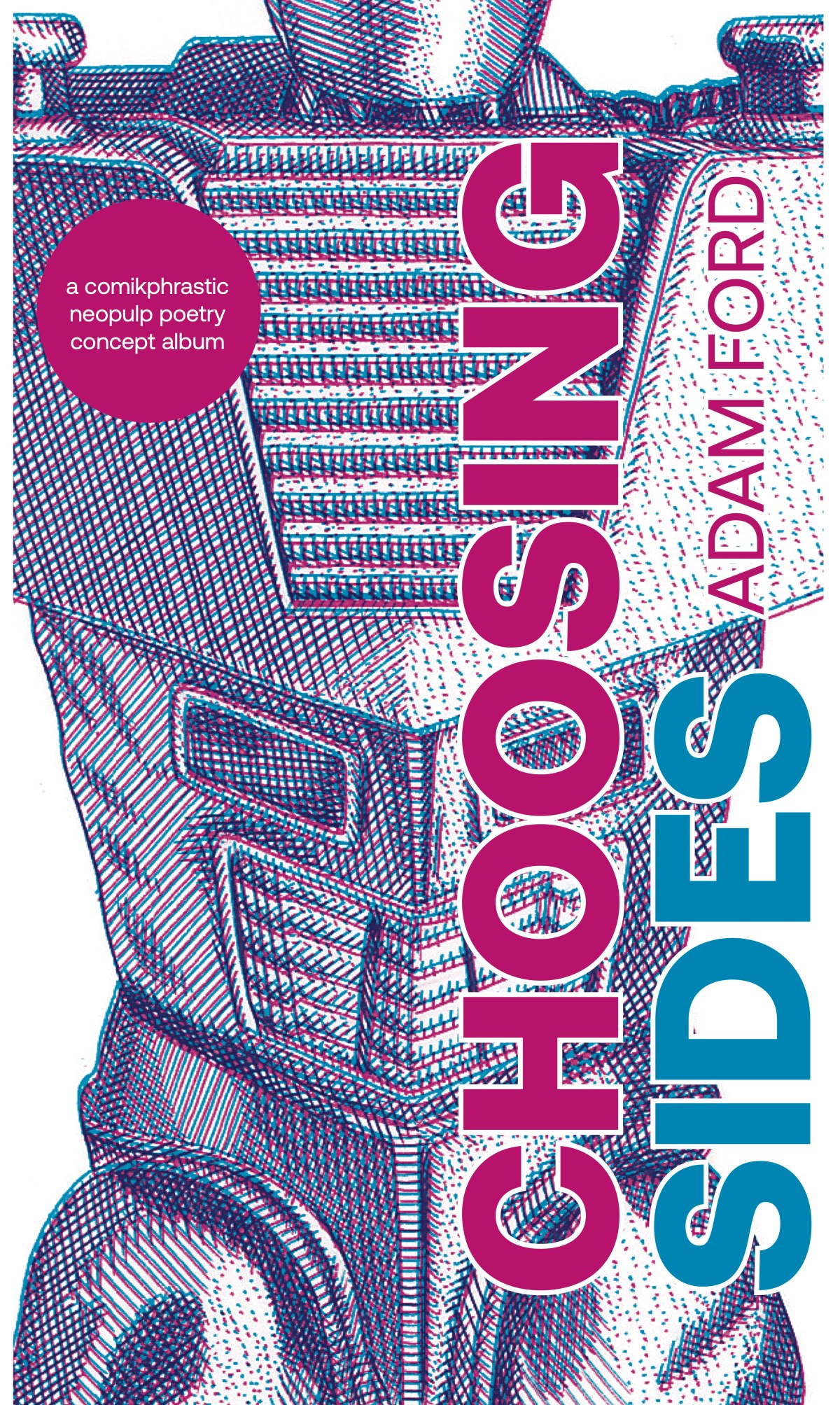
After completing work on a labour of poetic love that saw me write 79 poems in response to each and every issue of the comic book Rom: Spaceknight, I am now on the cusp of bringing a selection of those poems into print as Choosing Sides, a speculative poetry chapbook I am currently running a Kickstarter for to cover production costs

A quick recap: some years back I set myself a sort of morning pages task where I would read a different issue of Rom: Spaceknight, a heavily-B-movie-influenced 1980s superhero comic, for 79 days (one day for each issue of the series), then write a poem about that issue and then publish each poem online as it was written. You can read more about the project in my previous blog for Asimov’s.

Long story short: I did it. But after I had tidied things up and honed those 79 poems into a 33-poem draft manuscript I was faced with the question: How do I turn this manuscript into a book?

I’m not saying what follows is actually the answer to that question, but here’s what came next for me.

1. Pitch it

The logical first step was to find a publisher. My approach to this involved sending poems to journals while also sending the full manuscript out to publishers.

I had some success placing poems in journals including Strange Horizons, Star*Line, FreezeRay Poetry, cordite and the wonderful Asimov’s Science Fiction. But while journals were quite welcoming, finding a publisher for the manuscript was harder.

I searched online for journals and publishers and made a list of ones that seemed a good fit in terms of aesthetics, poetics and the work they published. Here in Australia there isn’t a lot of awareness (or publication) of speculative poetry, so I extended my search overseas. For whatever reason, the field is much more fertile in the US. My research identified about half a dozen publishers in Australia, the US and the UK, a mix of speculative publishers and poetry publishers who seemed inclined toward experimental writing.

I sent the manuscript out one publisher at a time. Often it would take months, sometimes even a year to hear back. Responses ranged from “this sounds interesting” and “thanks for letting us read your words” to “we only publish a few books a year, which limits our acceptances” and the occasional “actually we’ve decided to shut the press down because it’s so much work and we’re really tired”.  

One publisher even said, “we liked it but decided it was too niche for us,” which felt like an achievement. When an independent Australian publisher of small runs of poetry collections calls your writing “niche”, it makes you stop and think. Part of me wondered if it was a front cover blurb in waiting: “TOO NICHE FOR US—[name redacted]”

2. Give up

Persisting in the face of well-meaning rejection is exhausting. I had often wondered if my attempt to smash together the joys of pulp science fiction tropes with the precise language and deep personal insights made possible by the poetic form was something nobody but me wanted. Two years of thanks this is lovely but not for us was starting to make the answer seem like ‘quite possibly’.

When the next kind-worded rejection landed, I ran out of puff. I decided to stop sending the manuscript out. I still liked the poems, but my failure to get anyone else to like them enough to publish a book of them made me seriously consider packing the book away and finding something else to write about.

Around that time I caught up with some poet friends at a book launch. It doesn’t take poets long to get to the “are you working on anything?” part, and it wasn’t long after that I was telling a dear old friend about my decision to ditch the manuscript and my feeling that I had made a mistake spending so many years on it.

She listened quietly until I didn’t have anything more to say. The story told, we joined the rest of the launch celebration and talked about other things. For the rest of the night, though, and a long time after, I couldn’t stop thinking about how my story had seemed to make my friend really sad, and how sad that telling it had made me, too.

At first I had thought I was sad because I made my friend sad, but I realised that was only part of it. I also realised I wasn’t sad because I’d taken an artistic gamble and failed. I was sad because I was giving up on the book I’d worked on so hard for so long. That sadness was telling me something: I wasn’t ready to give up. And if I wasn’t ready to give up, I would have to make the damn book myself.

4. Self-publish

Confession time: I’ve actually got a lot of experience making books. I’ve worked as a book editor. I’ve edited and published literary journals. I’ve been making zines for decades. So I know how to put a book together. I also know how much effort it takes. That’s why had been keen for someone else to publish my book. But since no-one seemed to want to make it for me, it looked like it was going to be me after all.


Persisting in the face of well-meaning rejection is exhausting. I had often wondered if my attempt to smash together the joys of pulp science fiction tropes with the precise language and deep personal insights made possible by the poetic form was something nobody but me wanted.


Most of the times I’ve worked in publishing I’ve been on the editing side of the room. The part of making books I have the least experience with is working with printing companies. Fortunately, a comic artist friend had recently run a successful crowdfunding campaign for a comic about AI and art, and was happy for me to pick his brains (i.e., steal his ideas). His comic ended up being a lovely thing to hold in hand, and he was really happy with the printer he’d worked with. I asked him to pass on the printer’s details and got in touch.

Whenever I don’t know how to approach something that involves working with other people, I just come clean about my ignorance and ask a lot of questions. I sent the printer an email that basically said “me poet help make book you how”. They were incredibly helpful, showing me how to prepare a request for a quote they could respond to. They also explained how to prepare a design-ready layout they could work with that would take full advantage of their printing services. So I got the quote from them and I was on my way.

The rest of the production process was more familiar territory, which also involved reaching out to friends and colleagues for help. I hired a friend who is an experienced book editor to proofread the manuscript. He is also a manuscript reader, and offered some good suggestions about the structure of the book as well as checking for typos and consistency.

I reached out to another old friend who is a beautiful pen-and-ink illustrator and proposed commissioning a cover and some interior illustrations. To my joy he agreed and we spent a fun few months back-and-forthing over his illustrations of action figures and toy guns before we settled on something we were both happy with.

Finally I hit up my brother, a book designer and art director, to pull everything together into a print-ready design file. And with that, the book was ready to be made. The only thing missing was the money to pay the printer.

4. Find the money

Not done with stealing ideas from my comic artist friend, I yoinked his crowdfunding plan as well. Based on the quote from the printer and the costs of the cover and proofreading, I set up a campaign on the same crowdfunding website my friend had used. I kept things simple, mainly offering one or more copies of the book, with a couple of hail mary pledges for people to commission a poem or host a private reading from the book.

Assembling the pieces and parts of the campaign was straightforward, though it took a bit of time. The written pitch was easy, and setting up the site was easy too—the website gave good guidance. The sticking point was the video pitch, which took a lot of stuffing around to get recorded and edited in my spare time on my bodgy laptop using a free open source video editor called OpenShot (recommended) and the minimal skills I could remember from a course I’d done ten years earlier. But I got there in the end and the campaign was built. The final step was to submit it for review before going live. This is where things got a little weird.

The crowdfunding site offered a critical review of your campaign and advice about improving it. My comic artist friend had spoken highly of the advice he’d been given, so after submitting the project for approval and getting the green light, I signed up for an online consult.

Life being what it is, the day of the consult arrived and I almost forgot about it. I logged on five minutes late and wasn’t surprised when nobody was there. I emailed an apology and rescheduled the meeting, booking an appointment an hour after the one I missed. But when I logged in again, nobody showed. I contacted the company to apologise again and ask for the best way to reschedule. I waited a week for a reply.

While I was waiting, I looked over the website more closely. Most of the projects on their homepage were from a while back. I couldn’t find one less than 12 months old. Something was going on. My gut told me it was quite possible the company had quietly collapsed without decommissioning its website or any of its automated processes. I reached out to another friend who’d run campaigns on that platform and asked if he thought I was reading things wrong. He took a look and came back saying, “Yeah that doesn’t look so good.”

With no reply forthcoming and nothing concrete eventuating from my online searches for the fate of the company, I decided to find another crowdfunder and avoid the risk of running a campaign through a zombie website. I copied all of the bits and bobs I’d made across to Kickstarter, a larger and more well-known outfit that was definitely looking like a going concern.

It was easy to rebuild the campaign and send it for approval. Until I hit another snag. Kickstarter told me my use of the word “preorder” was against their policies. Because they don’t guarantee the success of any campaign, and because things don’t happen unless you meet your funding goal, technically if someone pledges to help me make the book, they’re not preordering it because if the campaign doesn’t succeed, they won’t get the book. It’s a fair point.

Revising the written part of the campaign was easy enough, but I had also said the word “preorder” about half a dozen times in the video. I had struggled to put the video together, and the prospect of going back and changing something so hard-won was daunting. After a bit of procrastinating I sucked it up and managed to chop out most of the p-words without massacring the video, though I ended up having to re-record the intro.

Edits done, I resubmitted the campaign and got the green light within 24 hours. I had given myself 60 days to raise the funds I needed, so it was time to press the start button and get hustling.

5. Do the hustle

As of this writing there’s about two weeks left in this eight-week campaign. Most of my promotion over the last six weeks has been online in the form of project update videos and on-camera readings from the book shared on Facebook, Instagram and Bluesky to reach a mix of friends, fellow poets and fellow nerds.

I’ve also been reaching out to the people who were supportive of my Rom poem project back when I was writing and posting them online, asking them to help signal boost the campaign. I’ve designed and printed promotional postcards, handing them out to friends and leaving them in cafes and bookstores (and the occasional bus stop). I’ve tabled at book fairs, read from the book at poetry open mics and appeared on my local community radio station. And throughout the whole thing I’ve been checking and refreshing my inbox and my DMs and the Kickstarter page every hour on the hour.

It’s exhausting—a fluctuating mix of desperation, elation, despair and hope. Every time someone pledges it’s a kick in the pants. The Scylla within my amygdala says This could actually happen. Every day that the number of pledges stays the same is the other kind of kick in the pants. The Charybdis in my frontal cortex says What are you wasting everyone’s time for?

Somehow I’ve managed to navigate between those extremes (so far) and I’m still standing (so far). I attribute that to the fact that everyone I have asked for help has been amazing. This whole project has reminded me that artistic projects are collaborative projects, and the joy that comes from collaborating with talented and generous people is maybe even the whole point of this kind of thing.

I think the term “self-publishing” is a misnomer. It’s not really something you do by yourself, because in all honesty you can’t. You can’t do it alone, because if you look around you, you’ll realise you’re not alone. You’re surrounded by talent and good will. We all are. That’s the thing that keeps me going.

6. And then…

As of this writing I am 39 per cent of the way toward the funding goal, with 15 days to go. There’s no guarantee I’m going to cross that finish line, but even if I don’t this has been a fulfilling experience.

Having to go to bat for my own writing despite the self-doubt and the generally-stacked-against-you-odds that come with trying to get poetry published has been a hell of a learning curve. I’ve honed my self-promotional skills, worked out how to look at my own work critically, made creative connections and met people who are fans of poetry or speculative poetry or Rom the Spaceknight or comic books (or even, sometimes, if I’m being honest, fans of me).

I may not know what the future holds for my book, but if I look back on its past, there’s a lot I’ve enjoyed and a lot to be proud of and a lot of people to thank for their support.

And if you think Choosing Sides sounds like a book you’d like to hold in your hands one day, I would love it if you helped to make that idea a reality by visiting the Kickstarter page before the campaign finishes up on October 30.

Lastly, thank you for reading this. I wish you all the best for your own creative ambitions. May they come to fruition in the way you desire with however much help and in however much time they need.


Adam Ford is a poet living on unceded Djaara Country in south-eastern Australia, in the former mining town of Chewton. He is the author of the poetry collections Not Quite the Man for the Job and The Third Fruit is a Bird, the photoromance zine Science Fiction Barbarians in Love and the online geohistorical spoken word walking tour Dance to the Anticlinal Fold.
Alex Jablokov on “The Last of Operation Shroud”

Find out how a rediscovery of a lost WWII-era bomb helped inspire Alex Jablokov’s latest story, “The Last of Operation Shroud,” now available in our [Sept/Oct issue, on sale now!]

Unlike some of my stories, “The Last of Operation Shroud” has a specific moment of genesis: a story in the New York Times about the discovery of an unexploded WWII munition at the bottom of a canal in northwestern Poland. It turned out to be a British bomb called a Tallboy, a powerful five-ton bomb designed specifically for hitting difficult high-value targets. Tallboys were used to destroy V-1 and V-2 launch sites during Operation Crossbow.

Tallboys were also used in a raid by specially modified Lancaster bombers to sink the German cruiser Lützow, which was holding up the Soviet advance along the Baltic coast, in the last weeks of the war. The raid succeeded in sinking the cruiser, but one bomb’s short-delay fuze failed and it ended up deep in the mud of the Piast Canal, where it stayed, undetected, for 75 years, until a dredging operation revealed it.

Polish divers attempted to defuse the bomb, but it eventually had to be detonated, throwing up the dramatic column of water in the photograph that initially caught my eye.

So that was my initial image: a concealed, unexploded munition, long forgotten. I knew that it concealed more of a secret than it originally appeared, and that the ship that had been its target also held a mystery. Unexploded munitions are a danger wherever there has been combat, the danger can remain for an astonishingly long time. Live WWI shells turn up in French fields, over a century on. The violence of combat still lurks beneath the leafy countryside, and its victims are innocent people going about their daily lives . . . or children who just want to play in the woods.

And I had my character, a veteran of the operation that destroyed that ship, one more difficult and complex than the one that sank the Lützow. She has returned to learn what actually happened during that mission, dealing the complexities of postwar attitudes in the country, not her own, where much of the war was fought, and the ship was sunk. And I knew she had to encounter the bomb disposal expert who was looking for the same thing.

Tallboys are a weapon with a kind of dark charisma. They were invented by the engineer Barnes Wallis, best known for the bouncing bomb used to destroy the Ruhr dams during the Dambuster raids of Operation Chastise in 1943. Among other targets, Tallboys were also used to destroy a vessel much larger than the Lützow: the Bismarck-class German battleship Tirpitz.

It took years, and multiple attempts, before late in 1944 the RAF succeeded in sinking the Tirpitz where it was concealed in a Norwegian fjord. One way it survived was by concealed itself beneath a cover of chopped-down trees and clouds of chlorosulphuric acid. That artificial fog damaged trees in the area, with damage detectable in the tree rings. That kind of damage also still remains, and affects how things grow, most of a century later.

That gave me something my main character to look for, a way of detecting where the operation had taken place, the operation she no longer remembers: what it did to the trees.

The other person she encounters, the bomb disposal expert, is tracking parts that came from the bomb, inspired by the Tallboy, that was used here. To understand how she might be trying to figure out where what she is looking for might be, I researched conflict archeology and conflict-landscape studies. These fields started with the structures and destruction of WWI combat, then evolved to be able to analyze the remains of the more mobile warfare of WWII, and have moved on from there. Studies of the Polish Kozle Basin, with its 6,000 preserved bomb craters, and of the Kall Trail and Vossenack Ridge in the Huertgen Forest, on the German/Belgian border, proved particularly useful for understanding what remains after combat.

I also learned how quickly many dramatic and violent events are forgotten. Their physical traces become keys to understanding what the participants experienced.

In developing the actual ground-level part of the operation to sink this particular ship, I was inspired in part by 1942’s Operation Frankton, where British Royal Marines used folding kayaks to attack cargo ships docked at Bordeaux with limpet mines. Poor planning and a lack of coordination with another service’s mission to accomplish the same goal, led to the deaths of most of the men on that mission.

Each piece of research took me back to the story with another view of how past and present relate. I wanted the landscape to feel something like the mixed forests of the south Baltic coast, a place I have never been, save through Google’s Street View. The countries are not real, but I like to feel that the people are.

Which brings me back to Barnes Wallis, a fascinating character whose first great design, long before the various bombs of WWII, was the airship R100, in 1930. When its competitor, the R101, crashed in a field in France, killing almost everyone aboard, the British government abandoned serious airship development—though by that point it didn’t make any sense to proceed any further down that path. This just goes to show that not all the research behind a story should make it into the story, but while my bomb designer is not Barnes Wallis, he clearly is inspired by him.

The characters are what is important, but they need a world to live in. I hope you enjoyed watching me dig through my research notes and documents—its own form of archeological research—to remember how that world came together.


Alex Jablokov’s short fiction has appeared in a variety of magazines over the years. The braided novel Future Boston, containing a number of his stories, some of which also appeared in Asimov’s, has recently been reissued by Fantastic Books (www.fantasticbooks.biz). He acknowledges the invaluable assistance of the members of the Cambridge Science Fiction Workshop and the Rio Hondo Writer’s Workshop in improving this story. In his new tale, we see that the remnants of war can remain actively deadly long after the war itself seems over.

Q&A With Ted Kosmatka

Two-time Readers’ Award winner Ted Kosmatka returns to Asimov’s with”The Signal and the Idler” in our [Sept/Oct issue, on sale now!]. In our latest Q&A, learn all about Ted’s creative process along with how his mother inspired him to write.

Asimov’s Editor: How did this story germinate? Was there a spark of inspiration, or did it come to you slowly? 
Ted Kosmatka: The whole thing started as a thought experiment that for a long time I had no idea how to write. All I had was this strange little extrapolation from quantum mechanics that I kept getting tangled up in. You can have a cool scientific idea in your head, but translating it into a story that someone will want to actually read is a totally different problem. In a weird way, sometimes the more excited you are by an idea, the harder it is to write the darn thing, because then you have to write a story that lives up to the idea. Eventually, you’ve got to just start typing hope for the best, so that’s what I ended up doing with this one. It was in my head for a couple years before I managed to write it.  

AE: Is this story part of a larger universe, or is it stand-alone?
TK: I’ve actually been wondering that myself lately, as it occurred to me that this story might be in the same universe as a couple other things I’ve written. My old Asimov’s story, “The Bewilderness of Lions” in particular might be circling around the same set of invisible antagonists, if I squint and think about it too long. But I’m not sure. If I ever expand this story into something longer, I guess I’ll get to the bottom of it.

AE: What other careers have you had, and how have they affected your writing?
TK: I’ve had a bunch of jobs over the years. Everything from corn detasseling, to kennel cleaning, to truck stop dish washer, to zookeeper, house painter, math tutor, you name it. The first job where I can remember having health insurance was as a laborer in the blast furnace department at LTV steel. I started off shoveling coke and sinter onto conveyor belts. That job saved me. I eventually became a sampler, and then a tester, working my way up to using this ancient Russian spectrograph machine that broke down all the time. When the company went bankrupt, I found my way into the chem lab at US Steel, and then eventually into a research lab where I got to work with electron microscopes. Later, I started selling stories and moved across country to work in games.

AE: What is your history with Asimov’s?
TK: I started reading Asimov’s magazine as a kid, since my mother had a subscription to it, so that was really my introduction to science fiction and reading in general. Eventually, we also got subscriptions for Analog and F&SF, so between those three magazines, I had access to a pretty steady diet of great stories growing up. Later, after years and years of trying, Asimov’s ended up being my first professional story sale, and I’ve been sending stories there ever since. I used to joke that I could wallpaper an entire bathroom with all the rejection letters I received before making my first sale. I still have a whole drawer full.


You can have a cool scientific idea in your head, but translating it into a story that someone will want to actually read is a totally different problem. In a weird way, sometimes the more excited you are by an idea, the harder it is to write the darn thing, because then you have to write a story that lives up to the idea.

AE: How much or little do current events impact your writing?
TK: My stories are usually based around some twist or weirdness in existing science, so current events tend not to figure into things too much for me. Though with that said, AI has sure been bashing down the door lately, pushing me to get on the wrong side of Roko’s Basilisk, so maybe that’ll change. World events seem to be catching up to science fiction pretty quick. 

AE: Are there any themes that you find yourself returning to throughout your writing? If yes, what and why?
TK: For sure, yeah. Every time I write a quantum mechanics story, I think to myself I’m glad I got that out of my system, and then six months later, I am back at it, thinking about some new angle on the subject, so I’ve pretty much realized I’m just going keep writing about quantum mechanics until I die. It’s the mystery that keeps dragging me back. Stories are just a way to think about things and try to impose some sort of structure on concepts you’re wrestling with. 

AE: What is your process?
TK: It seems to change all the time. I work a bunch of hours in my day job, so my current process mostly just involves writing late at night when the house is quiet, if I get the chance. I write more stuff than I ever send out.

AE: What inspired you to start writing?
TK: My mom, for sure, was a big inspiration to me. When I was a kid, she was always writing, along with all the other stuff she had to do as a nurse, raising four children, so it seemed to me that writing was an attainable thing that regular people could chase after. It was normal. My dad was an inspiration, too, in terms of his work ethic, all those years working at the mill. Both my parents worked hard and knew how to put the hours in to chase things they wanted to accomplish.   

AE: If you could choose one SFnal universe to live in, what universe would it be?
TK: That’s a tough question, since a lot of the best sci-fi stories would be nightmarish to try to actually survive in day to day. Difficult scenarios often make the most compelling stories, but you wouldn’t really want to live in those worlds. The universe of Dune is gorgeous, for example, but I’d have to think twice about picking that one, as my knife skills are lacking. Still, I probably would try to pick something that has humanity out in the vacuum, exploring the vastness of space. Battlestar Galactica, is one possibility. Or Ad Astra. Or maybe Foundation, by Asimov.

AE: What SFnal prediction would you like to see come true?
TK: I’d love to see the asteroid belt mined. I’d love to see us get out there and do some of the things I’ve been reading about for so long. The Expanse series by James S.A. Corey is a great bit of storytelling around that idea.

AE: How can our readers follow you and your writing? (IE: Social media handles, website)
TK: You can keep up with what I’m up to by checking out my website at https://tedkosmatka.us.


Ted’s work has been reprinted in numerous Year’s Best anthologies, nominated for both the Nebula Award and Theodore Sturgeon Memorial Award and has twice won the Asimov’s Readers’ Choice Award. His novel The Games was nominated for a Locus Award for Best First Novel. He grew up in Chesterton, Indiana, not far from Lake Michigan.

Q&A With John Kessel

John Kessel was first published in Asimov’s around 40 years ago. Now he returns with “The Ghost,” his latest novella in our [September/October issue, on sale now!]. Read on to find out how a turn-of-the century New Year’s Eve party hosted by H.G. Wells helped inspire this latest work.

Asimov’s Editor: How did this story germinate? Was there a spark of inspiration, or did it come to you slowly?
John Kessel: I’ve always been a fan of the science fiction of H.G. Wells, and became interested in his biography a long time ago. One of my most well-known stories, “Buffalo,” set in the 1930s, has the older Wells as one of the two major characters (the other is my father).
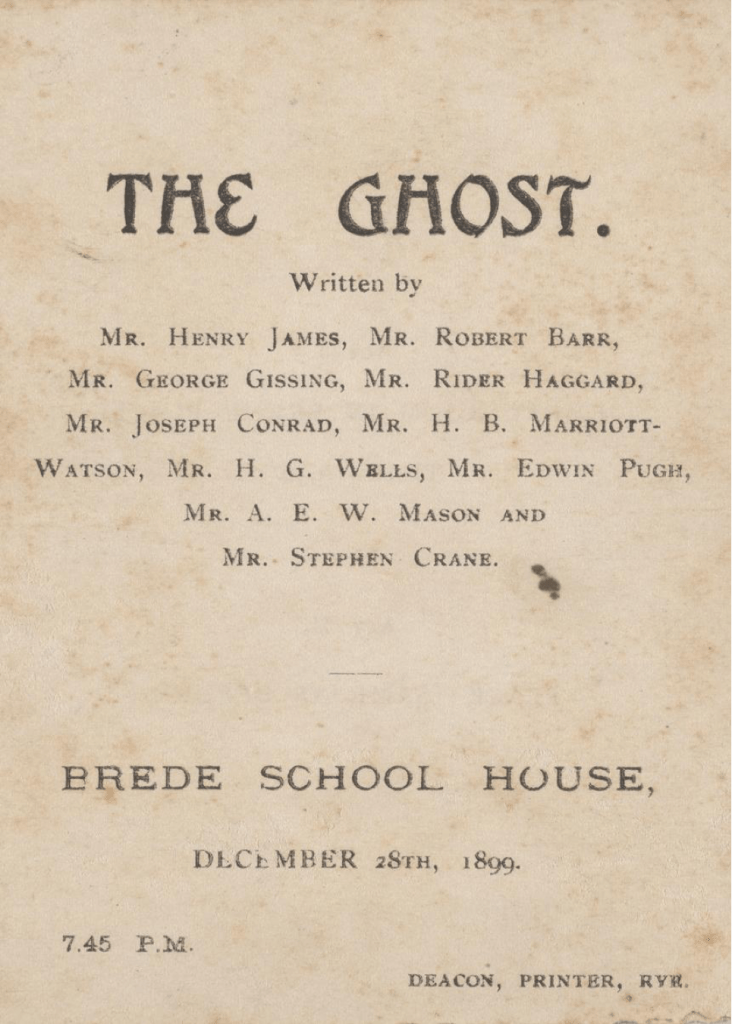
“The Ghost” started when I read that the American writer Stephen Crane, famous for The Red Badge of Courage, lived in England in the last years of his life, and that he and Wells were friends. They seemed like a real odd couple to me. Then I found out Crane threw a big multi-day New Year’s party at the end of 1899 to celebrate the start of the 20th century at a 500-year-old haunted manor house in the south of England. Crane persuaded a remarkable list of writers to contribute to a play, “The Ghost,” that the partygoers would perform for the people of a nearby town. Wells and his wife Jane were a part of all this; the more I learned about it the more I felt there was a story in it.
It took me a long time to find exactly the right story to tell, however. In what way was the house haunted, and who was at risk? It made me think about other stories set in an English manor house where a bunch of privileged people come together for a weekend and end up behaving badly.   

Here’s the first page of the playbill that was printed for the play.

Image

AE: Is this story part of a larger universe, or is it stand-alone?
JK: It’s one of a series of stories set in the first decade of the 20th century that I am writing. One of them, “The Dark Ride,” was the title story of my collection of 2022. All of the stories have some connection to the life and works of H.G. Wells, in particular his 1901 novel First Men in the Moon. I’m interested in the politics of that time, which reflect in some ways the politics of our own: vast inequalities between the rich and the poor, new technologies that were going to transform the next century, the personal struggles of individuals in this context, the efforts of artists like Wells to understand and affect the world. One of the other stories is set during a world’s fair, the Paris exposition of 1900;  “The Dark Ride” describes a “Trip to the Moon” fair ride at the Pan-American Exhibition in Buffalo in 1901, based on Wells’s novel, where the anarchist Leon Czolgosz assassinated President William McKinley. Yet another concerns the French pioneer filmmaker Georges Melies’ 1902 movie “A Trip to the Moon,” which also draws from Wells’s novel.
Eventually I expect these stories to make a book.

AE: What is your history with Asimov’s?
JK: It goes back a ways. Early in my career, in 1984 and 85, I had stories in Asimov’s back when it was edited by Shawna McCarthy, and later by Gardner Dozois, and still later by Sheila Williams.

AE: Who or what are your greatest influences and inspirations?
JK: Among SF and fantasy writers I’ve been affected by a lot of older writers from H.G. Wells to Robert Heinlein to Alfred Bester to C.M. Kornbluth to Damon Knight to Carol Emshwiller to Thomas Disch to Gene Wolfe to Ursula K. Le Guin. A lot of writers who came into the field in the 1980s when I did have had great influence, among them James Patrick Kelly, Karen Joy Fowler, Bruce Sterling, Kim Stanley Robinson, and a dozen others I could name.
And then there are the many writers outside the genre whose work I’ve admired, from classics to contemporaries. I don’t necessarily try to write like them, but I have learned from them, and the work they did has been an inspiration. To name just a few: Jane Austen, Herman Melville, Karel Capek, Raymond Chandler, Nathanael West, Flannery O’Connor, Kurt Vonnegut, Tobias Wolff, Don DeLillo.
I should mention that I have been an avid movie fan since I was a kid, and there are great films and filmmakers that have stuck in my mind and heart. Orson Welles, Preston Sturges, Stanley Kubrick, Akira Kurosawa, Michael Haneke, the Coen Brothers; individual movies from The Day the Earth Stood Still and 2001: A Space Odyssey to The Third Man and Fargo.


I’ve always been a political person who cares a great deal about right and wrong even when those things are not easy to determine, and I think my beliefs have shown up in my work, either through satire or through the fundamental values the stories espouse.


AE: Are there any themes that you find yourself returning to throughout your writing? If yes, what and why?
JK: I’ve always been a political person who cares a great deal about right and wrong even when those things are not easy to determine, and I think my beliefs have shown up in my work, either through satire or through the fundamental values the stories espouse. I try not to write tracts, or to preach. I don’t think there are many characters in my stories who speak for me; in fact, if a character gives a political speech in some story of mine, you can pretty well count on it not to represent my own beliefs. I use a lot of not completely reliable viewpoint characters.
Another area, related to this, that comes up in my fiction a lot is male-female relationships. I try not to approach them from the point of view of a political agenda. I’m more interested in the ways that interpersonal dynamics reflect gender attitudes.
And connected to this are questions of masculinity, which comes up a lot in my stories. What is it that makes someone a man? To what degree are the behaviors that have typically been associated with men, and that society has encouraged—not to say forced—men to adopt, the result of inherent biological inclinations vs. culturally constructed expectations?  I don’t necessarily know the answers to these questions. I look at this from a lot of different angles, ages, and circumstances. I think it’s there in “The Ghost” in the portrayals of Stephen and Cora, H.G. and Jane, though I’m not sure that is precisely what the story is about.

AE: What other projects are you currently working on?
JK: Most of my writing right now is taken up with the story series of which “The Ghost” is a part. I dabbled a bit in recent years in screenplays and writing for TV, but nothing has come of that yet.

AE: What are you reading right now?
JK: I recently read Gregory Frost’s trilogy Rhymer, Rhymer: Hoode, and Rhymer: Hel, and his separate historical horror novel The Secret House (set in the 1840s about the rise of John Tyler to the presidency, in a haunted White House). I like the way these books all use well researched historical material from which Frost creates fantasy and horror. And his characterization is great.

AE: Do you have any advice for up-and-coming writers?
JK: Read a lot, not just in your chosen genre, but every sort of fiction and non-fiction. Try to be a person who has both broad and deep interests. Follow them where they lead you. Be persistent. Try to have fun doing it. Find a way to fit your writing into your life in a humane way.

AE: What is something we should know about you that we haven’t thought to ask?
JK: I am very tall. This has had a significant effect on my life, mostly for good—as a teacher I suspect that I frequently received unearned respect from students just by walking into the room. But it has a downside that most people probably don’t think about, from the unintentional comedy of my using airplane restrooms to the astonishing number of times I have hit my head on things that most people never have to pay attention to: street signs, light fixtures, doorways, car hatches, tree limbs, stairwell ceilings. Ouch. 

AE: What other careers have you had, and how have they affected your writing?
JK: For forty years I taught literature and fiction writing at North Carolina State University. It had a great effect. The works and writers that I taught offered me many examples of different ways to be excellent, in addition to exposing me to material that I have incorporated into my fiction. “The Ghost,” filled with real historical figures and based on real events, is one example of a story that I never would have written if I had not studied literature. And teaching creative writing forced me to think a lot about what makes a good story, the different kinds of good stories, how one constructs such a story, and the subjectivity of standards. Teaching a skill almost automatically hones that skill.

AE: How can our readers follow you and your writing?
JK: I have a (rather dormant) website at:  https://johnjosephkessel.wixsite.com/kessel-website

You’re more likely to learn what I’m up to and what I’ve published at my facebook page: https://www.facebook.com/john.kessel3/

I also have a substack at: John Kessel


John Kessel is an emeritus professor at NC State University, where he helped found the MFA program in creative writing. His fiction has received the Theodore Sturgeon, Locus, James Tiptree Jr./Otherwise, Ignotus, and Shirley Jackson awards, and twice received the Nebula award. The Dark Ride: The Best Short Fiction of John Kessel, was published in 2022, and his collection The Presidential Papers appeared in PM Press’s Outspoken Authors series in 2024. 

Q&A With Leah Cypess

Prolific middle-grade author and Nebula finalist Leah Cypess tells us how her love of historical fiction helped inspire “A Tide of Paper,” her latest novelette, which you can find in our [Sept/Oct issue, on sale now!]

Asimov’s Editor: What is the story behind this piece?
Leah Cypess: This story started as a tie-in story for a book that has (so far) not been published.
Even though I mostly write science fiction and fantasy, I also have another beloved genre, which is historical fiction. Back in 2018, I finished a young adult historical fiction novel about crypto-Jews in Renaissance Venice. That book got me my current agent, but did not, sadly, sell to a publisher.
While researching Renaissance Venice, I bumped into a lot of information about (1) the Jewish printing presses in Renaissance Venice, and (2) the ghost stories that people in Renaissance Venice believed. I wrote several versions of this story, all with Samuel—who is based on a real historical figure—as the main character. Those versions all revolved around his romance with the main character in that YA book. In my final rewriting, I took all of those links out and focused just on Samuel’s personal arc (which also made it a stronger story), and then I sent it to Asimov’s. 😊

AE: How did the title for this piece come to you?
LC: The title, “A Tide of Paper,” is a direct quote from some of the complaints people in the Renaissance made about printing presses. (Fun fact, I actually had two titles in mind for this story, both real quotes from people unhappy with the results of this new technology: A Tide of Paper and An Overabundance of Books. Readers can let me know if they think I chose the right one!)

AE: What other projects are you currently working on?
LC: I’m currently publishing an early chapter book series, Miriam’s Magical Creature Files, with Amulet Books/Abrams. This series is so much fun—I love writing humor, and it is an amazing experience to see a fantastic illustrator bring a book to life! I’m also working on the sequel to my children’s science fiction book, Future Me Saves the World (and Ruins My Life), which was published by Aladdin/Simon & Schuster in June.

AE: What are you reading right now?
LC: I am someone who reads lots of books at once, so this is going to be a long answer! In historical fiction, I’m in middle of The Master Jeweler by Weina Dai Randel, and I also sneaked in the first few chapters of The Boy with the Star Tattoo by Talia Carner. In SFF, I just started an advance copy of The Philosophy of Thieves by Fran Wilde. I also read middle grade—partly because I write middle grade, partly because I just like it!—and so I also just started The Secrets of Lovelace Academy by Marie Benedict and Courtney Sheinmel.

And in non-fiction . . . no, just kidding, I think that’s enough.

AE: How can our readers follow you and your writing? (IE: Social media handles, website URL . . .)
LC: My website, which I update frequently (and where you can sign up for a new releases only newsletter), is www.leahcypess.com. Currently I post about books, scenery, and sometimes food on Instagram and Facebook, in both places as Leah Cypess.


Leah Cypess is the author of the middle grade series Sisters Ever After, the early chapter book series Miriam’s Magical Creature Files, and the middle grade book Future Me Saves The World (And Ruins My Life). Leah has also written four young adult fantasy novels and numerous works of short fiction. She is a four-time Nebula Award finalist and a World Fantasy Award finalist. You can learn more about her and her writing at www.leahcypess.com.