(Welcome
Tim Worstall &
OC Chronicle blog readers. If you have seen other links to this blogpost, please let me know. I'll leave the post up until Friday)
(And a very belated welcome to the readers of the
Anchoress, who featured on her blog, the blogpiece you will read below, on 2 August 2005)
If Pope John Paul II had lived exactly
2 years and 14 days more than what he did, we would never have heard of Joseph Cardinal Ratzinger's transformation into
Pope Benedict XVI. He would've been disqualified to vote for the new Pope, and thereto, perhaps to be Pope due to being 80 years old.
A pretty sobering fact when put that way, isn't it? As I said earlier,
timing is everything.
It struck me as I watched his recent
Installation this Sunday as Pope, of which this is a blog recap, but not only of that majestic ceremony, but of the almost month-long treatment of the illness, death and funeral of the late Polish Pontiff, and thereto Conclave, Election, and Installation of the new German Pope.
As you have no doubt noted, this seminal event made a tremendous impact on my daily life, and though I am loath to leave it entirely, my personality, of which my blog is a reflection, is too eclectic to sustain one topic for too long. So it's time to move on.
But not before I conclude with a rather long, but I hope, guilessly transparent wrap-up.
BACKROUNDIf you're like me, you wonder why certain things happen in life -- such as why we meet the people we do, of all the people, of all time that we could have met, millions and millions of years, billions and billions of people, and you got to sit next to stinky Sherman Kaplan in Brooklyn during all of 3rd grade.
This is mindboggling to me. God may not play dice, but grade schools certainly do.
A lot of people attribute these events to the mysterious and unknowable mind of God, whose ultimate plan for the history of the world will presumably not be revealed until the moment of the earth's extinction, and therefore ours. It's a heady thought, since it's a
nirvana which may last a second only.
But quick as a flash this past Sunday, I felt for a brief moment that I had peeked into the mind of the Deity. Ah, vanity - thy name really is woman.
Let me walk you through it.
COVERAGEI'm tired of moaning publicly of the treatment given this nascent Papacy by Mainstream Media. You can read what I have to say about that
here,
here and
here. Such moaning hasn't been heard without Ron Jeremy being present, in years.
Since I've been quick to assign bias to MSM, let me also be brisk in heaping praise where it's due.
If you were privileged to watch the Installation on
CBS, a network I usually dislike, you were lucky to witness Canadian journalist John Roberts (in sporting terms, the "play-by-play" guy), and guest analysts Fr. John Robichaud (the "colour" guy), Msgr. Robert Wister (the sideline "mic guy"), and CBS Rome/Vatican beat reporter, Allen Pizzey (the "suit").
Their coverage was
exceptional. I cannot state that enough.
They were able to combine objectivity with deference, interest without fawning, secularism with religiosity, in a way I have rarely seen on American media.
But the highest praise must go to the
lady translator, who seemlessly wove her voice with that of the Pope's during his dazzling
Homily. What a voice. What delivery. What depth of feeling.
As her voice broke during one passage, I felt tears come to my eyes, so completely and startingly overwhelming me, that I had to catch myself, as one would during a weepy in the cinemas.
I haven't found out who that lady was yet, but I owe her the sense of closure I feel today about the whole event, since it was partly due to her mellifluous voice that I feel, "it's enough". It often happens that way, as tears can be cathartic like few things can.
AUDIENCEI am an observer of the scene, and as such, I tend to focus on little things, on the inconsequential details of life. I am in love with descriptions, which simply add colour to the world around us, but they don't amount to a hill of beans otherwise.
For those of you who remember my "
Christiane Amanpour was the only news network reporter wearing all-white on the day of the Pope's funeral; everyone else was in deepest black" observation, you'll instantly recognise what I mean by this above.
(As an aside, ole Christiane was one of the few wearing deep black for the Installation, as if she were in mourning. Odd that)
So in this vein, some of the details I observed were:
- Prince Philip, the Duke of Edinburgh, born 1921, and thus only 1 year younger than the late Pope, represented the Queen at the ceremony. He looked, as ever, handsome, elegant, and quite uninterested in the goings-on.
- The King and Queen of Spain have now taken the reins from the British Royal Couple as far as social cachet is concerned, and are the guests of honour which all eyes focus on in these events. The Queen was wearing her usual towering Peineta (ornamental comb) and Mantilla (lace veil), in radiant white, signifying the end of official mourning for John Paul II. They were the ones who everyone wanted to shake hands with and talk to. The Queen was also seen reading the translation of the Homily with avid interest, never once lifting up her head to gape around her, like the King did.
- The Grand Duke and Duchess of Luxembourg were the other highest ranking members of a ruling family there, as Prince Albert II of Monaco's reign is too young for consideration, and the King of Sweden is Protestant. Maria Teresa, the Grand Duchess, was born in Cuba, and exiled as a child to Switzerland. She was also dressed in white, with a more discrete veil than Queen Sofia's, but well turned out in Oscar de la Renta nonetheless.
- Fr. Georg Ratzinger was not seated with the governing VIPs, but rather in the first row of the Roman Catholic Church VIP section, slightly to the right of the grandstand. I don't know if you've noticed this, but every time I see him, he looks resentful to the point of jealousy of his brother, and when the new Pope got into his new, open-air PopeMobile at the end of the ceremony, he barely clapped at him going by. When asked what he would say to the Pope upon meeting him after the ceremony, he said, "For his direct telephone number". I think the Castel Gandolfo operators would put him through to be honest.
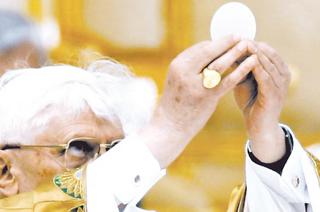
And finally, I've now seen the Pope several times. Enough to say how sweet, retiring, and shy he is -- and very genuine.
He laughs during his speeches, he shyly acknowledges cheers, looking a bit disconcerted at all the fuss about him, and he also uses his hands a lot, in that South German way which Italians will love, especially during his Homily. By the way, he has the hands of a banker: smooth, unlined, lily-white.
That enormous
Papal Ring seemed to fall off his feminine tapered fingers.
Though I haven't been able to find the official invited guest list for the Installation, I note that at least Gerhard Schröder and wife could make it, and though, as I saw on MSNBC immediately after his PopeMobile ride, they were the first to greet him in the conga line of dignitaries, Schröder looked decidedly uncomfortable, and gave the Papst the merest of moments of his time. His wife was a little more enthusiastic, at least. Here's the
full-funeral attendees list on Wikipedia.
THE HOMILYWas a masterstroke.
Once again you got the sense that this Pontiff writes his own speeches, because it conveyed his particular personality without sounding forced: erudite, philosophical, a past master of Church customs and doctrines.
Once in a lifetime, you sit down to write everything which has been percolating inside you your whole life. You unite all that you have learned, and join that to all you believe in.
And when that happens, you get a genius of a written piece. This is what the Homily sounded like.
It's not easy to condense 35 minutes of a speech (of which there were over 30 pauses for applause, really quite extraordinary when you think of it), but here are some of the finest phrases I remember, with my comments in between them.
They are very much the
Holy Father's Highlights.
"And now, at this moment, weak servant of God that I am, I must assume this enormous task, which truly exceeds all human capacity. How can I do this? How will I be able to do it?"
He opened his speech in exactly the same tone with which he used during John Paul II's funeral homily -- in that
coversational tone which strips away pretentious jargon, and reaches in deep inside you.
For anyone who has been a public speaker, you know this is a very difficult thing to do: to personalise yourself to your audience by lowering that unseen curtain which separates you from your listener.
He achieved this by a simple rhetorical device, as if speaking aloud more to himself, than to anyone specific. Magnificent.
"Yes, the Church is alive – this is the wonderful experience of these days. During those sad days of the Pope’s illness and death, it became wonderfully evident to us that the Church is alive. And the Church is young!"
He shouted "giovane!" and the rows and rows of youthful observers let out a huge cheer of surprise.
Yes, that is the one thing we all of us took away from this month-long Catholic orgy. The Church may have retreated in the 1960's-1970's, but here come the Millenial Generation, who grew up under John Paul's ministry.
The final chapter hasn't been written on the Catholic Church, yet. I suppose this is what so many who wish it had, resent.
"At this moment there is no need for me to present a programme of governance."
Another loud cheer from the crowd. Smart move. This is the part which the press is dying to hear, because then they can lynch him like they do politicians. They attack their specific "points of light".
So instead of dogma, he gave us divinity. How certain people must hate him for not falling into their traps so early.
"The first symbol is the Pallium, woven in pure wool, which will be placed on my shoulders. [..], may be considered an image of the yoke of Christ. [...] The symbolism of the Pallium is even more concrete: the lamb’s wool is meant to represent the lost, sick or weak sheep which the shepherd places on his shoulders and carries to the waters of life. [...] The human race – every one of us – is the sheep lost in the desert which no longer knows the way."
His knowledge of Catholic traditions and customs is so deep, that he can synthesise them in simple visual language, ex-professor that he is.
But more than that, as you can see below, his vision of his faith is
layered. Deeply layered. And he's not afraid of uncovering those layers, as he unveils them step-by-step to you.
"...so many people are living in the desert. And there are so many kinds of desert. There is the desert of poverty, the desert of hunger and thirst, the desert of abandonment, of loneliness, of destroyed love."
You could hear the audience gasp when he got to "desert of destroyed love". What a haunting vision that is. The kind of love that you feel when there's nothing left to be said anymore.
"The symbol of the lamb also has a deeper meaning. In the Ancient Near East, it was customary for kings to style themselves shepherds of their people. This was an image of their power, a cynical image: to them their subjects were like sheep, which the shepherd could dispose of as he wished."
A
frisson from the King of Spain, I thought.
"When the shepherd of all humanity, the living God, himself became a lamb, he stood on the side of the lambs"
This is it, really. This is what Jesus represents. One of us. And like one us, he died powerless, just like we would in that situation.
"How often we wish that God would make show Himself stronger, that He would strike decisively, defeating evil and creating a better world."
How many of us didn't utter that during the awful Tsunamis this past Christmas? Or when we read of the Holocaust? Or when you see a child born blind? All of us have at one point questioned why does God allow that, and why doesn't he do something about it?
"All ideologies of power justify themselves in exactly this way, they justify the destruction of whatever would stand in the way of progress and the liberation of humanity. We suffer on account of God's patience."
Harsh.
"At this point, my mind goes back to 22 October 1978, when Pope John Paul II began his ministry here in Saint Peter’s Square. His words on that occasion constantly echo in my ears: “Do not be afraid! Open wide the doors for Christ!” The Pope was addressing the mighty, the powerful of this world, who feared that Christ might take away something of their power if they were to let him in, if they were to allow the faith to be free. Yes, he would certainly have taken something away from them: the dominion of corruption, the manipulation of law and the freedom to do as they pleased."
As he said this passage, CBS split-screened the fabulously younger, vigourous John Paul II giving his Homily that October day, with his papers shaking as he shouted,
"NON AVIATE PAURA". DO NOT BE AFRAID.
John Paul II made people less afraid, and that's why they loved him, and some feared him so. They were so afraid of his strength to free people from their mental prisons, that they tried to kill him.
"The world is redeemed by the patience of God. It is destroyed by the impatience of man."
An anti-war crowd nod, but equally, it could signify our hastiness in all facets of life, before we know their consequences.
"God, Who became a lamb, tells us that the world is saved by the Crucified One, not by those who crucified Him."
And this is the most important of all the quotes, since it implicitly asks you:
Who do you want to be associated with? Those who believe in love, gentleness, abnegation, or those who believe in lies, power, and fear?
"We are not some casual and meaningless product of evolution. Each of us is the result of a thought of God."
I'm sure the secularists of this world must be seething at this not-so-veiled anti-evolution, pro-life message.
"And the account of the 153 large fish ends with the joyful statement: 'although there were so many, the net was not torn' (Jn 21:11). Alas, beloved Lord, with sorrow we must now acknowledge that it has been torn! But no - we must not be sad!"
He acknowledges that the Church has its problems, and it has reached mass exodus in some areas. But nets can be mended.
"Are we not perhaps all afraid in some way? If we let Christ enter fully into our lives, if we open ourselves totally to him, are we not afraid that He might take something away from us?"
How haunting.
This is what all post-modern people, myself included, feel about rules and regulations: that it takes away your freedom by imposing limits to it. And we're just too used to having them.
"Are we not perhaps afraid to give up something significant, something unique, something that makes life so beautiful? Do we not then risk ending up diminished and deprived of our freedom? And once again the Pope said: No! If we let Christ into our lives, we lose nothing, nothing, absolutely nothing of what makes life free, beautiful and great."
I can't believe how honest he is. And how he answers his own question by giving us strength through our choice, if only we make it.
HESITATIONYou know...after a month-long reassertion of what it means to be the Catholic Church, its mesmeric traditions, its grandiose liturgy, its vestments of Cardinals, its drama of ritual, its plethora of red sashes, curtains, balconies, litanies, gospels, cantors, on and on and on, in an assault of the ancient into the ultra-modern, I'm a bit scared.
Scared people will go to their Churches next Sunday, maybe some after a decades-long absence, recharged and perhaps a bit curious, wanting to prolong that feeling of purpose they felt after a month of in-your-face-Catholicism, and expect this:
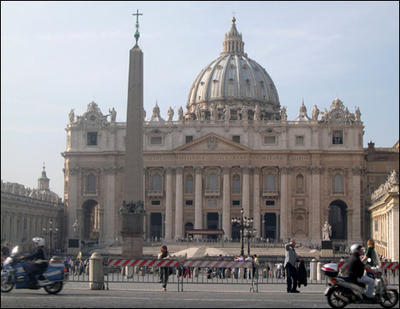
And get this.
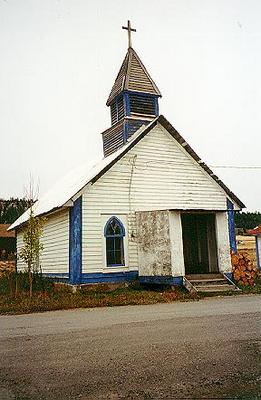
Unless the Vatican happens to be your parish, temper your expectations.
The litany may not be sung, especially not in Latin. The priest may not be kindly, and in fact, may be rather stern. Worse, he may be boring. And the vestments and rituals may conform more to practical local custom, than to the glorious pageantry we've just witnessed.
Each one of us must face the
reality of our churches, but knowing that for 400 years, there is a St. Peter's which awaits us when we grow weary of the drabness.
FEARSWhy are we afraid of Benedict XVI, then?
Well to some he must be the worst incarnation of everything they thought they had defeated, or had been discredited in some way.
Tradition. Austerity. Self-control.
Where some offer judgementless self-help, he counters with intellectual spirituality.
Where some suggest primacy of the communal, he reminds us of the singular path to faith.
And where some want to have validated their philosophies, their achievements, their world views, he makes them realise they haven't achieved as much as they thought.
Worse than that, their prime of life is slipping away before they have had a real chance to change things. To reform, to reinvent, to make their own. It's clear to them, their window of opportunity is being shut. For the Me-Generation, he represents the ultimate They. The They long-since thought overcome.
MESSAGEIt's difficult for me to write what I did above. I'm not religious. I don't know much more than the catechism I was taught for my First Communion and Confirmation. And I am not an historical apologist for the Church.
Even worse than all this is the evangelical zeal I feel is at the root of all Christianity, which needs to proselytise to gain converts. In fact, it's a prerequisite to be and stay a Christian.
I am simply too modern, and too set in my ways, to want to make others adhere to new ways.
I feel the imposition that they feel when people are preached at, and it bothers me. I could never, in this case, be a
Born Again Christian, even if I had a religious transformation.
In short, preaching makes me shy, embarrassed, awkward.
But once in a blue moon, as I have done this past April, I am alive to the possibilities of my faith.
The kind of renewed interest you have when you meet an old friend after a long absence, and discover something new, perhaps a hitherto unknown area of interest which you can share now.
This is how Pope Benedict XVI makes me feel.
Some people would have been comforted with any choice the 115 Cardinals had made. Perhaps I would too, but since it belongs to those 'what-ifs' of history, I will never know for sure until the Pope dies.
What I myself needed was to understand my faith, a faith I am not alienated from like so many others are. But like many more others are, it has just been put in the backburner of my existence.
When you are a child, you put away childish things, goes the Scripture verse, and in a sense, I put my Catholicism in that cabinet of discarded toys.
As I grow older, fast approaching my 30th year on earth, I feel a need to make sense of life before it gets away from me.
So when I was a child, I loved John Paul II because of his reassuring friendly presence, like that cabinet of loved childhood wonders.
But now that I am an adult, I need something a little different -- something which explains to me what I thought I knew, but in reality, I didn't know anything about.
I don't know why Benedict XVI was chosen to be Pope. I can't scan the mind of God.But in one instant I realise what those Cardinals understood in one day, that he was good for me, for others, for my Church, the perfect choice to succeed the late Pope, simply because he takes us into another path than our first teacher took us to, and yet, it's not that different a change, since it builds on what you already know, the product of its own journey.
What one gave was to shake away the half-sleep of childhood, by telling you not to be afraid of what will come, even though change is scary.
The other seems to take that faith, that strength already welled up inside you, and demystifies it so you can understand it for yourself.
What follows, none of us can predict, but at least you know, the choice has been yours for all the right reasons. After all...
First comes faith, then comes belief.
BLOGS ABOUT THE POPEThe Pope BlogBenedict XVI BlogPope Benedict 16 BlogE-Pope Benedict BlogPontifex Blog in GermanPapst Benedikt in German (Belgium)Papal Blog Spoof: Ask the PopeHardball Vatican BlogcastWindows Media "Habemus Papam!"George Weigel's Newsweek Article


