![[December 14, 1970] <i>Vector for Seven</i>, <i>The Gates of Time</i>, etc. (December 1970 Galactoscope)](https://galacticjourney.org/wp-content/uploads/2025/12/701214covers-672x372.jpg)
There are a lot of books in this month's Galactoscope, and not all of them are brilliant… but enough of them are that you must read to the end to learn what should be on your December reading list!


There are a lot of books in this month's Galactoscope, and not all of them are brilliant… but enough of them are that you must read to the end to learn what should be on your December reading list!
On the one hand, we're sorry this article's title gives the game away. On the other hand, what could be more tempting than four four-star books? You know they will be good reads, and there will be something intriguingly, perhaps maddeningly wrong with them that hold them back from perfection. Read on, and see which of the following quartet best suit your tastes!

Are you finding us from Worldcon?
Join us in Portal 55 (a great deal of DISCORD there…) for weekly broadcasts and perennial discussion!

This month's Galactoscope round-up of science fiction offers up some familiar names, some new names, and heights that don't exactly soar along with depths that don't precisely plump. See what's worth your six bits, and what should be left on the shelf this August!
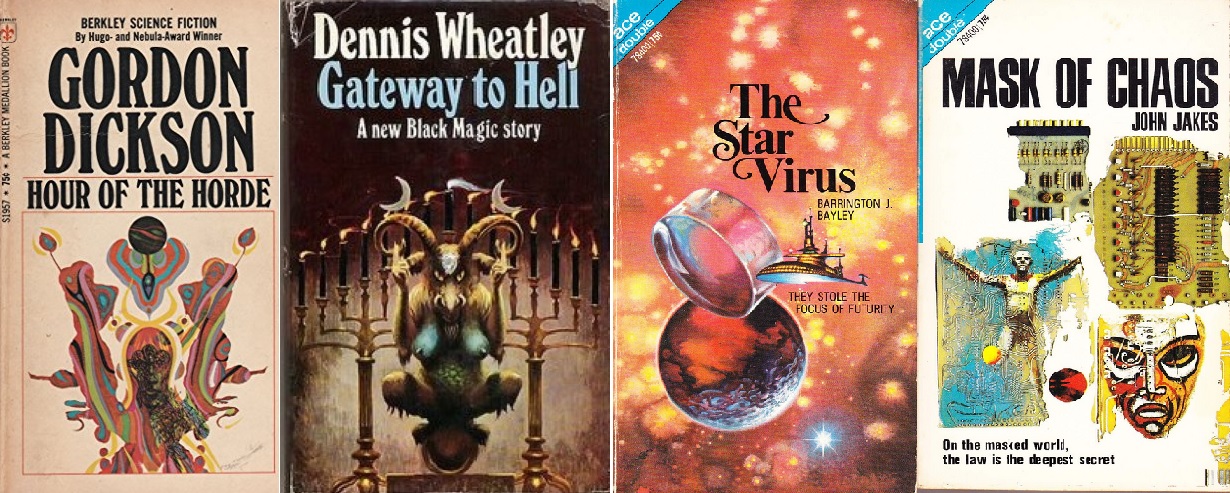
Continue reading [August 20, 1970] Hour of the Horde meets The Star Virus (August 1970 Galactoscope)
For our second of July's Galactoscopes, we have quite the mixed bag: two winners and two losers. Aren't you glad you've got us to navigate the dross for you?
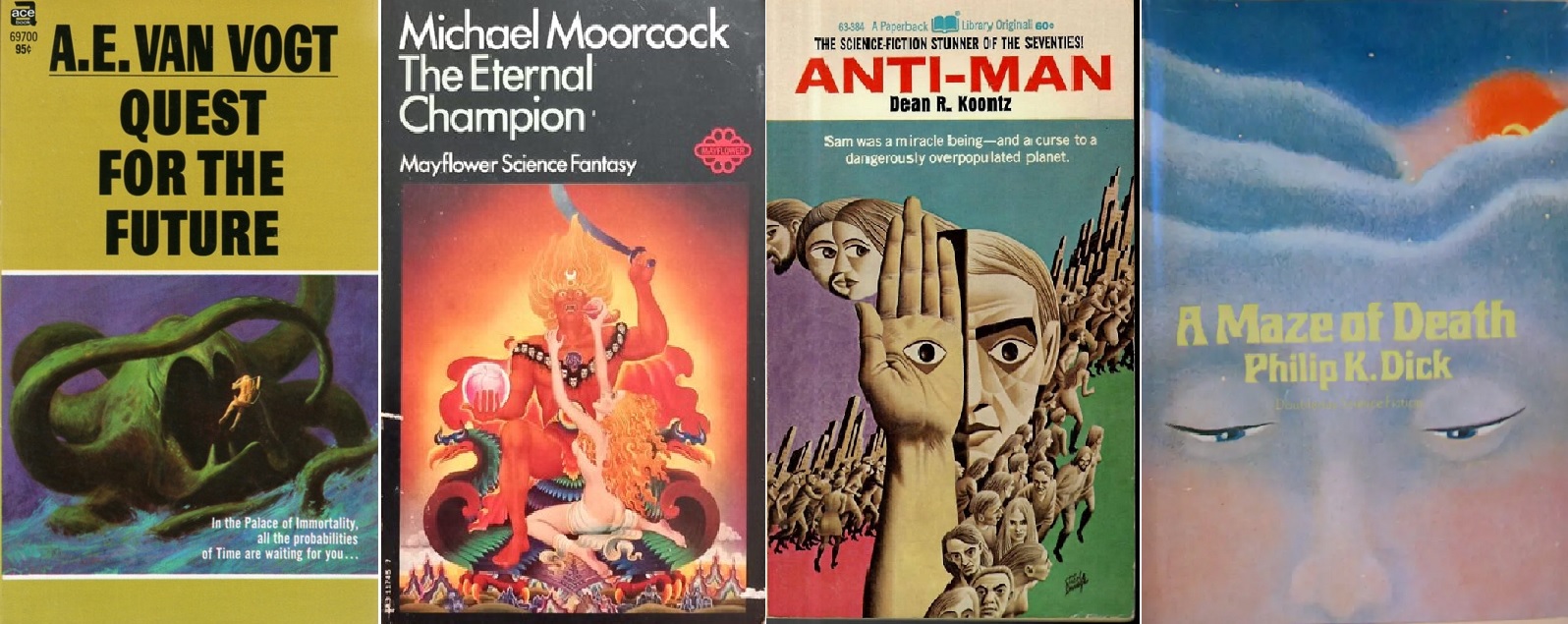

by Gideon Marcus
To Venus! To Venus!, by David Grinnell
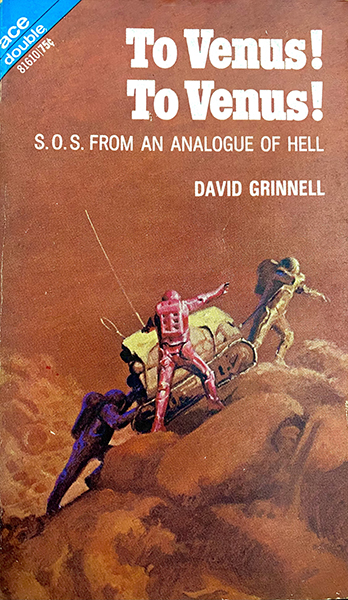
cover by John Schoenherr
Warning: the latest Ace Double contains Communist propaganda!
The premise to David Grinnell's (actually Ace editor and Futurian Donald Wolheim) newest book is as follows: it is the 1980s, and the latest Soviet Venera has confirmed the initial findings of Venera 4, not only reporting lower temperatures and pressures than our Mariner 5, but spotting a region of oxygen, vegetation, and Earth-tropical climate.
And they're launching an manned expedition there in less than two months.
Continue reading [March 14, 1970] To Venus and Hell's Gate… are we Out of Our Minds?
[We've saved the best for last this month—one of these books is sure to be a pick for the Galactic Stars. Read on about this remarkable quartet of science fiction tales…]

by Jason Sacks
Time Trap, by Keith Laumer
Sometimes a back cover blurb sells a book. “ABE LINCOLN IN AFRICA?” the cover reads in breathless bold sans-serif type. “He was seen – and photographed – in a Tunisian bazaar.” Hooked yet? How about the mention on the cover of “an ancient Spanish galleon, fully crewed with ancient Spaniards, was taken in tow off Tampa by the Coast Guard…”
Yeah, you probably thought, take my 75¢ plus tax, because that’s a book I have to read. Especially if it’s scribed by the always delightful Keith Laumer, he of the wildly satirical Retief series. At the very least, Time Trap has to be readable, right?
Well, yes, Time Trap is readable, very much so in fact. I flew through its 143 pages in near lightspeed. But there’s just no there there. Time Trap is like a Big Mac: enjoyable at the time but utterly devoid of any nutrition.
Laumer’s latest is fun, sure, but maybe it’s too much fun. Because the novel is just too silly, too whimsical, too full of absurd wordplay and pointless tangents and the sense that Laumer was scripting little bits of this story between partying with friends and warming up for his next, more serious novel.
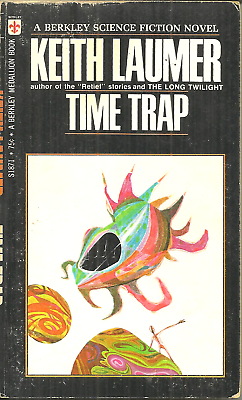
cover by Richard Powers

by Amber Dubin
As we close in on the end of the final year of the 60s, it seems the lengthening nights are seeping into my psyche more than usual. I find myself wishing I were more hopeful for the coming of a new decade, and maybe if I paid less attention to politics or the state of the world I could retain more resistance to the gloomy morale of our divided and unrested country. Thankfully, a timely distraction arose: just think how pleasantly surprised I was to discover that there was to be a diverting new work from Rod Sterling to grace our airwaves November 8, 1969!
I was a step beyond devastated when Twilight Zone left the air, as it remains one of my all-time favorite science fiction pieces to date. To know that Rod Sterling would once again be on my television just before the dawn of a new decade sparked a hope in me that’s just enough to disrupt the gloom I’m feeling at the end of this one.
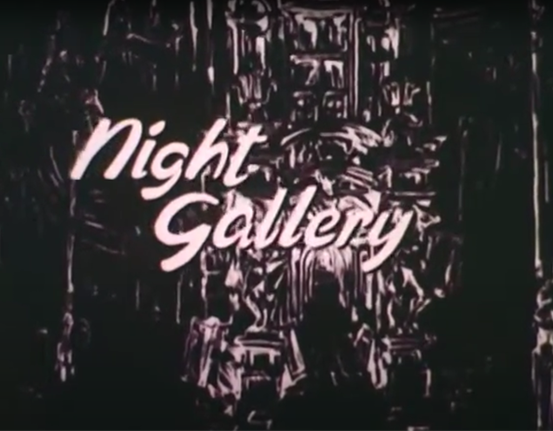
Rod Serling's "Night Gallery", shown on NBC Saturday Night at the Movies
Given the climate of our cultural atmosphere, however, I am not surprised that although the work that Rod Sterling chose to create is star-studded in cast, it is otherwise physically and emotionally dark. The macabre tone sets in right away as an eerie opening theme tinnily whines from the upper register of a harpsichord. The audience is led down a black and white drawing of a hallway, interrupted regularly by the chalky outlines of featured actors, not unlike how it would feel if one were to walk through a series of taped off crime scenes with final resting places similarly marked in each. This tense opening sequence maintains stress on the audience as the illustration gives way to the darkly enshrouded silhouette of the show’s host and final name featured in the credit sequence, Rod Serling.
Serling returns to the small screen, six years after he left it, in the resolute and deliberate fashion we’ve come to expect from him. Ever our guide through the mysterious and strange, he acts as curator of the mysterious in a black void of a presentation room featuring nothing but three portraits, their faces glamorously shrouded in red velvet curtains. He describes each of these covered works of art as suspended “in time and space, a frozen moment of a nightmare.”
Entering the scene associated with the first painting, "The Cemetery," this description is immediately validated as we are confronted with a room occupied by a once wealthy patriarch, bound both by a wheelchair and the living death that is the cognitive and physical decline of age. The elderly man, Mr. Hendrix, is waited on with care by famed film and TV veteran Ossie Davis (Mr. Ruby Dee), playing the sharply dressed and precise butler Osmond Portifoy. In a heartbreakingly relatable way, the rich and ailing painter is depicted as incapable of speaking, walking, or even holding a paint brush as he barely clings to life in his old-monied estate home. By contrast, we are confronted by his shiftless rapscallion of a nephew downstairs, who we are made to immediately dislike as he twitters about the house, disrespectfully upsetting its previous order and chirping our patient butler’s name in mockery as he puts his cigarettes out on the tray of discarded food he is carrying away from Mr. Hendrix’s room.
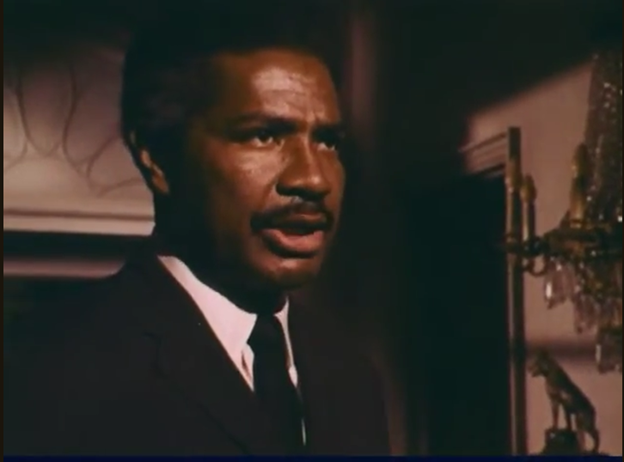
Portifoy is not amused
The obnoxious youth wastes no time in murdering his uncle once he has confirmed his inheritance of his estate, brazenly directing his uncle’s view to the window overlooking the family cemetery so the poor man can ‘view his future residence’ as he is slowly poisoned by the cold air from the purposely opened window that his frail body is unable to withstand. The greedy nephew makes no attempt to hide his disrespectful glee when the man dies, and he rudely directs the responding home-doctor and estate manager to hastily clear away as many traces as possible of the deceased man’s control over his wealthy home. Condescendingly, he allows Butler Portifoy to stay on staff, despite their obvious and open distaste for one another. However, Portifoy finds it almost more curse than blessing that he is allowed to continue to serve the Hendrix Estate under new management.
Just when it appears nothing could stop the young man’s wonton disrespect for all things dignified, his drunken carrying on hitches on a disturbing detail he notices in one of his uncle’s paintings hanging over the hallway stairs. When his uncle is interred in the family cemetery, it appears that the estate painting changes to depict an open grave in the corresponding area of the portrait. At first, he tries to brush off this change as a trick of the light, or his faulty memory, but the more time he spends in the home, the more fixated he becomes on the painting. When his paranoia grows to the point of inducing sleeplessness, he lashes out, ripping it off the wall and throwing it into the fireplace, only to find it back on the wall where it was before. He responds with violence to Portifoy’s insistence that there is nothing wrong with the painting and burns the man, finally breaking the man’s tolerance for his behavior. Portifoy quits on the spot, leaving the younger man to continue swiftly losing his mind alone in this apparently haunted house.
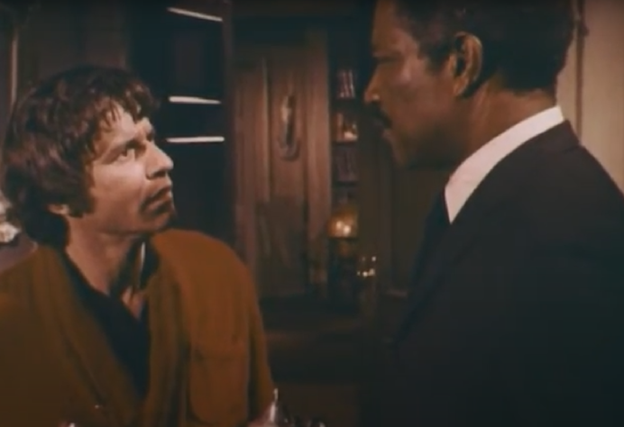
A rather satisfyingly contentious dynamic
In predictable fashion, the man fares poorly on his own, and he eventually succumbs to the battle with the paranormal forces at play, launching himself off the staircase entangled in the canvas of his dead uncle’s likeness. To my surprise, however, this is not where the story ends, and it appears that the doomed youth was not the only man in the house compelled by greed and willing to play with paranormal forces he did not understand. It's a twist too good to spoil here.
The second story, “Eyes,” features the fascinating combination of a winning performance by storied actress Joan Crawford and the professional debut of a young director named Steven Spielberg. Although it was rumored that this segment’s veteran star was originally reluctant to take a chance working with the inexperienced director, it appears her fears were unfounded. In fact, I’d go so far as to say that the direction of this segment was Rod Serling’s best choice of the featured three. From the elevator door closing on Joan’s character’s disgruntled employee as we open the scene, to the acrobatic shots we get from the ceiling looking through chandelier crystals, the cinematography and dynamic story telling are movie-quality.

An ambitious shot that inverts the surgeon as he has inverted his moral code.
The story in question revolves around the aging debutant Miss Claudia Menlo, played by Joan Crawford, whose nightmare appears to be the life-long curse of blindness. It seems as if the finery she surrounds herself with and the technology with which she’s been able to make her life self-sufficient has steadily transformed into bars of a gilded cage. She has become so obsessed with the idea of the sight that she has been robbed of, that she interprets it as a cruelty that she must turn into a weapon to settle the score. It is from this space that she discovers an opportunity to right the universal wrong, and she stops at nothing to seize it.
Through the perspective of the conscripted surgeon, we discover that Miss Menlo has bribed, extorted and blackmailed enough professionals and poor slobs to direct a procedure to take place where one man will lose his vision forever to give her but twelve hours of precious sight. It’s clear we are meant to condemn Joan Crawford's character’s actions, and to be sure her victim is pathetic enough to deserve all of one’s compassion, but I cannot help but understand her desperation. Yes, her vanity, decadence and aggressive way of tearing through everything that gets in her way is indefensible, but it’s hard to say if given the same circumstances I wouldn’t make similar choices. As a senescent ice queen of an empty decaying palace, the woman that life has made of her is twisted into an unlovable shape now, but I cannot help but imagine what torture it must have been to live a whole life of such beauty without the ability to see any of it.
No matter how thoroughly we are meant to have shut her out, I cannot help but feel a pang of ache when she screams about color, while decorated in such fine examples of the same. I understand the bad intentions she paved to her own destruction, but when the irony she earned comes to call, I cannot fully say it would have been a doom I could have avoided myself.
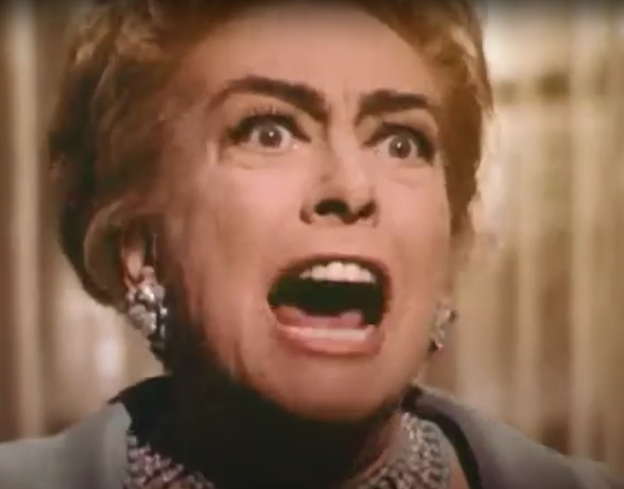
I am always hesitant to call a woman a nightmare, but when the shoe fits…
The last story for me is the weakest of the three. “Escape Route” features an ex Nazi officer from a concentration camp hiding out in Buenos Aires after the end of World War II. As many men with this description did (do?) in real life, he is haunted by paranoia of being found and held responsible for his cruelty and past actions as he lives a life of poverty and insignificance in a foreign country he does not seem to enjoy any aspect of. I felt like this had the least compelling premise because even if he wasn’t a war criminal, the protagonist seems to be a completely irredeemable, unlikable nightmare. While he is haunted, he appears remorseless and even defensive of his past behavior. It also seems to have turned him into a miserable, belligerent drunk who verbally abuses the only person in his life that knows his secret: his consistently drunk, lady-of-the-night neighbor. Even though she is the only one who seems to tolerate him, she still uses his secret to twist the knife of insults she slings right back at him.
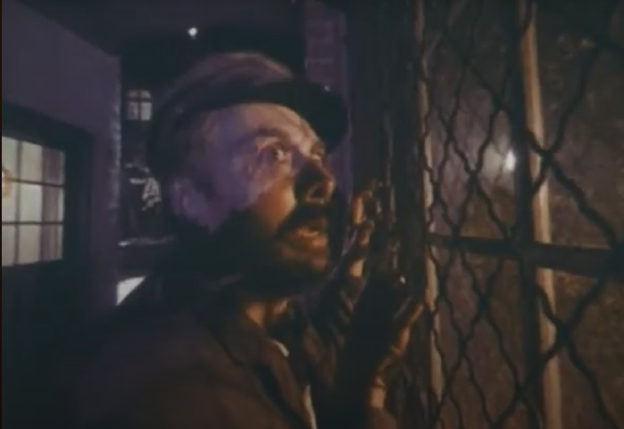
A well-deserved haunting
One day, in hiding from the detectives attempting to get him to answer for his crimes, he seeks refuge inside a closing museum and is unexpectedly moved by a painting of a fisherman who he hallucinates as having his face. It is here that his personal moment is interrupted by an elderly Jewish man emotionally connecting with another painting that expresses the agony of a holocaust victim. Based on how often he is drunk and/or hallucinating, I am not entirely convinced that the other man, Herr Bleum, isn’t a physical manifestation of the ex-Nazi’s guilty conscience.
In fighting against the web of his own weaving, he predictably hangs himself, using the thread of magic he has discovered in his story to yoke himself to a punishment far worse than any he could have received at the hands of real-life avengers.
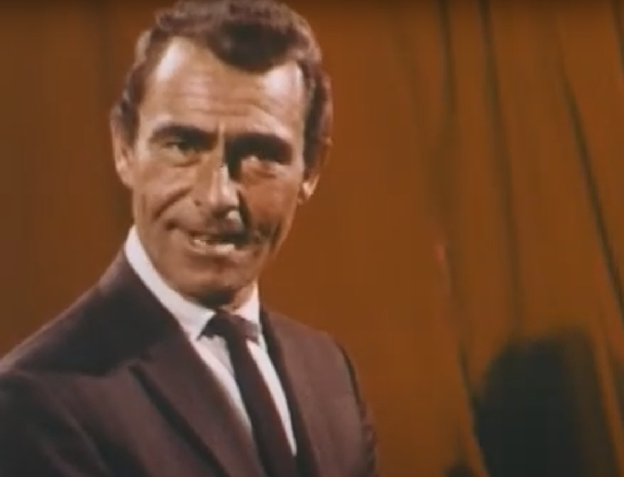
Rod Serling, in all his glory
Whatever unevenness exists in this trio of stories is overwhelmed by the sheer quality of production, and also the joy at having an old master back at the game. The gilded tapestry Rod Serling has woven with The Night Gallery is a welcome masterpiece capable of warming my heart in these cold and dark winter months. The papers say that Serling is uninterested in serialized television work after Twilight Zone, and that these three episodes were a one-off set. However, after turning out such well-crafted, well-acted and well-directed gems as these, I cannot imagine this vignette not inspiring a sequel or two in the coming decade, either penned by Serling or a successor he designates. That hope alone gives me something to look forward to as the curtain draws this year to a close.
5 stars
[New to the Journey? Read this for a brief introduction!]
The Corrosive Threat of Antidisestablishmentarianism

by Amber Dubin
US-world relations have been growing increasingly concerning as we venture cautiously into the first couple of months of 1969. From never having quite gotten back on the right foot since last year's Tet offensive (and with this year's edition currently ongoing) to the aftermath of the Pueblo incident, to the newly renewed Moon Race, it sometimes feels like America is standing on the world stage with shaky legs. It is easy to react to these uncertain times by pining for a prelapsarian epoch in human history.
It’s rather apropos, then, that Star Trek writers have once again turned to the often-referenced biblical Garden of Eden. Here, however, I'd argue that “The Way to Eden” approaches this subject in an unique way by suggesting, as Spock does here, that all advanced societies “hunger for an Eden, where spring comes.”

What happens when you set transporter coordinates for Haight/Ashbury
The episode opens on a familiar scenario where the Enterprise is hotly pursuing a stolen vessel that is overheating its engines to alarming levels. They manage to beam over the occupants just before the fleeing vessel explodes, and the crew of the Enterprise is confronted by a motley crew of ragamuffins. Kirk greets the strangely dressed, wild, love-and-peace-preaching, anti-authoritarian naturalists by informing them that they were only spared consequences for stealing and destroying a Federation ship because the wayward son of a political figure is among them.

"Don't trust the Fuzz, man!"
They respond to Kirk’s mercy without gratitude, disrespectfully requesting that the Enterprise act as a ferry in their quest to reach a planetary Eden and relocating to sickbay with extreme reluctance.
Meanwhile, Ensign Chekov discovers that a lovely dark-haired Russian beauty from his Starfleet Academy days is among the band of miscreants. Irina Galiulian and Chekov lost touch when she dropped out of Starfleet to chase nebulous and flighty pursuits, a choice that Chekov deeply disapproves of. They have an angry, yet charged, discussion which resolves nothing before she returns to her more amiable family of choice.

Is Chekov going through captain's training? Because I thought it was Kirk's job to be so enamored of the pretty lady that he forgets to protect the ship.
Back in sickbay, the situation has descended into chaos. The group’s leader, ex-research engineer Dr. Sevrin, has been determined to be a carrier for a superbug that is both incurable and created by the advanced sterilization techniques used to sustain Federation environments. He is thus quarantined and isolated from his flock, an action against which the rest of the group protests heavily.
Acting as both the snake and the snake charmer, the now deemed insane Dr. Sevrin spurs on the rest of his group to break him out of isolation and seize control of the Enterprise, knowing their musical seductions and rapscallion ways will cause the crew to lower their defenses and underestimate any hidden, nefarious intentions.
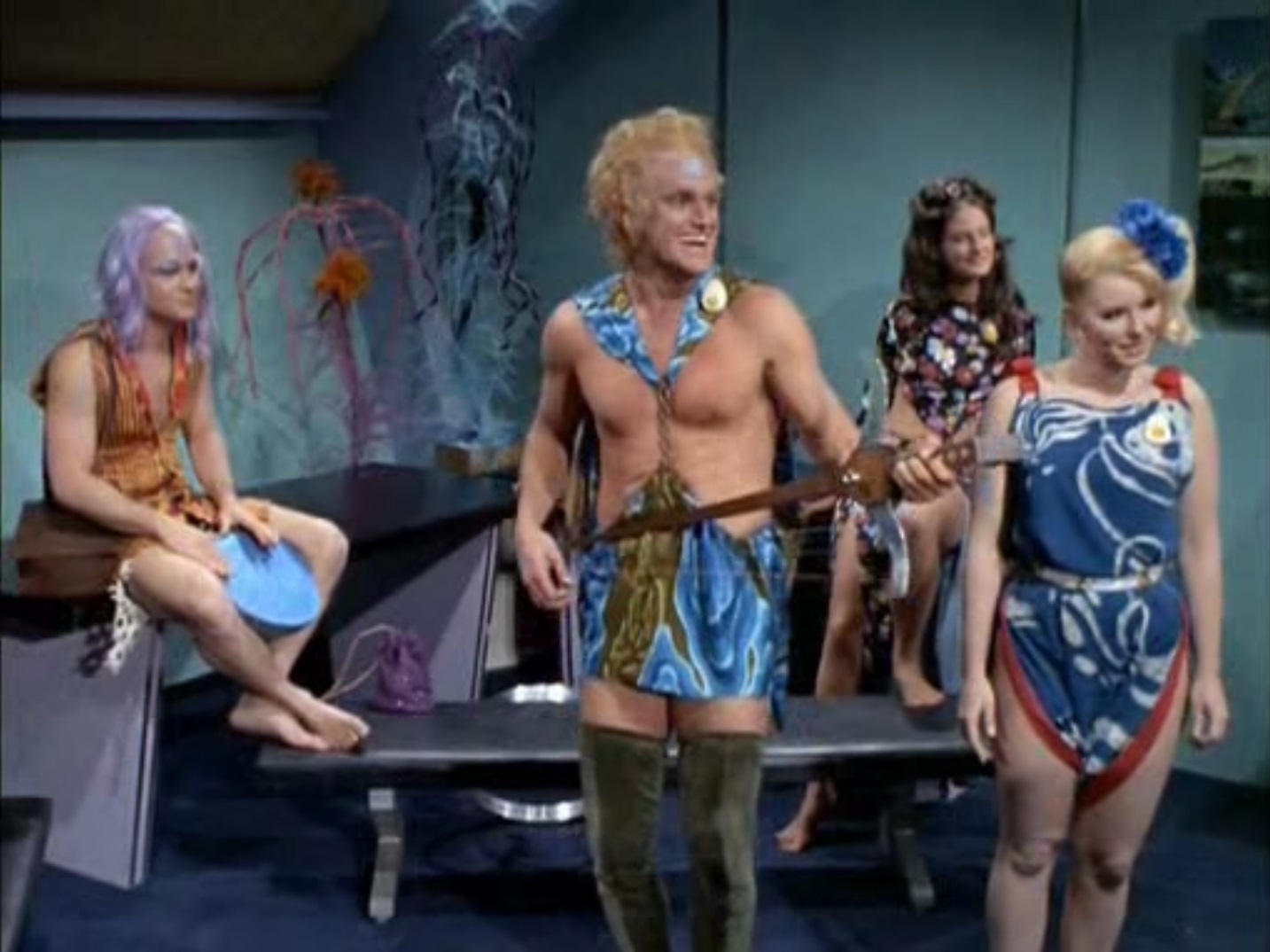
Tonight on Hullabaloo!
Furthering this goal, Irina isolates Chekov and effortlessly steps into the role of femme-fatale, doing little else other than batting her lashes and breathing lightly on Chekov’s lips to get him to spill his guts about every single operating mechanism of the ship’s security and navigational systems. Next, the group minstrel, Adam, begins a pied piper act, strumming and singing his way through the whole ship. He even convinces Spock to display his instrumental talents in a seemingly impromptu concert that gets broadcast over the ship’s speakers, in a very effective misdirection campaign that covers for his comrades as they disable ship security and free their leader.
Now in control of the Enterprise, the group barrels into Romulan space towards a planet that ship’s scanners have defined as Eden, setting a trap to disable the crew and allow them time to escape. There is a brief pause where members of the group try and fail to dissuade the power-mad Dr. Sevrin from making this trap fatal for the Enterprise crew, but thankfully this is the one part of their plan that the crew is able to disrupt before succumbing to those permanent consequences.
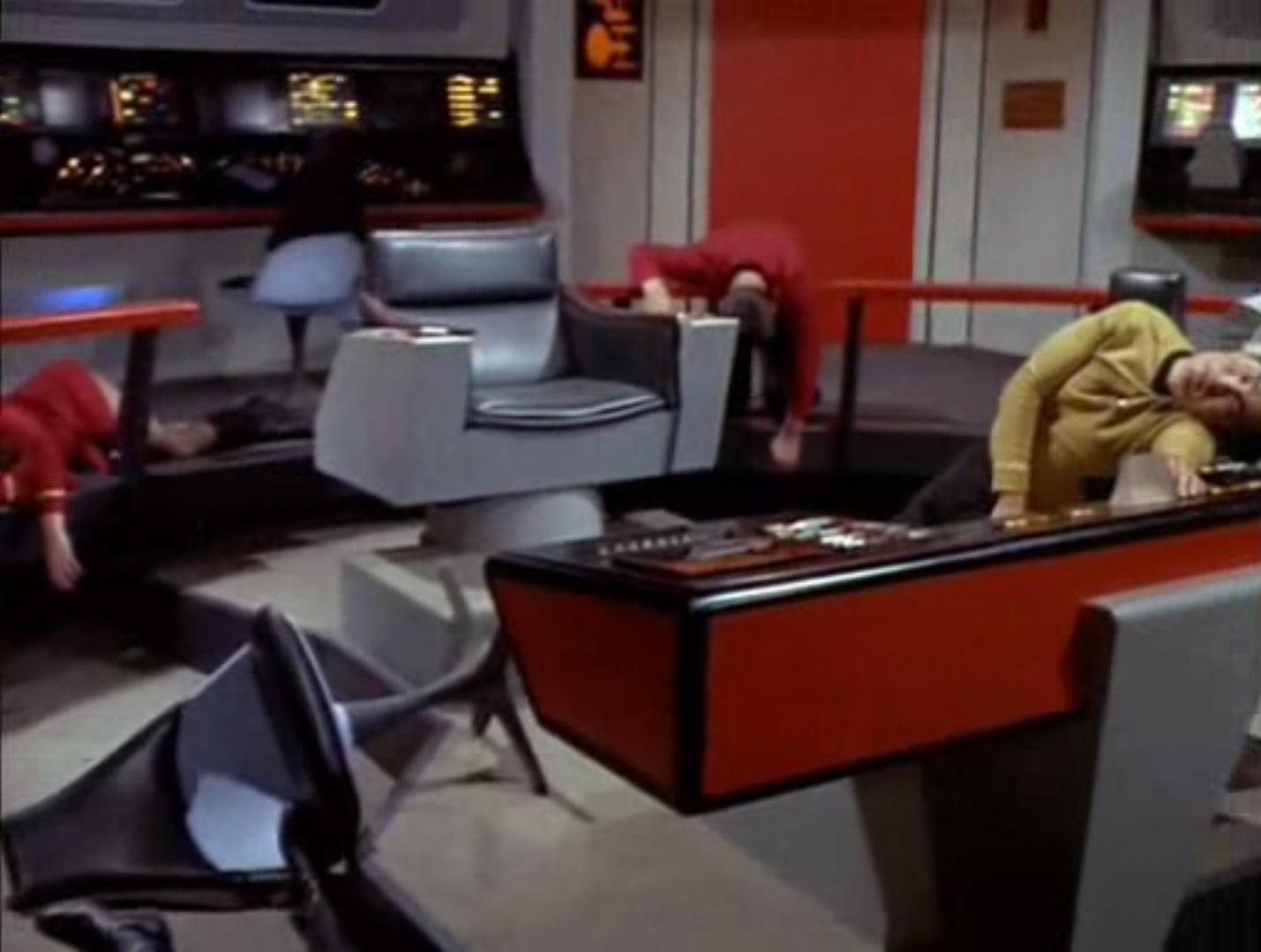
Asleep on the job
The band briefly appears victorious in the acquisition of their fabled garden, but find the paradise hostile to humanoid life, and the bare-footed hippies literally get burned by the acid-coated plants growing in an Eden that was supposed to welcome them. Faced with the devastating failure of his quest, Dr. Sevrin willfully consumes the deadly fruit, very plainly demonstrating that the insanity brought on by his dual lust for anarchy and power was fatal.

The metaphorical apple (still much better than "The Apple")
I think boiling this episode down to “the one about beatniks in space” is both simplistic and disrespectful to the subtlety of the message it’s trying to convey. I see how, on its face, it could appear that the plot of this episode is a ham-fisted attempt to judge the reactions of the Enterprise crew when introduced to hippies from our time, but I’d argue their role here is to demonstrate the corrosive nature of antidisestablishmentarianism. I think the fact that such a small group of humanoids, with no greater powers of intelligence or manipulation than any other aliens we’ve met so far, was able to so swiftly and effortlessly take control of the ship, speaks to the power of hiding in plain sight.
Rather than the loudly chanting overtones that kindness can be fatal, the more subtle message here is that these intruders merely awakened seeds that were pre-sown into the mind of every being in known society. The unspoken fear that our zeitgeist whispers, is that every established system only functions as long as the seeds of hedonism, anarchy and sedition do not grow to destroy it. It is the reason power fears the rhetoric of communists, cultists and anarchists; why it tries to silence the rabble-rousers, quell the mobs, round up and isolate the dissenters, and burn the witches.
The wolf is efficiently hidden in sheep's clothing when love-drunk, starry-eyed hippies prove themselves not to be peaceniks –but weapons. Weapons so effective that, in a matter of hours, they reduce an advanced, peaceful, orderly, military vessel to the plaything of a handful of gleeful, half-naked, singing fools.
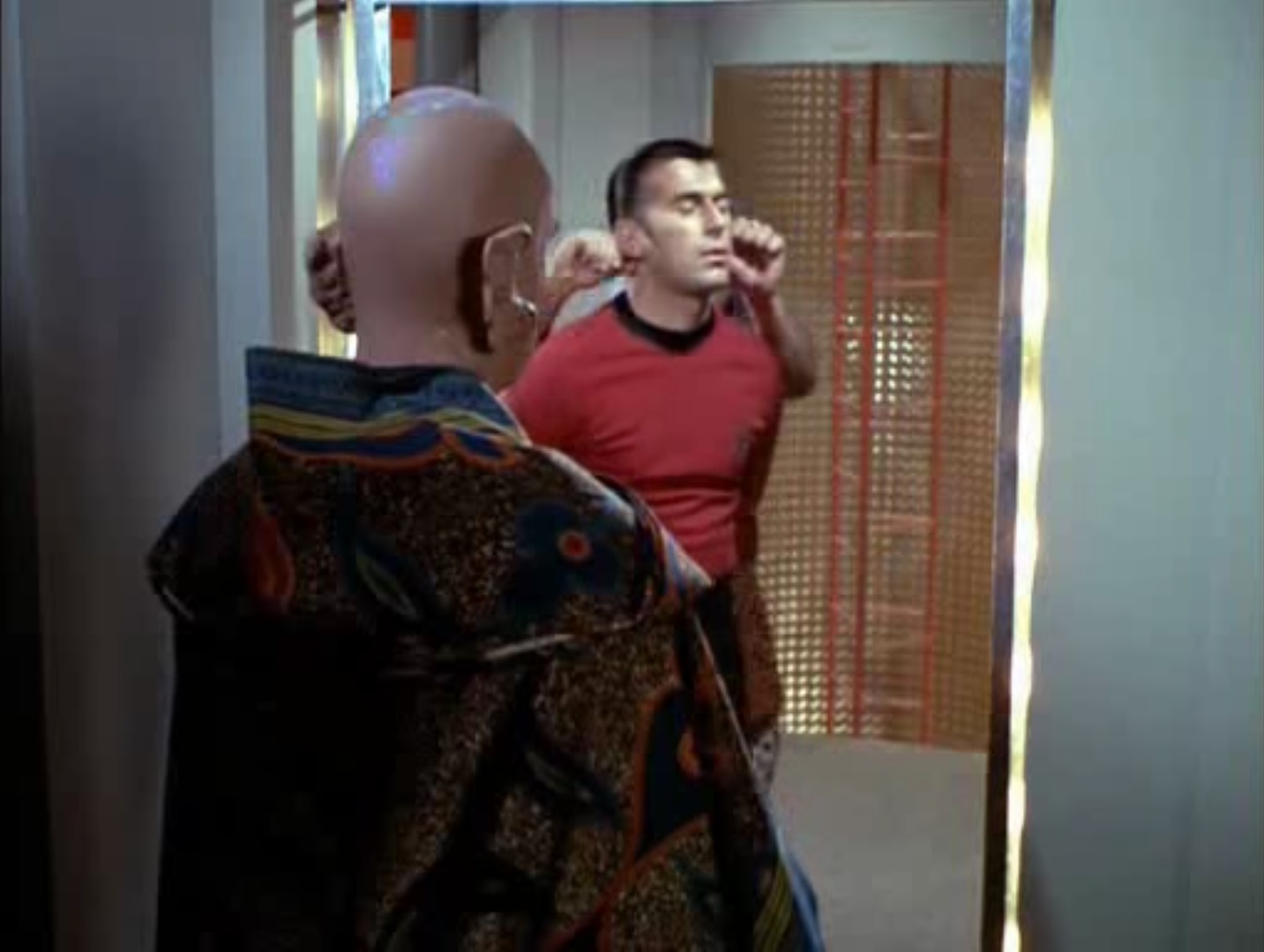
If only they let Bob Hope tour the Enterprise, the crew wouldn't be so starved for entertainment. Then again, they might…
This episode very effectively warns against the dangers of what can happen when a charismatic, silver-tongued leader sinks his fangs into the impressionable minds of restless sycophants. It demonstrates how powerful that sharp-witted leader can become when he knows how to wield such universally disarming weapons as pleasant music, a righteous and honorable cause, and the promise of affection and approval from smiling, scantily-clad, untamed youths.
Despite its disarming façade, this episode is not a light romp. It is a cautionary tale; and in my opinion a particularly well-woven yarn.
5 stars.
Space Hippies

by Erica Frank
We only see six of the Edenites, but they must be part of a larger movement: Spock knows their greeting and their philosophy, and "reaches" them well enough to be the ship's liaison with them. Either they are very numerous, or very influential, or both.
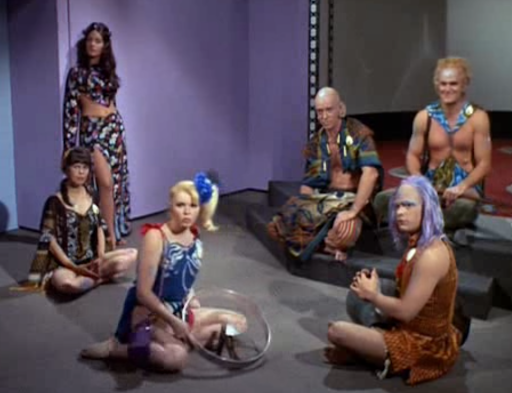
Clockwise from center: Dr. Sevrin, a brilliant engineer; Adam, a musician; Tong Rad, son of the Catullan ambassador, who plays drums; nameless blonde musician who plays the stringed wheel; nameless brunette woman; Irina Galliulin, Chekov's former girlfriend.
Spock respects their goals even when he recognizes that Sevrin is manipulative and deceitful. At least three of them are well-educated, talented, and lauded in their fields; we have no reason to suspect the others are random dropouts. These aren't people who have failed at mainstream society and are chasing myths to make up for their inadequacy–rather, they have judged the Federation and found it wanting in soul and harmony. As Spock says, "They regard themselves as aliens in their own worlds… a condition with which I am somewhat familiar."
They have lost their leader and their Eden, but four of them remain, and they need not give up their quest for a peaceful community, away from a technological, regimented society.
We've seen at least two places they could go: One where people can live a mellow and gentle life, but slowly lose their drive for creativity. And one where they could have fantastic adventures, but none of it would be real. Or they can keep searching for a tropical paradise planet that's not full of acid and poison, although any of those in Federation space are likely to be populated ("exploited," I'm sure they'd say) unless there's some reason not to go there.
…Maybe paradise planet is being used as a retirement facility now, and is too commercialized for the hippies. Maybe the Shore Leave planet is restricted – the aliens who run it don't want the Federation trying to figure out their technology. So perhaps they need to look for somewhere else. But on their quest, they can visit other planets and find people looking for a simpler, gentler life.

They'll need to find a new lead guitarist.
Five stars (but I'm probably very biased). I loved the music, and that the ending, although touched with tragedy, wasn't "it's all ruined." There's room for hope that someday, they will find their Eden.
Back to the Beginning
by Gideon Marcus
Remember first season Star Trek? When Kirk was a "a stack of books with legs", stiff and Hornblower-like? When Spock was cold on the outside, hot on the inside? When other members of the cast had lines? When the Enterprise halls were filled with crew members and guests? When music was a fundamental part of the show? (viz. Uhura singing in "Charlie X" and "The Conscience of the King")
There are many reasons to like "A Way to Eden", and they are well-represented in the above entries by my colleagues. But what I loved about the episode the most was that it felt like a return to the Trek I liked best. After so many episodes in which the characters acted contrary to their nature, when plots were half-baked, when technology was inconsistent, when our favorite vessel seemed sterile and incomplete—finally, the Enterprise feels alive again.
You can even see the relief in the crew. The fellow guarding the brig was mesmerized listening to that (quite excellent) jam between Spock and the exquisite and talented Deborah Downey. He must have been just parched for entertainment. No wonder they all were so susceptible to the influence of One.

I'd watch this episode of Jazz Casual any day…
Spock's heart-wrenching expression of support of the Edenites' quest, his solidarity with their feeling of alienation within utopia, was worth the price of admission all on its own. The space hippies weren't characterized as naive, pampered rich kids who didn't know what was good for them. They are the free spirits for whom middle class American values just don't wash. A key message of this episode: surely, the Federation must be big enough for them, too. Infinite Diversity in Infinite Combination, ¿qué no?
And finally, if Charles Napier and Deborah Downey ever release an album of their performances on this show (I can absolutely buy that Adam's space guitar provides perfect acoustics and amplification for his voice), I will be the first in line. Also, if anyone's started a Deborah Downey fan club, I want to be a charter member. Otherwise, I might have to make one myself…
Four stars.
[Come join us tonight (February 28th) for the next thrilling episode of Star Trek! KGJ is broadcasting the show live with commercials and accompanied by trekzine readings at 8pm Eastern and Pacific. You won't want to miss it…]



The Tholian Threads
by Amber Dubin
This is the episode that fully cemented season 3 in my mind as the highest quality season so far. The special effects were impressive, the costumes were simply spiffy and the pacing and audio were smooth and well-balanced. My only frustration is that it lacked one major connecting thread in the plot, which left it with inconsistencies great enough to turn this otherwise seamless Tholian web into a loose and fraying net.
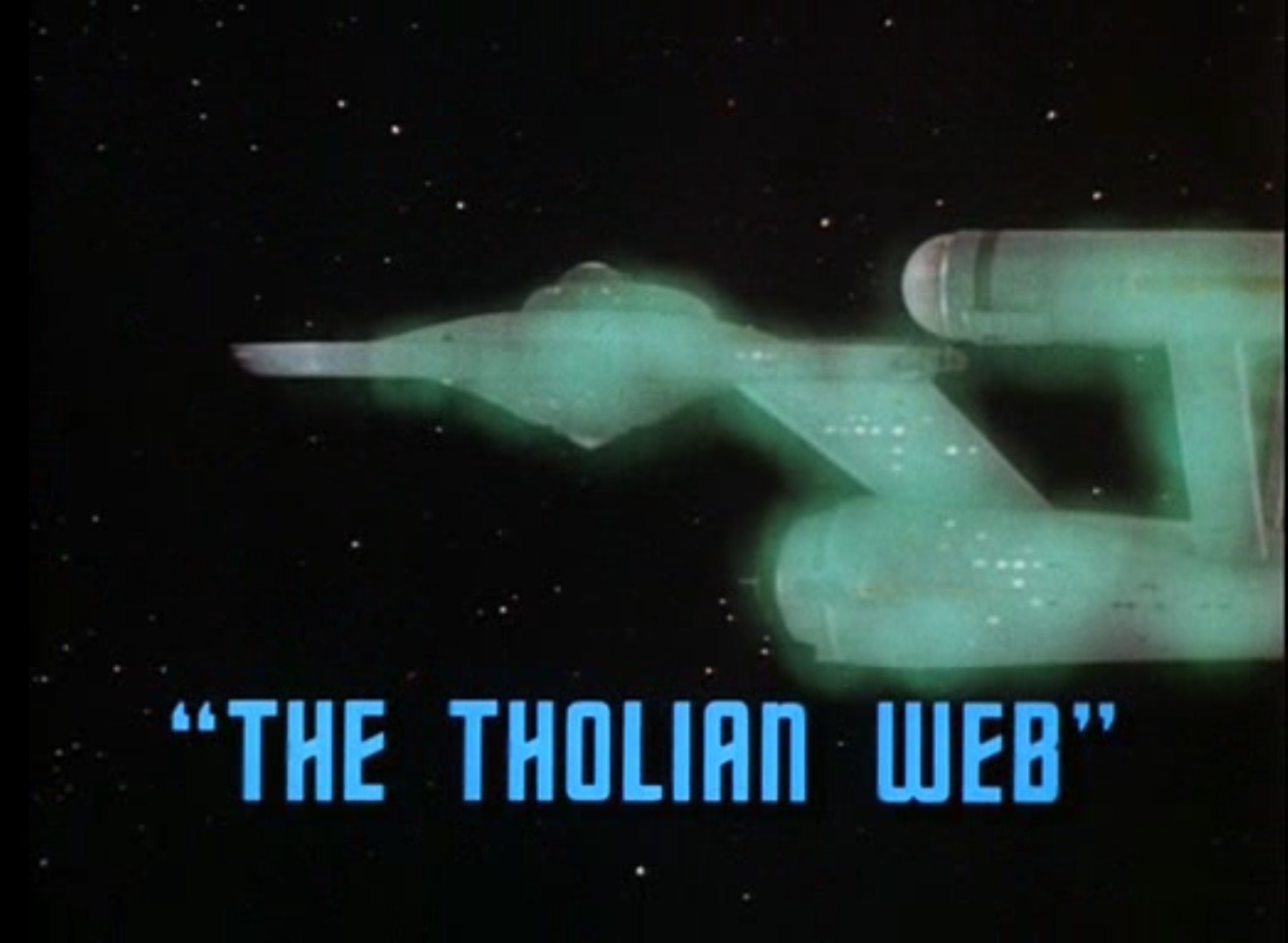
In a masterful opener, we are dropped in the thick of the action from the very beginning, with the crew staring in concern at all the viewscreens, as they are informed that they have entered a region of space "that appears to be breaking apart." I would have loved an explanation as to what readings led Spock to that conclusion, but everyone else seems to take Spock’s assessment with no further elaboration. Their attention is swiftly caught by the appearance of a marooned Federation Starship, one that Captain Kirk identifies on sight as the U.S.S. Defiant. Wasting no time, he rushes to beam onto it with nearly all the highest ranking officers (you’d think he’d learn that effectively decapitating the chain of command before even assessing the nature of the fate that befell an adrift starship is something he should be a bit more cautious about doing, but it seems he prefers learning the hard way yet again). When Kirk, Spock, McCoy and Chekov beam over to the other starship, we see that they have at least learned to take the small precaution of contamination reduction suits this time.

But they don't decontaminate them when they come back to the Enterprise—well, perhaps that's part of the transporter beaming now.
In a sequence of events that should surprise no one at this point, the danger that annihilated the Defiant's crew begins to affect the away team right away. Just as we saw just two weeks ago in “Day of the Dove,” Chekov starts being influenced by a violent murderous madness, and just as the ensign did in “The Naked Time,” he tells no one of his symptoms before bringing a contagion back to the ship with him. Meanwhile in the Defiant’s sickbay, Dr. McCoy makes an immediate and even more disturbing observation when crewmen and objects on the ship phase out of existence as he tries to touch them. Thankfully, Kirk at least treats this threat with the appropriate level of alarm, and immediately orders a retreat to the Enterprise, but it appears to be too late, as whatever forces seem to be affecting the dissolution of the Defiant cause the ship to disappear while the captain is separated from the away team, mid beaming sequence.

The chicken-soup dispenser has become a tricorder device.
The focus now shifts to the delicate dance of keeping the ship in close enough proximity to the Defiant to make another attempt at retrieving the captain while managing to keep the ship in one piece as it withstands the conditions of this volatile section of space. Confusingly, Spock attempts to explain what's happening with vague multiphasic pseudo-science. He says the computer can calculate the pattern in which our universe and the Defiant's overlap with enough regularity that he speculates that the defunct ship will reappear in two hours. Here, he muddies the waters by throwing in noncommittal statements like “the dimensions are totally dissimilar and any use of power disturbs it,” that made me so frustrated with his vagueness that I agreed with Chekov's violent outburst that interrupted it.

"The science in this episode is too confusing!"
The writers decide here that the episode needs even more tension, choosing this moment for the Tholians to zoom into view. Seeking, too late, to guard this unstable portion of space, an alien ship containing beings calling themselves the Tholians hails the Enterprise demanding an explanation for their trespassing and requesting they leave the area immediately. Spock negotiates the calculated amount of time he requires to interact with the Defiant again. When Spock’s calculations prove erroneous, the Tholians swiftly open fire on the Enterprise, feeling as if they were maliciously deceived. Following a brief fire-fight, the Enterprise and the Tholians end up disabling each other, and the Tholians retreat and enact a new strategy to defeat the Enterprise, gathering reinforcements and using several ships to slowly build a web of energy beams.
As if there wasn't enough going on with this intergalactic battle, at the same time, McCoy is engaged in a battle of his own against the interphasic space madness affecting Chekov and the crew. He sets about the monumental task of medically creating an internal shield to barely comprehensible degradative forces, much as we've seen him do in “Miri” and “The Deadly Years.”

"Physician, heal thyself!"
Spock takes this lull in the immediate external danger to officially declare Captain Kirk dead, and he holds a brief, ship-wide funeral service for him. Dr. McCoy drags Spock very reluctantly to an audience with Kirk’s recorded Will and rather unnecessarily takes an opportunity to try to bully, insult, and squeeze an emotional reaction out of Spock. It seems as if this is another one of their typical disputes, but when Kirk’s voice rings out through his tapes, counseling them to stop bickering, it feels as if he’s reaching out from beyond the grave to bring home the gravity of the situation they are in. McCoy immediately apologizes, noting, "It hurts, doesn't it?" In the tense silence where Spock replies softly "What would you have me say, Doctor?" The scene is suddenly imbued with a surprisingly beautiful tenderness that only the shared grief that the loss of a captain and dear, true friend could elicit.

"I can't leave you two alone for five minutes!"
In yet another tonal shift, we find that it's Uhura who helps solve the mystery of their still interdimensionally traveling Captain, as she is first to see his “shadow” phasing in her mirror. One by one, the crew begins sharing in what Uhura had thought to be her own personal hallucination, and they realize Kirk is still alive on a plane of existence that is erratically phasing with ours. Here, the plot seems to completely unravel for me. Apparently a phaser beam punched a hole through the dimensional veil and Kirk got through and somehow also another hole is about to open in the Tholian Web that the Enterprise can slip through while also scooping up Captain Kirk in one fluid movement. Also McCoy discovers the cure for the rabid space sickness (which, truly, why does that matter if they are all about to leave this space in 20 minutes?) and Scotty takes it to his quarters to drink it down like it’s a cocktail mixer rather than an anti-interdimensional-radiation medicine.

"Subtle, yet bold!"
The rest of the episode rushes to a “just because” conclusion, only necessary because they had loaded the story up too much in the beginning. If the SFnal concepts had been more simplistic like “colliding space eddies,” and they hadn’t re-used the space madness subplot so soon, or even if they had taken another moment to acknowledge how emotionally compassionate it was of Spock to make time for a memorial service in the midst of a crisis out of deference to his human subordinates, the episode could have come to a more settled conclusion. Instead, the final scenes collide and coalesce into a sudden messy slop.

The Enterprise escapes the Tholian web 'with a mighty leap.'
In total, the quality of this episode's elements was excellent, but could have stood to benefit from a couple more minutes of editing. Maybe a few more threads woven into web of this plot would have been enough to ensnare my full endorsement of it
4 stars.
Tangled up in Interspace

by Trini Stewart
“The Tholian Web” completely enveloped me in its tense atmosphere this week, largely because I had to watch helplessly as my favorite character, our dearly beloved Spock, faced nearly insurmountable challenges as captain. Spock had to defuse so many high-pressure situations simultaneously that were overwhelming just to imagine, and each aspect of Kirk’s complicated rescue was painfully resolved on the thinnest of ice (to no fault of Spock’s careful guidance).
Other than the strain of having to hinge everyone’s lives on multiple close calls, perhaps the most problematic facet of Spock’s predicament was McCoy’s aggressive response to Spock’s leadership. Acting as a foil to Spock’s calm and focused responses, McCoy persistently questioned and blamed their dire straits on Spock, who had to spend precious time defending his decisions as he urged that they press on. I’ll be the first to admit that, if it were anyone else besides Spock in charge of weighing the risks of Kirk’s rescue, I too would insist that we save the crew while the ship could still leave.

Spock—the best man for the job.
Still, I couldn’t tell if McCoy was just completely distraught by Kirk’s being lost, or if he was influenced by the interspace deterioration to some degree, but I was hurt to see Spock at odds with a partner he can usually trust when he needed him most. My bias will ultimately lie with Spock’s reliability to make the best decision available in any given situation, and I wish that despite the intense circumstances, McCoy had at least conceded to work together with Spock once the ship was down. It was a pretty low blow to assume Spock meant to endanger everyone to secure his captain status, especially after Spock explained his reasoning perfectly.
Thankfully for everyone, Kirk had predicted exactly how the two officers would interact, and he gave them just the sobering insight they needed to cooperate peacefully. I loved that Spock was reminded that McCoy was there to help when matters couldn’t be resolved by his best judgment alone. It was equally sweet (and satisfying) to see Kirk remind McCoy that Spock could make human mistakes too, right after McCoy made a rude remark about Spock’s Vulcan half.
All in all, I loved this entire episode with its suspenseful atmosphere, satisfying characterization, and well-earned resolution. I can only imagine how long-time fans must have enjoyed this episode knowing the characters’ history with one another!
4.5 stars.
Our Little Vulcan’s Growing Up

by Andrea Castaneda
It has been a while since I've caught an episode of Star Trek. In fact, the last episode I watched was “Amok Time”, in which we saw a glimpse of Mr. Spock’s vulnerable side. So I'm glad the show I finally found time for was “The Tholian Web”, featuring our favorite Vulcan in a leadership role. I was happy to see another glimpse of this stoic character. And indeed, compared to how he was in season one (which I got to see fairly regularly), we’ve seen a lot of character growth in how he leads a mission and communicates with his crew.
We first saw Spock’s role as a leader in season one’s “Galileo Seven”. In it, he and other crew members were sent to scout a newly discovered planet. Through twists of fate, they are left stranded, alone, and facing a hostile native species.
When one crew member dies, Spock insists they spare no time to respect their fallen comrade, focusing on finding a way home. It’s logical to him, but it sparks ire amongst the crew members, thus sowing seeds of discontent. As they search for a way back, the crew continues to be uncooperative and critical of his orders, save for Scotty. Here, it’s Spock’s lack of understanding human emotion that jeopardizes their mission. Despite the “illogical” nature of the situation, his crew members want their grief respected. And while we, the audience, understand Spock does what he thinks is best, one can understand why the crew sees him as “cold”.
By season three, he seems to have learned from this experience. In “The Tholian Web”, while he remains calm and collected when faced with Kirk's death, he chooses to spend a moment to hold a brief but effective memorial service. It is done very much in Spock's way, but it shows how the Vulcan first officer is able to empathize with his crew. And the gesture pays off. Despite one crewmember going mad during the service, it seems to solidify Spock's position as new leader. The members of the Enterprise— save for McCoy– respect his orders, call him "Captain", and do not question him, showing how much he’s earned their trust.

Spock, having learned from experience, foregoes the traditional comedy monologue.
Another stark contrast is how his attitude shifts from “saving the village above all” to “no man left behind”. In “The Galileo Seven”, after scrimping together repairs to get their shuttle into orbit, Spock states that the crew should go on without him if he is compromised. And inevitably, Spock is incapacitated right as the shuttle lifts off. The surviving crew members rescue him despite his insistence to go on. It’s a heroic act, but one that costs them their window of opportunity to leave. Because of that, he scolds them for it and they respond with frustration. (But worry not; they make it to the Enterprise in the end.)
In “The Tholian Web”, Spock seems to take the opposite approach. When faced with the prospect of losing Kirk, he risks the Enterprise’s escape window for the chance to save Kirk. I should note that one can interpret this as Spock making a special exception for their captain. But I choose to believe Kirk’s ideals have rubbed off on him. Right on cue, he receives much criticism from McCoy, who is being particularly prickly even for him. Their banter serves as a good vocalization for what the audience might be thinking. But it was interesting seeing the logical Vulcan take the riskier approach. I will say, Spock’s choice does endanger the rest of the crew–the very thing he was trying to avoid in “Galileo Seven”. But once again, I think it shows how much Kirk has influenced him.
In the end, the gamble pays off. Kirk is rescued, the Enterprise escapes, and everyone goes on to explore another day.
Indeed, this episode can be interpreted as a better evolved version of the “Galileo Seven”. The stakes were higher, there were more plot elements in play, and the alien species they faced was more threatening. The story kept me guessing and didn’t have predictable moments (despite the ending being a tad bit convenient.) It was a delight to see how Spock not only survived but thrived as a leader. I very much look forward to seeing how Spock will continue to develop, both as a leader and as a true friend to the Enterprise.
Five stars
Behind the scenes
by Gideon Marcus
Back in the first season, the Enterprise was a living, breathing entity with 430 varied souls on board. Over the course of the show, the focus has shifted sharply onto The Big Three (viz. last episode, in which the starship might as well have been the personal vehicle of Kirk, Spock, and McCoy a la Peter's woody in The Mod Squad).
This week, we saw a bit of the old Enterprise, the kind we haven't seen since "Balance of Terror", really. There were some 30-40 people at Kirk's (premature) funeral, lots of people in engineering, McCoy's lab, on the bridge. There were enough people that department heads could, rightly, not spend all of their moments doing hands-on work. Uhura got to take a few minutes off, which we haven't seen since her impromptu concert with Spock in "The Conscience of the King" (the enforced hiatus in "The Changeling" doesn't count).
Interestingly, this actually turned Lorelei off a bit, so used is she to the more-than-one-braid-on-their-sleeves stars and co-stars doing all the work. But I'll never criticize a show for getting things right. Now if they can just get some trained Marines to beam ashore instead of the ship's senior complement…

A Tholian spins its web. Note: not to scale (this is supposed to be "out of phaser range".)
Anyway, I loved this episode, from beginning to end. It took a bunch of somewhat familiar elements, mixed them with some new ones, and tied them all together with the thread of Spock's first real command. It reminded me a bit of a second-season Burke's Law episode where Captain Amos Burke goes on vacation, and the rest of his team have to solve a case without him. Kirk's absence gives "The Tholian Web" room to breathe (even as he suffocates). This enhances the poignancy of his taped final orders to Spock and Bones.
I loved getting to see Sulu cradle Chekov's head after the navigator goes mad (they do love to hear him scream). I loved seeing Uhura mourn for the Captain, seeing her in her quarters! And we see Spock's quarters again, too. Scotty, McCoy, and Spock enjoy a drink together before the engineer takes the bottle of cure away to share it with someone else—probably Kevin Riley.
And I always love getting to see another starship, even if they are inevitably in distress. Somehow, each has its own unique flavor, even though they always use the same sets. Finally, I loved meeting the Tholians, an attempt at a true alien race.

In Communist Red, no less…
Never mind the brilliant special effects, the superlative acting, the real tension, even knowing Kirk was going to live (as he must, and as we saw in the preview; this was a negative point for Lorelei, too).
Thus, I can give this episode no less than five stars. Frankly, Season 3 has been, so far, my favorite season yet.
[Come join us tonight (November 22nd) for the next thrilling episode of Star Trek! KGJ is broadcasting the show live with commercials and accompanied by trekzine readings at 8pm Eastern and Pacific. You won't want to miss it…]

by Gideon Marcus
After several weeks in science fiction's New Wave, Star Trek returned last week to its roots—specifically, the pages of Astounding Science Fiction. Those who read Robert Heinlein's Universe when it was serialized in the 1940s or the novelized version, Orphans in the Sky in the early '50s, will be thoroughly familiar with the plot of the latest Trek episode.

We start in medias res: the Enterprise is under fire by a cluster of missiles. After dispatching them with phasers, Captain Kirk orders the ship to investigate the source. On the way, Dr. McCoy gives Kirk a bombshell announcement—McCoy is dying from a terminal disease and has one year to live.

"I'm (about to be) dead, Jim."
In short order, the Enterprise arrives at the missiles' point of origin, which turns out to be a large asteroid. It looks just like the one "The Paradise Syndrome", and the parallels do not stop there. For the asteroid is actually hollow and has engines. It's a generation ship (a sort of slower-than-light space ark on which people will live and die for centuries) called Yonada, and the people onboard have lapsed to primitivism, unaware that they are even on a mobile vessel. The ship is on a collision course with the highly inhabited world, Darin 5. Impact date: about a year hence.

For the walnut is hollow, and I have eaten the pith.
Kirk, Mr. Spock, and McCoy beam down to investigate, because, of course, it's always those three these days. They are taken prisoner by a bunch of mooks in parti-color sheets led by the beautiful Priestess/Queen Natira, and presented to The Oracle. This is a black monolith with a camera eye and a menacing voice (pretty sure it's the versatile Jimmy Doohan, once again) who zaps the Federation trio to let them know what he's capable of.

The Yonadan handshake.
When the three awaken, McCoy is the most affected thanks to his illness. Upon learning about McCoy's condition Spock grips Bones' shoulder with an intensity that belies his stoic demeanor. They are clearly very close friends, bickering aside.


"Put your hand on my shoooouldeeer…."
Queen Natira is quite taken with Bones and candidly asks if he'll be her mate. It's all very sudden, but if you reverse the sexes, it's actually not unusual for the screen—after all, James Bond seduces even more quickly. Anyway, since Bones digs Natira and he only has a year left, why not? Meanwhile, Kirk and Spock monkey around in the Oracle's room and get sentenced to death for blasphemy. They are saved by McCoy's intervention and beam back to the ship, leaving McCoy behind at his request. As part of his citizenship rite, Bones is implanted with The Instrument of Obedience, a subcutaneous pain inducer installed in a person's left temple.
Kirk and co. are about to warp away from Yonada on the direct orders of an Admiral, when Bones calls the ship on his communicator. In the Oracle room, McCoy has seen a book that contains all the knowledge of the folks who built Yonada, a super-advanced race called The Fabrini. He thinks it has the key to getting the ship back on course so it won't hit Darin 5. But as he relays this information, his Instrument begins to glow, and Bones collapses.

"Chicago Mobs of the 1920s?"

Excedrin headache #1701
Kirk and Spock beam back to Yonada, the latter extracting McCoy's Instrument, the former convincing Natira of the truth of her situation. They all confront the Oracle, who is displeased, but as we've all guessed, he's just a computer and easily deactivated. Kirk and Spock get the asteroid back on course (but the destination is still, apparently, Darin 5) and the day is saved. Natira asserts that, much as she loves Bones after the 38 minutes they've spent together, she must stay behind with her people and guide them, now that she knows the truth. But McCoy can catch up with her in a year when they reach their goal.
There's not too much to say here. I enjoyed the return to classic SFnal fare, and I particularly liked Natira, who is bold but reasonable, and there's no "a woman?" reaction to her leading her people. I guess Kirk learned his lesson from "Spock's Brain." It's a pretty episode, particularly this great through-the-stairs shot as our heroes descent into the ark proper (which, as a watcher pointed out, also saved a lot of money since the rest of the set didn't have to be shown).

But the episode sort of plods. There is a bit of padding, which the show can ill afford given how much it tries to do in 60 minutes. My biggest issue is Kirk deducing that Yonada is somehow broken. How can he tell the Oracle doesn't plan to decelerate once the ship gets to Darin 5? And, of course, the Fabrini data tapes coincidentally having the cure to McCoy's illness, cheapening the whole "Bones is dying" plot.
Three stars.
Eve's Bitten Apple is a Hollow Fruit
by Amber Dubin
With a title including the words “I have touched the sky,” I expected the the writing quality in this episode to reach a bit higher in metaphorical heights. Unfortunately, the intellectual peak of this episode is the lofty language of the title. I say this because the plot appears to be a sex-reversed version of Adam and Eve.
At first blush, Natira seems to be an original character. A strong-willed priestess/queen who is a decisive and effective leader and emissary for the authoritative voice of the Ancients. However, this illusion of originality quickly fades when she is viewed through a biblical lens as Adam, the founder of humanity and the only one entrusted with hearing the Voice of God. While it is a slightly interesting spin to cast McCoy as Eve offering her the apple of knowledge, it’s a frustratingly over-done concept. I may be biased, as I also take issue with the biblical moral being that seeking knowledge is worthy of punishment, but I don’t see why this story needs to keep being told ad nauseum. And, more importantly, how is it that even though the woman is playing Adam this time, she’s still being punished?
Adam famously pointed the finger at Eve to avoid being branded with the title of ‘original sinner,’ and yet when Natira doesn’t pluck the apple herself, she is still painted with the same brush as McCoy. Also, I am not a fan of the fact that the Ancient Ones are once again an all-powerful race with the forethought to sustain their people for 10,000 years (a la the Eye-Morgs in “Spock’s Brain” or the Creators of “The Paradise Syndrome”) and yet their grand plan to support their people is an authoritarian, theocratic government with shock collars to keep their subjects in line? Again? Can all these ancient, powerful, alien races truly be that intellectually evolved when not one so far has established a system whose fabric doesn’t completely unravel at the slightest pull on a thread tugged by a single dynamic thinker? Did they truly expect to be able to exterminate every single person who ever suggested climbing the incredibly accessible fence posts on their containment unit? Did that actually work for 10,000 years? Is a species so devoid of curiosity even worth saving at that point? I’d argue no, but that’s speaking as someone who would have been eliminated from the gene pool immediately under those parameters.

For the world's a set, and I have touched the walls.
I did like that McCoy got his moment in this episode. I’m always refreshed when Kirk isn’t seducing every woman on screen with the power of being the main character. I also enjoyed seeing a woman maintaining strong leadership when she chooses duty and responsibility to her people over love of a stranger. The love at first sight concept was slightly more tolerable being presented from the perspective of a female pursuer, and it may only have raised my hackles since I'm a bitter old maid myself.
Overall I didn’t love this episode but it wasn’t horrible. I may be harping on it so because of the motif fatigue I’m experiencing after it followed such other innovative and unique episodes in this season. Though I do think that the poetic title earned it an extra half star above average.
3.5 Stars
Why to Try Touching the Sky
by Trini Stewart
Hello, my name is Trini Stewart, and I showed up to the Star Trek party in a similar fashion to how I arrive at most parties- unreasonably late, and with no idea what’s going on at the moment. My journey with Star Trek began recently with “Is There in Truth No Beauty?,” and now I am happy to be strapped in for the ride.
As the title of this week’s episode implies, “For the World is Hollow and I have Touched the Sky” tells a story of questioning and exploring one’s reality, and does so effectively through the frame of a conflicted leader’s pursuit of objective truth.
The Priestess and Queen of the hollow world Yonada, Natira, is introduced with no clue that Yonada was actually a vessel. Natira clearly has no intention of questioning the stern punishments and vague promises of the Oracle, that is, until the Enterprise officers challenge the queen’s understanding of her world and its fate. The initial cracks in Natira’s worldview can be attributed to lowering her guard around Bones, as she is earnestly smitten with him the moment she sees him captured, and she dares to hope that “men of…other worlds hold truth as dear as (Yonadans) do.” Subsequently, Natira seems to be more receptive to questions about the Oracle from the foreigners, and, in a show of trusting McCoy’s testimony for Kirk and Spock, she openly defies the will of the Oracle to pardon them from a death sentence.
These subtle changes within the queen are suddenly imperative when she later faces Kirk, who insists he has a warning regarding the fate of her world. For Natira to acknowledge that her world is in peril is to reject that the Oracle knows what is best, let alone how merely listening to a truth that is not “Yonada’s truth” is precarious heresy in itself. In contrast to the Oracle’s mysterious promises, Kirk’s transparency and willingness to reason appeals to Natira, and though it is incredibly difficult for the queen to withstand the Oracle’s threats, she is convinced to confront her authority for the sake of her home. Natira pleads that she listened to the outsiders because they spoke the truth, and remarks her new understanding of truth, exclaiming, “Is truth not truth for all?” Even willing to die for the safety of her people, the queen exhibits her newfound reverence for objective truth in one last, defiant plea, “I must know the truth of the world!” before collapsing at the behest of the Oracle.

The truth will set your teeth on edge…
Ultimately, Natira’s new understanding of what is true shifts her relationship with McCoy; formerly enamored by McCoy to the point of locking him into a hefty vow of obedience, she opts to honor the intended course of the Generation ship and to hope for a fulfilling life for the doctor, even when he resists. It is Natira’s receptiveness to new ideas that reveals the state of her world and saves billions of people, thus revealing the importance of both appreciating different perspectives and reforming one’s own comprehension of the world around them.
On that note, I as a viewer can truly appreciate this episode’s call to challenge ourselves, to challenge authority, and to even challenge "truth". Now, more than ever, that "Law and Order" Nixon is about to be our next President.
At the very least, I can hope that between this week’s message and the pacifist musings of “Day of the Dove,” Star Trek watchers will reflect on how we react to political discontent in our personal lives. 3.5 stars.
Short Shrift

by Janice L. Newman
The scriptwriter crammed a lot into this week’s episode, and unfortunately the episode suffered for it. While the ideas introduced were intriguing and potentially poignant, the rate at which the story had to be told to fit within the time slot left me frustrated and unsatisfied. The pacing of the episode itself was fine, that is, it didn't hit the story beats too fast. But by its very nature, the story had too much to do and not enough space to do it in, which left the beats themselves feeling shallow or curtailed.
McCoy’s illness could have been a wonderfully dramatic plot point if it had been introduced in a prior episode or at the beginning of a two or three-part story. Instead, it falls flat. The illness feels like a contrivance and the solution feels horribly pat.
The romance between Natira and McCoy feels similarly forced. The scriptwriter did their best to make it plausible. One can say that McCoy’s knowledge of the limited time he has left to live drives his choices, or that he’s mostly manipulating Natira to save his friends’ lives, just as Kirk has done on many occasions. Yet the whirlwind ‘romance’ between Spock and the Romulan Commander in The Enterprise Incident had far more emotional impact, even when we knew or guessed that Spock was ‘faking’. McCoy’s and Natira’s romance just feels weird, almost a developing relationship shown in quick cuts.

"Goodbye, sweet what's-your-name…"
The background of Natira’s race could have been fascinating, if the author had been able to do more with it than the barest sketch. A ten thousand year-old race that sent a generation ship to the stars when its sun went nova is a compelling concept deserving of some screen time. The fact that they had medical advancements sufficient to cure Dr. McCoy’s illness but that their weapons weren’t advanced enough to hurt the Enterprise is suggestive and interesting.
I imagine multi-part stories are not what a network or syndicator wants. Being forced to show certain episodes in a certain order, all the while risking pre-emption or cancellation if a sports game runs long or a political speech comes on, must be anathema to broadcasters. They must want neat, tidy stories that fit within their time slot and don’t have any connection or major changes from episode to episode; in other words, interchangeable, truly episodic pieces that they can fit into whichever slot they want without worrying about audience retaliation. (Batman and soap operas seem to be the exception to this.)
Unfortunately, limiting the story to a tidy 50-something minute block means that no matter how good the acting and direction, no matter how hard the scriptwriter tries, some kinds of stories are going to get short shrift.
This was one of those stories. Or to put it another way, great ideas, mediocre execution.
Three stars.
Spring of Hope

by Joe Reid
“For the World is Hollow and I have Touched the Sky” was the title of this week’s episode of Star Trek. The title is a mouthful but does a decent job of giving us a feel for what we saw in this entry. The title is one that evokes hope out of despair. This episode was a tale filled with many hopeful outcomes springing out of situations heading towards tragedy. In fact, despair and hope were so perfectly bookended by this airing that it would make your local librarian proud. Let’s examine a few ways that this was accomplished.
The opening shot was that of missiles flying through space heading for the Enterprise. Granted these missiles barely caused a concern for the crew of the powerful starship as they were dispatched with a quick command from Captain Kirk. No, the real despair inducing news came in the following scene where we learned that our beloved Doctor McCoy was inflicted with an illness that would kill him within a year. That he would die a lonely bachelor. This caused a tonal shift in every scene we saw McCoy in, giving a gravity to this scene, it perhaps being the last time that we might see our favorite TV doctor.
If that wasn’t bad enough, Bones, Kirk, and Spock were soon violently attacked by a mob, electrocuted and imprisoned. After that they were scheduled for execution due to committing crimes against the creators. Shortly after that they were forced off the alien world one crewmember short as greater than 2 billion lives hung in the balance. With so many worry inducing elements coming forth in an episode, it’s a wonder that any one of these tragedies didn’t become the focus of the entire episode. No, the beauty of this episode was that no desperate situation was left without hope for very long.
After being attacked and mistreated on the alien world the inhabitants quickly changed to welcoming them as friends, granting them free access to the entirety of their world. The lonely doctor found love on the alien world, meeting and marrying the priestess and leader of the people. He was then able to save Kirk and Spock from execution, getting their lives as a gift from his new wife. The ultimate hope-filled outcome is that not only do the billions of people find salvation, but also our favorite doctor is cured from the illness plaguing him at the start of the episode.
Sadly as the episode drew to a close we witnessed the parting of McCoy and his wife as she chose to stay with her people as they were finally heading to a new homeworld for themselves. Even this scene was given a happy ending as we soon learned that the Enterprise would be present as the people found their new world and that he would be reunited with his wife.
“For the World is Hollow and I have Touched the Sky” was a well-acted episode, with great wardrobe, and a plot that felt original. It was refreshing to see McCoy be the object of feminine attention and DeForest Kelly's performance was the standout of the show.

Next year, Natira will get to wake up to this handsome face every morning!
Four stars.
[Come join us tomorrow (November 15th) for the next thrilling episode of Star Trek! KGJ is broadcasting the show live with commercials and accompanied by trekzine readings at 8pm Eastern and Pacific. You won't want to miss it…]


![[August 20, 1970] Hour of the Horde meets The Star Virus (August 1970 Galactoscope)](https://galacticjourney.org/wp-content/uploads/2025/08/700820covers-672x372.jpg)
![[July 19, 1970] Dips in road (<i>Maze of Death</i>, <i>The Eternal Champion</i>…and others—July Galactoscope #2)](https://galacticjourney.org/wp-content/uploads/2025/07/700719covers-672x372.jpg)
![[March 14, 1970] <i>To Venus</i> and <i>Hell's Gate</i>… are we <i>Out of Our Minds</i>?](https://galacticjourney.org/wp-content/uploads/2025/03/700314covers-672x372.jpg)
![[February 18, 1970] <i>Time Trap</i>, <i>This Perfect Day</i>, <i>Whisper from the Stars</i>, and <i>The Incredible Tide</i>](https://galacticjourney.org/wp-content/uploads/2025/02/700220covers-672x372.jpg)
![[December 10, 1969] Night Gallery: A Frightening Tableau](https://galacticjourney.org/wp-content/uploads/2024/12/NightGallery-553x372.png)

![[February 28, 1969] We Reach (<i>Star Trek</i>: "The Way to Eden")](https://galacticjourney.org/wp-content/uploads/2024/02/690301title-1-672x372.jpg)
![[Nov. 22, 1968] Bound to thrill (<i>Star Trek</i>: "The Tholian Web")](https://galacticjourney.org/wp-content/uploads/2023/11/681122title-672x372.jpg)
![[November 14, 1968] "'S'cuse me while I touch the sky!" (<i>Star Trek</i>: "For the World is Hollow and I have Touched the Sky")](https://galacticjourney.org/wp-content/uploads/2023/11/681114title-672x372.jpg)