Archive
Normal Service will be Resumed Shortly
I’m going through a rough patch, both personally and professionally. I had intended to post on the never-released GW Frankenstein game, but time got away from me. Soon, I promise.
For now, here’s an update on my Monster of the Month Club Patreon campaign. Please back it if you can – even $1 a month makes a difference – or buy me a coffee at https://buymeacoffee.com/graemedavis.
Anything is greatly appreciated.

Here’s the most recent post:
The Pooka is now posted for paying members, and voting is open for November’s Monster of the Month! Choose from:
1. Banshee
3. Hag
4. Basilisk
5. Redcap (Borders ogre type)
Vote in the community channel that corresponds to your membership level!
June’s Monster of the Month: The Manticore

Chosen by a vote of paid members, June’s Monster of the Month is the Manticore. Think you know all about it from fantasy game monster books? Think again!
Want to support my work?

If you’ve enjoyed the content on this blog, please consider supporting me by making a small donation. Here are a couple of ways to do so.
Thanks!
Ask Me Anything!

Next Wednesday, it’ll be time for the next Ask Me Anything Post. for members of the Monster of the Month Club. There haven’t been many questions so far, so now’s your chance to ask me anything you’ve always wanted to know.
If you’ve run out of questions, though, I’ve got one for you: what would you prefer to see in place of a monthly AMA post? Here’s what I can’t do, but everything else is fair game.
1. Anything for WFRP. That goes on my personal blog, for free, so there’s no chance I can be accuse of selling WFRP material in violation of GW or Cubicle 7 copyrights.
2. Anything with stats for a particular game. Same reason.
3. Anything I’m already doing monthly, like book and game reviews and reposts of old articles.
Other than that, let me know in the comments!
Want to support my work?
If you’ve enjoyed the content on this blog, please consider supporting me by making a small donation. Here are a couple of ways to do so.
Thanks!
The Water Leaper: A Welsh Monster for WFRP4
I’m getting ready to launch my new Patreon project, the Monster of the Month Club.
Every month, members will get a 4-8-page treatment of a creature from world myth and folklore, presented in a system-agnostic format with guideline stats for d20/3d6 and d100 systems, plus comparables (e.g. Strength: as ox; Intelligence: as normal Human) for easy conversion to all tabletop roleplaying systems. Basic and Optional abilities are described in detail so GMs can tailor each creature to their own preferences and create unique, elite individuals, and adventure seeds are provided for fantasy, historical, and modern settings.
Memberships start at US$1.00, and free memberships are available.
…Okay, that’s the commercial over. Now to the show! Here’s a WFRP4 adaptation of the Water Leaper from Welsh folklore. You may remember that I mentioned this beastie in an earlier post: it may or may not have been made up in a Welsh pub to keep the ale flowing, but in WFRP it is terrifyingly real.
It only remains to say that like everything on this blog, the following should be considered a fan work and no challenge is intended to copyrights held by Games Workshop, Cubicle 7, or anyone else. Enjoy!

no challenge to copyright intended.
Water leapers are native to the lakes and bogs of western Albion, though there have been some reported sightings in the Wasteland and the lower reaches of the Reik. They look something like large toads with wings (sometimes bat-like, and sometimes like those of a flying fish) instead of front legs and a long, sinuous tail instead of back legs. Their broad mouths are full of very sharp teeth. Their bodies are 2-3 feet long, with tails twice as long again. Some individuals have venomous stingers tipping their tails.
They will attack almost anything, and regularly destroy the nets and lines of local fishermen. They also attack swimmers and livestock drinking at the water’s edge.
Water leapers have been known to try to knock fishermen out of their boats by deliberately leaping at them. They can emit a piercing shriek which can startle an unwary fisherman or animal, making their attack easier. In the water, up to 12 of the creatures can attack a human-sized victim at the same time.
Their pack attacks show a rudimentary organization. For instance, they may spread out and attack a target from all sides at once. One creature may stand a little way off and shriek just as the others are swimming or leaping to the attack.
Water leapers can live on lake fish, but their appetites are so voracious that they quickly deplete the fish stocks in any lake they inhabit. They seem to prefer the meat of sheep, cattle, and humans. They have no natural enemies apart from enraged fishermen and deadlier water monsters such as lake worms and fenbeasts.
| M | WS | BS | S | T | I | Ag | Dex | Int | WP | Fel | W |
| 4* | 35 | – | 25 | 30 | 35 | 30 | – | 15 | 15 | – | 9 |
*2 on land
Traits: Amphibious, Bestial, Fly 60, Scream, Skittish, Stealthy, Swamp-strider, Territorial, Weapon +6
Optional: Armour 1 (scales), Size (Large), Venom (Very Easy – Very Hard)
New Traits
Scream: All who hear a Water Leaper’s scream must pass a SL 3 Willpower test or gain a Stunned condition.
Slam: While flying, a Water Leaper can opt to end its movement by slamming into a target, requiring them to make an Agility Test opposed by the creature’s Strength, gaining the Prone condition if the test is failed. If the victim is in a small boat, this may result in them being knocked into the water. The Water Leaper, meanwhile, lands back in the water 2 yards from the victim’s position.

The Water Leaper has also received a system-agnostic treatment from the Monster of the Month Club, and is available as a free sample, downloadable from https://www.patreon.com/MonsteroftheMonthClub
More WFRP 4 Monsters:
Medusas – Three Old Citadel Miniatures
Citadel’s C18 Night Horrors miniatures were issued between 1984 and 1986. Most of them never received game stats for Warhammer or WFRP, and I have covered a few of them in earlier posts in this series.
The Stuff of Legends site has a complete listing of the range here, but for this post, I’ll concentrate on the Medusas.


There were three figures in total. One was a snake-haired hag, another had a snake body like the version of Medusa in the 1981 movie Clash of the Titans, and the third was armoured and dressed in a flowing robe (actually a simple head-swapped variant on an armoured wight figure from the same range).
To the best of my knowledge, Medusas (or Gorgons, as I prefer to call them, since in Greek myth Medusa was one of three sisters by that name) have never received rules or stats in any official WFRP publication, though a comment below shares some links to previous Warhammer incarnations. I’ve based my stats and rules more on the miniatures than these past versions, though. Needless to say, what follows is in no way official and should be considered a fan work. No challenge is intended to copyrights or trademarks held by Games Workshop, Cubicle 7, or anyone else.
Medusas
These fearsome but reclusive creatures inhabit the remotest mountains of the southern Old World, from the Border Princes to eastern Tilea. They appear in several legends from Classical times, but their origins are unclear. While they are clearly creatures of Chaos, they appear not to be aligned with any one of the Ruinous powers, although a Medusa will occasionally ally with a Champions of Chaos or other warlord for the right price.
| M | WS | BS | S | T | I | Ag | Dex | Int | WP | Fel | W |
| 4 | 35 | 45 | 35 | 45 | 45 | 25 | 35 | 45 | 45 | 20 | 15 |
Traits: Fear 1, Mental Corruption (Hateful Impulses), Mutation (Snake Hair – see below), Night Vision, Petrifying Gaze, Weapon +5
Optional: Armor 2, Champion, Mental Corruption (Unending Malice), Mutation (Snake Body), Ranged +9 (150)
Snake Hair: A Medusa’s hair gives her a +5 attack at Personal range, with Venom. This cannot be used in the same round as any other attack.
Snake Body: Movement -1, Tail +5 attack
The Monsters so Far:
Doomlord – Greater Daemon of Malal

As I said in my previous post on the Lesser Daemon of Malal, the Renegade God was cut from Warhammer canon before Realm of Chaos was published. Two excellent posts from Awesome Lies and Realm of Chaos 80s give a fuller account. During my time on the project, I developed Lesser and Greater Daemons for him, based on existing art by Tony Ackland.
Before the decision was taken to cut Malal, I worked to include the Renegade God in my draft of Realm of Chaos. This included describing two Daemons for him: one greater and one lesser. By following my blog, Warhammer fans voted for both these creatures to receive stats for WFRP 1st and 4th editions. As always, what follows is to be regarded as a fan work and no challenge is intended to copyrights held by Games Workshop, Cubicle 7, or anyone else.
The mighty Doomlords are the most powerful servants of the Renegade God Malal. Massive creatures with hooves, horns, and tails, they fight the forces of Chaos with massive weapons and soul-sucking magic.
WFRP 4th Edition
| M | WS | BS | S | T | I | Ag | Dex | Int | WP | Fel | W |
| 6 | 110 | 95 | 90 | 90 | 100 | 70 | 40 | 85 | 85 | 85 | 280 |
Traits: Armour 4, Belligerent, Bite +10, Champion, Corruption (Major), Daemonic 7+, Frenzy, Hatred (creatures and followers of Chaos), Horns +7, Painless, Size (Monstrous), Soul Drain (new), Tail +6, Terror 3, Unstable, 2 x Weapon +16
Optional: Fast, Elite, Hardy
New Trait: Soul Drain
When the Doomlord’s tail attack scores a critical on any creature without the Undead or Daemonic Traits, do not roll as normal. Instead, the tail-barbs seize the victim and the human-looking head on the tip of the tail bites deeply into the victim’s flesh, draining their soul in an instant and leaving their body a shriveled, dead husk.
Half of the victim’s Wounds (at the time the critical was scored) go to Malal as a soul sacrifice. The other half are added to the Doomlord’s own Wounds score, for the next round of combat only. If the Doomlord is wounded during the round, these additional Wounds points are used first.
This attack counts as magical.
WFRP 1st Edition
| M | WS | BS | S | T | W | I | A | Dex | Ld | Int | Cl | WP | Fel |
| 6 | 90 | 93 | 7 | 7 | 39 | 100 | 10 | 89 | 89 | 89 | 89 | 89 | 20 |
Special Rules: 2 armour points on all locations. Subject to hatred against creatures and followers of Chaos (except Malal). Cause terror in all living creatures under 10 feet tall. Subject to instability. Immune to psychological effects except those caused by gods. Cannot be forced to leave combat except by such beings.
The Monsters so Far:
Golems in Warhammer
Golems have a rather patchy history in Warhammer and WFRP. The conventional four types – clay, flesh, iron, and stone – were established in fantasy games by the AD&D Monster Manual back in 1977, and Citadel made a few Golem figures in the late 70s and early 80s.


No rules were published for Golems in Warhammer, although it might be argued that the Ushabti from the Tomb Kings army lists are a form of Golem.
A couple of Flesh Golems appeared in WFRP 1st edition adventures. Death on the Reik featured the Wittgenstein Monster, and a similar creature appeared in the adventure “The Curse of the Reichenbachs” in Death’s Dark Shadow. Golems were mentioned in the WFRP 2nd edition supplements Liber Necris and Renegade Crowns, but without game stats. A kind of Flesh Golem appeared in Forges of Nuln, but it was far from standard – if a Flesh Golem can ever be described as standard.
My earlier post on Gargoyles covered the living-statue type of that creature, and can be used for Stone Golems. Another take on Stone Golems is given below, along with the other three “classic” Golem types. As always, everything that follows is completely unofficial and should be regarded as a fan work. No challenge is intended to trademarks or copyrights held by Games Workshop, Cubicle 7, or anyone else.
Golems
Imbued with a semblance of life through magical and alchemical processes, Golems are Constructs of flesh or other materials. Most take humanoid form, but theoretically that can be any shape.
A distinction must be made between true Golems and the humanoid mechanical constructs made by some Dwarven and other engineers. Golems are animated by magic rather than engineering, while the others rely on steam and other power sources and move by the action of gears, wires, and levers.
Stone Golems include the massive Ushabti of ancient Khemri, animated Gargoyles, and other living statues. They are often created as guards, and given orders to attack anyone except their controllers.
| M | WS | BS | S | T | I | Ag | Dex | Int | WP | Fel | W |
| 4 | 45 | 25 | 75 | 75 | 10 | 10 | 10 | – | – | – | 28 |
Traits: Armour 3, Construct, Dark Vision, Fear 1, Hardy, Immunity (poison, fire, electricity), Immunity to Psychology, Magical, Painless, Stupid, Territorial (one building or small area), Weapon +10
Optional: 2 Fists +10, Die Hard, Size (Small to Enormous), Magic Resistance 1-2, Ranged (Throw) +10
Iron Golems (and more rarely, Golems of brass or other metals) are also used as guards and troops, although they can only guard a location for a few centuries before becoming corroded and useless. Their great strength makes them useful as menials and labourers.
| M | WS | BS | S | T | I | Ag | Dex | Int | WP | Fel | W |
| 4 | 45 | 25 | 70 | 70 | 10 | 10 | 10 | – | – | – | 28 |
Traits: Armour 2, Construct, Dark Vision, Fear 1, Hardy, Immunity (poison, fire), Immunity to Psychology, Magical, Painless, Stupid, Territorial (one building or small area), Weapon +9
Optional: 2 Fists +9, Die Hard, Size (Small to Enormous), Magic Resistance 1-2, Ranged (Throw) +9
Clay Golems are less durable than most other types but easier to make, and the secrets of their construction are more widely available. There are many tales of a Clay Golem being constructed by a learned priest or other scholarly individual as a bodyguard or servant.
| M | WS | BS | S | T | I | Ag | Dex | Int | WP | Fel | W |
| 4 | 25 | 25 | 65 | 65 | 10 | 10 | 10 | – | – | – | 18 |
Traits: Armour 1, Construct, Dark Vision, Fear 1, Immunity (poison), Immunity to Psychology, Magical, Painless, Stupid, Territorial (one building or small area), Weapon +8
Optional: 2 Fists +8, Die Hard, Size (Small to Large), Magic Resistance 1
Flesh Golems are often made by necromancers, although they are not undead. Instead, they use alchemical processes to imbue a dead body – or a construct assembled from parts of several bodies – with a semblance of life and intelligence.
| M | WS | BS | S | T | I | Ag | Dex | Int | WP | Fel | W |
| 4 | 20 | 0 | 60 | 60 | 10 | 10 | 10 | – | – | – | 18 |
Traits: Afraid (Fire), Construct, Fear 2, 2 Fists +7, Stupid, Territorial (one building or small area), Weapon +7
Optional: Die Hard, Size (Large)
The Monsters so Far:
Menfish – Another Lost Warhammer Race

Menfish? Yes, that’s right. These creatures were briefly a part of Warhammer lore. As well as the ad above from the first Citadel Compendium (1984), they were written up in the first edition Warhammer rules:

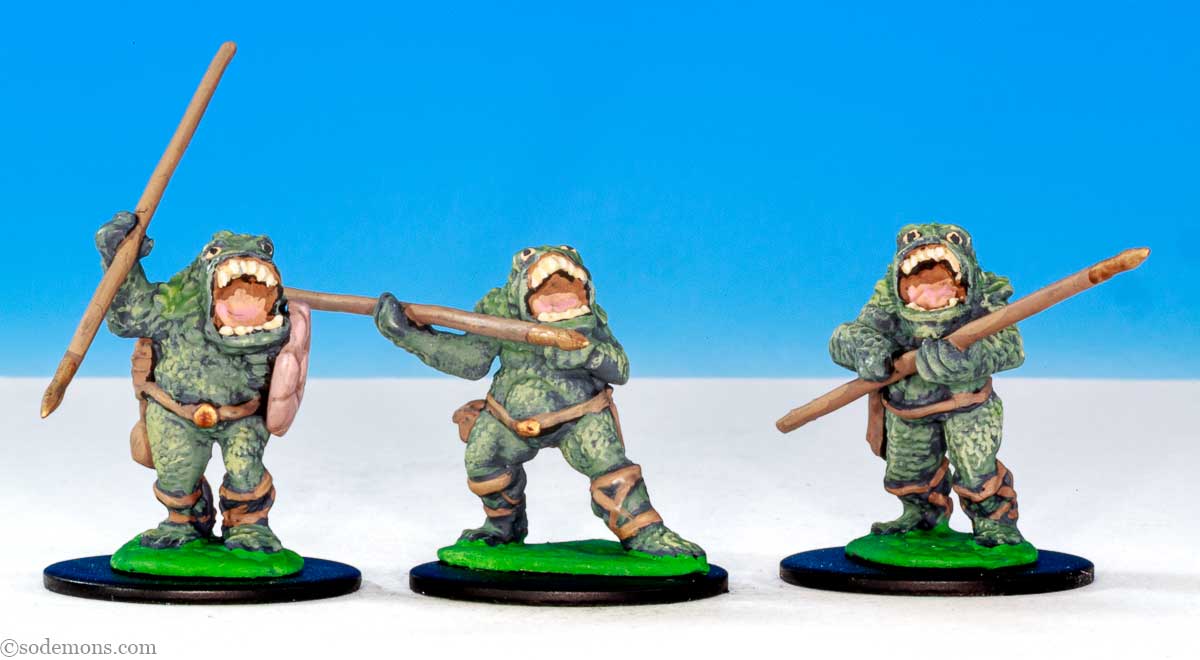
A few other humanoid fish types were released, such as the Fishman in the C38 Chaos Beastmen release and the early WH40K minitaure “Zhar d’uin, Piscean Prince,” but there was no further attempt to develop the Menfish concept or to create another aquatic or amphibious race.
Blazindragon left a comment in my post on Chaos Snakemen asking if I could cover the Fishmen for WFRP 4th edition, so here goes. As always, what follows is in no way official and should be considered a fan work. No challenge is intended to copyrights or trademarks held by Games Workshop, Cubicle 7, or anyone else.
Menfish

Menfish live in the underwater caves beneath the sea, and a few communities have been found in larger lakes. They live by fishing, mounting night-time raids on coastal villages, and sinking ships. Loyal only to their own kind, they attack the communities of Humans, Elves, Greenskins, and others without making any distinction between them.
The Sea Elves and other peoples have sent embassies to the Manfish communities of the northern seas proposing alliances against the forces of Chaos, but without success. It seems that the Menfish treat all outsiders as enemies, and only a handful of ambassadors escaped with their lives.
| M | WS | BS | S | T | I | Ag | Dex | Int | WP | Fel | W |
| 4 | 30 | 20 | 20 | 20 | 30 | 25 | 30 | 25 | 30 | 15 | 9 |
Traits: Afraid (Fire, Sunlight), Amphibious, Animosity (other species), Bite +4, Cold-blooded, Night Vision, Swamp-strider, Territorial, Weapon +6
Optional: Armour 1, Hatred (other species), Ranged +6 (6 yards), Stealthy
The Monsters so Far:
Leaping Slomm Two-Face: Another Old Citadel Miniature
Here is another creature from the “The Mark of Chaos” article in The First Citadel Compendium.

Slomm was one of three creatures presented as worked examples of the article’s Chaos attributes system.
Miniatures were made for all three, but Slomm was the only one to appear in two versions. According to the excellent Stuff of Legends web site, the original design, based on Tony Ackland’s illustration, did not cast well. By the time the second Citadel Compendium was published the following year, it had been replaced by a more upright version, and the original is now a collector’s item.
Slomm has sunk into undeserved obscurity, although there was a flurry of excitement in 2014 when some images of Tim Prow’s “Son of Slomm” project appeared on the Realm of Chaos 80s blog.
Tim’s Diehard Miniatures still produces the “Son of Slomm,” though I didn’t know until Garrett Sheehan pointed me to it. Thanks, Garret!

Below is my re-imagining for Warhammer Fantasy Roleplay 4th edition, using the expanded Physical Mutations table in the Enemy in Shadows Companion and the free 4th Edition Conversion Rules from Cubicle 7. Needless to say, what follows is in no way official and should be considered a fan work. No challenge is intended to copyrights or trademarks held by Games Workshop, Cubicle 7, or anyone else.
Leaping Slomm Two-Face, Chaos Troll
Trolls are often found among the forces of Chaos, and many show signs of corruption and mutation. Some acquire too many mutations and become Chaos Spawn. This fate almost certainly awaits Slomm, at some point in the future.
| M | WS | BS | S | T | I | Ag | Dex | Int | WP | Fel | W |
| 8 | 30 | 15 | 55 | 45 | 10 | 15 | 15 | 10 | 20 | 5 | 38 |
Traits: Ambidextrous, Armour 2, Bounce, Die Hard, Fear 2, Frenzy, Infected, Mutation (see below), Regenerate, Size (Large), Stupid, Tough, 2 Tusks +9, 2 x Vomit, 2 Weapons +9
Mutations: An asterisk (*) indicates that Slomm’s stats and Traits have been amended to reflect the mutation’s effects.
- Multiple Heads (new)*
- Beast Head (Walrus – new)*
- Long Legs*
Walrus?
There are no rules for a Walrus head in the Enemy in Shadows Companion, so I decided that Slomm’s tusks replace his normal bite attack, adding +1 to Damage because of their size.
The second miniature has much smaller tusks, and it would be appropriate to give it the Bite +8 attack common to all Trolls. The same is true of Tim Prow’s “Son of Slomm,” which has one dog head and one Rat-Ogre head.
The Monsters so Far:
The Mud Elemental: Two Old Monsters Combined for WFRP4
The Viydagg and Mardagg were not the only unusual “elementals” in Citadel’s miniatures range in the ’80s. The C22 “Creatures” range included a Mud Elemental, for which game rules and stats were never published.

Five years later, in the Doomstones adventure Blood in Darkness, a creature named Xhardja appeared. Also made of living mud, Xhardja took the form of lashing tentacles that rose up to attack trespassers in its mud-choked lair.

I wondered whether these two creatures might be one and the same. While Xhardja didn’t rear up in humanoid form to talk to the PCs, it is entirely possible that it could have done so. So I decided to combine the two. Here are stats for WFRP4. As always, everything that follows is to be considered a fan work and no challenge is intended to copyrights held by Games Workshop, Cubicle 7, or anyone else.
Mud Elemental

There is some debate among Wizards and other academics over whether or not these entities are true Elementals, or constructs magically animated from mud, or something else entirely. Those who reject the term “Elemental,” and those who do not concern themselves with such distinctions, simply call them Mudmen.
Mudmen are found in swamps and other muddy areas, both above and below ground. They can draw themselves up into a humanoid shape or sink down and become indistinguishable from the mud around them, attacking with a number of tentacles of animated mud.
Two profiles are provided below, one for the creature’s humanoid form and one for a single tentacle. The creature has a number of tentacles equal to its Wounds score, and each tentacle that is destroyed reduces the creature’s overall Wounds total by 1.
Humanoid Form
| M | WS | BS | S | T | I | Ag | Dex | Int | WP | Fel | W |
| 3 | 45 | – | 45 | 50 | 45 | 20 | 35 | 40 | 55 | 25 | 19 |
Traits: Amphibious, Bash (2) +8, Construct or Daemonic, Dependent (Mud), Dark Vision, Painless, Shapeshift (Mud), Swamp-Strider, Unstable
Optional: Die Hard, Size (Large), Territorial
| New Traits Dependent (Various) The creature requires something to sustain it. At the end of every round in which it has not been in contact with the required substance, the creature loses 1 Wound regardless of Toughness and armour. Shapeshift (Mud) The creature can shift between humanoid form and an amorphous form in which it becomes one with the surrounding mud. The transition takes a full Action. While shapeshifted into amorphous form, the creature is vulnerable only to attacks that have an area of effect or to attacks directed against its tentacles. |
Tentacle
| M | WS | BS | S | T | I | Ag | Dex | Int | WP | Fel | W |
| 2 | 33 | – | 45 | 50 | 65 | 10 | 15 | – | – | – | 1 |
Traits: Amphibious, Painless, 1 Tentacle +6, Swamp-Strider, Unstable
Optional: Die Hard, Size (Large), Territorial
 Graeme Davis
