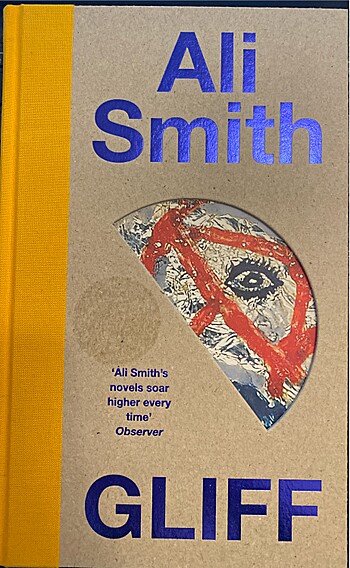
Hamish Hamilton, 2024, 280 p.
 Even without reading a word, a glance at the interior of this book would immediately let you know it is by Ali Smith. It has her usual unjustified right margin, giving the text a ragged appearance, the Sabon MT Pro font, and the uncapitalised section titles (here horse, power, lines) rendered in bold type.
As to the novel itself, it is a kind of follow-on to Smith’s Seasons quartet (quintet if you include Companion Piece) Set in an unspecified future in an apparently authoritarian state (though one never explicitly spelled out as such) where people can be designated UV (unverifiable) it tells the story of Briar (Bri, the non-binary male who narrates it) and their sister Rose.
Their mother kept them off-grid, therefore unverified. She refused them smartphones, told them, “There are different realities, and the net is a reality with designs on general reality, and I’ll prefer it if you both experience the real realities as your foremost realities.”
They had lived with their mother and her man friend Leif before their mother left to look after her sister’s interests. After visiting her one day, they come home with Leif to find the house surrounded by a red painted line, rendering them personae non grata. They have to leave in their campervan. That night the campervan also has a red line painted round it while it is parked. Leif takes off, ostensibly to find their mother and the siblings are left to fend for themselves.
As they are travelling the pair come across a field with horses in it and are accosted by a boy named Colon who says the horses belong to his father. Colon notices their bare wrists and wants to know where their educators are (pointing to where his is) and is confused when they say they don’t have any.
In a later encounter Colon’s brother, Posho, spouts all sorts of mysogynistic nonsense to Rose but lets her know of the Adult retraining centres, Arks, and child retraining centres, Circuses, where the unverified are set to work, on “majorly foul jobs” and, if they refuse, they disappear. Rose takes to one of the horses, calling it Gliff (a word meaning glimpse, or glance, a fright, a brief moment or a gleam of light – or everything and nothing at the same time.)
In later sections it becomes clear Bri is narrating this in retrospect when he has been separated from Rose but accepted into the authoritarian system and is trying to subvert it from within.
Gliff is a propulsive book about forced alienation and the difficulty, as well as the need, to resist it.
The people who need to read Gliff almost certainly won’t. The people who do read it will most likely be convinced of its message before they do.
Pedant’s corner:- No entries.


