Image

Season’s Greetings to all my readers

Season’s Greetings to all my readers. The end of the year starts early with the Blender Studio’s Xmas Party, and it is not even December. Blender is a place where contemporary art and street art meet, get cut up and mixed about. Its annual Xmas party is a mix of an exhibition opening, an open studio and an end-of-year party; live music by Get Rumpus, performance art, a bar (the Blender Art Cafe is new) and a sausage sizzle.

Image
Akemi, Transcendence, resin 91x26x30

It was hard to tell how many people were at the party, as Blender is a warren of small studio spaces spread across two floors in a former pub in West Melbourne. Artists, musos, art collectors, undercover Sigmund Freuds… Heesco leading a small horde of two other Mongolians from studio to studio. Listening to Sandrew talk about trying to establish a Melbourne Street Art Centre, an institution that is well overdue. Their “Outsiders Melbourne” exhibition this year demonstrated the public interest in seeing a good collection of street art.

Another demonstration of public interest in exhibitions about popular mediums, Auto Photo: A Life in Portraits, a collaboration between the Centre for Contemporary Photography and RMIT Gallery, attracted 30,000 visitors and led to a photobooth being permanently installed at RMIT. It was a particularly memorable exhibition for me because my lifetime photobooth collection was included. Thank you to Catlin Langford and Metro Auto for curating the exhibition; it was a life-affirming moment for me.

But on the subject of the institutions of the art world. Let’s turn our attention to their use as symbols of the civilised, cultured, progressive, tolerant state by the genocidal war criminals. This year, the submissiveness of senior administrators in assisting political censorship has destroyed the credibility of many Australian institutions, including Creative Australia, various state libraries, universities, book festivals and even Melbourne’s Royal Children’s Hospital. Faced with the decision to trust their staff’s decision-making capability or show subservience to war criminals, very few institutions have shown any integrity or even honesty. Consequently, Zionists now have the kind of censorial control that Archbishop Pell wanted when he tried to have Andre Serrano’s Piss Christ removed from exhibition at the NGV in 1997.

Image

Although I haven’t been visiting as many galleries as I used to. Nor going to as many parties like the one at Blender. But I’m still walking along the city’s lanes and alleys, keeping my eyes open for street art and graffiti. This year, the angry snowman has expanded his image tagging, taking PAM the bird’s position as one of the most prolific public image-makers in the city. Also, somewhere close to the top of that list should be Carmadymnd, whose assemblages on tiles could be seen, glued to walls across the city.

Image
Carmadymnd

This is my 52nd post of the year, my last. I’ll be taking a break now, but I intend to be back early in 2026 with more posts about Melbourne’s visual arts and culture. Thanks to Dan Wollmering for being a driving force behind several blog posts this year. Thanks to Paul Gorman for his tour of the Toorak Village Sculpture Show. Shout-out to Lorraine for sharing information about street artists. And thank you for reading/subscribing.

Cheers, Mark

Image

Unseen – Art Crime in Australia

There is the seen, and there is the unseen; likewise, there is history, and there is un-history. Just because something is unseen doesn’t mean it doesn’t exist, as do the unmentioned, the under-acknowledged and underrepresented parts of history. Un-history is what is untold, not discussed, the blind spots in the narratives. In art history, money, copying, and art crimes are not discussed.

Image

In her new book, Unseen – Art Crime in Australia, Dr Penelope Jackson argues that art crimes are part of art’s un-history. The theft of Picasso’s Weeping Woman is not mentioned on the didactic card beside it in the gallery. Nor is the unauthorised removal of Picasso’s La Belle Hollandaise for the Queensland Art Gallery, as the man who broke into the gallery to take it has told me several times. (I’m not a random reviewer but a long-time observer of the intersection of art and crime in Australia.)

Art crimes need to be exposed more, as do the other unseen elements of the art world. Raising awareness that art crime is not a victimless crime, and that its victims are not only wealthy art collectors. Indigenous people are now common victims of both art theft and art forgery. And the most common of victims are artists who stereotypically are living in poverty, and actually living in relative poverty.

From criminals avoiding detection to victims reluctant to publicise thefts and forgeries, art crime is often intentionally unseen. There is a chapter on the normally unseen backs of six forged or faked paintings. And although the subtitle of the book is“Art and Crime in Australia”, Jackson keeps the main title, the unseen, as a constant theme in the book, even when it isn’t about art crime. There is a chapter on copies, which, although fake and forgery-related, is a separate subject. However, given the current status of copies in the art world, where the NGV’s copies are consigned to storage, they are part of the unseen un-history of art, along with women artists, Australian artists who practice offshore, and data and statistics.

In general, data and statistics about the art world are limited to non-existent. Data and statistics on art crimes are not available; the police classify miscellaneous things as “art”. But there is no data on vandalised or damaged works in public collections.

In one chapter, Jackson examines whether being the repeated victim of art theft affects an artist’s work’s value; the answer is no. She presents 20 cases of theft involving paintings by William Dobell. It wasn’t that the thieves were targeting Dobell, who was a popular and prolific artist whose work was in many collections. Measures of popularity are relatively easy, but what does “prolific” mean? Jackson turns to the data when it comes to this overused description of an artist.

The theme of the unseen serves Jackson well. From her imaginary exhibition of stolen art, because so much is missing and probably will never be recovered, the missing provenance of forgeries, and finally, the missing specialist law enforcement in Australia, the missing evidence, and prosecutions. So much about art crimes is missing, not here, untold, unmentioned, the under-acknowledged and underrepresented; in contrast, Jackson’s book has the details of the art involved in many art crimes, great and small.

Jackson focuses on the art rather than the details of the crimes, tracing their sometimes surprising origins and destinies. As a former public art gallery director and curator, she is keen to locate the art and is interested in the physical object. However, this background doesn’t serve her well in examining vandalism, where she spends five pages complaining about the unmentioned but negligible cost of damage caused by climate activists, compared to the three pages she devotes to $4.2 million in damage by climate change when the Lismore Regional Art Gallery was flooded. In this case, the damage to institutions’ reputations appears to be a greater concern than the damage to art.

Image
The back (in verso) of a forgery

A final detail about Unseen: the book launch was at Lauraine Diggins Fine Art, a commercial gallery in a quiet Caulfield North street. The location has resonance in the history of exposing art forgery in Australia, and one of the forgeries that motivated this was on hand as a visible example of the detail a forger will add, even to the back of a painting. Lauraine Diggins Fine Art does not consider itself an art crime victim, more of an avenging angel. She funded the Grimwade Centre for Cultural Materials Conservation to establish authentication services, which, in turn, have exposed more forgeries.

Penelope Jackson, Unseen – Art and Crime in Australia (Monash University Publishing, 2025)

Image

The Genius of Chromatovore

This is genius-level placement. I’ve written about the importance of placement in street art before, but this is one step beyond finding the perfect location for a piece. The paste-up bird is not transparent; it is printed on opaque paper, as you can see from the white parts. It has been carefully placed over the existing graffiti. Chromatovore must have photographed the site before creating his paste-ups. I don’t know who did the snail he pasted over; the WWW crew of World’s Worst Writers do a lot of graffiti in my area, but I don’t think it is one of theirs.

Image
Chromatovore

This boarded-up shop front on Munro Street, in suburban Coburg, has long been covered in graffiti, paste-ups and people writing random stuff. Milk Bars and other small shops were once found on suburban street corners. They have mostly shut now, made redundant by the supermarkets, but the buildings remain, reused and repurposed as living or storage spaces.

Another of Chromatovore’s paste-ups reads on the same wall, “What is real?” Beside it is another paste-up with a colour shift version, and another with the pixelated version of the “Munro Street Boys”, the graffiti writing they are pasted over.

Image
Chromatovore paste-ups
Image
Chromatovore paste-up details

More from Chromatovore’s back catalogue, and why I know his pronouns, because years ago I saw him putting this one up. He looked like a dad pushing his kid in a baby carriage, with his paste-up supplies stashed in the bottom. (It is like something that Phoenix would do, now that he is a grandfather.) That was 2014, so I guess his kid is a bit more independent now, and dad/Chromatovore has some time to get back to his street art. Back then, his CCTV camera character was cute but not colourful; now Chromatovore is living up to his name with all this colour.

Image
Chromatavore

I mentioned his paste-up in a blog post, and so his name has become burned into my memory.

Has anyone else seen any work by Chromatovore?

P.S. 11/12/25 Most of these works by Chromatovore were buffed by the owner of this derelict storefront. Very random and incomplete buffing; maybe he ran out of paint.

Image
Buffed Chromatovore

However, the genius of Chromatovore’s placement is that he simply added a new copy on top of the old, creating a view through the buffing.

Image
Chromatovore

Street Art, October 2025

A look at some street art and several notable locations around Melbourne during October 2025.

Image
Hello my name is… Hosier Lane

The fame of Hosier Lane, coupled with its convenient location, makes it a victim of its own success. Tourists continue to take selfies there, regardless of the quality of the pieces on the walls. The best new addition has to be the giant “Hello My Name Is” stuck high enough on one wall to deter all but the most ambitious of toys from adding their stickers.

Image
Louis Moore

Further along Flinders Lane, AC/DC Land and Duckboard Place are where the better street art is still being done and enjoyed. Muralist and graffiti artist Louis Moore is also a street artist painting animals, particularly the quintessential birds of the streets, pigeons. They are like Banky’s rats to Moore. There are generally a couple of other street art aficionados here taking photographs.

These are relatively easy to find, but the less well-known location and the added complexity of navigating to Presgrave Place mean that it offers nothing to graffiti writers and obsessive taggers looking for highly visible locations. Here, the work doesn’t get covered over; it just builds up and slowly grows.

Image
SB6Six

Drewery Lane has a bit of work by the usual suspects and the odd combination of an official Legacy community mosaic, which has been added to by street artists, including SB6Six, Take the Topo and the ubiquitous carmadymnd.

Image
Alfiêiûm

In all of these locations, there have been blue and pink stencils by Alfiêiûm. And more from Baden Johnson with his church of AI (see my earlier blog post), in the form of crudely made statues and rudimentary printed paste-ups —a marked decline in technology and finish. Is this part of the enshittification process of the church of AI? Or, a covert nod to the only human worker?

I keep visiting these locations and noting my observations in this blog to create a durational record of Melbourne’s street art movement.

Image
Church of AI

The Melbourne Art Library

I now have a library card for a new library in Coburg. The old Railway Station, a narrow red-brick nineteenth-century station building now under the new overhead railway line, has been turned into a specialist library, the Melbourne Art Library. The art library has art and design books, rather than being a library that loans art (for that, see my post on Art Bank). The former station’s waiting room, with its high-arched windows, creates a well-lit and attractive space.

Image
The Melbourne Art Library

Although it has only recently moved into the old station building, the Melbourne Art Library is a volunteer-run organisation that began five years ago. It is a free, not-for-profit lending library, and I hope it will be a big assistance in my research. As I’m not associated with any institution, in the past, accessing such material has been difficult or impossible. So I feel that the newly opened Melbourne Art Library will change my life, and maybe the lives of others researching or studying visual art or design. Not just with their collection, but by being another physical location that creates connections in Melbourne’s art and design.

The main problem with this library that I’ve found is that instead of organising their shelving by the Dewey decimal system, authors’ names or even broad genre categories like ‘sculpture’, they have organised it alphabetically by title. So Graeme Sturgeon’s book The Development of Australian Sculpture, 1788-1975 was amongst other books beginning with titles starting with a D. This isn’t great for browsing the collection and requires a specific (e.g. Development of… ) rather than general knowledge of the book (e.g. Sturgeon’s history of Australian sculpture).

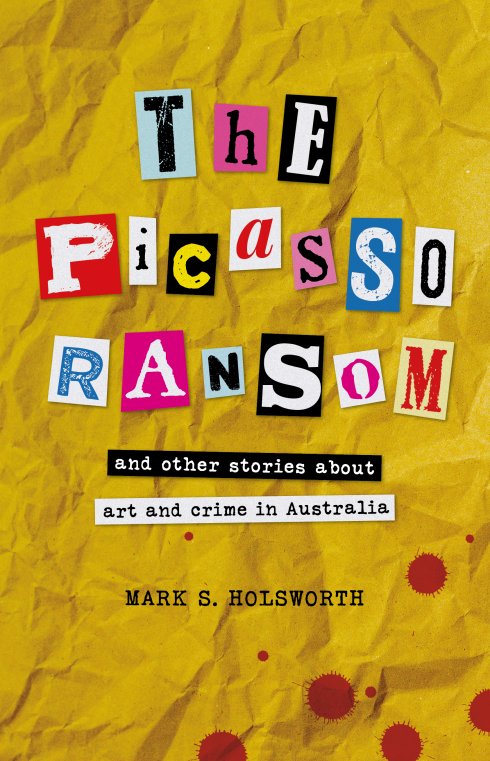
I’ve donated money to the library and offered to donate copies of my books, Sculptures of Melbourne and The Picasso Ransom, as well as duplicate issues of art magazines and catalogues that I have.

Image

Cemeteries as Sculpture Gardens

A bronze hound guards its owner’s grave. A bronze woman weeps on the steps of a tomb. An army of marble angels stands watch, wings folded, adorning tombs and mausoleums. This post is about another place I missed in my “Art beyond the Art Gallery”—cemeteries. Cemetery sculpture, like other forms of public sculpture, has a tradition of religious or ceremonial significance. Memorial monuments in cemeteries are private sculptural commissions in public space, and sculpture is part of mortuary practices. I’m not saying that the monumental masonry in cemeteries is great art, but it does represent the tastes of all those who can afford a tombstone. 

I recently visited Melbourne General Cemetery, primarily to see the grave of a bushranger turned prison sculptor turned memorial stone mason, William Stanford. Stanford was robbing people at gunpoint on the Bendigo gold fields before learning to carve bone, and then stone, during a very long sentence at Pentridge Prison. After his release, he assembled the granite fountain he’d carved in prison and then worked as a monumental mason for the rest of his life.

Image

His double grave plot, in a good location by the path, was initially his first wife’s grave, but later included him, his second wife, and their daughter. I don’t know if Stanford made any of the tomb himself; his wife’s family were also monumental masons. It could be the work of several different masons, as the white marble urn and wreath are of a different style from the rigid symmetry of its granite canopy. 

Image

I’ve made jokes about penisculpture measuring competitions — “who has the biggest?”— in this blog before, but I never expected to encounter one in a cemetery. Still, Governor Hotham was that kind of man, or at least his wife thought he was, for she ensured that his memorial would be the tallest in the state. I couldn’t help but see the subsequent erection—a neoclassical white phallic symbol—is at least partially concealed by trees. Imported from England, it is a rare piece of neoclassicism by the architect George Gilbert Scott, known for his Gothic Revival work, and the sculptor John Birnie Phillip, with whom Scott frequently collaborated.

My earlier blog posts about cemeteries include a look at the Springthorpe Memorial in Boroondara Cemetery and a search of Coburg Cemetery for the grave of a sculptor known for his war memorials. The Springthorpe Memorial, one of the finest, as well as one of the most over-the-top superstar displays of Victorian sentimentalism, is from a mourning husband to a wife who died in childbirth. Boroondara Cemetery also has other fine works of funerary art, including the Syme Memorial, an Egyptian revival temple. In Coburg Cemetery, C. Web Gilbert is buried with a simple slab and the minimum of text, ironic for a sculptor who made many memorials. 

Although I haven’t yet heard of a cemetery that promotes itself as a sculpture park, I wouldn’t be surprised if I did.

Image
Springthorpe Memorial

“Please make it stop”

On Friday night, I went to Leon van der Graaff’s exhibition “Please make it stop” at Pea Green Boat Artist Studios and Gallery. Pea Green Boat is in the group of three warehouses full of artist studios in Tinning Street on the east side of the Upfield railway line.

Image
Pea Green Boat Artist Studios and Gallery

“Please make it stop” is a small, self-curated retrospective in the gallery space at the front of the studios. Including an early film, originally shot on Super 8 and now on video, assembled sculptures, and Joseph Cornell-inspired boxes made of found objects. Ranging from fun to funky, van der Graaff’s art has lots of moving parts, recorded messages, small screens and cranks to turn.

Image
Leon van der Graaff, Untitled Self Port..

“Untitled Self Port..” consists of an adjustable shaving mirror with a boxing glove instead of a mirror, so you can see yourself being punched in the face. Leon van der Graaff’s art doesn’t have a punchline; it is more a sustained assault on conventional thinking. It is all meticulously presented, not surprising given that his day job is an arts technician/installer.

Image
Leon van der Graaff in his studio

Leon offers to show us his studio. Some artists’ studios have well-constructed walls, but not at Pea Green Boat; it is a shanty-town collection of studios with walls made from whatever materials were at hand. I half-expect to pass an open curtain doorway to see a family of refugees camped inside. Leon’s studio was too full of lumber from his day job for me to squeeze in. So he’s up on a ladder demonstrating more work on a shelf, along with junk he’s collected.

Image
Glenn Waverley and the Mentones at the Edinburgh Castle Hotel

After the exhibition, I walked on to the Edinburgh Castle Hotel, where Glenn Waverley and the Mentones were entertaining a mostly older crowd. They were playing what they called ‘western swing’, which is some kind of country style. The group has been playing around Melbourne since the 80s, and they look it, apart from the bass player, Geoff Irvin, who isn’t yet in his 60s.

Friday night… please make it stop.