“Andrew Shea: Grocery Slips” at J.J. Murphy Gallery, New York, NY

Via J.J. Murphy Gallery
Andrew Shea, “Morning Coffee” (2025); Courtesy J.J. Murphy Gallery
* * *

Andrew Shea’s paintings, the subject of an exhibition at J.J. Murphy Gallery, are quiet in their ambition and deceivingly modest in scope. The show’s title, “Grocery Slips,” couldn’t be more unostentatious, connoting, as it does, a vestige of everyday life that most of us can hardly be bothered with. The subjects of the canvases are similarly commonplace: the morning’s first cup of coffee, an afternoon siesta, one’s belongings refracted in a mirror, and, well, what is it that’s happening in the painting titled “9 A.M.”? 

A figure at her morning toilette, perhaps; a woman huddling in a dense robe, maybe. The scene is energized with a flurry of chromatic grays, and situated within an expanse of milky green. Selective dabs of ochre, blue, and red, along with gray, black, and ivory, dance toward the left of the composition, suggesting objects in the distance. How important is it that the viewer pin down the specifics of an image? Not much: It is enough that Mr. Shea has given permanence to a moment otherwise lost in the passage of time.

Image
Andrew Shea, “Grocery Slip” (2025); courtesy J.J. Murphy Gallery
* * *

“Grocery Slips” is the first New York City exhibition of a painter who has made a name for himself as an art critic, having written for the Wall Street Journal, the New Criterion, and the Brooklyn Rail. Mr. Shea is a rarity in a field renowned for its lumpish and often obscurantist jargon. His prose is supple, his eye nuanced, and his temperament appreciative — though he is capable of being pointed when the subject warrants skepticism. The German painter Gerhard Richter, Mr. Shea wrote in a memorable apercu, “has the whimsicality of an accountant.”

How well does the wordsmith fare as a painthandler? The tool most in evidence is among the least gainly: a palette knife. Imagine rendering an image in a manner not unlike spreading cream cheese on a bagel: detail and finesse are sacrificed for blunt shapes and a generous physicality. As a result, Mr. Shea’s paintings are endowed with a lush and somewhat counterintuitive monumentality. The surfaces are sumptuous to behold.

Image
Andrew Shea, “9 A.M.” (2025); courtesy J.J. Murphy Gallery
* * *

Mr. Shea claims as inspirations the poets William Carlos Williams and James Schuyler, temperaments who sought to underscore (pace Schuyler) “a nothing day full of wild beauty.” A similar elevation of the ordinary occurs in the intimisme of Pierre Bonnard and Edouard Vuillard. The former divined within the accumulative process of layering oils an underlying tenderness beneath the prosaic; the latter put brush to canvas with a terse obdurance and sneaking psychological portent. Mr. Shea is in direct correspondence with these precedents, and acquits himself handsomely in the process.

By virtue of its scale, the largish “Morning Coffee” (2025) should count as the show-stopper, and, truth to tell, its bravura run of warm, unnameable colors has much to recommend to it. But Mr. Shea has a gift with small formats, for condensed areas of real estate that prompt an exacting focus on suggestion. The cool grays that dominate “Wickenden Breakfast” and the tawny range of hues seen in “Drawing Session (A+B)” (2024) seem to expand beyond the borders of the canvases, endowing their miniaturist mises en scène with both gravity and grace.

For those who treasure art for how it can elaborate on the vagaries of everyday experience, Mr. Shea’s fetching array of “residual gestures” should not be missed.

(c) 2025 Mario Naves

This review was originally published in the October 30, 2025 edition of “The New York Sun.”

“Mistress Dispeller”

Via Oscilloscope Laboratories
‘Teacher’ Wang in “Mistress Dispeller”; courtesy of Oscilloscope Laboratories
* * *

Elizabeth Lo’s “Mistress Dispeller” begins with a run of text testifying to the veracity of the events we’re about to watch and how everyone in the film agreed to appear on screen. Ms. Lo was wise to do so: Her documentary had undergone a circuitous, three-year route, largely due to its original subjects — six married couples based in China — withdrawing consent to have their stories aired in public.

One motivator was the picture’s emphasis on adultery, not the easiest subject about which to be open, but so was the director’s duplicity. As outlined by a journalist, George Fenwich, writing in AnOther magazine, Ms. Lo “had to conceal the true nature of the documentary.” The wiggle room between cinéma and vérité is inescapable, but some filmmakers wiggle more than others. Ms. Lo re-started “Mistress Dispeller” with her ducks in a row and in plain sight.

Still, it’s a wonder what people are willing to do when a camera is in the room. Take Mr. and Mrs. Li, a middle-aged couple at the center of “Mistress Dispeller.” They are stunningly ordinary: The Lis have a modest flat in Luoyang, exercise regularly, and live a life of unostentatious comfort. Mr. Li is a man of few words; Mrs. Li is distracted. Boredom bred of duty typifies the marriage.

Mr. Li is never without his phone and rarely at home. What he’s doing and where he’s going is never made clear to Mrs. Li, but she has her suspicions. Mrs. Li and her younger brother visit Wang Zhenx, a 30-ish woman who specializes in saving marriages beset by infidelity and who goes by the honorific “Teacher.” A marriage counselor, you might think, but Teacher Wang’s methodology is distinctive: Using false pretenses, she enters into a couple’s life and attempts to save the union by, you guessed it, dispelling the mistress.

Image
Fei Fei in “Mistress Dispeller”; courtesy of Oscilloscope Laboratories
* * *

The practice has been with us or, rather, the denizens of China for about 20 years. Unhappy partners can spend significant sums of money to ward off those who would break up their marriages. A founder of the Weiqing Love Hospital, Shu Xin, avers that there are 33 ways in which a straying partner can be waylaid in his amorous pursuits. More than a million clients have engaged Mr. Shu’s services. How many of them were happy with its program is left unanswered.

Teacher Wang, upon being hired by Mrs. Li, pretends to be a friend eager to improve her skills at badminton — a sport at which Mr. Li is adept. A casual game turns into a dinner invitation at the Li home for which there’s been some serious machination on the parts of Mrs. Li and Teacher Wang. 

The women agree that Mrs. Li will make a fuss at the dinner table and leave Teacher Wang alone with Mr. Li. The plan goes into effect and Mr. Li confesses to having an affair with a business associate, a younger woman who cuts a slim and fashionable silhouette, Fei Fei. The mistress soon finds herself, and not without complaint, in the company of Teacher Wang.

“Mistress Dispeller” is a fascinating venture, surprisingly non-prurient yet unseemly all the same. It’s also sad, very sad. 

Among the more surprising insights gleaned from Ms. Lo’s film is Teacher Wang’s theory about mistresses: “When someone becomes a mistress, it’s because they feel they don’t deserve complete love.” Toward the end of the picture Fei Fei meets with Mrs. Li face to face under the guidance of Teacher Wang. The resulting conversation is remarkably sober and even-handed, but high drama all the same — the kind of scene documentarians dream about. How the dreams of our three principals are faring since the completion of “Mistress Dispeller” is a question you can’t help but ask when leaving the theater.

(c) 2025 Mario Naves

This review was originally published in the October 24, 2025 edition of “The New York Sun.”

“Kevin Brownlow” at Film Forum

Via Film Forum
Kevin Brownlow; courtesy of Film Forum
* * *

If Kevin Brownlow can’t be counted as a renaissance man, he nonetheless wears more hats than most of us can claim. Sure, Mr. Brownlow’s purview is the movies, but he comes at it from a number of angles: as filmmaker, author, preservationist, historian, Oscar winner, and, if his efforts in restoring Abel Gance’s “Napoleon” (1929) are an indication, an indefatigable optimist with the patience of Job. 

Casual cinema-goers will need patience, too, should they decide to attend the screening of “Napoleon” that will be held at Film Forum as part of a series of films honoring Mr. Brownlow. Coming in at five and a half hours, Gance’s epic will test the mettle of the most devoted film scholar. Should you hesitate in making room for a day at the movies, consider that a French director, Georges Mourier, has done additional restoration on “Napoleon” and added another 90 minutes. You’ll be getting off easy with Mr. Brownlow’s version.

Kevin Brownlow” comes five years after its initial scheduling, having been waylaid by the pandemic. Over the next few weeks, Film Forum will be hosting a run of pictures that honor Mr. Brownlow’s efforts as documentarian and director, as well as films that had a decisive impact on his aesthetic. Given that the estimable historian has devoted a significant part of his career to silent cinema, New Yorkers will be able to take in films starring, among others, Douglas Fairbanks Sr., Lon Chaney, and Harold Lloyd.

Mr. Brownlow’s 1968 book, “The Parade’s Gone By …,” is a lodestar of film history, being an enthusiast’s encomium to pre-talkie cinema. Although the author was too young to directly experience the silent era — a chronological fate Mr. Brownlow likely rues — he was able to interview those who were still on hand in the 1960s, including Mary Pickford, Gloria Swanson, and Buster Keaton. Chapters are devoted to the craft of filmmaking and specific movies like Allan Dwan’s “Robin Hood” (1923) and Cecil B. Demille’s first go at “The Ten Commandments” (1923). The book has never been out of print.

A three-part series Mr. Brownlow made with fellow historian David Gill, “Unknown Chaplin” (1983), should be manna for aficionados of film comedy. Narrated by James Mason, the programs feature rare footage gathered from the comic’s widow, Oona O’Neill Chaplin. Among the topics highlighted are the comedian’s cunning use of trick photography, his exhaustive working methods, and a seven-minute excerpt that didn’t make the final cut of “City Lights” (1931). Chaplin was right to expunge the scene, but it goes to show how exacting he was as a filmmaker.

Image
Charlie Chaplin at left; courtesy of Film Forum
* * *

Among the most curious pictures on view is “It Happened Here” (1964), a black-and-white fantasy written and directed by Mr. Brownlow and Andrew Mollo. Over the course of eight years, the then-teenage filmmakers imagined a Great Britain that had surrendered to Germany and was under occupation. It’s a scrappy effort, and rough edges are plain to see in its early minutes. With the subsequent aid of directors Stanley Kubrick and Tony Richardson, the boys pulled together a movie that suggests not only that evil is banal, but that bureaucracy is its primary mover.

Notwithstanding clunky moments of explication and off-the-rack actors — hundreds of them, few of whom were professional, and most of them volunteers — “It Happened Here” is smartly crafted and choreographed. Set in 1944-45, the story follows the travels of an apolitical Irish nurse, Pauline (Pauline Murray), who, in trying to get by, becomes a collaborator. The Nazi propaganda machine is incessant, and Pauline begins to buy into it. But, then she’s transferred to a country hospital whose idyllic surroundings belie a darker purpose.

Pauline is captured by the British resistance and is drafted into treating the wounded. Through it all, she remains fast and stoic, an observer of the new regime whose skepticism and dismay gradually increases. All the while, Mr. Brownlow and Gill bring a starkly poetic eye to limning the moral capitulations that sometimes come with war. “It Happened Here” ends on an abrupt and discomfiting note that, nonetheless, rings true for a dour, involving, and fascinating film.

(c) 2025 Mario Naves

This review was originally published in the October 24, 2025 edition of “The New York Sun.”
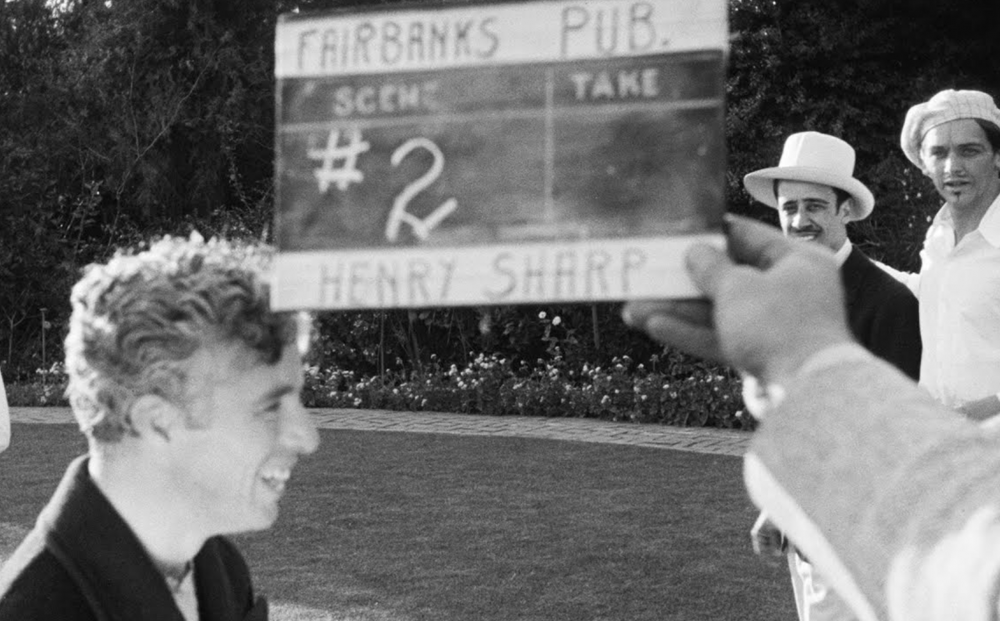
“The Man Who Saves the World?”

Via Rough House Pictures
Patrick McCollum in “The Man Who Saves the World?”; courtesy Rough House Pictures
* * *

Gabe Polsky’s “The Man Who Saves the World?” is an odd film on several counts, detailing, as it does, the efforts of a lone individual on his quest to set the cosmos aright. It’s worth noting that three of the picture’s executive producers are affiliated, largely if not exclusively, with comedy. 

Danny McBride and David Gordon Green are responsible for, among much else, the HBO series “Eastbound & Down” and “The Righteous Gemstones.” Peter Farrelly garnered an Oscar for Best Director of “Green Book” (2018), but he’s likely best known for a spate of rude comedies on which he collaborated with his brother Bobby, including “Dumb and Dumber” (1994) and “There’s Something About Mary” (1998).

Mr. Farrelly has gone on record as describing “The Man Who Saves the World?” as “life affirming.” Mr. Polsky hopes that it will prompt viewers to wonder whether “maybe, just maybe, the world is opening up to something new.” But these observations are on paper. The director’s onscreen conclusion is, I think, more telling: “It’s really easy to doubt and judge … how we see this story reveals everything about who we are.” 

In other words, cast your skepticism to the wind lest we have to suffer a fool like you. Given Mr. Polsky’s demeanor — he appears in “The Man Who Saves the World?” as low-key and humble, a naif by choice — you wouldn’t think him capable of doling out condescension as back-handed as all that. But, then, one might need a rationale for having spent months, perhaps years, taking note of the quixotic adventures of Patrick McCollum.

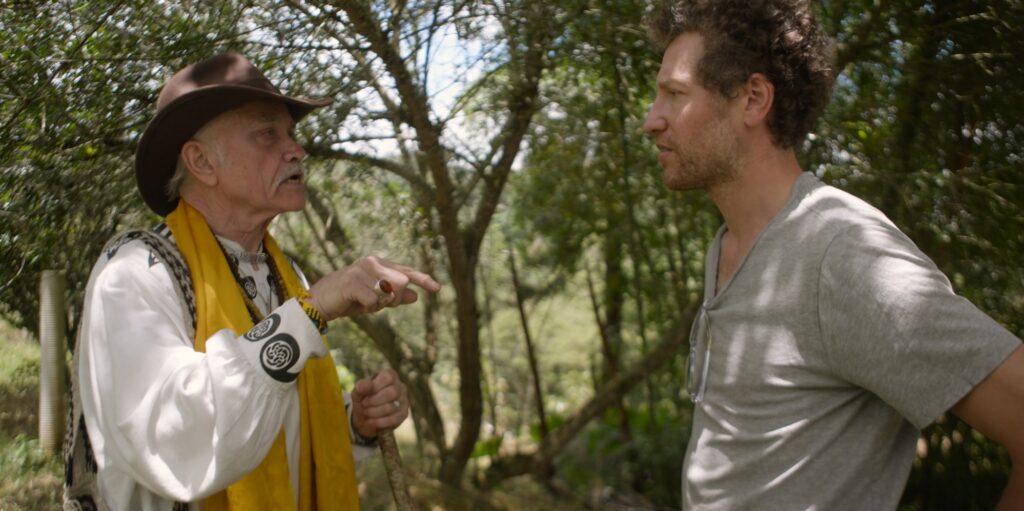
Image
Patrick McCollum and Gabe Polsky in “The Man Who Saves the World?”; courtesy Rough House Pictures * * *

The last time we heard from Mr. Polsky was “Butcher’s Crossing” (2022), a horse opera of impressive metaphorical grit. This time around, he’s put on a documentarian’s hat to pick up the trail of Mr. McCollum, racking up frequent flyer points following the sacred activist and interfaith chaplain to various world locales. Toward the end of the film, Mr. Polsky posits that he has served as Sancho Panza to Mr. McCollum’s Don Quixote.

The implication is that Messrs. McCollum and Polsky are inseparable partners, buddy-buddies in body and spirit. Still, Mr. Polsky must know something about Cervantes’s epic novel, “Don Quixote.” A few minutes before likening himself to Sancho Panza, he raises Mr. McCollum’s ire by implying that the activist’s long and complicated quest to save the Amazonian rainforest may be so much tilting at windmills. A patching up between the two men takes place, but just barely.

Mr. McCollum is a member of a grand tradition of American eccentrics, a man who has a can-do attitude in the face of significant odds. He’s at the center of a prophecy that has pegged him as the catalyst for, as the film’s title has it, saving the world. In order to do so, our hero must see to the reuniting of indigenous peoples of South America. 

This quest is of a piece with Mr. McCollum’s other exploits, including jewelry design, welding, kung fu, explosives, deep sea diving, sorcery, circus carney, chaplain to the Menendez brothers, and friend to the recently deceased Dian Fossey. Mr. McCollum is fluent in “magical languages” that allow him to communicate with flora. They have, apparently, some stories to tell.

Mr. McCollum is an affable man of modest means with a loving wife, a bad back, a cluttered household, and a second home out in the desert with a stairway that ascends to nowhere. Whatever one might think of his mission or the otherworldly portents to which he subscribes, there’s no doubting an abiding sense of purpose. 

Mr. Polsky is another matter, having milked one man’s far-ranging idiosyncrasies for a film that embodies a 21st-century variant on noblesse oblige by reviving the 19th-century notion of the noble savage. On those points, “The Man Who Saves the World?” isn’t funny at all.

(c) 2025 Mario Naves

This review was originally published in the October 22, 2025 edition of “The New York Sun.”

“Dark Magic: Hexes and Haunts for Halloween” at the Museum of the Moving Image

Via Wikimedia Commons
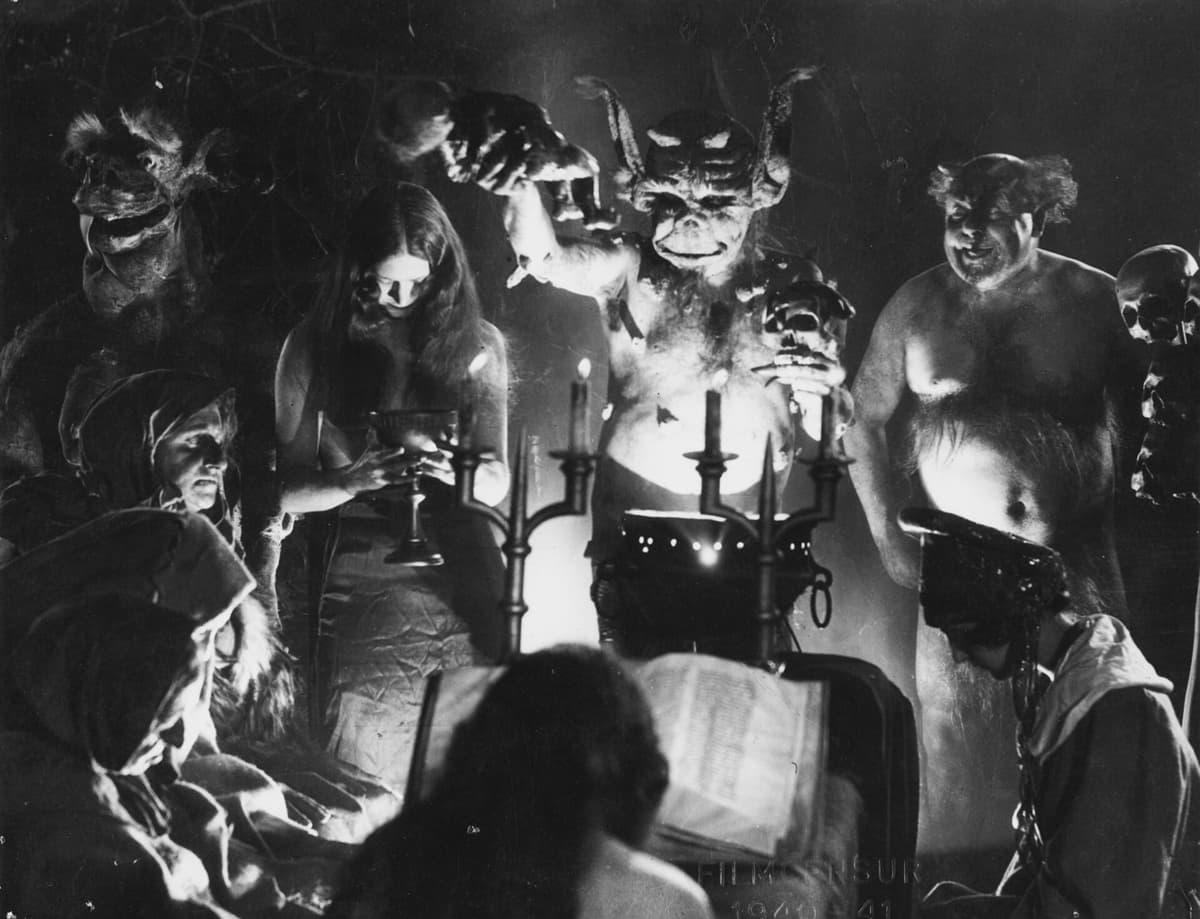
Scene from “Häxan” (1922); Via Wikimedia Commons
* * *

A senior curator at the Museum of the Moving Image, Michael Koresky, has teamed up with an Oscar-winning filmmaker, Jeff Reichert, to organize a run of pictures peculiar to the fall season, “Dark Magic: Hexes and Haunts for Halloween.” The program has been mounted in conjunction with the publication of a compendium of essays culled from an online magazine affiliated with the museum, Reverse Shot, and Messrs. Koresky and Reichert promise that New Yorkers will be suitably “ensorcelled” by their curatorial choices.

Incantations of a nefarious sort are the emphasis of the nine films in the MoMI series. Fans of cinematic witchery will bemoan the exclusion of their own particular favorites — mine would be Carl Dreyer’s brutal “Days of Wrath” (1943) and Michael Reeves’s “Witchfinder General” (1968), with its flinty title performance by Vincent Price. Still, “Dark Magic” is rife with curiosities; you can’t always have your bubbling cauldron and sup from it, too. 

The earliest item on the docket is Benjamin Christensen’s “Häxan” (1922), a picture that should engage those who take pleasure when the distinctions between fact and fiction become muzzy. A Swedish production helmed by a Dane, “Häxan” couches its exploration of all things supernatural in didactic terms, posing as an academic lecture laid out in discrete chapters. At the time the most expensive film made in Denmark, “Häxan” was deemed by Variety as “absolutely unfit for public consumption.” Even at this late date, it is remarkably lurid and often disturbing.

The development of the horror film is unimaginable without “Häxan.” Christensen looked to Bosch, Bruegel, and Goya in setting up the various mises en scène and employed stop-motion animation, puppetry, and optical effects to impressive effect: They’re all the more gritty for a relative crudity. Johan Ankerstjerne’s brooding cinematography and Richard Louw’s cunning art direction bring an uncanny veracity to scenes that might otherwise have been laughable. Pianist Makia Matsumura will be on hand at MoMI to offer appropriately eerie accompaniment.

Image
Via Wikimedia Commons
* * *

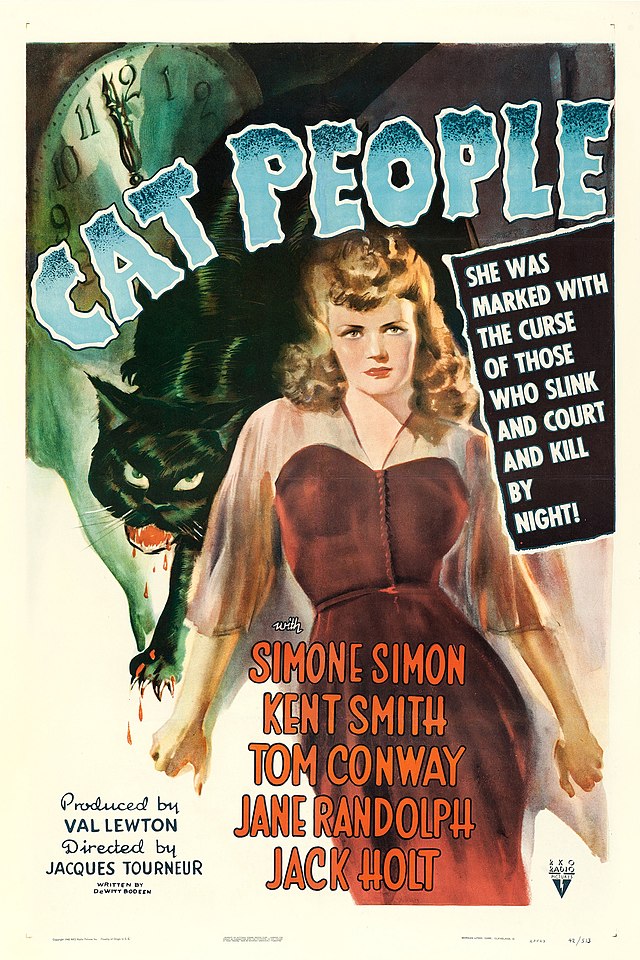
Jacques Tourneur’s “Cat People” (1942) set a cinematic standard for B-movies that, in terms of quality, belied the label. RKO Studios tasked producer Val Lewton to come up with horror movies on-the-cheap, providing him with suitably eye-catching titles. Lewton’s ingenuity and a gifted corpus of sidemen hunkered down to work on a sordid tale of “those who slink and court and kill at night.” The suits at RKO, initially skeptical about the results, kept their mouths shut when “Cat People” proved a smash.

Clocking in at an hour and a quarter, “Cat People” takes place in a Hollywood backlot that attempts to pass as New York City. Irena Dubrovna (Simone Simon) is a Serbian immigrant who lives in fear that she’s beholden to a curse that will transform her into a panther upon being sexually aroused. This puts a crimp in Irena’s marriage, and when husband Oliver (Kent Reed) begins to take a shine to his co-worker, Alice (Jane Randolph), the burdens of myth come true. All the while, Tourneur sustains a tenseness of mood and isolation.

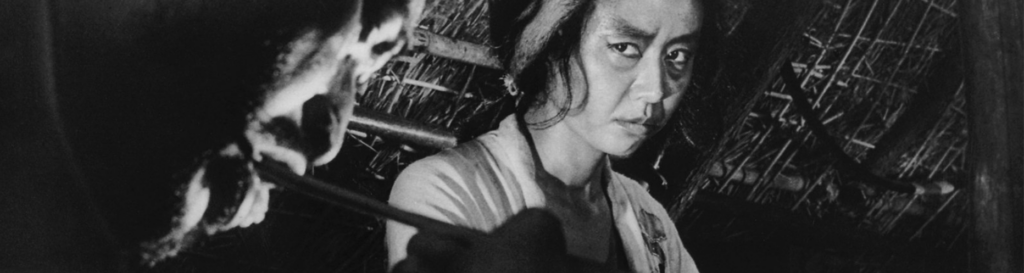
Kaneto Shindo’s “Onibaba” (1964) is, arguably, the best of the bunch, though historians, critics, and film buffs are likely to haggle on how best to classify its barebones story about war, famine, sex, and retribution. Set in mid-14th century Japan, “Onibaba” follows a nameless mother and her daughter-in-law (respectively, Nobuko Otowa and Jutsiko Yoshimura) as they navigate a war-torn country, summarily killing stray soldiers, dumping the bodies, and selling the armor to a local black marketeer, Ushi (Taiji Tonoyama).

Our protagonists have this murderous routine down to an art until a deserter, Hachi (Kei Satō), shows up at the door. The daughter takes a shine to the wayward soldier and they begin an affair. 

Image
Kei Satō and Nobuko Otowa in “Onibaba” (1964); Via the Museum of the Moving Image
* * *

Mom begins to fret about mixed allegiances, and when she acquires an elaborately stylized mask from a recent kill she uses it as a means of intimidating her daughter. The trouble is the mask comes with its own set of prerequisites, all of which are unexpected and most of which prove catastrophic. There’s a lesson to be learned here, so it comes as no surprise to find out that “Onibaba” had as its basis a Buddhist fable about hubris and deceit.

Shindo’s picture is powered by some fierce performances — Otowa’s as the ruthless mother is particularly intense — and the atmosphere is dense with sweat and desperation. The overall mood of the piece is dour, and should you want to assign an overweening sense of dread to the aftermath of the bombings of Hiroshima and Nagasaki, well, that’s the way the director planned it. By turns poetic, erotic, horrific, and philosophical, “Onibaba” has more layers than you might initially think, and is well worth attending to.

(c) 2025 Mario Naves

This review was originally published in the October 16, 2025 edition of The New York Sun.

“Darling” (1965)

Via Rialto Pictures
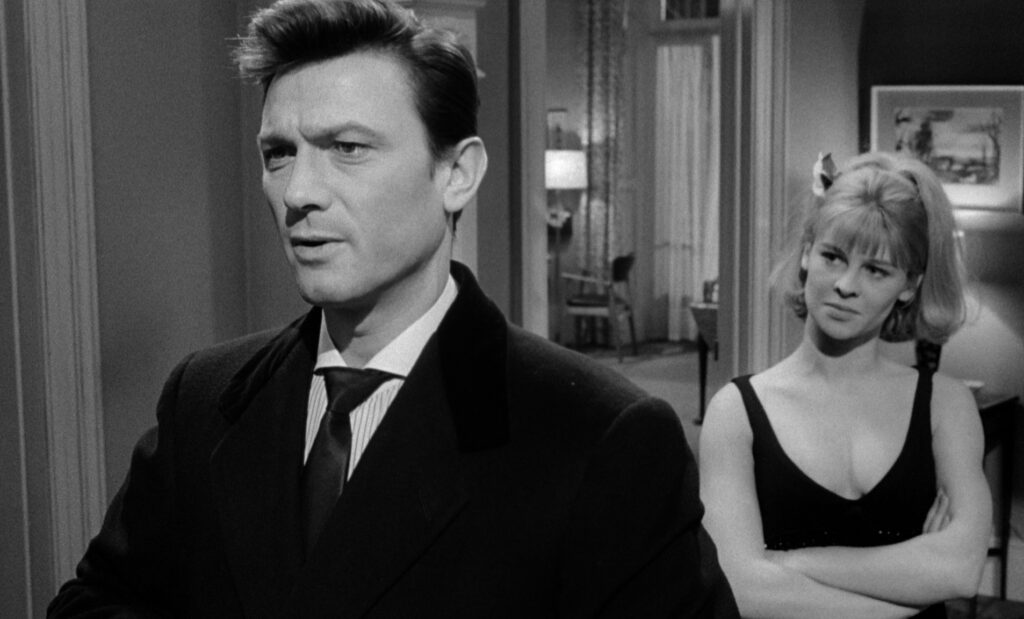
Julie Christie in “Darling” (1965); Via Rialto Pictures
* * *

John Schlesinger’s “Darling” (1965) will be undergoing a two-week revival at Film Forum on the occasion of its 60th anniversary. An international production and distribution company, StudioCanal, has overseen a 4-K restoration of the picture and, as such, the black-and-white cinematography of Kenneth Higgins will likely occasion huzzahs for its pewter-like patina. Schlesinger’s compositional strategies — often daring, sometimes ostentatious — are bound to gain in impact when seen on a big screen. That’s all to the good.

“Darling” did well at the box office back in the day, particularly here in the States, and racked up an impressive array of awards. Schlesinger lost out to Robert Wise as best director at the 38th Academy Awards — nothing could stem the juggernaut that was “The Sound of Music” — but the movie earned Oscars for Julie Harris’s costume design, Frederic Raphael’s original screenplay, and Julie Christie’s turn as the title character. 

Critics festooned Schlesinger’s movie with plaudits. Film societies from Moscow to Mexico chimed in with their laudatory two-cents, being especially generous to Ms. Christie. This was also the year that the actress appeared as Larissa Ameliava Antipova in David Lean’s “Dr. Zhivago.” Ms. Christie is likely better remembered for turn as the doctor’s true love than the flighty, self-absorbed, and rootless model, Diana Scott.

It might be worth mulling if Ms. Christie garnered the gold statuette less for “Darling” than for a memorable double-dip year because, let me tell you, Diana Scott is an appalling character. Unlikable or abhorrent dramatis personae need not stem the tide of a viewer’s engagement — our cultural heritage would be considerably slimmer without them — but when a protagonist’s failings are unredeemed by an aesthetic rationale, the cinematic row can be tough to hoe.

Image
Laurence Harvey and Julie Christie in “Darling” (1965); Via Rialto Pictures
* * *

Which was likely the point of a movie that tries to score points by underlining social inequities — the arrogance of capital, say, or the legacy of colonialism — by centering it on a character who is neither Candide-like in her innocence or a tabula rasa, but, rather, an attention-deprived sounding board of inordinate loveliness. Ms. Christie brings a fair share of actorly flourishes to her performance, and Harris saw to it that she looked fabulous even when in a state of deshabille. 

Still, Diana Scott remains too much a coefficient of the filmmakers’ cynicism. Working in conjunction with Frederic Raphael, whose script is often sharp and funny, Schlesinger establishes a cynical tone from the opening titles — in which fashion signage is posted over photos of starving Africans — and doesn’t let up. Would that his ire were more consistently applied, veering, as it does, between sharp social commentary and boorish condescension. If Mr. Raphael’s screenplay depended on Diana Scott having human dimension, then Schlesinger’s hand pretty much quashed it.

“Darling” follows Diana through a 1960s picaresque that is to London what Jean Luc-Godard’s “Breathless” (1961) was to Paris and Federico Fellini’s “8-1/2” (1963) was to Rome. Fans of the picture commend its period portrait of Swinging London, but there’s less of Carnaby Street in Schlesinger’s picture than the “kitchen sink” realism of which he was a proponent. Diana’s husband, Tony (T.B. Bowen), is an immature yob; her lover, Robert (Dirk Bogarde), an intellectual of humble means. When she trades up for a jet-setting advertising executive, Miles Brand (Laurence Harvey), any hint of modishness is summarily placed in the rubbish bin.

Should the idea of two hours spent watching Ms. Christie pout, emote, and otherwise take on the guise of a brat sound tiresome, be aware that Bogarde and, especially, Harvey are in fine fettle. The former’s portrayal of a man broken by a raft of bad decisions is as moving as it is pathetic; the latter plays it to the hilt as a man whose charms are no less seductive for being reptilian. Whether their considerable efforts are worth a few hours of your time will depend on just how much jaundice a body can withstand.

(c) 2025

This review was originally published in the October 9, 2025 edition of The New York Sun.

The New York Greek Film Expo 2025

Via Foss Productions

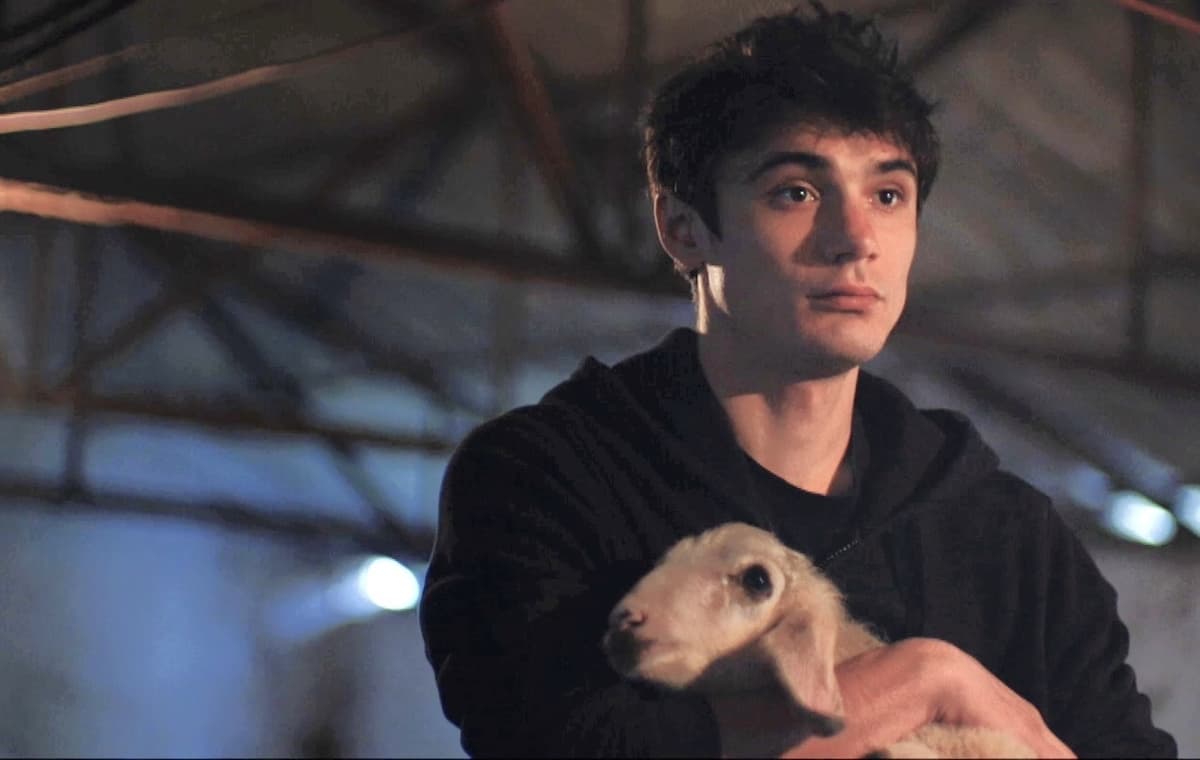
Kostas Nikouli in “Meat”; Via Foss Productions

* * *

The metaphor that can be gleaned from the title of Dimitris Nakos’s debut feature, “Meat,” is blatant, maybe too blatant. A primary component of the story is an unregistered slaughterhouse in the far reaches of a mountain village in Greece, a locale in which civic bonds and personal grudges are held tightly. A murder occurs, and though its repercussions prove difficult to bear for those within its orbit, that’s not to say that some lives aren’t considered more expendable than others. 

The moral quandaries at the core of Mr. Nakos’s picture are dense and difficult. Its abiding dilemmas can be likened to those found in the novels of Feodor Dostoevsky, Albert Camus, and Patricia Highsmith. Given the context in which I saw “Meat,” the New York Greek Film Expo, audience members couldn’t help but peg it as a Greek tragedy. Mr. Nakos, who was at the screening and fielded questions afterward, confirmed the analogy, pointing out that the power of the genre lies in its inevitability. We know a tragedy won’t end well.

“Meat” is one of seven recent films that will be making their American premieres at the New York Greek Film Expo, an annual event that is being held at three venues: Manhattan’s Village East Cinema, the Barrymore Film Center at Fort Lee, New Jersey, and the Museum of the Moving Image at Astoria, Queens. The latter has long been host to a recurring film series presented by the Hellenic Film Society, “Always on Sunday,” and has seen fit to mount a concurrent retrospective of a veteran Greek director, Pantelis Voulgaris.

Movie-goers curious about world cinema and who enjoy the experience of going to a theater are advised to mark their calendars: How likely it is that these films will get a broader release on these shores is an open question. The breakout picture from last year’s expo, Sofia Exarchou’s “Animal” (2023), is available to stream but has yet to have a proper American run. Why our art houses and revival theaters haven’t yet hosted the film is a mystery. “Animal” deserves to be seen.

Image
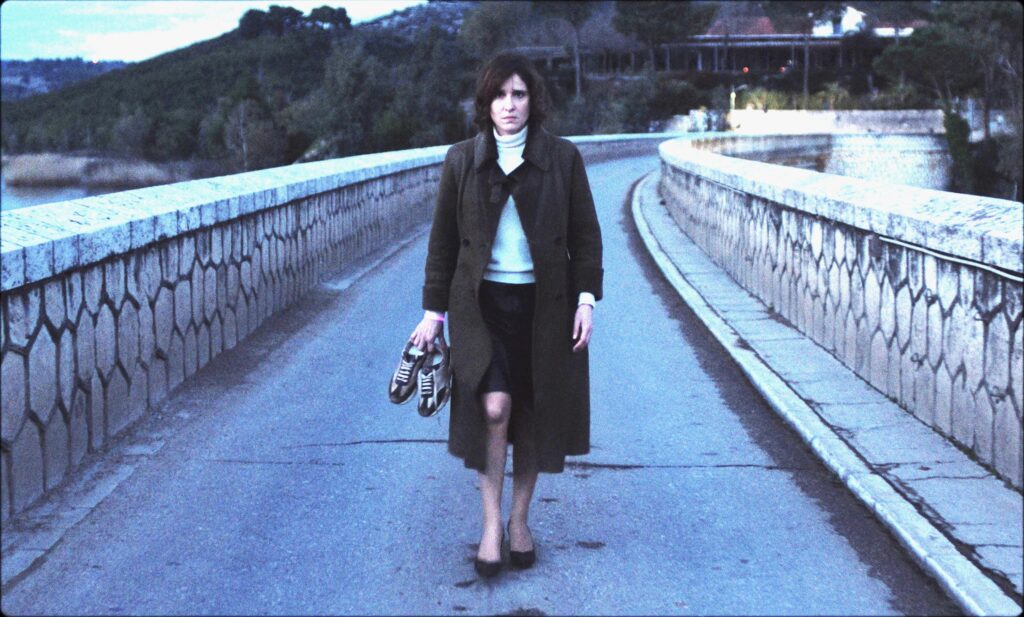
Angeliki Papoulia in “Arcadia”; via Foss Productions
* * *

This year’s expo opened with Angelos Frantzis’s “Murphy’s Law,” an alternate reality film about middle-age career disappointment, and questions that should not be mooted lightly. Mr. Frantzis is clearly conversant with cinematic staples like “Here Comes Mr. Jordan” (1941) and “Groundhog Day” (1993), and the picture’s uptempo rhythms recall the screwball comedies of Howard Hawks and Preston Sturges. Katia Goulioni, who has racked up plaudits and awards for her performance as an actress at the end of her rope, proves amenable to working with children and dogs.

Yorgos Zois’s “Arcadia” made a sweep of the Hellenic Film Academy Awards — it won Best Screenplay, Best Director, and Best Picture — and has been submitted to the Academy of Motion Picture Arts and Sciences as Greece’s nominee for Best International Feature Film. The scuttlebutt surrounding “Arcadia” posits it as heir to the so-called Weird Wave of Greek cinema, a genre known for its off-kilter, eccentric, and often unpleasant tendencies. A review in Variety notes that Mr. Zois’s picture “will hold limited appeal for those who generally look to find comfort at the movies.”

A similar caution could be applied to “Meat,” but Mr. Zois’s film is marked by an abiding sense of rectitude whose resonance is deeper than mere outrage. The story is as simple as death: A father strikes a deal with a valued associate to save the life of an errant son. The reverberations set into motion by the disappearance of a local man and the subsequent compromising of cultural loyalties are mirrored in Giorgos Valsamis’s jittery handheld camerawork, and amplified by a keening, atonal soundtrack by Konstantis Pistiolis. All the while, Mr. Zois plumbs the inner workings of the human psyche with an acuity that will, fingers crossed, garner the audience it deserves.

(c) 2025 Mario Naves

This review was originally published in the October 8, 2025 edition of The New York Sun.

“Ju Dou”

Via Film Movement
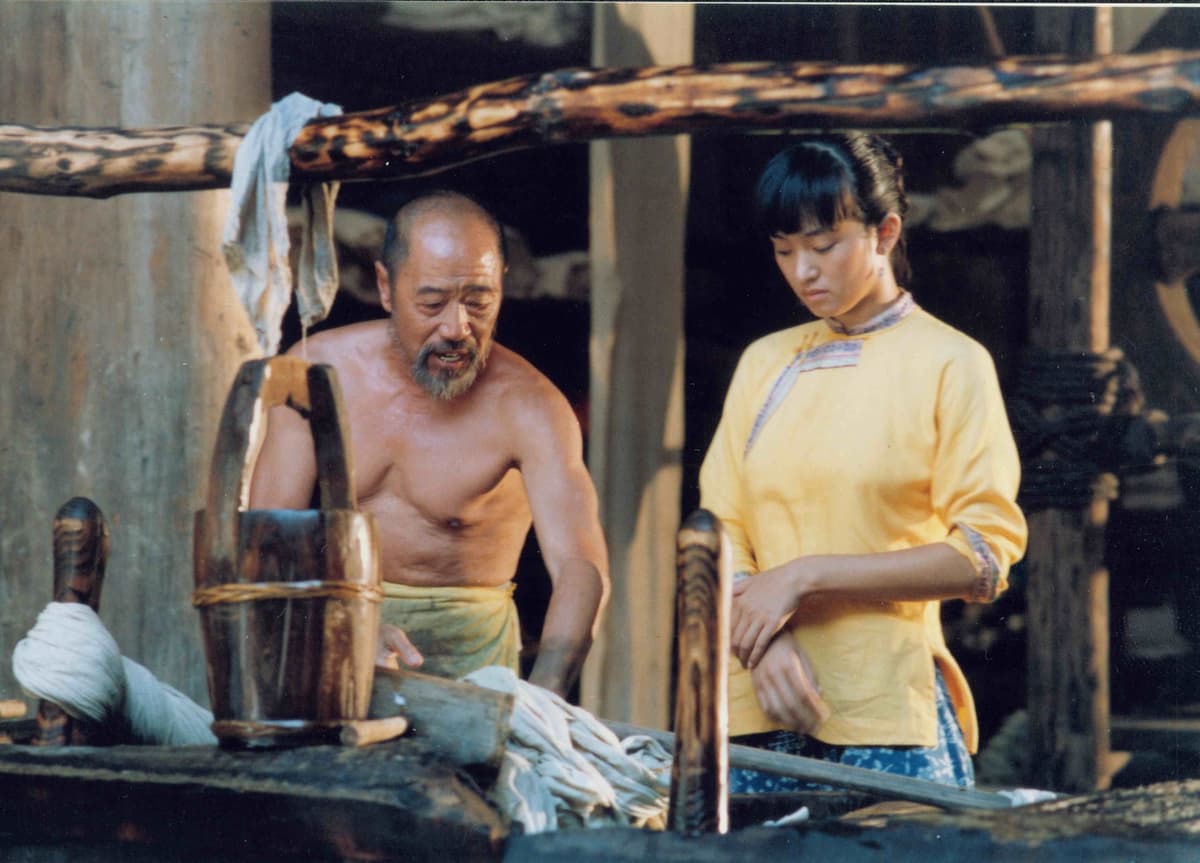
Li Wei and Gong Li in “Ju Dou” (1990). Via Film Movement
* * *

A 1990 film undergoing a revival at Film Forum, “Ju Dou,” is as sumptuous a morality tale as you’re likely to imagine. Co-directed by Zhang Yimou and Yang Fengliang, the picture was based on a novella by Liu Heng, “Fuxi Fuxi.” Mr. Heng adapted his book for the screen, but, really, this story of family bonds, community mores, and love gone awry could’ve been the work of Sophocles, Anton Chekhov, or David Seltzer.

One might ask: “David who?” Also, I suspect Mr. Seltzer might do a double-take at being lumped in with such an illustrious company. His book “The Omen” is likely best known for the 1976 movie version directed by Richard Donner and starring an ill-at-ease Gregory Peck. The plot, you’ll remember, dealt with a young boy who turned out to be the Antichrist. “Ju Dou” is nowhere near that apocalyptic, but it does raise distressing questions about the supposed inherent innocence of children.

Tianbai (portrayed by Yi Zhang as a child and Zhen Ji’an as an adolescent) is a boy whose only joy is causing distress. He carries himself in a severe manner and invariably pops up in situations at which the other parties are behaving badly. Tianbai is the hard-won scion of Yang Jinshan (Li Wei), the owner of a silk-dyeing mill and a vindictive old man. Did Jinshan kill his first two wives because they couldn’t bear children? That’s the scuttlebutt, and it seems probable.

“Ju Dou” takes place in a rural outpost of China around 1920, though the overall temper of the film is more feudal than modern. Tianqing (Li Baotian) is nephew to Jinshan, and has come to work for the old man. Upon arriving he learns that his uncle has taken a new bride, Ju Dou (Gong Li). Tianqing takes particular note of his aunt: How could he not? Ju Dou is young, beautiful, and covered in bruises: Jinshan is physically abusive, a tendency only exacerbated by his impotence. Ju Dou’s screams punctuate the night.

Image
Gong Li in “Ju Dou” (1990); Via Film Movement
* * *

The dye-works in which our protagonists live and toil is an elaborate, maze-like setting, an edifice with pools of pigmented liquid, elevated drying racks, and heaving wooden wheels. The filmmakers, who worked in conjunction with cinematographers Gu Changwei and Lun Yang, play up the panoply of colors and textures that festoon, engulf, and otherwise pockmark the surroundings. “Ju Dou” was filmed in Technicolor — a technology that had since been abandoned in the States. The picture has vivid, old school resplendence.

In and amongst the nooks-and-crannies of Jinshan’s homestead, Tianqing and Ju Dou begin a relationship. When Ju Dou becomes pregnant and later delivers a baby boy, Jinshan is ecstatic, believing that the child is his. For the sake of Tianbai and an abiding sense of family loyalty on Tianqing’s part, the couple keep their relationship secret and do their utmost to encourage the illusion of Jinshan’s paternity. All the while, Tianqing and Ju Dou continue to meet on the sly, their lust getting the better of them.

The dynamic between the players becomes ever more fraught, taking some bizarre and genuinely surprising turns. Jinshan earns our sympathy after undergoing an accident that leaves him paralyzed — but that doesn’t diminish his villainy — even as Tianqing and Ju Dou prove themselves capable of callousness and cruelty. All the while, Tianbai grows more sullen, more knowing, and increasingly punitive in his temper and actions. He’s not a good kid.

The upshot of all this is vivid, rash, and operatic, with a denouement that proves “Ju Dou” a fairy tale in which redemption is moot and forgiveness not forthcoming.

(c) 2025 Mario Naves

This review was originally published in the October 3, 2025 edition of The New York Sun.

“Good Boy”

Via IFC and Shudder
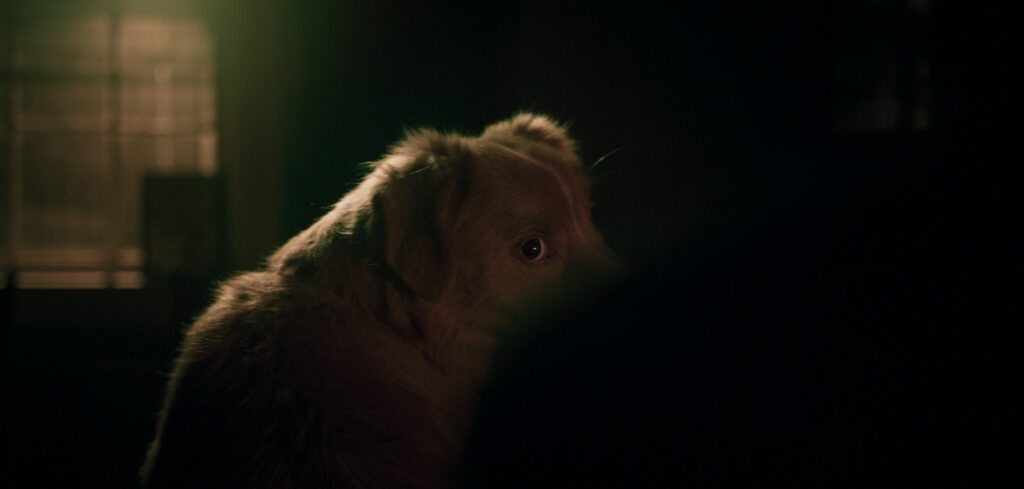
Indy in “Good Boy”; Via IFC and Shudder
* * *

For anyone who’s wondered what the family dog is looking at as it gazes intently toward a middle-distance at which nothing can be ascertained, Ben Leonberg’s “Good Boy” provides a supposition. His film is seen entirely through the purview of a Nova Scotia Duck Tolling Retriever and what the dog sees — well, it’s worrisome. The novelty of this approach is elaborated upon by (1) an inordinately clever filmmaker; and (2) a dog. I mean, who doesn’t love a dog?

Our star’s name is Indy, and he belongs to Mr. Leonberg and his wife and co-producer, Kari Fischer. The couple worked with Indy over the course of three years, placing him within closed sets at the family home. Notwithstanding its idyllic surroundings and homey ambiance, their cabin is not without creaky stairs, flickering lights, a basement better left unexplored, and things that bump, whimper, and scuttle in the night.

You’d best believe Indy is wiser to these things than his fictional owner, Todd (Shane Jensen). We rarely get to see Todd in toto and when we do, he’s usually engulfed in shadow. Humans are at the periphery of “Good Boy,” though it’s a human predicament that sets the story in motion: Todd is suffering from an unnamed but debilitating medical malady. He’s constantly receiving text messages and calls from his sister, Vera (Arielle Friedman). She’s worried about Todd’s health and, increasingly, his frame of mind.

Todd hightails it out of the city without giving Vera a heads-up, driving to their grandfather’s house out in the woods in order to get his head straight. The homestead is in need of upkeep — the electricity is, at best, iffy — and the weather is perpetually inclement. As for an apparition seen by Indy: Could it be the ghost of Todd’s long-dead grandfather (Larry Fessenden)? Todd has seen a lot of grandpa after watching a cache of video-taped home movies.

Image
Indy in “Good Boy”; Via IFC and Shudder
* * *

When these grainy videos aren’t being played, the television is either running static or a non-stop array of black-and-white horror movies — “Night of the Living Dead” being the most recognizable. Indy is less perturbed by the TV’s perpetual glow than the spirit of a dog haunting the premises. Mr. Leonberg, who wrote the screenplay along with Alex Cannon, lets us know through deft traversals of the mise en scène that the phantom dog once belonged to Todd’s grandfather. Now you see it, now you don’t, but Indy is attuned to the animal’s nearness.

Todd’s condition worsens and his behavior becomes erratic. Indy bears the brunt of his master’s emotional extremity. As with most horror movies, “Good Boy” taps into primal anxieties — in this case, the frailty of the body — and puts them into a psychological pressure cooker. Mr. Leonberg’s picture grounds the supernatural doings by iterating the bond that can accrue between a dog and its owner. However lousy or dismissive Todd’s actions might be, Indy is there to forgive and protect him.

Mssrs. Leonberg and Cannon’s lone misstep is being overly concrete in their manifestation of memory and illness. Given how adept they are at tweaking genre conventions and how well they employ suggestion, the last thing this monster movie needs is, you know, a monster. Why overstate your case when you’ve got a cinematographer like Wade Grebnoel on hand to bring amplitude and mystery to the play of light and shadow? 

Still, it’s the rare horror movie that is as benevolent in its turns as this one. “Good Boy” is a good movie.

(c) 2025 Mario Naves

This review was originally published in the October 3, 2025 edition of The New York Sun.

“The Ice Tower”

Via Yellow Veil
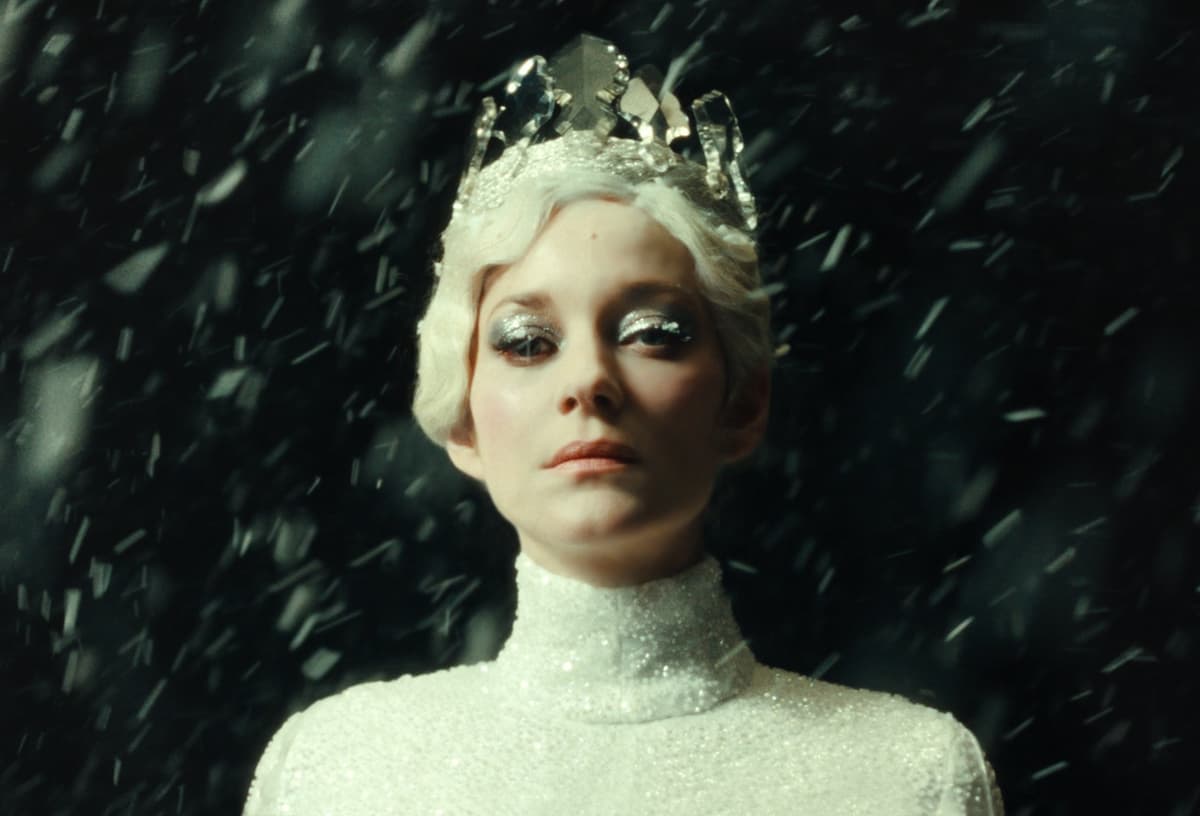
Marion Cottilard in “The Ice Tower”; Via Yellow Veil
* * *

Hans Christian Andersen’s “The Snow Queen” is a fairy tale told in six parts, each section of which becomes increasingly Byzantine in its narrative turns. The story concerns a boy and a girl who traverse a world in which the devil has sown chaos. Talking animals figure into the adventures of Kay and Gerda, as do singing rose bushes and magic mirrors. As for the title character: She makes a brief but potent appearance.

The Snow Queen is ravishing to behold and adorned in finery not unlike her disposition — that is to say, “ice-shining, glittering ice.” Kay falls into the Snow Queen’s clutches, and begins to yield to her feminine charms. The villainess is circumspect enough to caution her willing ward about being kissed to death. An unstinting Gerda ultimately saves Kay from his own devices, and the pair end up basking under the grace of a warm summer sun.

The director Lucile Hadžihalilović was 5 years old the first time her mother sat down to read her Andersen’s fable and the Snow Queen — that “inaccessible and mysterious, simultaneously attractive and terrifying” figure — left a mark. Ms. Hadžihalilović’s new feature, “The Ice Tower,” doesn’t tell the story, but it does traverse similar thematic terrain, especially the notion that innocence is rare and faith, hardwon. Oh, and there’s a kiss that is, if not fatal, then decidedly uncomfortable.

“The Ice Tower” is an outstanding film, often suspenseful, sometimes unseemly, and ingrained with a foreboding that is both childlike in its naivete and adult in its longueurs. The screenplay, co-written by Ms.  Hadzihalilovic, Geoff Cox, and Alanté Kavaïté, favors mood over logic and gesture over dialogue. It’s a quiet, purposefully elusive movie, shuttling promiscuously between actual events and dreamlike reveries. Cautionary tales and cinematic spectacle converge only to have their whimsies called into question.

Image
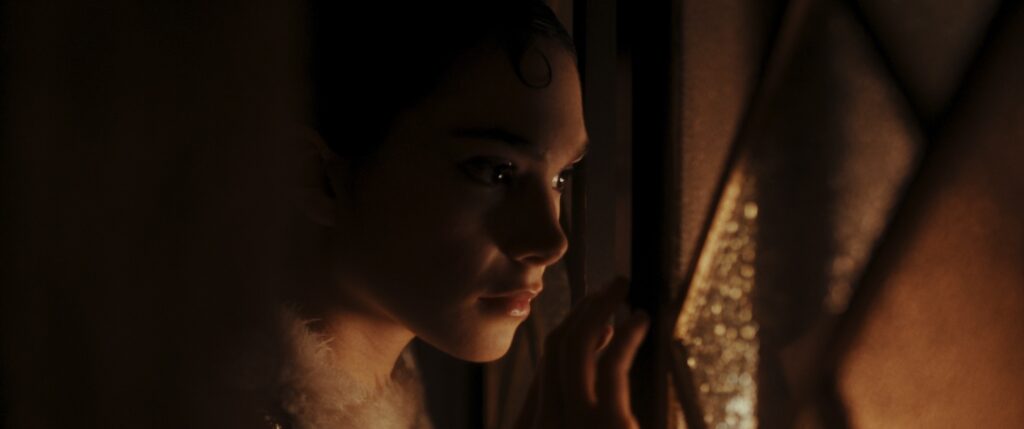
Clara Pacini in “The Ice Tower”; Via Yellow Veil
* * *

This is a film about children abandoned by circumstance and the fantasies proffered by art. The time is the 1970s; the setting, a French mountain retreat. Our 15-year-old heroine, Jeanne (Clara Pacini), is chafing under the restraints of a foster home to which she’s been consigned after the death of her mother. Jeanne runs away, hitches a ride into town, and finds herself at a local ice rink. She becomes entranced with a skater, Bianca (Valentina Vezzoso) — as do the rest of us. Ms. Hadžihalilović’s loving emphasis on the woman’s skill and physiognomy makes sure of that. 

Jeanne and Bianca cross paths a second time, and the former gains possession of the latter’s purse, taking advantage of its spare francs and forms of identification. Desperate for a place to hunker down for the night, Jeanne stumbles into an empty set for a movie production of “The Snow Queen.” She becomes entranced by the actress in the lead role, Cristina Van Der Berg (Marion Cottilard). The star is flighty, demanding, and churlish. We learn about Cristina’s behavior on the down-low, primarily through Jeanne’s eyes. Voyeurism is a key component of this movie’s unsettling tone. Mses. Pacini and Cotillard are as winsome and magnetic as the occasion calls for.

Cristina takes a shine to Jeanne, notwithstanding — or, maybe, because of — her myriad duplicities. When the young woman is hired as an extra, Cristina sees to it that her involvement in the film becomes more substantial. Jeanne follows along in a puppy dog-like manner, seeking emotional solace that is clearly not forthcoming. All the while Ms. Hadžihalilović increasingly fudges the temporal and logistical flow of the story. Hard-and-fast distinctions are rendered muzzy. 

Ms. Hadžihalilović’s movie is at once elaborately contrived in its plot points and wholly organic in how they are given dramatic emphasis. The director’s methodology won’t be to all tastes, favoring, as it does, the gradual, the intimate, and the mystical. But she knows the strength of collaboration, and yokes stunning work from cinematographer Jonathan Ricquebourg, production designer Julia Irribarria, and, especially, Ken Yasumoto, whose sound design is alternately sneaking and brash. 

The best films waylay their readiest criticisms. “The Ice Tower” is one of them.

(c) 2025 Mario Naves

This review was originally published in the October 2, 2025 edition of The New York Sun.

“Are We Good?”

Via Utopia
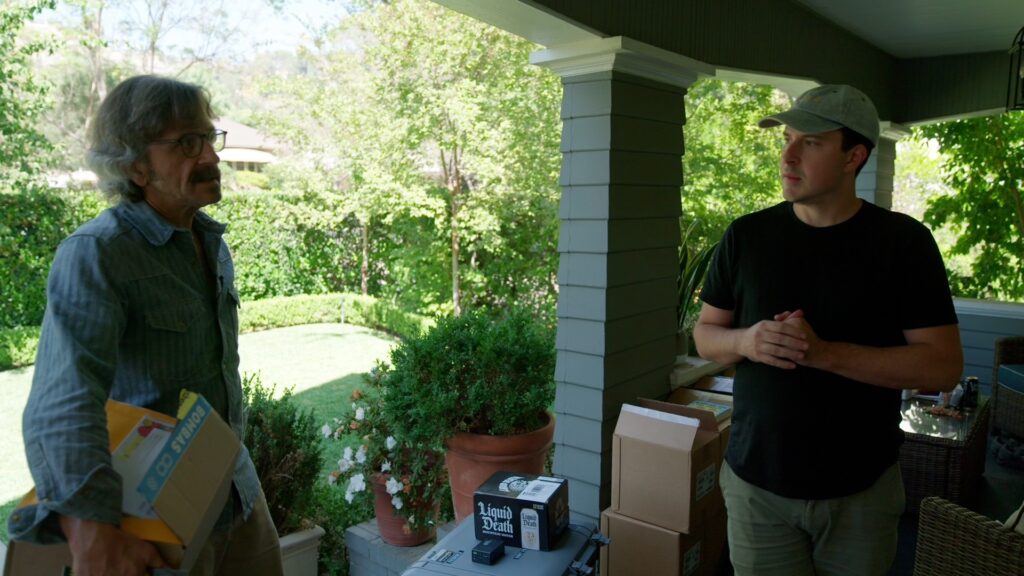
Marc Maron in “Are We Good?”; Via Utopia
* * *

Age becomes Marc Maron — maybe. The comedian, actor, and podcaster is the subject of Steven Feinartz’s documentary, “Are We Good?” It begins with Mr. Maron waiting to go onstage at Los Angeles’s Comedy Store. When he’s not pacing, Mr. Maron sits with his arms folded, nervously jiggling his leg. He gripes, albeit with admiration, about the cadence and craft of the unidentified comic preceding him.

Mr. Maron is less kind to Mr. Feinartz. “You’re going to destroy me with this stupid movie,” he tells the camera. The charm offensive continues: Mr. Maron calls the director annoying and then predicts that not only will Mr. Feinartz come to hate his subject, but he will subsequently post calumnies about the comedian on social media. At which point the curtain opens and Mr. Maron walks onto the stage to a welcoming round of applause.

We hear from a handful of Mr. Maron’s comrades in comedy. David Cross testifies that few people have been able to tolerate him. W. Kamau Bell describes Mr. Maron as “his own worst enemy.” Nate Bargatze, playing the diplomat, avers how Mr. Maron is underrated, but, really, he’s not the type to play arenas. Later, we watch as Mr. Maron talks smack about Dave Chappelle and Joe Rogan. Mr. Feinartz is invariably there to take down a peg or two. That’s what he gets for having the audacity to think that Mr. Maron and his travels are worthy of examination.

Mr. Maron isn’t the first subject of a documentary to complain about the proceedings at hand. Throughout Terry Zwigoff’s “Crumb” (1994), the cartoonist Robert Crumb bristles under the camera’s gaze, as did the comedian Gilbert Gottfried in Neil Berkeley’s “Gilbert” (2017). Given Mr. Maron’s prickly reputation, Mr. Feinartz knew what he was getting into; so did Mr. Maron. The jibes the former has to withstand from the latter are less irascible than self-serving. “Performative” is a term in desperate need of retirement, but Mr. Maron’s grousing has little heft.

Image
Marc Maron and Steven Feinartz; Via Utopia
* * *

Then again, there’s no one Mr. Maron bedevils more than himself. “Are We Good?” traces a bumpy, often drug-addled life that ends up in a good place. After spending close to 25 years trying to make a go of it as a stand-up comedian, a broke and twice-divorced Mr. Maron started a podcast titled “WTF.” Setting up a studio inside of his garage, Mr. Maron began interviewing a litany of cultural figures and proved a deft, if sometimes contentious, hand as a conversationalist. Word got around; popularity ensued. The long-suffering insufferable comedian had found his niche.

Actors, directors, authors, musicians, and even a president — that would be Barack Obama — hunkered down inside Mr. Maron’s garage. The most significant guest was likely director Lynn Shelton. Say what you like about hindsight, but the initial conversation that took place between Mr. Maron and Ms. Shelton is suffused with, and there’s no other word for it, wonder. A spark was lit — though it took time, as well as the relinquishing of contemporaneous relationships — for a romance to gain in intensity. Is love capable of lessening the cynicism of a cranky comic? You might as well ask if Shecky Greene was temperamental.

The relationship was short-lived. Shelton died of a rare blood disease in 2020, a story that is elaborated upon in heartbreaking detail throughout Mr. Feinartz’s picture. Mr. Maron has spoken of his grief, both on “WTF” and in his stand-up routine, and has come through it a transformed man. Actually, make that relatively transformed: Mr. Maron is still abrasive — really, he can’t help himself — but his bitterness has diminished and his gratitude is less begrudging. Count “Are We Good?” as one small step for humankind.

(c) 2025 Mario Naves

This review was originally published in the October 2,, 2025 edition of “The New York Sun.”
“Bacurau” (2020)

Via IFC Center
Sônia Braga, center, in “Bacurau” (2020); Via IFC Center
* * *

The IFC Center on Manhattan’s Sixth Avenue is in the process of celebrating its 20th anniversary by mounting a series of films, “20 Films for 20 Years.” It’s been a wild round robin of movies culled from the world over, including an Oscar winner for Best Picture, Bong Joon  Ho’s “Parasite” (2019), Bill Morrison’s haunting documentary, “Dawson City: Frozen Time” (2017), and Hirokazu Kore-eda’s superlative rumination on the strains of keeping the collective head of one’s family above water, “Shoplifters” (2018).

Among the oddest items on the docket is a Brazilian film co-directed by Kleber Mendonça Filho and Juliano Dornelles, “Bacurau” (2020). Mr. Mendonça Filho’s previous film,  “Aquarius” (2016), was a study in the often rapacious nature of economic development and the long-standing verities of place. Sonia Braga starred as a 65-year old woman who refuses to knuckle under to real estate developers eager to tear down the apartment building she calls home. Some observers pegged it as the best performance of Ms. Braga’s career. That sounds about right to this critic.

Ms. Braga is also on hand for “Bacurau.” This time around the actress isn’t at the center of the proceedings — the picture is very much an ensemble piece — but Ms. Braga cuts an imposing figure all the same as the lone doctor in an arid Brazilian backwater called Bacurau. Don’t bother trying to locate the place on a map: It’s a fictional town close enough to civilization that a nearby political candidate comes by to campaign for votes, but remote enough to cultivate its own culture. 

The screenplay, co-written by Messrs. Mendonça Filho and Dornelles, plunks us down in the middle of the place with nary a how-do-you-do. Whatever we can glean about the customs of Bacurau and its relationship to the broader culture is achieved by inference, not explication. The setting is simultaneously pre-modern and contemporary. The niceties of modern day infrastructure are meagre, but the citizens have cellphones and video displays. Where and when are we?

The answer is within the boundaries of a universe culled from a lifetime spent at the movies. Bacurau is a not-so-distant relative of the isolated villages seen in Akira Kurosawa’s “Seven Samurai” (1954) and “Yojimbo” (1961), or the remote townships favored by Sergio Leone, Sergio Corbucci, and other maestri of the Spaghetti Western. Not a few times during the run of “Bacurau” one expects to hear the distinctive strains of Ennio Morricone’s theme music for Leone’s “The Good, The Bad and the Ugly” (1966). 

Instead, the filmmakers go with sprightly Brazilian pop songs that aren’t as anomalous as one might think — largely because “Bacurau” is laced with a blatant strain of irony, a degree of apocalyptic portent and old school cinematic flourishes. A mixed bag, this kind of thing, and Messrs. Mendonça Filho and Dornelles hold it together by not worrying overly much about narrative or temporal logic. When we discover the identity of the boss to a posse of gun-wielding villains, we realize that the character is less important than the actor — in this case, the silky and snide Udo Kier.

The plot of the picture is — well, it’s murky. Why Mr. Kier’s cadre of English-speaking mercenaries are out to decimate the citizens of Bacurau may have something to do with local politics or, more likely, the bestial nature to which humankind can descend. Then there are those nameless pills that the Bacurauians repeatedly ingest for reasons that remain unclear and a city that seems to be equipped, not for indoor plumbing, but incarceration of a rather elaborate sort. As it turns out, our heroes are not always heroic.

In retrospect, “Bacurau” sounds tiresome, like a post-modernist lark distinguished by a casual loping tempo. On the other hand, you can’t help but be entranced by its go-for-broke whimsy while watching the damned thing. How much you enjoy the movie will depend on the credence you give to immediate impact or the mild hangover following in its wake.

(c) 2025 Mario Naves

This review was originally published in the September 26, 2025 edition of “The New York Sun.”
“Chain Reactions”

Robert Muratore
Patton Oswalt in “Chain Reactions”; Via Robert Muratore
* * *

Is “The Texas Chainsaw Massacre” the greatest movie title ever? That’s the opinion of a comedian, actor and gameshow host, Patton Oswalt. A title, he tells us, “should let you see a free movie in your head.” 

The line is culled from Mr. Oswalt’s 2004 stand-up special, “No Reason to Complain,” but the bit is only nominally a joke. Tobe Hooper’s seminal horror film is the rare venture that exceeds the most elaborate of preconceptions. It’s unremitting and gnarly: Few entertainments have stuck in the craw of popular culture with as much tenacity.

On the occasion of its 50th anniversary, director Alexander O. Philippe brings us “Chain Reactions,” a cinematic meditation on a notoriously “scruffy, no-budget independent film.” Utilizing clips from “The Texas Chainsaw Massacre,” some of them previously unseen outtakes, Mr. Philippe attempts to unpack the qualities that have made it an enduring artifact. Five notables are on hand to testify about the film’s impact on their lives and careers. The broader culture and the body politic figure into it as well.

Mr. Oswalt is here, as are the directors Takashi Miike and Karyn Kusama, the Australian critic Alexandra Heller-Nicholas, and the writer Stephen King. Each of them is interviewed within the dilapidated environs of a farmhouse similar to that seen in “The Texas Chainsaw Massacre.” Director of photography Robert Muratore imbues the place with a keening golden light that is a far cry from the grain of the original movie. As is noted repeatedly during “Chain Reactions,” the picture’s coarse cinematography is an inherent component of its unsettling power.

Image
Karyn Kusama in “Chain Reactions”; Via Robert Muratore
* * *

Ms. Heller-Nicholas describes watching an umpteenth-generation dupe of “The Texas Chainsaw Massacre” and how it made the film seem Australian: its harsh yellow light bringing to mind the changes of atmosphere wrought by the continent’s dust storms. Mr. Philippe managed to track down some of those degraded prints and places them side-by-side with clips from the real thing. The commonalities between Hooper’s arthouse mainstay and Aussie favorites like “The Proposition” and “Wake in Fright” are uncanny.

“The Texas Chainsaw Massacre” was recognized as something unique upon its release. The Museum of Modern Art acquired the film for its collection straight out of the box. In a contemporaneous review, Rex Reed, a critic not always amenable to unconventional strains of cinema, hailed the film for its brilliance. Not everyone agreed: Countries around the world banned the picture and, as Mr. Oswalt notes, “a specific generation” of movie-goers weaned on old school bumps-in-the-night took a pass. Hooper’s picture drew a line in the sand.

Mr. Phillippe has made a specialty of his fascination with fantasy, science fiction, and horror films, having done deep cinematic dives into “Star Wars,” “Alien,” “The Exorcist,” the director David Lynch, and the unstoppable William Shatner. Like them, “Chain Reaction” will appeal predominantly to fans, a select group for whom the preaching to the converted is a means of confirmation and community. 

That isn’t to say “Chain Reactions” doesn’t have its share of insights into the filmmaking process, the ramifications of art, and the less attractive attributes of the human animal. Here is a film whose purview is limited but surprisingly deep.

(c) 2025 Mario Naves

This review was originally published in the September 19, 2025 edition of “The New York Sun.”
“Peacock”

Via Oscilloscope
Albrecht Schuch and Julia Franz Richter in “Peacock”; Via Oscilloscope
* * *

The debut feature from Austrian filmmaker Bernhard Wanger, “Peacock,” has, at its core, a premise that seems to place it at a near point in the future. Perhaps it’s the streamlined settings in which much of the action takes place or the overall tenor of the proceedings, a kind of wheedling satire reminiscent of Stanley Kubrick’s “A Clockwork Orange” (1971). “Peacock” isn’t as provocative or violent as all that, but the movie does cultivate its own dry sense of outrage.

Mr. Wanger’s picture takes place in the here-and-now, though its premise will seem like science fiction to a lot of us: making a career as a professional friend. Like many quixotic ventures, the rent-a-friend industry began in Japan where lonely men and women could, for a fee, engage in conversation over lunch or attend a concert with, if not a like-mind, then a kind soul. Professional mourners we’ve had since antiquity — a duty that contemporary professional friends can also accommodate.

Articles about the phenomenon are quick to distinguish the trade from prostitution or therapy, arguing that it serves a distinct social need — particularly in an age when so much of life takes place on screens. Mr. Wanger did his legwork, traveling to Japan and investigating how agencies provide not only solace to alienated individuals but camera-friendly ballast for those eager “to improve your public image or to manipulate someone.” 

An undercurrent of market skepticism feeds into “Peacock,” but Mr. Wanger’s movie casts a wider net, being a free-ranging social satire predicated on the doubts harbored by a lone man. Matthias (Albrecht Schuch) is not only a professional friend working for a venture dubbed My Companion: He owns the place along with his business partner and friend, David (Anton Noori). 

Image
Albrecht Schuch, center, in “Peacock”; Via Oscilloscope
* * *

The outfit seems to be doing well providing company for those with emotional needs and, of course, discretionary income. But what can it mean when the opening scene has Matthias brandishing a fire extinguisher and applying it to a golf cart that is, for some reason, dramatically ablaze along a manicured fairway?

A dumpster on fire would have been too obvious, but a tone has been set — unsettling, quirky, and a tad threatening. We see Matthias at work with his clients: attending a posh concert of some avant-gardish music with an attractive woman; having dinner with a “father” who is planning a lavish birthday celebration, and wowing an audience of school children with his manufactured tales of aviation. And then there’s Vera (Maria Hofstätter), a despondent older woman who is seeking guidance in dealing with an inflexible and argumentative husband.

Vera finds strength in working with the role-playing Matthias, but other clients are less pleased with his talents. The same is true of his wife, Sophia (Julia Franz Richter). When Sophia decides to leave him because he “doesn’t seem real anymore,” Matthias is blind-sided, but we aren’t. The tension in their relationship is there to see. Perhaps, Matthias — with his coiffed hair, “healing” manner, and blandly unassuming smile — is so dutiful in adopting different guises he can’t stop being “on.”

As it turns out, the lonely person in need of a friend is our hero, and his struggles to regain a sense of self are awkward and sweet. Notwithstanding Mr. Wanger’s astringent wit — he has some cutting observations to make about therapeutic language and the artsy set — the picture is warmer than its chilly production design would seem to suggest. Might Matthias be a harbinger, however halting or unlikely, of a healthier time? That’s the question “Peacock” puts into play.

(c) 2025 Mario Naves

This review was originally published in the September 19, 2025 edition of “The New York Sun.”
“100 Years of Peter Sellers: From Britcoms to International Icon” at Film Forum

Via Film Forum
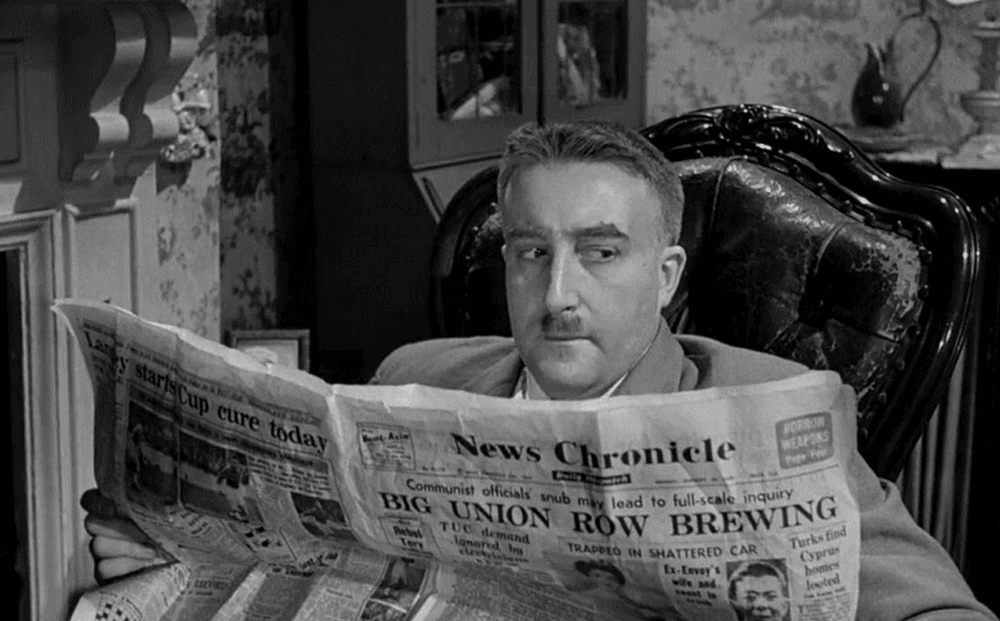
Peter Sellers in “I’m Alright Jack” (1959); Via Film Forum
* * *

You never can tell with art. Take Blake Edwards’s “The Party” (1969), a movie that will be included in an upcoming series at Film Forum, “100 Years of Peter Sellers: From Britcoms to International Icon.” Edwards’s comedy did not sit well with the people of India or, at least, some of its more voluble members. 
Peter Sellers’s portrayal of Hrundi V. Bakshi, a bumbling but sweet tempered actor from India who inadvertently finds himself amongst a cadre of Hollywood elites, was seen as a demeaning caricature. The government of then prime minister, Indira Gandhi, saw fit to ban the release of the picture.

The thing is, Gandhi was a fan of “The Party.” She held special screenings of the film — for impressionable young children, no less — and took particular notice of Hrundi’s response to the bullying question of an American film producer, “Who do you think you are?” To which Sellers’s fish-out-of-water responds, “In India, we don’t think who we are, we know who we are.” Still, the prime minister capitulated to elite opinion.
The filmmaker Satyajit Ray wasn’t thrilled by Sellers in “The Party,” but did admire his turn as Dr. Ahmed el Kabir in Anthony Asquith’s “The Millionairess” (1960), and thought him more than capable of playing an Indian character. A planned collaboration between the two, “The Alien,” fell apart due to a variety of factors, not least Sellers’s ego: He wanted more screen time than Satyajit’s script allowed for.

Image
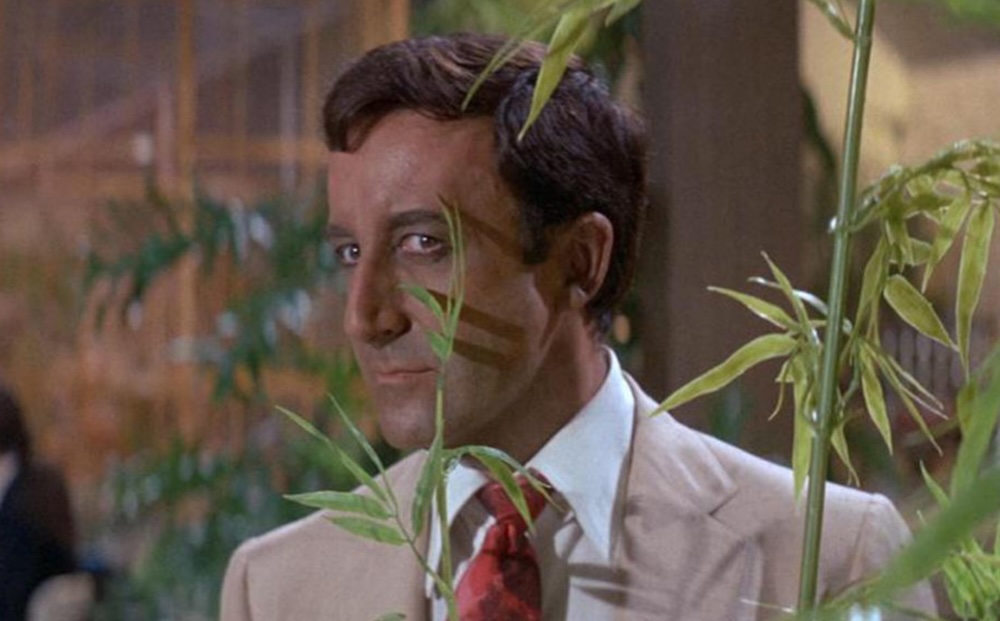
Peter Sellers in “The Party” (1969); Via Film Forum
* * *

Whatever objections a viewer might have about “The Party” are made less pressing when considering the quality of the picture: It’s very bad. On the lone occasion that Edwards and Sellers worked together on a project that wasn’t centered on the inept detective of “The Pink Panther” franchise, Inspector Clouseau, the director proved reliably ham-handed. There have been few auteurs who have worked as strenuously to thwart the possibility of laughter.

Allowing improvisational leeway for his star was something of a mitzvah on Edwards’s part, but how good, really, was the man born Richard Henry Sellers? Even before his death in 1980 at the age of 54, the actor and comedian was highly thought of and eagerly sought out for his chameleonic skills at impersonation. Comparisons to Charlie Chaplin were the rule; “genius” was the go-to descriptor.

Sellers famously essayed three roles in Stanley Kubrick’s “Dr. Strangelove or: How I Learned to Stop Worrying and Love The Bomb” (1960) and was set for a fourth, that of Air Force Major T.J. “King” Kong. Western stalwart Slim Pickens took on the role when Sellers sustained an injury and found it difficult to mimic a Texas accent. Kubrick went on to hire Sellers as a kidnapper and pedophile, Clare Quilty, in “Lolita” (1962), expanding the role beyond the scope of the Vladimir Nabokov novel on which it was based.

The Kubrick pictures remain inescapable as cinematic monuments, but they have their flaws — flaws that are directly traceable to Sellers. If acting is an illusion that takes on the guise of verity, then “Strangelove” and, especially, “Lolita” are hobbled by a creative facility that was, at its basis, self-aggrandizing. Like Alec Guinness, another actor with a talent for mimicry, Sellers invariably set himself apart from the business at hand, flouting an abiding artifice but rarely transcending it. Sellers is particularly insufferable in “Lolita”: how a control freak like Kubrick let an actor’s arrant schtick all but capsize the proceedings is a mystery.

Compare Sellers’s performances in “Strangelove” with those of George C. Scott and Sterling Hayden and you’ll be able to glean the difference between expertly contrived mannerisms and grotesques given life. An early performance as a harrumphing bourgeois Marxist in John Boulting’s “I’m All Right, Jack” (1959) is similarly strait-jacketed and outclassed by less studied comedic talents like Ian Carmichael and Terry Thomas. 

Is there a film in which Sellers, a man who famously stated that “there is no me … I do not exist,” truly found himself lost in a role? “100 Years of Peter Sellers” is the place to find out.

(c) 2025 Mario Naves

This review was originally published in the September 17, 2025 edition of The New York Sun.

“Sunfish (& Other Stories on Green Lake)”

Via The Future of Film is Female
Marceline Hugot in “Sunfish (& Other Stories on Green Lake)”; Via The Future of Film is Female
* * *

Green Lake is a sizable body of water situated toward the northern part of Michigan. It’s surrounded by a township of the same name and has a modest population — about 6,700. The claim to fame of this not-so-famous place is the prestigious Interlochen Center for the Arts and an attendant school. Among its alumni are the actress Tovah Feldshuh, opera singer Jessye Norman, and pop star Chappell Roan.

Screenwriter and director Sierra Falconer isn’t a graduate of the “rich kids’ camp” — that’s what one of the characters in her debut feature, “Sunfish (& Other Stories On Green Lake),” calls the place — but she did attend the rich kid-adjacent Wesleyan University. Ms. Falconer went on to earn a master’s in production and directing at the University of California at Los Angeles. “Sunfish” is her thesis project, an academic effort subsequently picked up by the Sundance Film Festival — a nice feather in the cap for a 20-something filmmaker.

Hewing to the old saw about “writing about what you know,” Ms. Falconer predicated her screenplay on experiences gleaned from growing up in an environment that is, to pinch a phrase from Thomas Hardy, far from the madding crowd. Her grandparents’ home on Green Lake was bereft of cellphone service and, until recently, the internet. It was, Ms. Falconer says, “a really magical place … like a little bubble, it never changed and still hasn’t.” 

An abiding sense of fondness is palpable throughout “Sunfish,” but it’s not an environment that suits all comers. Take Annie (Karsen Liotta), a single mother and all-purpose barkeep who likens the place to a black hole: “Once you’re in  it. Can’t ever get out of it.” But even Annie, whose story centers on a death that occurs under mysterious circumstances, manages to locate joy and meaning in this rarified enclave. Ms. Falconer has some sad stories to tell, but the sadness in them isn’t a permanent condition.

Image
Marceline Hugot and Adam LeFevre in “Sunfish (& Other Stories on Green Lake)”;
Via The Future of Film is Female
* * *

Green Lake is the hub around which four coming-of-age tales are interwoven, and Ms. Falconer does so with a precision that is, if studied, then also gently stated. The film doesn’t coalesce in terms of plot — narratively speaking, “Sunfish” doesn’t go anywhere — but as a cumulative accounting of lives in transition, it touches upon moments and emotions that we recognize. Even “Two Hearted,” a story that skirts the fantastic by poaching upon Herman Melville’s “Moby Dick” and the myth of the Loch Ness monster, feels lived in.

The movie proper begins on the shore of Green Lake as an older couple, Nan (Marceline Hugot) and Pop (Adam LeFevre), wield their binoculars in the grand pursuit of birding. They take particular note of a baby loon — or, as Nan has it, a “loonlet” — whose mother seems particularly blasé about the care of its progeny. As if on cue, Nan and Pop inherit a loonlet of their own, their 14-year-old granddaughter Lu (Maren Heary). Mom has dumped Lu off at her parents’ lake home while she gallivants on a honeymoon that seems every bit as rushed as the original courtship.

And so it goes in this not-so-sleepy hamlet in which lives undergo changes that are no less significant for being mundane. Kids go to summer camp, sisters go to college, men chase their dreams, and women break free of the burdens they carry. If Ms. Falconer errs on the side of hokum — the homespun Americana of the soundtrack is particularly egregious — she’s also wise to the way in which tone, character, and setting can put it right. You won’t find a more grounded film in theaters any time soon.

(c) 2025 Mario Naves

This review was originally published in the September 13, 2025 edition of The New York Sun.

“Naked Ambition”

Via Music Box Films
‘Bunny’ Yeager in “Naked Ambition”; Via Music Box Films
* * *

“One of the great things about the passage of time is that it will take the veneer of filth off of nude material and turn it into art.” That’s the opinion of an American magazine editor, Dian Hanson, as espoused in “Naked Ambition,” a documentary by Dennis Scholl and Kareem Tabsch. Given the salacious periodicals with which Ms. Hanson has been associated — the titles of which won’t be mentioned here — her expertise favors prurience over aesthetics. No one should go mistaking her for Immanuel Kant.

At the risk of engaging in unfortunate punning, time does tend to iron out the kinks of culture. Take the work of photographer Linnea Eleanor Yeager (1929-2014), better known to the world as “Bunny.” The nickname didn’t come, as one might suppose, from the mascot of Playboy magazine, a publication to which Yeager was an early and frequent contributor. The nom de plume was adopted from Robert Z. Leonard’s “Week-End at the Waldorf” (1945), a film in which Lana Turner starred as a stenographer named Bunny Smith.

Platinum blondes of a feather will flock together, I guess, but Yeager’s renown is due primarily to a woman whose hair was raven black, Bettie Page (1923-2008). Should you not be a member of Page’s fervent fan base — please, let’s not call it a cult — “The Queen of the Pin-ups” is notable for bringing a fresh-faced innocence, a kind of sinless esprit, to her modeling gigs. She never “looked down her nose” at the audience. Did the select crowd who purchased magazines like Flirt, Bold, and Male Life intuit Page’s nonjudgmental ethos?

Yeager and Page met each other in 1954 and spent the year working together, most notably at a Boca Raton amusement park at which the willing model dressed up in jungle gear and cavorted with a pair of disgruntled cheetahs. Hugh Hefner took note of the photos, hired Yeager as a regular contributor to the pages of Playboy, and made Page the focus of a Christmas-themed centerfold. The erstwhile model would later show up in FBI files as a consultant with a bead on “obscene” materials. She ultimately converted to Christianity.

Image
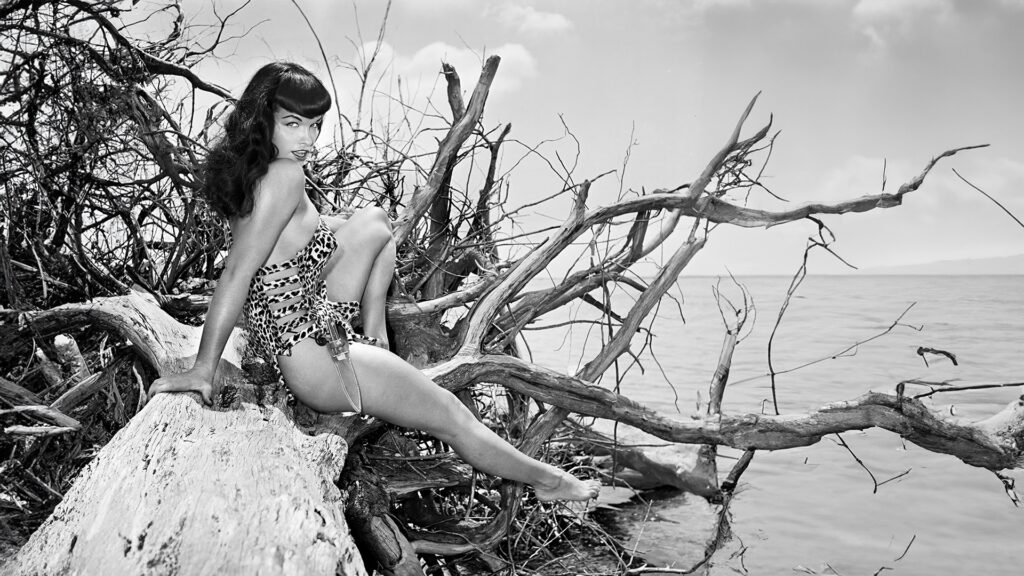
Bettie Page in “Naked Ambition”; Via Music Box Films
* * *

It’s an interesting story with a lot of sad turns, as was the life of Yeager. Before she picked up a camera, Yeager worked as a model and won numerous beauty pageants in her adopted home of Florida, including Miss Trailercoach of Dade County. When Yeager took classes in using a large-format camera she wondered why a woman couldn’t be a player in the pin-up industry. Her subsequent entry into the field, as well as her success, came quickly.

The novelty of a woman toiling in a realm catering to the as-yet-unnamed male gaze did not go unnoticed by mainstream organizations. Yeager went on to work for United Artists, Esquire, and that paragon of middle-class femininity, Redbook. 

Time and fashion do march on, and Yeager found that the market for “clean wholesome cheesecake” was being superseded by an industry increasingly geared toward graphic sexual content. Yeager struggled as ejection slips became the norm. A career as a nightclub singer floundered, the family finances took a dip, and her husband’s suicide shattered what had been a happy home.

Or maybe not-so-happy. Yeager’s two daughters, Lisa and Cherilu, are of two minds on Bunny as both mother and artist. They’ve done their share of tussling over an estate that has gained in notoriety and, with it, commercial potential. Messrs. Scholl and Tabsch missed interviewing the 85-year-old Yeager by a matter of days, and their film suffers as a result: We never get a real sense of just what it was that made this woman tick. Yeager remains, if not a cipher, then more of a blank slate that the filmmakers might like to admit. “Naked Ambition,” in the end, proves a frustratingly provocative venture.

(c) 2025 Mario Naves

This review was originally published in the September 11, 2025 edition of The New York Sun.

“A Savage Art: The Life & Cartoons of Pat Oliphant”

Via Magnolia Pictures
Pat Oliphant in “A Savage Art”; Via Magnolia Pictures
* * *

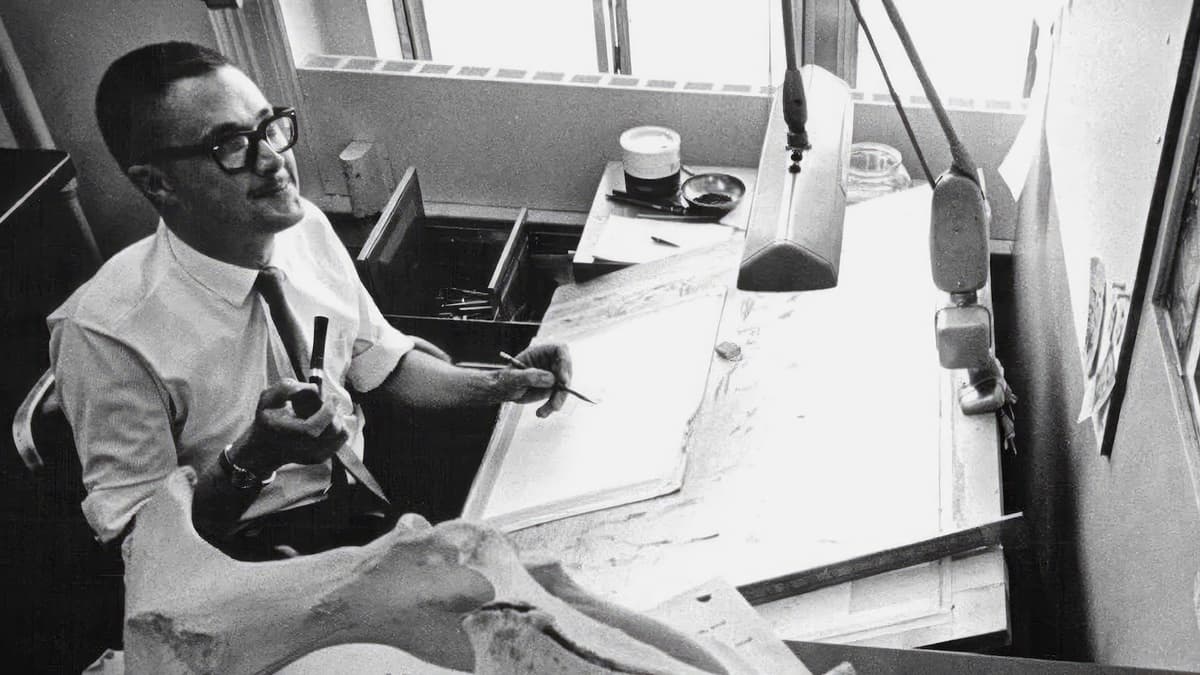
Among the benefits of having been born-and-raised at Salt Lake City, Utah, was my parents’ subscription to the Salt Lake Tribune. As a child, the news of the day couldn’t have mattered less to me, but the comics and movie listings were plentiful: Riffling through them made eating my morning bowl of Grape Nuts an event worth looking forward to. At some point, I noticed that there were single-panel comics on the editorial page and, through them, began to familiarize myself with the politics of the day — largely through the efforts of one cartoonist, Pat Oliphant.

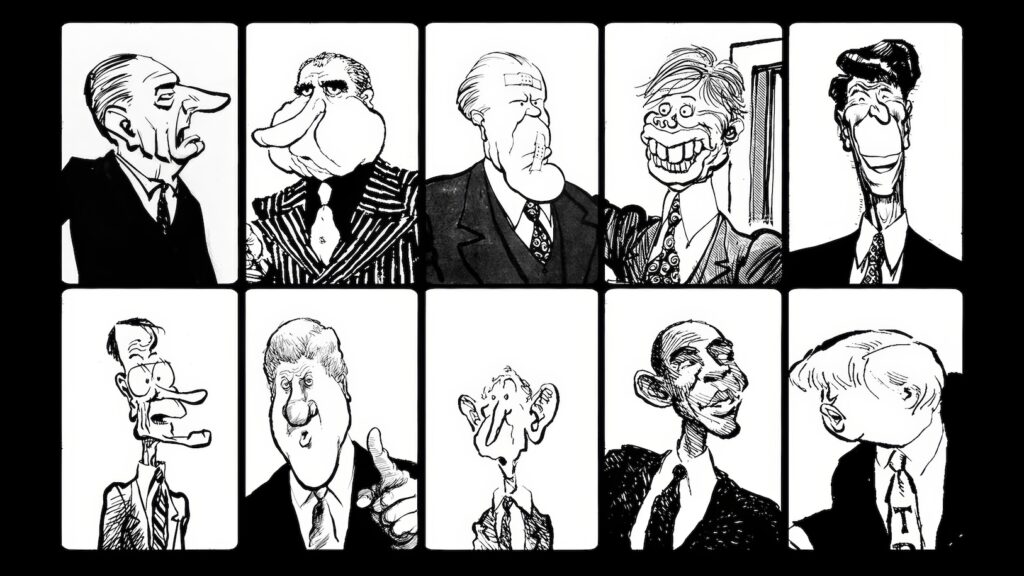
Just who was this creature with the odd name and what was up with those wild drawings? Mr. Oliphant’s cartoons were rambunctious, elastic, and unsparing in their details. Caricature isn’t inherently a cruel avocation — were that the case, any number of artisans offering portrait drawings on our city streets would be out of work — but anatomical exaggerations can elaborate upon and underscore the physical and moral character of a person. The novelist Joseph Conrad noted that caricature “is putting the face of a joke on the body of a truth.” Few artists have joked quite as fiercely as Mr. Oliphant.

Bill Banowsky’s new documentary, “A Savage Art: The Life & Cartoons of Pat Oliphant,” pays homage to an atypical talent through means that are, one must say, typical. Mr. Banowsky has done his leg work marshalling the facts, absolutely, but the resulting picture is conventional in cinematic structure. Documentary footage is juxtaposed with contemporary interviews, all of which is formatted within discrete segments covering this-or-that aspect of the artist’s biography and work. Dutiful, our filmmaker is, and kind of poky too.

Still, those who prize Mr. Oliphant’s scabrous humor and exemplary draftsmanship will find their collective good taste confirmed by each and every chapter of “A Savage Art.” The headings to these sections feature an animated version of the pickle-nosed gremlin who punctuated the margins of Mr. Oliphant’s cartoons. “Punk” was based on a penguin that a colleague brought to the office, a visitation that inspired Mr. Oliphant to employ a character in his panels that provided commentary on the matter at hand. Alternately bemused, stunned, or despairing, Punk added a sharp frisson of emphasis to an already pointed illustration.

Image
A political cartoon by Pat Oliphant from “A Savage Art”; Via Magnolia Pictures
* * *

Mr. Oliphant is Australian by birth and American by choice. His career as a cartoonist began when the editors of an Adelaide newspaper, the Advertiser, noticed that the copy boy was a deft hand with drawing. After plying his trade close to home for over a decade, the artist up-and-moved his family of four to the United States, having gotten a job as an in-house cartoonist at the Denver Post. Ten years and one Pulitzer prize later, Mr. Oliphant again moved kith-and-kin — this time to his adopted homeland’s seat of power, Washington, D.C. 

The move did wonders career-wise: Mr. Oliphant was at the center of the political universe and even got himself invited to the White House. President Ford took a shine to the cartoonist’s depiction of him as a galumphing klutz with a band-aid on his forehead. Not all presidents were happy with Mr. Oliphant’s caricatures: George Herbert Walker Bush — who suffered, you might recall, from the “wimp factor” — disliked that he was forever portrayed wielding a purse. Nor was Mr. Oliphant happy with all presidents, though Nixon’s physiognomy and Clinton’s philandering offered an abundance of comic material.

Family-wise, the move to the nation’s capital was complicated: Mr. Oliphant soon divorced and his responsibilities as a parent increasingly took second place to the imperatives of his art. All the while, his line became more fluid, his hatching more assured, and his use of chiaroscuro operatic. A leap in skill corresponded with a wit that gained in acidity, outrageousness, and, at moments, profundity. 

Mr. Oliphant created some 10,000 political cartoons during his lifetime and a gratifying number of them are seen during the run of Mr. Banowsky’s film. All of which goes to confirm that he has more than earned a place alongside masters of the form like James Gillray, Thomas Nast, and Honore Daumier. “A Savage Art” is an informative and entertaining testament.

(c) 2025 Mario Naves

This review was originally published in the September 5, 2025 edition of The New York Sun.

“The Baltimorons”

Jon Bregel
Liz Larsen and Michael Strassner in “The Baltimorons”; Via Jon Bregel
* * *

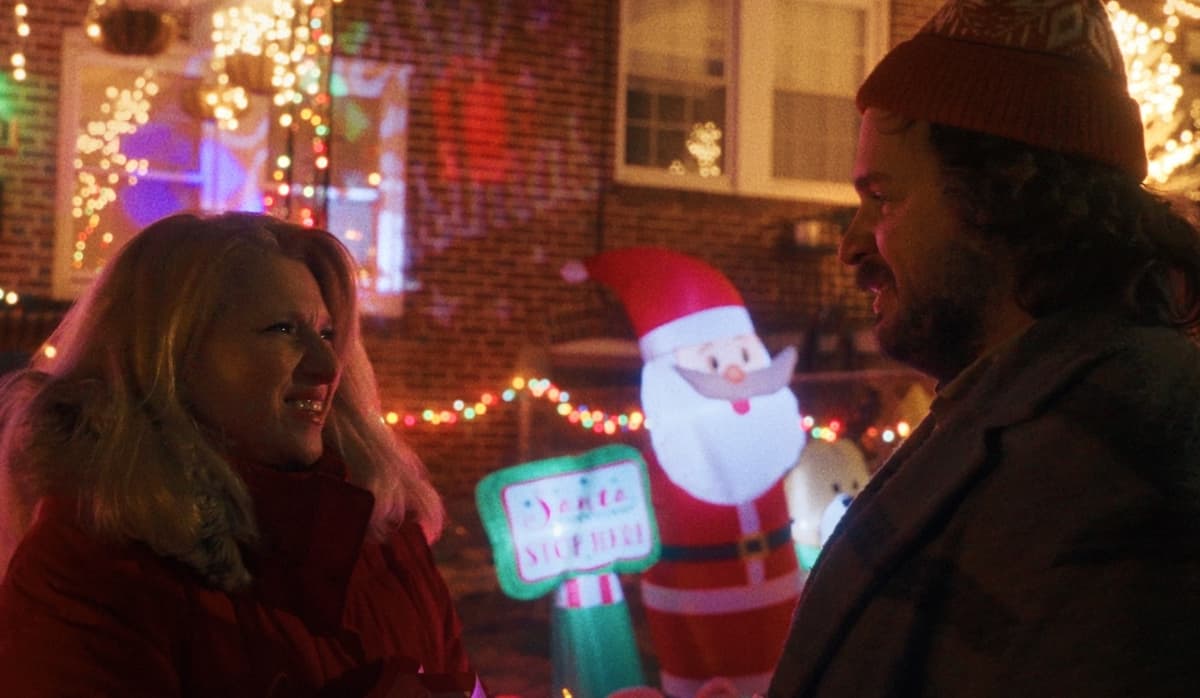
“The Baltimorons” is a terrible title for a sweet film. What were director Jay Duplass and co-screenwriter and leading man Michael Strassner thinking? They were likely thinking that it keyed into a segment of the film in which our hero, Cliff (Mr. Strassner), gets on stage and runs through an improv comedy bit that has been a staple of the local scene. Dubbing the local crowd “morons” has its purposes in a raucous club setting, but there are better ways of selling a rom-com, especially one as unexpected as this one.

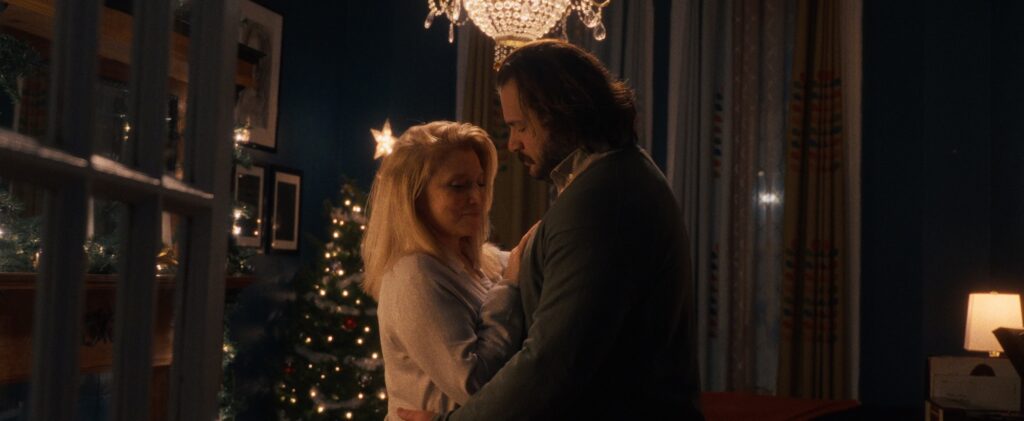
Then again, Messrs. Duplass and Strassner haven’t brought us a typical rom-com. “Baltimorons” hits the beats to which any devotee of the genre will recognize — the “meet cute” or the sundry volleys in which our protagonists engage before relinquishing their qualms to the blessings of love. The story takes place on the day of Christmas Eve, sneaking a bit into Christmas itself. Presents are bestowed, remonstrances forgiven, and families find joy in each other’s company. Is that the sound of sleigh bells? You get the point.

But then there is a suicide attempt and other unpleasantries, including emergency dental work, breaking and entering, a tenuous sobriety, and the difficulty in locating soft shell crabs during the off-season. Our characters are not standard-issue Hollywood idols: Cliff is unkempt, chubby, and not always as funny as he thinks he is; Dede (Liz Larsen) is a divorced woman of a certain age who radiates an air of been-there, done-that.

From this tangled web is woven a low-key, low-budget, and unassuming love story. Mr. Duplass’s name at the top of the credits prompted wariness from some moviegoers — particularly those who appreciate the finer delicacies of enunciation. Mr. Duplass and his brother Mark are known as the progenitors of “mumblecore,” a subset of contemporary cinema that presumes to take on the cadences of actual conversation through the use of improvisational strategies. When one observer heralded “The Baltimorons” as “an endearing throwback to mumblecore’s heyday,” not a few of us rolled our eyes and hoped for subtitles.

Image
Liz Larsen and Michael Strassner in “The Baltimorons”; courtesy Jon Bregel
* * *

That fear was waylaid as soon as the picture started rolling and, besides, there are welcome facets of mumblecore that are front-and-center, especially a middle-class milieu, documentary-like grit, and narrative apercus that, though absurd, have about them the weight of experience. As a director, Mr. Duplass has a deft touch, forgoing cinematic flash in the grand pursuit of plumbing the complexities and contradictions of his characters — and these are characters worth knowing. 

Our anti-hero, the 30-ish Cliff, is at an important juncture in his life, having become affianced to his long-suffering girlfriend Brittany (Olivia Luccardi) and taking on a daunting set of responsible duties, not least of which is visiting his potential in-laws for brunch on Christmas Eve. Cliff never makes it through the door: He walks smack-dab straight into it and loses a tooth. 

Stemming a tide of blood with an ungainly terry-cloth towel, he calls every dentist in town, finally reaching Didi (Ms. Larsen), a self-admitted workaholic who likes to get down to brass tacks or, in Cliff’s case, a temporary filling. Even at this early stage in the game, Mr. Strassner and Ms. Larsen exhibit considerable chemistry, evincing vulnerability and kindness through a tense back-and-forth.

What happens next is a domino-like shuttling of one damned thing after another, a series of events that bring our unlikely couple closer together. Cliff never makes it to his in-laws, though he does attend the wedding party of Didi’s ex-husband and, in a sop to showbiz predictability, redeems himself as a performer at a pop-up comedy club with Didi as his partner.

The thing is, the scene in which our two leads perform “The Baltimorons” sketch is among the most affecting in the movie: Mr. Strassner and Ms. Larsen offer a master class in acting that is subtle and insinuating. If Mr. Duplass lets his movie wander a bit too much after this scene, he soon sets it right and ties up the loose strings in not too strenuous a manner. Here is a gratifying pre-holiday treat.

(c) 2025 Mario Naves

This review was originally published in the September 4, 2025 edition of The New York Sun.

“Don Siegel: The Last of the Independents” at The Metrograph, New York, NY

Via the Metrograph
Geraldine Page and Clint Eastwood in “The Beguiled” (1971); Via the Metrograph
* * *

Is the American film director Don Siegel (1912-91) on record concerning his thoughts about the auteur theory — that is to say, a critical train of thought that places the person at the helm as the primary engine of a collaborative art form? One can imagine the nuts-and-bolts Chicagoan bristling at the sheer Frenchness of the notion: “Most of my pictures, I’m sorry to say, are about nothing. Because I’m a whore. I work for money. It’s the American way.”

In a blurb accompanying an upcoming retrospective at the Metrograph, “Don Siegel: The Last of the Independents,” an anonymous scrivener describes Siegel as “a utility man … who managed to survive and thrive inside The System while taking no s— from the moneymen who run (and ruin) the movies.” So, a company man and a rebel — a man given to getting the job done, doing the job well, and not putting on airs about it. That, and we learn that Siegel was responsible for “the finest sex scene of Walter Matthau’s career.”

Should that factoid pique your interest, Matthau’s brief but scintillating moment can be found in “Charley Varrick” (1973), a crime thriller that was originally crafted for Clint Eastwood. Mr. Eastwood passed on the role, feeling that the title character had little to recommend it. Just who it was that decided Matthau was a suitable replacement is unknown, as is the reason the actor took on the role. A stretching of actorly muscles, perhaps? 

Matthau’s performance as a stunt pilot, bank robber, and ladies’ man was awarded Best Actor by the British Academy of Film and Television Arts and garnered acclamation from even the most vituperative of critics. Still, he was unhappy with the movie and famously went about bad-mouthing it. Siegel blamed the picture’s disappointing box office take on the actor’s public grousing. Not even having a “slightly better than average intelligence” could assuage Matthau’s doubts about “Charley Varrick.”

Image
Walter Matthau in “Charley Varrick”; Via the Metrograph
* * *

Matthau’s frustration is nowhere in evidence during the course of the movie: He seems to be having a grand old time playing it cool as a low-rent gangster. Siegel helps with a guiding hand that is typical in its terse lack of sentiment. What was once a minor light of 1970s cinema has improved with age.

A tagline emblazoned upon the jacket worn by Varrick as he tends to his day job as a crop-duster endows the Metrograph series with its title. Just how independent Siegel was as a filmmaker isn’t up for debate so much as riven with contradictions. In an homage to his mentor, director Sam Peckinpah related how Siegel “was and is constantly amazed at the idiocy of our industry, while still being delighted by its competence and professionalism.” The mannish circumspection of Siegel’s aesthetic benefited from a fraught commercial dynamic.

The five films that Siegel made with Mr. Eastwood are on the docket. “Dirty Harry” (1971) you likely know about, as is the case, perhaps, with the last film on which they worked together, “Escape From Alcatraz” (1979). But then there’s a Civil War gothic, “The Beguiled” (1971): Was the novel by Thomas B. Cullinan on which the picture was based as weird and kinky as its cinematic transcription? 

A wounded Union soldier, John Burney (Mr. Eastwood), is taken in by the charitable souls at a woman’s seminary in deepest Mississippi. His presence subsequently transforms the place into — well, calling it “a den of iniquity” is putting it mildly. Let’s just say that tawdry and torturous events occur, as does, alas, a gaggle of tinkly sound effects. Is Siegel’s film a study in toxic masculinity or an avowal of feminist comeuppance? Brave cineastes can look forward to flipping that coin.

The Ludlow Street arthouse will be showcasing a variety of cinematic chestnuts, including Siegel’s testament to Cold War paranoia, “Invasion of the Body Snatchers” (1956), John Wayne’s last film, the elegiac “The Shootist” (1976),” and “Riot in Cell Block 11” (1954), a public service announcement for prison reform masquerading as a tough-as-nails noir. Even at his least impressive — the much ballyhooed but aimless “The Killers” (1964) — Siegel emerges, if not unscathed, then tougher for his travails. This latter attribute may be the most American thing about him.

(c) 2025 Mario Naves

This review was originally published in the September 2, 2025 edition of The New York Sun.

“A Little Prayer”

Via Music Box Films
David Strathairn in “A Little Prayer”; Via Music Box Films
* * *

After watching Angus MacLachlan’s “A Little Prayer,” I sat down to write about the film and began rifling through the accompanying press notes. While trying to ensure the correct spelling of each participant’s name and gathering sundry biographical details, I did a double-take upon reaching a page titled “‘Words We Use’ Language Guide,” a document provided by the Center for Reproductive Rights. It warns about the “weaponization” of certain phrases, and how fact-based, “objective and inclusive language” should be employed when discussing abortion.

A movie review isn’t the time or place to moot the finer points of this disquisition, but the “Words We Use” addendum does put one in mind of how ideological partisanship can not only slant a work of art but narrow its aesthetic compass. “A Little Prayer” does involve a woman’s right to choose — a phrase absent from the “Language Guide,” I’ll note — but it encompasses a gamut of concerns, not least the psychological aftermath of wars on the soldiers who fought in them and the devastating role that addiction plays in the body politic.

Even saying this much colors Mr. MacLachlan’s picture in a strident manner, for what he’s given us is a character study of a family, an observational drama that is rare in its intimacy and understanding of human nature. “In retrospect …, I was writing about parenting adult children,” Mr. MacLachlan notes. “How you still want to protect them and tell them what to do, and you can’t.” What is remarkable about both his direction and screenplay is their invisibility: The tenets of drama subsume the craft by which they were shaped. “A Little Prayer” is like real life.

Mr. MacLachlan is aided by a cast whose range is nuanced and unassuming. David Strathairn is Bill, a resolute family man, Vietnam vet, and businessman who runs a steel mill at Winston-Salem, North Carolina. His wife Venida (Celia Weston) used to oversee the factory’s books and now volunteers, in period costume, at a local historical site. The business continues as a family concern as their son, David (Will Pullen), is ensconced in a managerial role, second-in-command to Bill. 

Image
David Strathairn and Jane Levy in “A Little Prayer”; Via Music Box Films
* * *

David and his wife Tammy (Jane Levy) live out back of his parent’s home in a small garden house that has been retrofitted for the young couple. Family is paramount to Bill and Venida, but that’s not to say its dynamics are without the requisite bumps. This proves especially true when their daughter Patti (Anna Camp) and granddaughter Hadley (Billie Roy) descend on the premises, belongings in tow. This isn’t the first time the brash and needy Patti has moved back in with mom and dad. Bill and Venida know the routine: They’re resigned to old patterns.

It’s the new patterns that prove vexing, particularly for Bill. He is particularly unmoored upon noticing David’s behavior around the office secretary, Narcedalia (Dascha Polenco from “Orange Is the New Black”). Their relationship seems a bit more than familiar and might well explain David’s late nights out — presumably at work, probably at play. When Narcedalia attempts to negotiate a pay raise with Bill by intimating that she’s got a better offer elsewhere, the boss offers to help at the new job by cooking the books on his end. Deceit is preferable to the fraying of his son’s marriage.

Mr. MacLachlan is likely best known for having written the screenplay for Phil Morrison’s “Junebug,” another meditation on the complicated lives of modest people. What they share is an acknowledgment that human behavior is never without its contradictions and that forgiveness is a marker of decency and, often, a necessity. 

Toward the end of “A Little Prayer,” Bill and Tammy sit on a park bench eating their sack lunches. Their conversation is plain, steady, and more real than fiction would seem to allow. It’s fitting, really: The scope of Mr. MacLachlan’s picture is wider than any “Language Guide” could imagine.

(c) 2025 Mario Naves

This review was originally published in the August 29, 2025 edition of The New York Sun.

“In Our Blood”

Image

Brittany O’Grady and E.J. Bonilla in “In Our Blood”; courtesy Utopia

* * *

Pedro Kos’s “In Our Blood” is a deftly choreographed cheat, a film whose contrivances are well-deployed if not altogether satisfying in resolution. As a subject for review, Mr. Kos’s picture poses a pickle: Providing too thorough a synopsis will render its narrative emphasis and cinematic rationale close to moot. Even saying as much runs the risk of making potential ticket-buyers warier than is ideal.

“In Our Blood” is Mr. Kos’s first narrative feature, and he brings to it lessons learned from years spent as a documentary filmmaker. He earned an Emmy for his editing skills on Jehane Noujaim’s “The Square” (2013), and an Oscar nomination for a short film co-directed with Jon Shenk, “Lead Me Home” (2021). Being familiar with the conventions of cinéma vérité, as well as its pitfalls, Mr. Kos has put together a found footage horror movie that feels real on the ground.

The roots of the genre can be traced back to the early 1960s, but the most popular and influential example of the genre is “The Blair Witch Project” (1999), directed by Daniel Myrick and Eduardo Sánchez. That story, ostensibly culled from video recordings made in situ, followed the adventures of a group of film students as they set out to research a mythical Appalachian phantom. Made on the cheap, Messrs. Myrick and Sanchez’s picture went on to earn well over 1000% on the original stake.

And so a canon is born. Many of the movies made in the wake of “The Blair Witch Project” are negligible in quality, with the exceptions of the “Paranormal Activity” franchise, with their now-you-see-them-now-you-don’t spooks and specters, and “Late Night With The Devil” (2023), directed by Australian siblings, Colin and Cameron Cairnes. The latter was particularly ingenious in replicating the ambiance and settings of 1970s late night television, so much so that my colleague at The New York Sun, Adrian Nguyen, recommended it as “a sober character study of a media personality losing all control of the events around him.”

“In Our Blood” takes place in the here-and-now and has, at its core, the lives of those affected by substance abuse. Emily Wyland (a brooding and beautiful Brittany O’Grady) is a documentary filmmaker traveling to Los Cruces, New Mexico. She has, in tow, a cinematographer, the chatty and convivial Danny (E.J. Bonilla). The pair are making a film about the reunion of Emily and her estranged mother, Sam (Alanna Ubach). It’s been years since the two were in contact: Emily was removed from Sam’s care when mom’s addiction took precedence over her responsibilities as a parent.

Image

Krisha Fairchild in “In Our Blood”; courtesy Utopia

* * *

Sam has since kicked the habit and is working in an administrative role at a local rehabilitation clinic. The newfound sobriety was the prompt for reaching out to Emily, who is conflicted about the reunion and carries with her a bitterness that is the result of a traumatic and, in some ways, missing childhood. The Los Cruces we see in “In Our Blood” is as tattered, gritty and isolated as Sam’s home, which is off the beaten path and humble in its dimensions. Ms. Ubach’s performance is of a piece with the despairing tone set by Mr. Kos.

Emily, Danny and Sam have a tense and accusatory Thanksgiving dinner, but agree to meet in the morning: mom is eager to give them a tour of the workplace and, in doing so, confirm that her life has changed for the better. 

When our filmmakers arrive at the Hooper Center, Sam is nowhere to be found. The facility’s chief administrator, Krisha Fairchild (Ana Stuart), doesn’t take kindly to the clientele being filmed by strangers, but ultimately relents and sets out to help our heroes. The worry is that Sam has started using again. Other strange things are afoot: a small band of Sam’s friends start disappearing one-by-one under mysterious circumstances.

We subsequently meet up with a married pair of restaurateurs (Bianca Comparato and Steven Klein), a god-fearing local of unsound mind (Leo Marks), a bevy of poisoned rats, and what looks to be the stockpile for a black market in–well, let’s not spill the blood, shall we? Suffice it to say, Mallory Westfall’s screenplay takes some wild turns, some of which are rendered more convincingly than others. Ms. Stuart proves particularly vital in this regard, and the actress pulls out all the stops when Krisha’s true purpose is revealed.

As for Ms. O’Grady: she does what she can with a denouement that would’ve made a bracing twist on Rod Serling’s “The Twilight Zone,” but feels a mite pat  here in 2025. Genre fans can expect to have most of their pleasure buttons pushed by “In Our Blood”; the rest of us should gauge just how forgiving a mood we might be in before capitulating to Mr. Kos’s entreaties.

(c) 2025 Mario Naves

“Angelheaded Hipster: The Songs of Marc Bolan and T. Rex”

Via Greenwich Entertainment
Marc Bolan, center, in “Angelheaded Hipster”; Via Greenwich Entertainment
* * *

As far as cinematic hagiographies go, Ethan Silverman’s “Angelheaded Hipster” should gratify fans of Marc Bolan (1947-77), the frizzy-haired mastermind behind a 1970s glam rock outfit, T. Rex. The film has an impressive array of talking heads, including Sir Elton John, Ringo Starr, and, through archival footage, David Bowie. There are interpretations of T. Rex songs by Nick Cave, Kesha, Macy Gray, and Lucinda Williams. Remember “Bang a Gong (Get It On)”? U2 puts it through the wringer with Sir Elton on keyboards.

If you came of age in the United States during the 1970s, “Bang a Gong (Get It On)” is likely the only song you know by T. Rex: It reached no. 10 on the Billboard Hot 100. Bolan’s paean to his “dirty sweet” inamorata is impossible to resist, what with its propulsive rhythm, squawking riff, and sweeping sing-along chorus. The insinuating swagger of the lyrics is tempered by Bolan’s fey delivery. Rarely has macho been quite as denatured. 

T. Rex is considered a one-hit wonder on this side of the pond, but the band was hot stuff in its native Britain. Bolan and percussionist Mickey Finn began their careers with a twee species of folk rock, combining an unapologetic dependence on Chuck Berry with whimsy stemming from the poems of Edward Lear and Alice’s forays through Lewis Carroll’s fecund imagination. Unicorns, fairies, and modest sales typified T. Rex’s early musings. The group had an out-of-left-field hit in 1970 with “Ride a White Swan,” an infectious ditty replete with druids, tattooed gowns, and a reference to a pagan rite of summer, Beltane.

A significant component of “Angelheaded Hipster” is devoted to the recording of a tribute album, “Angelheaded Hipster: The Songs of Marc Bolan and T. Rex,” overseen by an eclectic music producer, Hal Wilner. He had headed similar ventures dedicated to an Italian film maestro, Nino Rota; two American jazz musicians, Thelonius Monk and Charles Mingus; a German composer, Kurt Weill, and songs from Disney films. The album dedicated to T. Rex is similarly wide-ranging in musical talent. Wilner’s taste was catholic and his ability to corral talent impressive. 

Will Mr. Silverman’s film bring greater acknowledgement to a performer who was, as it is reiterated any number of times during “Angelheaded Hipster,” ahead of his time? As a progenitor of gender-bending imagery and a flamboyant fashion sense, Bolan went nose-to-nose with Bowie, the former’s glitter-splayed whimsy vying against the latter’s theatrical contrivance.

Image
Marc Bolan, center, in “Angelheaded Hipster”; Via Greenwich Entertainment
* * *

That Bowie conquered America and, in doing so, achieved a greater market share put a temporary wedge in their friendly correspondence. T. Rex’s ninth album, “Zinc Alloy and the Hidden Riders of Tomorrow,” was an attempt to top Bowie’s seminal album, “The Rise and Fall of Ziggy Stardust and the Spiders from Mars.” It didn’t.

Fame is a flukey thing, but so, too, is talent, and it’s worth considering the scope of T. Rex’s music — its structural narrowness, say, or the brittle nature of Bolan’s lyrical fascinations. His early death in an automobile accident put an obvious stop on his development, but Mr. Silverman’s documentary doesn’t entirely forestall a sense that Bolan had spent his artistic gift. That Bolan didn’t live long enough to put away childish things places a pall over the film. “Angelheaded Hipster” is, in the end, more a requiem than a celebration.

(c) 2025 Mario Naves

This review was originally published in the August 8, 2025 edition of The New York Sun.

“Autumn Selects” at Alex Ferrone Gallery

Image

* * *

I’m pleased to announce that my work has been included in a group show at Alex Ferrone Gallery in Cutchogue, New York. Should you be traveling through wine country, please do stop by!