Tag Archives: Julia Franz Richter

“Peacock”

Via Oscilloscope
Albrecht Schuch and Julia Franz Richter in “Peacock”; Via Oscilloscope
* * *

The debut feature from Austrian filmmaker Bernhard Wanger, “Peacock,” has, at its core, a premise that seems to place it at a near point in the future. Perhaps it’s the streamlined settings in which much of the action takes place or the overall tenor of the proceedings, a kind of wheedling satire reminiscent of Stanley Kubrick’s “A Clockwork Orange” (1971). “Peacock” isn’t as provocative or violent as all that, but the movie does cultivate its own dry sense of outrage.

Mr. Wanger’s picture takes place in the here-and-now, though its premise will seem like science fiction to a lot of us: making a career as a professional friend. Like many quixotic ventures, the rent-a-friend industry began in Japan where lonely men and women could, for a fee, engage in conversation over lunch or attend a concert with, if not a like-mind, then a kind soul. Professional mourners we’ve had since antiquity — a duty that contemporary professional friends can also accommodate.

Articles about the phenomenon are quick to distinguish the trade from prostitution or therapy, arguing that it serves a distinct social need — particularly in an age when so much of life takes place on screens. Mr. Wanger did his legwork, traveling to Japan and investigating how agencies provide not only solace to alienated individuals but camera-friendly ballast for those eager “to improve your public image or to manipulate someone.” 

An undercurrent of market skepticism feeds into “Peacock,” but Mr. Wanger’s movie casts a wider net, being a free-ranging social satire predicated on the doubts harbored by a lone man. Matthias (Albrecht Schuch) is not only a professional friend working for a venture dubbed My Companion: He owns the place along with his business partner and friend, David (Anton Noori). 
Image
Albrecht Schuch, center, in “Peacock”; Via Oscilloscope
* * *

The outfit seems to be doing well providing company for those with emotional needs and, of course, discretionary income. But what can it mean when the opening scene has Matthias brandishing a fire extinguisher and applying it to a golf cart that is, for some reason, dramatically ablaze along a manicured fairway?

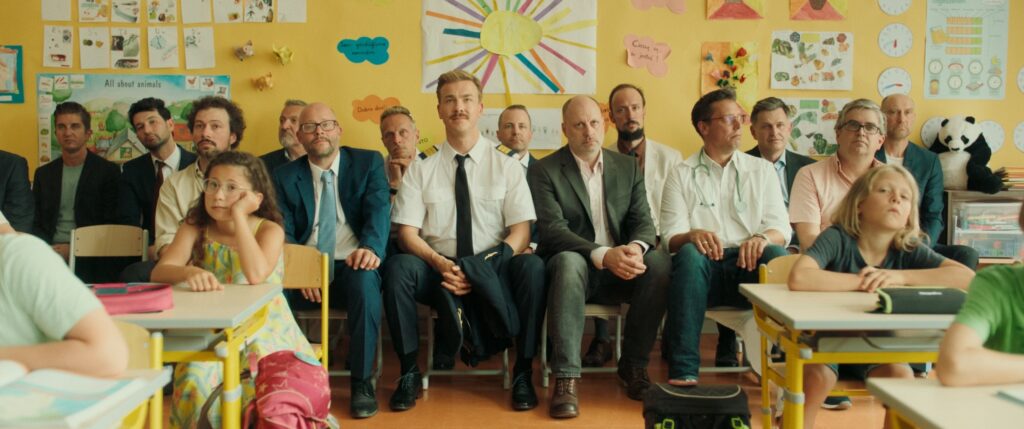
A dumpster on fire would have been too obvious, but a tone has been set — unsettling, quirky, and a tad threatening. We see Matthias at work with his clients: attending a posh concert of some avant-gardish music with an attractive woman; having dinner with a “father” who is planning a lavish birthday celebration, and wowing an audience of school children with his manufactured tales of aviation. And then there’s Vera (Maria Hofstätter), a despondent older woman who is seeking guidance in dealing with an inflexible and argumentative husband.

Vera finds strength in working with the role-playing Matthias, but other clients are less pleased with his talents. The same is true of his wife, Sophia (Julia Franz Richter). When Sophia decides to leave him because he “doesn’t seem real anymore,” Matthias is blind-sided, but we aren’t. The tension in their relationship is there to see. Perhaps, Matthias — with his coiffed hair, “healing” manner, and blandly unassuming smile — is so dutiful in adopting different guises he can’t stop being “on.”

As it turns out, the lonely person in need of a friend is our hero, and his struggles to regain a sense of self are awkward and sweet. Notwithstanding Mr. Wanger’s astringent wit — he has some cutting observations to make about therapeutic language and the artsy set — the picture is warmer than its chilly production design would seem to suggest. Might Matthias be a harbinger, however halting or unlikely, of a healthier time? That’s the question “Peacock” puts into play.

(c) 2025 Mario Naves

This review was originally published in the September 19, 2025 edition of “The New York Sun.”

“Ghost Trail”

Via Music Box films
Adam Bessa an Julia Franz Richter in “Ghost Trail”; Via Music Box films
* * *

A French actor with roots in Tunisia, Adam Bessa, is garnering critical accolades as the protagonist in Jonathan Millet’s debut feature, “Ghost Trail.” Mr. Bessa cuts a brooding, often hard-to-parse figure playing a Syrian refugee tracking his way through Europe — as well he should, considering his character, Hamid, has undergone travails that don’t beggar the imagination so much as confirm one’s worst fears about the base potentialities of humankind. Is Hamid’s stoicism an innate trait or a survival mechanism? It’s hard to say.

The antagonist of Mr. Millet’s picture is — well, what is the true name of the man portrayed by Tawfeek Barhom? At the French university at which he’s studying he’s known as Hassan and, like Hamid, he is a member of the Syrian diaspora. Hassan is eager to distance himself from his countrymen. That’s the primary reason he left Germany: Too many Syrians in the mix. Strasbourg is a necessary respite from birds of a feather.

Hassan’s views on displaced Syrians are of a piece with his elliptical take on the regime of Bashar al-Assad. Upon sitting down with Hamid, Hassan dodges and feints in his conversation, being pointed in intonation but vague in particulars. Mr. Barhom gives a mesmerizing performance, inhabiting a man whose caginess is indistinguishable from his mendacity. Mr. Millet’s camera accentuates the close-shaven angularity of the actor’s features, making Mr. Barhom seem, at times, more bone than skin.

The crux of “Ghost Trail” is the divination of Hassan’s true identity. Could he be Harfaz, a former torturer at the notorious Sednaya prison, a facility colloquially known as the “human slaughterhouse?” Mr. Millet, who co-wrote the script with Florence Rochat, based “Ghost Trail” on the true story of Kais Al-Abdallah, a Syrian refugee once ensconced in Germany. The courts couldn’t muster enough evidence to try him for “suspicion of terrorist activities,” but the Criminal Courts in Paris had a boost from information provided by an underground organization dubbed the Yaqaza Cell.

Image
Tawfeek Barhom in “Ghost Trail”; Via Music Box Films
* * *

How much truth can be gleaned from “Ghost Trail”? Having lived for some time at Aleppo, Mr. Millet kept in contact with friends and acquaintances, learning that his old neighborhood had been demolished by government forces: “I met a large number of Syrians and listened to their stories of war, imprisonment, and torture.” His research led him to secret cadres of Syrians whose mission is to track Mr. Assad’s henchmen and bring them to justice.

“Ghost Trail” is a cat-and-mouse spy thriller whose parameters glance on fact. Our hero, the sullen Hamid, is part of a secret society that communicates primarily through a combat video game. Names, if not locations, are kept secret, though Hamid does meet regularly with a woman we come to know as Nina (Julia Franz Richter), an operative who lost her Syrian husband to the vagaries of war. As Hamid winds his way through various internment camps searching for his nemesis, he meets the statuesque Yara (Hala Rajab), who is, at least initially, wary of this stranger’s inquiries. Best to be careful: Mr. Assad’s agents are everywhere.

Hamid’s pursuit of Hassan is deftly put into place by Mr. Millet, who favors a gradual build-up of narrative increments not only to generate suspense but as a means for yoking more intensive facets from his characters. Although “Ghost Trail” is very much a chase movie — that is, after all, implicit in the title — the final catch is less important than the transformation of the character doing the chasing. 

The director states that he is incapable of making a film absent some indication of hope. Whether he’s done so here can be decided by moviegoers eager for a night of sitting on the collective edge of their seats.

(c) 2025

This review was originally published in the May 30, 2025 edition of The New York Sun.