Archive for July 2nd, 2021

Ambedkar and LSE: Exhibition “Educate. Agitate. Organise.”

July 2, 2021

Superb bit of exhibition curated by Daniel Payne on Ambedkar and LSE.

Bhimrao Ramji Ambedkar, affectionately known as “Babasaheb” (“Respected Father”) led an extraordinary life. Born in 1891 in India to a poor family belonging to a Dalit community (referred to at that time as “Untouchables”; considered to be the lowest of the social hierarchy and outside of the Hindu caste system), he faced extreme discrimination and segregation throughout his life. He went on to gain two doctorates from LSE and Columbia University, and was also called to the bar at Gray’s Inn. A brilliant scholar of social justice, Ambedkar fought for the representation and rights of Dalit communities and was involved in the Independence movement in India; he was Chair of the Drafting Committee for the Indian constitution.

This online living exhibition is a collaborative space between the LSE South Asia Centre, LSE Library and DecolonisingLSE Collective. It begins by showcasing for the first time the entirety of Ambedkar’s LSE student file – a record of Ambedkar’s interactions with LSE – and will serve as a place to document and bring together activity at LSE inspired by the life and legacy of Ambedkar. Over time we will add recordings to events, reading lists, podcasts, and other material, and invite contributions from the LSE community on what Ambedkar means to us.

Many thanks to Dr Nilanjan Sarkar (LSE South Asia Centre), Dr Jayaraj Sundaresan (LSE Geography), Andy Jack (LSE Library Web Editor), and Sue Donnelly (retired School archivist) for their assistance, expertise and kindness in making this space possible.
 

Mumbai Samachar completes 200 years

July 2, 2021

Asia’s oldest existing newspaper Mumbai Samachar completes 200 years.

Asia’s oldest existing newspaper – “Mumbai Samachar” – where once Mahatma Gandhi, Jawaharlal Nehru and Sardar Vallabhbhai Patel used to drop in for tea and a chat, entered the 200th year of publication on Thursday.

It was started as a small bunch of pamphlets on July 1, 1822, by Parsi priest-cum-scholar, Fardunjee Murazban – considered the prioneer of Gujarati journalism – through the first Indian printing press which he launched in 1812.

Initially, Murazban brought out a Gujarati calendar in 1814 before jumping into media journalism in 1822 with the “Mumbai Samachar, 14-pages on three small quarto sheets and a half-sheet supplement in a 10 by 8 inch format.

While the first Asian newspaper was “Hicky’s Bengal Gazette” or the Original Calcutta General Advertiser, which came out from 1780, it folded up in 1782. “Samachar Darpan” the country’s first non-English newspaper, was published from May 23, 1818 from Hooghly, followed by the “Mumbai Samachar”.

“It catered to the thriving business community of the city and provided business-related news, death announcements, and especially shipping time-tables as all trade was conducted through the Bombay port,” its present-day owner-Director Hormusji N. Cama, told IANS in a free-wheeling chat.

More in Indian express, Times of India


Why is inflation synchronised globally?

July 2, 2021

Christopher J. Neely in this St Louis Fed short research note:

In most traditional economic models, inflation is entirely a domestic event, fomented by domestic factors and/or policies, such as money creation. There is some truth to this in extreme cases. For example, essentially all hyper­inflations—monthly inflation greater than 40 percent—result from uncontrolled domestic fiscal deficits that are financed by domestic money creation and followed by a self-reinforcing cycle of price rises and increases in the velocity of money. At less-pathological rates of inflation, domestic policies, especially those of central banks, are still important. Even central banks of small, open economies can approximately determine average levels of inflation over periods of at least several years. 

Image

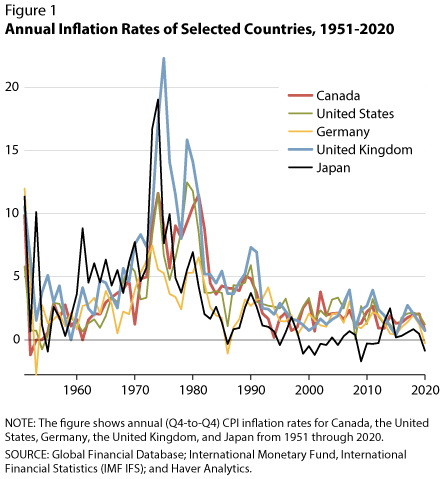
Yet international inflation rates clearly move together. Figure 1 shows that the inflation rates of several leading economies have moved together for many years, with the great inflation of the 1960s-70s and the subsequent great disinflation dominating that illustration. 

What explains this? Read the note…

Why Is the U.S. Lagging in Adopting Mobile Payments?

July 2, 2021

Pengfei Han and Zhu Wang in this Richmond Fed research:

The U.S. is considered a global leader in payment services. Yet, the U.S. appears to lag some developing countries in adopting the latest mobile payment innovations. We show that previous card payment leaders such as the U.S. naturally tend to fall behind in mobile payment adoption. This can be explained by optimal choices of card payment users in such countries because the incremental improvement introduced by the current mobile payment technology does not justify the costs for them to switch.

What led American political parties to transform itself into a cult of personality in which obsequiousness trumps merit?

July 2, 2021

Prof J Bradford Delong in this ProjSynd piece:

What could possess one of America’s two main political parties to transform itself into a cult of personality in which obsequiousness trumps merit? An examination of the Communist Party of China during Mao Zedong’s Cultural Revolution suggests some striking parallels.

At the CPC’s Lu Mountain Plenary Meeting in 1958, Marshall Peng Dehuai pointed out that Mao’s judgment was flawed, and that he could no longer be trusted as primus inter pares. The only question was whether the other party grandees could move ahead without Mao’s charismatic link to the party’s gullible base.

But Mao struck first. While party officials like Peng Zhen, Luo Ruiqing, Lu Dingyi, Yang Shangkun, and Deng Xiaoping were purged, Peng Dehuai and Liu Shaoqi both turned up dead, and the rest of the grandees got with the program.

That program was the total chaos of the Cultural Revolution. Recognizing that those who had benefited from the initial purges would need to be kept insecure and toothless, Mao continued to shake things up. Chen Boda was purged, Lin Biao was eliminated, and Deng – with his reputation for bureaucratic competence – was brought back into the fold, only to be purged again after being threatened with the promotion of Wang Hongwen (backed by the rest of the “Gang of Four” and Kang Sheng) and then Hua Guofeng.

Through all this shuffling, only two personnel qualifications mattered: obsequiousness and powerlessness. If the official in question fulfilled both, he would be praised, honored, and promoted. If he lacked one or the other, he would be taken down a peg, sent to work as a pipefitter, or assassinated (the one exception was Zhou Enlai, whose unfailing sycophancy perhaps made up for the fact that he wasn’t entirely powerless).

This process could be sustained because there was always an ample number of party officials who saw the chaos as an opportunity for their own advancement. But while deferentially doing Mao’s bidding could yield career advantages, he was old, low on energy, and on his way to meeting Karl Marx in the great beyond. So, the court intrigue continued, with officials falling over each other to “work toward the Chairman,” even though nobody but Mao’s nephew and closest aide could claim to understand his incoherent grunts and scrawls.

…..

The comparisons to the Republican Party under Trump should now be obvious. The most sycophantic and impotent Republicans are duly selected by Trump for promotion, while those with any modicum of power or self-respect are cut off at the knees. Trump knows that the latter cohort would seek to sideline him as soon as it gained power or forged its own links to the base. The purges are carried out from Mar-a-Lago, where Trump denounces his former appointees and aides as losers and RINOs (Republicans in name only).

The Achievements and Challenges of the Kerala ‘Model’

July 2, 2021

Prof Jayan Jose Thomas of IIT Delhi in this TheIndiaForum article:

The experience of Kerala ever since its formation in 1956 shows that, contrary to received wisdom, high public spending on social sectors improves people’s lives and also provides a positive thrust to economic growth.

Design a site like this with WordPress.com
Get started