Saturday, December 20, 2025

Averaging temperature over a time/region with stations of varying climate.

If you want to track an average of some quantity over time, with samples that change from time to time, then it is important that the quantity be homogeneous. That is, the samples (which here are station readings) should behave as if they came from the same statistical dostribution. Otherwise if there is some systematic change in where you are getting your samples, that will of itself cause a spurious drift in the average.

I do a lot of such averaging in assembling the monthly global average temperature anomaly (TempLS). I have written a general guide to that program here, and an article on the general principles here. The first link leads to many other articles.

I have been looking at this again because of some articles written recently by Dr Roy Spencer, first on Max and Min temperatures for Canada, and then for UK. For Canada at first, he just averaged the temperatures as they came. But that ran into the homogeneity problem. Over time there were more northern stations in the sample (and hence colder). So that caused a spurious cooling trend, which countered the true warming trend. So he developed a pairwise comparison method similar to that of Hansen and Lebedeff (1987, and still used in Gistemp). This seems to work well enough, but is to my mind rather complicated, and hard to analyse. It also does not include area weighting, and it isn't easy to see how that could be done.

Least Squares

I use variants of a very direct method. I write down a statistical model for the observed temperatures for a given month of the year, say:

Tₛₜ=Lₛ+Gₜ+εₛₜ

Subscript s represents station, and t time. For monthly data, t would be years. The model says that if you represent T as the sum of a local climate Lₛ, independent of t, and a "global" change Gₜ, independent of s, then that should take out the major sources of inhomogeneity, and so the residuals εₛₜ should appear as random variation with the same distribution. The numbers L and G are then varies to minimise the sum of ε².

That sounds complicated, but L and G are loosely coupled, so simple iteration converges quickly. The algorithm is

Start with G=L=0. Then repeat:
Average T-G over t to update L.
Average T-L over s to update G

That converges after a few steps. Averaging over t, if steps in t are uniform, is just a simple average. But averaging over s should really be done with area weighting, and much of my work with TempLS is about how to do that. But you can do a simple average, and that is the result you will get.

I tried that with Roy's data for Alberta, Tmin and Tmax, and got essentially the same result. And I note that Roy's method gives the same result for the UK as does UKMO. So far, so good. So why suggest something else?

I don't think Roy's method would work globally, or even, say, for all of Canada. That is why GISS uses it within cells, but combines te cells with area weighting.

Another method

Here is another method which I have used, also fairly simple. I define a set of approximately orthogonal functions over the region, Fourier style. I use it globally and so use spherical harmonics. This can be fitted using least squares regression to determine coefficients. Then the residuals have had the spatial effects removed, and so their average should be near zero. The answer is then just to average mathematically the approximating function, which because of orthoganility, should be just the fitted zero order coefficient.

I hope to follow up with a more detailed exposition, particularly addressing area weighting.

Thursday, December 11, 2025

November global surface TempLS up 0.06°C from October.

The TempLS FEM anomaly (1961-90 base) was 1.091°C in November, up from 1.031°C in October. It was the thirdd warmest November in the record, behind 2023 and 2024.

As in recent months, GHCN has gaps in coverage, which I have partly filled with JMA data. The critical point is cover of land stations outside US. This time I have 2529.

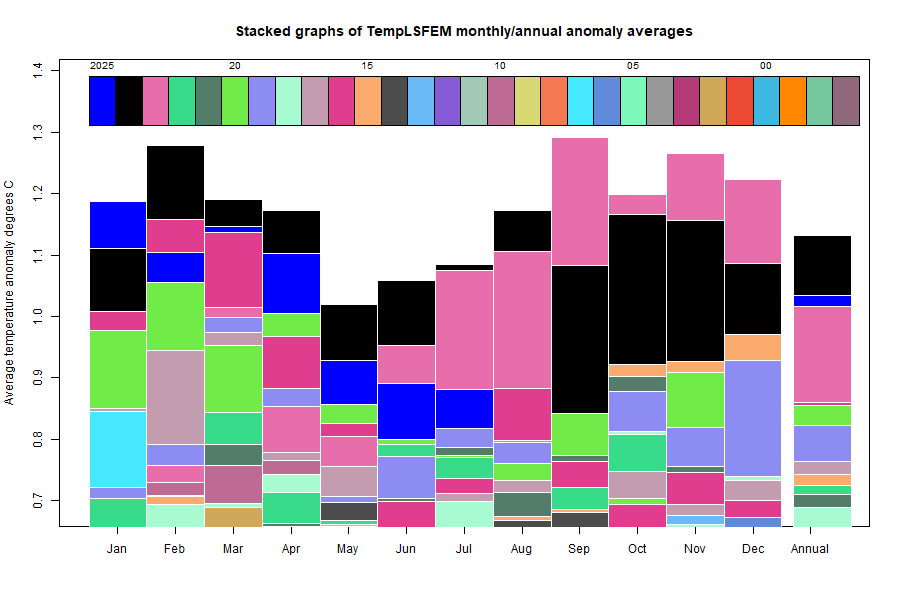
Here is the corresponding stacked graph. 2025 YTD stands in second place, behind 2024 but just ahead of 2023 and it would take a very cold December to change that.

Image
Here is the temperature map, using the FEM-based map of anomalies. Use the arrows to see different 2D projections.


As always, the 3D globe map gives better detail. There are more graphs and a station map in the ongoing report which is updated daily.

Tuesday, November 11, 2025

October global surface TempLS down 0.011°C from September.

The TempLS FEM anomaly (1961-90 base) was 1.042°C in October, down from 1.053°C in September. It was the third warmest October in the record, behind 2023 and 2024.

There were 2489 land stations outside the US included, well short of the 3200 I would normally wait for. Japan MA data is included, which gives reasonable coverage. There is unlikely to be more data; September still has only about 2483.

Here is the corresponding stacked graph:

Image
Here is the temperature map, using the FEM-based map of anomalies. Use the arrows to see different 2D projections.


As always, the 3D globe map gives better detail. There are more graphs and a station map in the ongoing report which is updated daily.

Saturday, October 11, 2025

September global surface TempLS up 0.051°C from August.

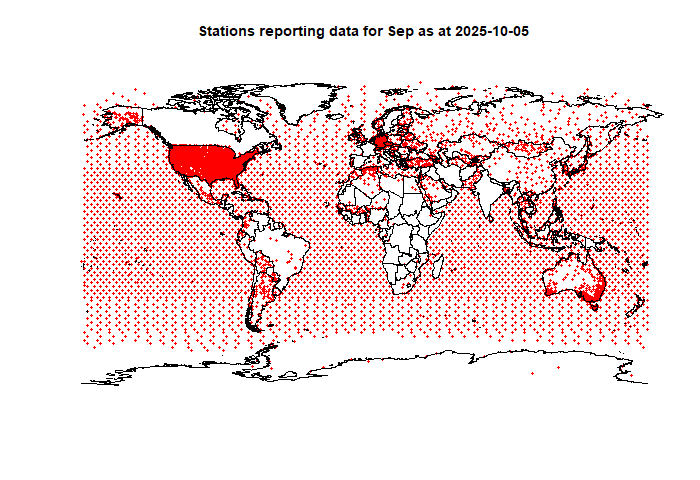
As last month, data from NOAA's GHCN V4 was patchy, missing China among other places. I suppose with the shutdown, we're lucky to have any data at all. So, as last month, I have augmented with JMA data where GHCN is missing. JMA seems to have data from stations that submit CLIMAT forms, which is roughly GHCN V3. With that added, there were 2414 land stations outside US. I would normally hold out for 3200, but there is at least some coverage of most areas except much of Africa. I'll show below a map of stations included.

The TempLS FEM anomaly (1961-90 base) was 1.04°C in September, up from 0.989°C in August. It was the third warmest September in the record, behind 2023 and 2024.

Here is the temperature map, using the FEM-based map of anomalies. Use the arrows to see different 2D projections.


As always, the 3D globe map gives better detail. There are more graphs and a station map in the ongoing report which is updated daily.


And here is the map of stations reporting:

Image

Thursday, September 18, 2025

Update on August Global Average Surface Temperature Anomaly, with information about sources.

This replaces a post of three days ago, which had some errors in numbering. In a few cases data was filled with the wrong JMA stations, which created a few large errors. I now use a more conservative correspondence rule.

Last week I posted provisional results for August, noting that the number of stations reported by NOAA's GHCN was unusually low, and didn't seem to be improving. In particular, no results for China, Iran or Kazakhstan.

NASA GISS had a similar difficulty, reported here. They mention mainly problems in Africa, so maybe they have alternative China data. It is available; China has sent in their Climat forms. NOAA has posted an August average with, as far as I can see, no caveats. So I looked for other accessible data.

The best I found was JMA, which does have that Climat data. So I combined that with the GHCN data (details below)(. This gave me about 300 more stations outside US (ROW), and 100 within. The number of US stations is still a lot less than usual, but more than we need. I now have 2515 stations in ROW, which is less than the 3200 I would normally use as publishable, but does now at least have reasonable coverage of China and Kazakhstan. I'll show the map below.

The change amplified the rise since July, from 0.881°C to 0.981°C (last post was 0.968°C). That is now a substantial rise of 0.1°C, but still with some missing data. GISS got a provisional rise of 0.13°C; NOAA of 0.07°C.

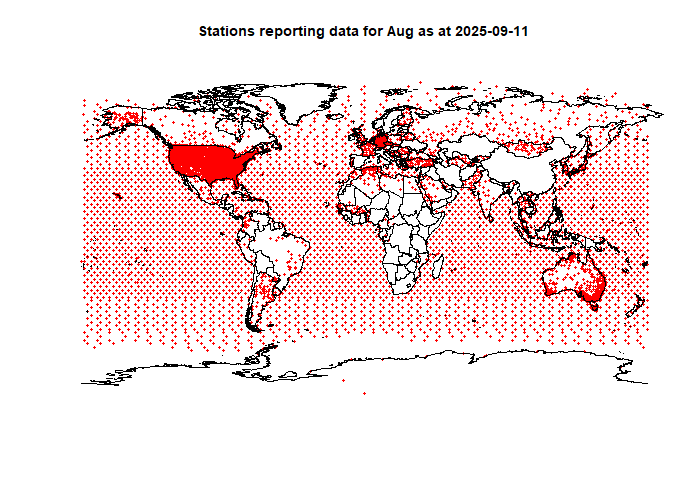
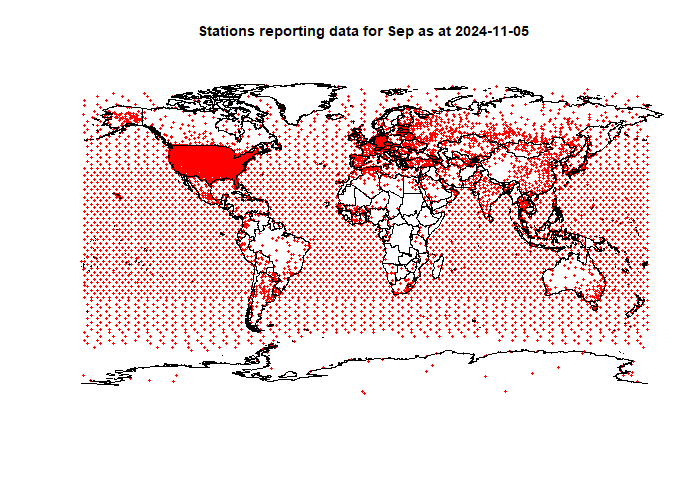
Here is the map of stations now included, with the map for September 2024 for comparison:
Image Image


Here is the temperature map, using the FEM-based map of anomalies. Use the arrows to see different 2D projections.


Combination rule

The JMA gives the name of station and country, but these don't reliably match GHCN letter by letter. They give the WMO number. GHCN gives a code of 11 chars, often ending in the WMO number. My earlier problem was that sometimes it doesn't, and in fact there can be very different stations with the last 5 chars. But if it is a WMO number, usually it will be preceded with 3 zeroes, so I made that a requirement. I use JMA only where GHCN is missing.


As always, the 3D globe map gives better detail. There are more graphs and a station map in the ongoing report which is updated daily.

Thursday, September 11, 2025

GHCN data late this month - interim results August warmer than July.

I have been posting monthly global temperatue anomaly averages for nearly fifteen years, based on land temperaturess from GHCN and ocean temperatures from ERSST. Both come via NOAA. In that time most temperatures are reported during the first few days. This was so last month, but this month there is a definite delay. The counts I use to determine publication were, on August 11:
ROW=3657 US=4705 Sea=3558
US means stations in USA; ROW means land stations elsewhere (both GHCN).

On September 11 we have:
ROW=2016 US=4692 Sea=3557

I normally require ROW>3200 for posting. Not only is the number of ROW stations low, but it has been increasing very slowly.

You might well wonder whether degraded NOAA capability following Trump intervention is responsible. But it is true that the big gaps are in China, Iran and Khazakstan, so current geopolitical tensions may play a role. But they haven't previously.

2000 ROW stations reporting is still respectable; it is far more than used to report in GHCN V3. So I'll post the results, but they may change if a large number of delayed data do turn up. 


The TempLS FEM anomaly (1961-90 base) was 0.968°C in August, up from 0.881°C in July, a rise of 0.081°C. That would make it the third warmest August in the record, just behind 2024 and 2023.

Here is the map of stations reporting:
Image
Here is the corresponding stacked graph:

Image
Here is the temperature map, using the FEM-based map of anomalies. Use the arrows to see different 2D projections.


As always, the 3D globe map gives better detail. There are more graphs and a station map in the ongoing report which is updated daily.

Saturday, August 9, 2025

July global surface TempLS down 0.011°C from June.

The TempLS FEM anomaly (1961-90 base) was 0.881°C in July, down from 0.892°C in June. It was the third warmest July in the record, behind 2023 and 2024. Here is the corresponding stacked graph:

Image
Here is the temperature map, using the FEM-based map of anomalies. Use the arrows to see different 2D projections.


As always, the 3D globe map gives better detail. There are more graphs and a station map in the ongoing report which is updated daily.