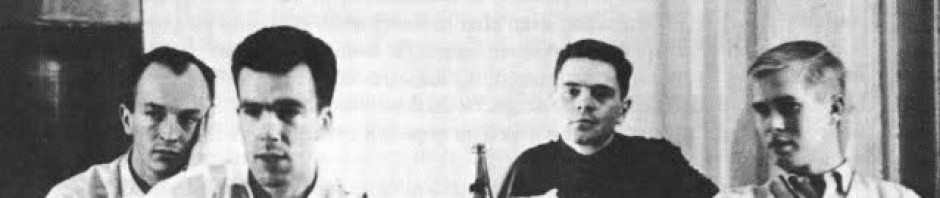
John Ashbery, Kenneth Koch, Frank O’Hara, and James Schuyler — the four poets and close friends who served as the nucleus of the New York School of poets in its original, 1950s heyday, spent a lot of time together, hanging out at the Cedar Tavern and San Remo, sharing poems with one another, drinking, and gossiping. But while there are numerous pictures of these four in various pairings and arrangements, strangely enough, I don’t know of any photographs of the quartet together — until now.
I was surprised and delighted to come across the photo below in the wonderful book Grace Hartigan: The Gift of Attention, which is edited by the curator Jared Ledesma and features contributions by Terence Diggory, Rachel Blau DuPlessis, and Frances Lazare. The book accompanies a superb exhibition of the same name that is currently showing at the North Carolina Museum of Art in Raleigh (April 12 to August 10).
Celebration for Folder magazine, 1955, James Schuyler, John Ashbery, Frank O’Hara, Kenneth Koch, unidentified photographer
In the photo, we see Koch (holding a bottle of something) and Schuyler looking relaxed and happy in their 50s ties and jackets, Ashbery leaning in, characteristically bemused, and O’Hara, face turned to his right, showing off his famously distinctive, broken-nose profile. The occasion was a 1955 celebration for Folder magazine, the important little magazine edited by Daisy Aldan, which was an early home for a good deal of New York School poetry.
The image is actually a cropped part of a larger photograph of the event, which features Hartigan, Aldan, and several others and which offers a sense of the wider community of writers and artists who Aldan brought together in the pages of Folder:
Celebration for Folder magazine, 1955, Daisy Aldan, Richard Miller, William Weaver, Grace Hartigan, John Ashbery, Frank O’Hara, James Schuyler, Kenneth Koch
The photo gives us a neat window onto the intersection of friendship, poetry, editing, and publishing that gave rise to the great little magazines of the postwar period. In her article on Aldan and the editing of Folder magazine, Anderson notes that in the 1950s and 1960s, “friends helped make magazines and books and wrote the contents of said publications; friendship, with all its tensions and flexibilities, oriented conceptions of community. The party, in various forms — the collating party, the release party, the post-reading party — was one of the most exuberant versions of community…Collating parties, in which magazines were assembled by individuals picking up single pages from piles of copies, often made the authors included in table of contents part of the publishing process.” Anderson mentions Aldan describing “how she and ‘the poets’ collated Folder” and notes that such “parties provide a glimpse into the shifting, constellating, and participatory characteristics of community.”
The full photo is a great snapshot of this kind of literary and artistic community in action, and is especially valuable for highlighting the crucial and still undersung role of brilliant women like Aldan and Hartigan to the evolution of the New York School.
But I also love having the rare opportunity to zoom in and access a single moment in which these four friends, John, Frank, Kenneth, and Jimmy, can be seen together, young, laughing, full of poetry and life, which seems like a special gift indeed.
Kenneth Koch, one of the central founding figures of the New York School poets, was born on February 27, 1925. To mark his centenary, there have been a number of celebrations, tributes, and book clubs devoted to his work and large legacy. In March, the New School in New York (where Koch taught from 1958 to 1966) hosted a big celebratory event featuring a host of esteemed writers, filmmakers, artists, poets, and friends, many of them former students. The lineup included the director (and Koch student) Jim Jarmusch, critic Lucy Sante, artists Jim Dine and Alex Katz, Maxine Groffsky, Phillip Lopate, Ron Padgett, Charles North, Tony Towle, John Keene, and Jeffrey Harrison. The poet and editor, and one-time Koch assistant, Jordan Davis hosted the event, with a general introduction by Robert Polito of the New School.
You can watch the event here:
But wait — there’s more! Next week, on May 17, the Flow Chart Foundation (the organization devoted to the legacy of John Ashbery) will be hosting “Kenneth Koch Centennial: A Gathering” in Hudson, New York, a daylong event celebrating Koch’s legacy, featuring talks, readings, screenings, and short performances.
I’m thrilled and honored to be participating myself, appearing with my old friend and fellow Koch-assistant Jordan Davis. Jordan and I plan to discuss “Kenneth Koch as Boss and Mentor in the 90s,” in which we compare notes on our experiences working with Koch and recall Koch’s table talk, advice, criticism, and conversation — the backstage side of a public poet and professor.
Other guest speakers include Anthony Atlas, David Lehman, Dorothea Lasky, Emily Setina, Jordan Davis, Mitch Sisskind, and Susannah Hollister. There will also be a series of performances of Koch’s wonderful short plays alongside the works of contemporary playwrights.
If you happen to be anywhere near Hudson, NY, on Saturday May 17, please come by (and register in advance here, where you can also see more information and a tentative schedule). And hopefully the event will be recorded as well.
Happy 100th birthday year to the amazing, inexhaustible Kenneth Koch!
Frank O’Hara’s influence continues to pop up in unexpected places, including in a new book called Chipped: Writing from a Skateboarder’s Lensby the essayist, poet, and playwright José Vadi, which is described by its publisher (Soft Skull) as “an intimate, genre-pushing meditation on skateboarding and the reasons we continue to get up after every fall life throws our way.”
As Emily St. Martin notes in her review of the book for Alta, “throughout Chipped, Vadi pays homage to the skaters, musicians, and poets who inspired his deep appreciation of the culture. ‘You can’t accurately talk about skateboarding,” he says, “without talking about music and art.”
“One such inspiration is Frank O’Hara, whose book Lunch Poems was written as he observed the midday bustle of midtown Manhattan. Much like a skateboarder, Vadi notes, O’Hara kept to a pedestrian’s perspective and a ground-level connection with space. When it came to his poems, he wasn’t precious, often shoving them, crumpled, into a pocket. ‘His carelessness for his own physical writing,’ Vadi writes, ‘reminds me of those obsessed, talented, but myopic pro skaters who didn’t care to redo a trick if it was filmed poorly or not filmed at all, the day’s vibes and the knowledge that they did it—and didn’t need to publish it—is such an unassuming braggadocio as to infuriate the hardest working skaters of the world.'”
I am not aware of any evidence that O’Hara ever tried skateboarding himself, but he did declare “my force is in mobility” and wrote lines like this: “A bus crashes into a milk truck / and the girl goes skating up the avenue / with streaming hair / roaring through fluttering newspapers … as the day zooms into space.” Even if that girl was probably zooming along the street on rollerskates, it’s not hard to imagine O’Hara being quite happy that his work inspired what St. Martin calls Vadi’s “extended mash note to the rich subculture of the board.”
This has been a busy time for fans of Alice Notley’s work, with three books appearing just in the past year or so, and many interviews, reviews, articles, and poems popping up all over the place.
In the new issue of the Yale Review, the critic Tausif Noor offers a compelling look at Alice Notley’s recent work, especially her massive 2023 volume The Speak Angel Series and the just-published Being Reflected Upon (which is subtitled a memoir of 17 years, 2000-2017). Using as a throughline Notley’s enduring devotion to a “poetics of disobedience,” Noor provides a useful introduction to the sweep and evolution of Notley’s long and varied career, from the striking poems of the late 1960s and early 1970s gathered in the recently-published Early Works(edited by Nick Sturm) through her beloved feminist epic The Descent of Alette to her two most recent collections.
As its epigraph shows, Notley’s newest book, Being Reflected Upon, borrows its unusual title from one of her guiding lights, Frank O’Hara. Notley took the phrase from an intriguing passage in O’Hara’s poem “Essay on Style” about how we, and our minds, interact with the world: “I was reflecting the other night meaning / I was being reflected upon that Sheridan Square / is remarkably beautiful…”
Being Reflected Upon is a “melancholic, often wistful collection,” Noor writes. This “memoir-in-verse” is “bookended by the death of Notley’s second husband, the British poet Douglas Oliver, in 2000 and the end of Notley’s treatment for her breast cancer in 2017.” Noor observes that “together these recent publications underscore the poet’s instructive philosophy of the self as a set of constantly evolving forms, forms that are unearthed only through the evisceration of convention.”
Here is a taste of the interview, from its opening question:
“INTERVIEWER
Where do you think great poems come from? There’s an idea in psychoanalysis that one thing artists are doing in their work is sublimating.
ALICE NOTLEY
That’s ridiculous. I’ve never sublimated. I’m never sublimating. No, I think the real answer has to do with suffering, and how you perceive things after suffering. You might just freeze, but if you don’t, other worlds open to you. I started hearing the dead, for example. And I felt that, because I had some new knowledge, I had something to give people—that I had things to say that would make them feel better.”
In conjunction with the interview, The Paris Review also published a piece about Notley’s work called “On Being Warlike” by poet Joyelle McSweeney. In the essay, McSweeney praises Notley for unfurling “a spangled aegis over the field of battle that is human existence over the past five decades on this planet,” only to quickly point out that such an image “contradicts the anti-masculinist, anti-patriarchal, anti-militarist thrust of Notley’s poetry and her statements about her work.” But, McSweeney goes on, “the truth is, this refulgent contradiction—Notley’s staunch anti-militarism versus what for lack of a better word might be called her ‘warlikeness’—her indefatigability, the relentless resourcefulness of her dismantling of the masculinist structures that support war, exploitation, destruction, and harm—might be the signature of her greatness itself, the reaction fueling its flight.”
Like Noor, McSweeney calls attention to “disobedience” as the powerful force at the center of Notley’s thought and writing — “an action of mind, ethics, and art,” disobedience is Notley’s “signature gesture,” in which “total refusal becomes paradoxically foundational.” At the end of her haunting essay, McSweeney writes:
“The ultimate figure of Disobedience, of alternative, gold-blossoming colonnades, unfurling a dream-space away from the masculinist militarism of the waking world, is the reader. Notley assigns to the reader her Disobedience while also distributing her infinitude, her stamina, her resourcefulness, her munificence, to the mind of the reader herself. Under the aegis of Disobedience, we oar away from war, by night, through dream, then into light.”
And then there’s Notley’s poem “Jim Carroll’s Ass,” which appears in the June 2024 issue of the Baffler (“Nothing seems real yet I’m willing / to play ‘the real’ game for ones I love / … I like to remember Jim Carroll / mooning Ted at the entrance to Julian’s Billiard Academy / the first time I met him he was showing off for me / and had a pearly ass this is cerebrality // but not within the time frame of my research”).
I’m sure there’s more where that came from, but for now, hope you enjoy these recent Notley riches!
Each installment of the PBS series “Poetry in America,” hosted by scholar Elisa New, gathers a group — typically made up of writers, artists, musicians, politicians, actors, and other public figures — to read and discuss a poem in detail. The show, now in its fourth season, has a delightful new episode devoted to Frank O’Hara and his 1961 poem “Steps,” one of O’Hara’s signature “I do this, I do that” poems.
To recite and discuss “Steps,” New brings together four poets who are longtime fans of O’Hara (Todd Colby, Terrance Hayes, Eileen Myles, Robert Pinsky), the choreographer Mark Morris, and musicians Rachael Price and Vilra.
For me at least, “it’s wonderful / to get out of bed / and drink too much coffee” and spend 25 minutes watching these smart and interesting people read and talk about “Steps,” which is both one of O’Hara’s most charming love poems and an exuberant ode to New York in all its dynamic bustle, glory, and absurdity.
In important, breaking literary news, the men’s magazine GQ (in its UK edition) has declared that “‘Hot guy books’ are the hot new accessory” and has included Frank O’Hara’s 1964 book Lunch Poems near the top of its list of the “hottest, most alluring book covers to carry this year.” As the author Josiah Gogarty puts it in his tongue-in-cheek piece, Lunch Poems is a book you could “read at lunch in Pret as the office workers come and go, and look like the most tasteful executive in town.”
This is not the first time Frank O’Hara’s Lunch Poems has been treated as a fashionable accessory in recent years — O’Hara-watchers will remember the odd moment a few years back when Jennifer Lawrence was spotted carrying a very expensive clutch that was actually designed to look like an oversized version of O’Hara’s pocket-sized paperback.
After discussing the recent trend of beautiful celebrities toting highbrow, literary books, Gogarty notes that “carrying around classic novels doesn’t just give models an aura of intellectual chic – regular civilians are now doing it too, as a kind of brainy thirst trap. An article in Bustle last September reported on men ditching selfies with puppies to pose with female-coded books by the likes of Sally Rooney and Ottessa Moshfegh, in the hopes of dredging up dating app matches. There have also been recent reports of men taking books to bars to try and attract girls. With this in mind, here is an entirely serious, entirely scientific ranking of the hottest, most alluring book covers to carry this year.”
Number 2 on this “entirely serious, entirely scientific ranking” of the hottest book covers to be spotted carrying around is the “City Lights Pocket Poet” series, with a special nod given to Lunch Poems
“City Lights Pocket Poets
This series has proper historical weight: it was started in 1955 by poet, bookseller and publisher Lawrence Ferlinghetti, and its fourth release, Allen Ginsberg’s Howl and Other Poems, was the subject of a landmark obscenity trial in the US in 1957. They also look great, particularly the navy-and-red edition of Frank O’Hara’s Lunch Poems – which you could indeed read at lunch in Pret as the office workers come and go, and look like the most tasteful executive in town.”
Somehow this all reminds me of a passage in O’Hara’s “Steps,” one of the most lovable poems in Lunch Poems:
“everyone’s taking their coat off so they can show a rib-cage to the rib-watchers”
O’Hara would likely have chuckled at the idea of Lunch Poems being called a “brainy thirst trap” and topping a list of the “hottest, most alluring” books for men to flaunt that they’re reading — after all, he was a poet whose half-serious take on technical matters of poetic craft was to say “that’s just common sense: if you’re going to buy a pair of pants you want them to be tight enough so everyone will want to go to bed with you.”
2023 was an anniversary year for this humble blog, since it has been 10 years since I decided to create a website devoted to the New York School of poets and artists and name it Locus Solus, after the legendary little magazine that briefly served as the movement’s house journal.
A few months ago, to mark the occasion of this anniversary, the Flow Chart Foundation (the wonderful organization devoted to the legacy of John Ashbery) and the critic Mandana Chaffa generously invited me to have a conversation about the blog, its mission and history, and the New York School more broadly, which was held virtually on Wednesday, June 15, 2023.
Here is a recording of the event. Thank you to everyone who has visited this space over the years, sent tips and books and sightings my way, and supported my work on this project!
Next Saturday, October 28, there will be a symposium and poetry reading in New York hosted by the Network for New York School Studies (a recently founded organization I wrote about previously here) in conjunction with the Brooklyn Rail. It will take place in Brooklyn from 12-8, is free of charge, and open to anyone interested in attending. I’m thrilled that I will be taking part in this exciting event, and I hope those of you in the area will come by. More information can be found here.
The organizers have given the gathering the title “These Little Oases” after a wonderful line in Frank O’Hara’s “Poem Read at Joan Mitchell’s”: “let’s advance and change everything, but leave these little oases in case the heart gets thirsty en route.”
As you can see from the image above, the symposium will feature poetry readings by a long list of poets associated with the New York School and its lineage, including Anne Waldman, John Yau, Anselm Berrigan, Edmund Berrigan, Jordan Davis, Kay Gabriel, Patricia Spears Jones and many others.
It will also feature a roundtable discussion with a four scholars who write about the New York School of poetry: Alexandra Gold, Libbie Rifkin, Nick Sturm, and myself. The roundtable’s focus will be “New York School Studies Now” and will be chaired by Mandana Chaffa, President of the Board at the Flow Chart Foundation, and founder and editor-in-chief of Nowruz Journal.
But wait, there’s more: the symposium will be preceded on the evening of Friday 27th October, 7-8.30pm, by a very special performance of Frank O’Hara’s short play Try! Try! at Torn Pagein Chelsea. To be more exact, there will actually be two performances of O’Hara’s play, one for each of the two distinct versions he wrote.
“Try! Try! Twice! stages two versions of the play back-to-back, accounting for the 1951 version, inspired by O’Hara’s friendships with Violet Lang and John Ashbery, and the 1953 rewrite, informed by his intimate relationship and artistic collaboration with painter and set designer Larry Rivers. This production presents both plays back to back with identical casts navigating the tonal shift from 1951’s surreal Sirk-ian melodrama to 1953’s screwball sex comedy, much like Rock Hudson would navigate from the world of a film like Magnificent Obsession to that of Pillow Talk.”
The play features Lee Ann Brown, Emmitt Joe George and Tony Torn, and is directed by Torn himself.
If anyone is interested, I wrote about in Frank O’Hara’s Try! Try! — and how the play, in both its versions, stages O’Hara’s anxieties about friendship and selfhood — in my book Beautiful Enemies.
I hope you will come join us in these little oases next weekend, which may come in handy if the heart gets thirsty en route — please spread the word and hope to see some of you there!
James Schuyler, one of the central poets of the New York School of poetry, was born 100 years ago this November. In honor of his centenary, there will be a wonderful three-day program celebrating Schuyler’s life and work on November 4-6, 2023, in New York.
Hosted by the Dia Art Foundation, the Poetry Project, and NYU, and co-organized by Matthew Bevis of Oxford University, Always More Roses: James Schuyler at 100 promises to be an exciting weekend that will consist of three parts.
First, “A Morning for the Poet,” on Saturday, 11/4, at NYU. This event will feature a great roster of critics, poets, and friends of Schuyler’s who will be giving short talks on a variety of topics. Speakers include Stephanie Burt, Rona Cran, Jeff Dolven, Tonya Foster, Peter Gizzi, Kamran Javadizadeh, Nathan Kernan, John Koethe, Simon Pettet, Emily Skillings, and Tracie Morris. I’m very excited that I’ve been invited to take part in this event as well, and will be speaking on Schuyler’s friendship with Frank O’Hara and the wonderful, oblique elegy he wrote for O’Hara, “Buried at Springs.” You can see the full slate of speakers and titles of their talks here.
Second, on Saturday night, 11/4, Dia Art Foundation in Chelsea — the same place where Schuyler gave his legendary, late-in-life, first-ever poetry reading in 1988 — will host “It Goes, It Goes: James Schuyler Centenary Celebration,” “an evening in praise of the beloved poet.” The event will feature readings by Wayne Koestenbaum, Chad Morgan, Eileen Myles, Funto Omojola, Teline Trần, and others to be announced.
Third, on Monday, 11/6, the Poetry Project at St. Marks will host a performance of Schuyler’s amazing long poem “Hymn to Life,” featuring a multi-generational, polyvocal group of Schuyler fans, friends, and protégés. As the Poetry Project puts it, “A true poet’s poet, lover’s poet, everybody’s poet, James Schuyler was a dear and committed friend and mentor to many in the Poetry Project’s community, and generations later remains a reason many of us are poets at all.” This in-person event will also be livestreamed via The Poetry Project’s YouTube.
Please join us in celebrating James Schuyler at 100. Hope to see some of you there in person in New York!
Happy Bloomsday! Over the past few years, to mark this special day, I’ve had a tradition of reflecting on Joyce’s powerful but little-discussed influence on the poetry of the New York School, as you can see in these posts about how Frank O’Hara, James Schuyler, and John Ashbery felt about Joyce’s magnum opus.
This year, I wanted to pay tribute to one of the most overt and important examples of Joyce’s special place in the New York School canon: the work of the late Bernadette Mayer (who passed away in November 2022), and especially her most explicitly Joycean project, Midwinter Day, in which she, like Joyce in Ulysses, undertakes a radical experiment in turning a single, ordinary day into an epic, book-length work of literature.
Mayer frequently acknowledged that Joyce, and Ulysses in particular, played a formative role in her development as a writer and artist. In a 2010 interview with Adam Fitzgerald, Mayer discussed her early adventures in self-education, which led her to tackle a series of great, long works, including Joyce’s novel, which she explains she liked best of all:
~~~~~
“BM: I took a year off to read all the long books. The Cantos. The Waste Land. Paradise Lost. Ulysses. Better than school, I’ll just read all these books. I’m sure I was inspired by Bill [Berkson] to read the books by their size. Milton kind of left me cold. I felt like reading him was like an achievement that you wanted to get to the end.
AF: “No man ever wished it longer.”
BM: Right!
AF: What about Joyce?
BM: Well, of all of those books, I really enjoyed Ulysses the most. To read it just like that—I don’t think many other people have done, where you just read it from beginning to end—is pretty astonishing. You’re all of a sudden living in a different world. So I like that book. I remember I had gotten in trouble in Catholic school for reading A Portrait of the Artist as a Young Man. And they said, ‘If you didn’t have such good marks, we’d throw you out.'”
~~~~~
Not surprisingly, critics have often noted Joyce’s important role as a source for Mayer’s entire body of work — from her fascination with the mundane and daily, her exuberant formal experimentation, her devotion to creating extremely long, inclusive works (like Memory, Studying Hunger, and Midwinter Day) that seek to capture as much of the world and experience as possible, to her interest in tracking the movement of thought and consciousness.
In a letter Mayer wrote to Bill Berkson in 1977, about 2 years before she wrote Midwinter Day, she acknowledged (with some self-deprecation) her long-standing ambition to try her hand at doing her own take on Joyce’s quotidian epic: “I’m always getting ready to do my version of Ulysses. Now that is really presumption.”
Not long after this letter, Mayer seemed ready to take her shot. On December 22, 1978, she undertook an unusual experiment that she had been planning for weeks: she wrote an entire book-length poem during and about the events and thoughts she experienced on that particular day. The poem recounts an ordinary day in the life of a young woman, her husband, and two young children in the small town of Lenox, Massachusetts, where Mayer and the poet Lewis Warsh had recently moved from New York City. As the poet Alice Notley has noted, Midwinter Day is an “epic poem about a daily routine.”
But despite the parallels, Midwinter Day doesn’t merely pay homage to Joyce — it also comments on, critiques, and subverts its model. As Maggie Nelson has pointed out, Midwinter Day both echoes and “tampers with the modernist obsession with charting the path of human consciousness over the time span of a single day — an obsession epitomized not only by Woolf’s Mrs. Dalloway, but also by Joyce’s Ulysses. Joyce chose June 16th for Bloomsday; Mayer chose December 22 as her parameter — the shortest day of the year, and nearly the polar opposite of Joyce’s date on the Zodiac.” As Nelson argues, the poem “ends up staging quite a struggle with its (mostly male) literary forerunners.”
Mayer’s sharp ambivalence towards her male predecessors is threaded throughout the book, but it’s particularly evident near the start when she writes “Freud Pound & Joyce / Are fine-feathered youth’s fairweather friends / I take that back, better not to mention them / Or it’s the end.”
Even while she warns herself not to mention these domineering male forbears (right after mentioning them), Mayer does encourage us to see the connection to Joyce from the very start: as ypu can see in the images above, Midwinter Day’s first word (complete with an oversized capital S) directly alludes to the famous beginning of Ulysses. Where Joyce wrote “Stately, plump Buck Mulligan,” Mayer writes “Stately you came to town in my opening dream”).
Although the “you” addressed in this opening passage may be Mayer’s husband Lewis (as is the case throughout the book), it could also be an invocation of the muse, a nod to the conventions of the epic as a genre — in other words, the “you” who came to town could be Ulysses itself. This long poem might start with a nod to an inspiring but daunting source of inspiration that has arrived, in stately fashion, just in time for this “opening” section (indeed, “lately you’ve been showing up a lot” she acknowledges, just as she sets out on her own long-planned journey through a capacious day).
As I wrote in my discussion of Mayer in my book Attention Equals Life: with this typographical and verbal echo, Mayer “alerts us right away that she will be putting her own subversive stamp on this mini-genre [of works that encompass a single day]. If those landmark modernist works were radical attempts to shift the scale of the novel to the daily life of ‘ordinary’ people, Midwinter Day not only extends that project but also takes it in a notably different direction. First, the events of those novels seem momentous in contrast to the much more mundane ordinariness of Mayer’s day, in which nothing conventionally ‘dramatic’ happens at all (by far the biggest moment of conflict is a toddler’s tantrum in the town’s public library—a far cry from, say, the suicide of Septimus Warren Smith in Mrs. Dalloway [or the wild events of the Nighttown section of Ulysses]). Second, Mayer pointedly replaces the concerns of the Joycean everyday (largely male and urban) with the thoughts and actions of a woman caring for little children in a small town.”
“Furthermore, unlike those examples, Mayer’s poem is not a fictional representation of a single ‘day in the life.’ It was actually written on a single day, by a woman who was also a primary caregiver to two young children. In that sense, Midwinter Day ups the ante on its predecessors and their claims about the everyday: it becomes a performance piece and feat of endurance. It is also a feminist refusal to abide by strict divisions of labor and the engrained belief that the domestic and the intellectual are incompatible.” (For more, see the rest of my chapter in Attention Equals Life).
I think it’s safe to say that one of the most remarkable and increasingly influential poems of the later 20th century grew out of the author’s desire to do her own “version of Ulysses.” In so doing, Mayer also created one of the more distinctive, pointed, and revelatory of the seemingly infinite number of responses to Joyce’s towering monument of modernist fiction.
Several years ago, the poet Becca Klaver began staging a series of annual events and group marathon readings on December 22 to mark the day Midwinter Day was written on and about — and as Klaver notes, she too did so with Ulysses, and its yearly festival, in mind as a model: she refers to these readings as a “global anniversary party I instigated so that Midwinter Day might become a literary holiday like Bloomsday.”
It seems only fitting that this new Mayer tradition has already begun to take off — for many of us, Midwinter Day Day now stands alongside June 16th, Bloomsday, the date that marks one of its own crucial, inexhaustible predecessors.


 Andrew Epstein


 Locus Solus: The New York School of Poets
