Blessed William Howard

1st Viscount Stafford, martyr; born 30 November, 1614; beheaded Tower-Hill, 29 December, 1680.

Bl. William Howard, Viscount of Stafford, Painting by Van Dyck

Bl. William Howard, Viscount of Stafford, Painting by Van Dyck

He was grandson of the Saint Philip Howard, Earl of Arundel, mentioned above, fifth son of Earl Thomas (the first great art collector of England), and uncle of Thomas Philip, Cardinal Howard. Brought up as a Catholic, he was made a knight of the Bath, at the coronation of Charles I, 1 February, 1626, and married Mary, sister of the last Baron Stafford, October, 1637; the title was revived for him 12 September, 1640, and he was immediately afterwards created a viscount.

He is said to have joined the royal army during the Civil War, but perhaps erroneously, for in 1642 he was in Holland, attending the exiled royal family and his mother and father. He was also employed by the Emperor Ferdinand in missions to Flanders and Switzerland. After his father’s death, 4 October 1646, many painful quarrels with his nearest relatives ensued. The Howard properties in England having been sequestrated by Parliament, the family was much

Henry Howard, 22nd Earl of Arundel (1608-1652), brother of Bl. William

Henry Howard, 22nd Earl of Arundel (1608-1652), brother of Bl. William

impoverished, and William’s eldest surviving brother, Earl Henry Frederick, was induced to commence a series of unjust and vexatious suits against his mother, and practically robbed her of her dowry. William, as her representative, was involved in these painful and prolonged quarrels, and even after both mother and brother had passed away, his cousins and their agents continued against him a quasi-persecution for several years.

The details of these transactions are obscure, but it would seem that the viscount was, under foreign law twice actually arrested, at Heidelberg, July to September, 1653, and at Utrecht in January, 1656, in the latter case he was acquitted with honour, though the charges, of which the particulars are not now known were insulting and vexatious (Stafford Papers, 15 January, 1656, see below). In these troubles his most dangerous opponents were perhaps Junius and other literary adherents of his father, who were claiming manuscripts and rarities from the Arundel Collections in payment of their debts, while Lord William successfully proved that those collections were not liable to such charges. Though they lost, they continued to write bitterly of him, and these complaints have found a permanent record in the diaries and other writings of Evelyn, Burnet, Dugdale, etc. After the Restoration, 1660, his rights were firmly established and his life within his large family circle must have been extremely happy. The brightest hours were perhaps those spent in conducting his nephew Philip to receive the cardinal’s hat in Rome (1675).

Subscription24

Three years later Oates (q.v.) and his abetters included Lord Stafford in their list of Catholic lords to be proscribed, and eventually he was put first upon the list. It has been supposed that this was done because his age, simplicity, and the previous differences with other members of his family suggested that he would prove comparatively easy prey. On 25 October, 1678, he was committed to the Tower, and it was more than a year before it was decided to try him. Then the resolution was taken so suddenly that he had little time to prepare. The trial, before the House of Lords, lasted from 30 November to 7 December, and was conducted with great solemnity. But no attempt was made to appraise the perjuries of Oates, Dugdale, and Tuberville, and the viscount was of course condemned by 55 votes to 31. It is sad to read that all his kinsmen but one (that one, however, the Lord Mowbray, with whom he had had many of the legal conflicts above here noticed) voted against him. His last letters and speeches are marked by a quiet dignity and a simple heroism, which give us a high idea of his character. His fellow prisoner and confessor, Father Corker, O.S.B., says: “He was ever held to be of a generous disposition, very charitable, devout, addicted to sobriety, inoffensive in words, a lover of justice.” A portrait of him by Van Dyck belongs to the Marquess of Bute. (cfr. 1910 Catholic Encyclopedia)

He was beatified in 1929 by Pope Pius XI.

{ 0 comments }

King David

Image

David playing the harp before King Saul

In the Bible the name David is borne only by the second king of Israel, the great-grandson of Boaz and Ruth (Ruth, iv, 18 sqq.). He was the youngest of the eight sons of Isai, or Jesse (I Kings, xvi, 8; cf. I Par., ii, 13), a small proprietor, of the tribe of Juda, dwelling at Bethlehem, where David was born. Our knowledge of David’s life and character is derived exclusively from the pages of Sacred Scripture, viz., I K., xvi; III K., ii; I Par., ii, iii, x-xxix; Ruth, iv, 18-22, and the titles of many Psalms. According to the usual chronology, David was born in 1085 and reigned from 1055 to 1015 B.C. Recent writers have been induced by the Assyrian inscriptions to date his reign from 30 to 50 years later. Within the limits imposed it is impossible to give more than a bare outline of the events of his life and a brief estimate of his character and his significance in the history of the chosen people, as king, psalmist, prophet, and type of the Messias.

The history of David falls naturally into three periods: (1) before his elevation to the throne; (2) his reign, at Hebron over Juda, and at Jerusalem over all Israel, until his sin; (3) his sin and last years. He first appears in sacred history as a shepherd lad, tending his father’s flocks in the fields near Bethlehem, “ruddy and beautiful to behold and of a comely face”. Samuel, the Prophet and last of the judges, had been sent to anoint him in place of Saul, whom God had rejected for disobedience. The relations of David do not seem to have recognized the significance of this unction, which marked him as the successor to the throne after the death of Saul.

Image

The Triumph of David. Young David holds the impaled head of the Philistine giant, Goliath, and marches in front of King Saul, who is riding a white horse.

During a period of illness, when the evil spirit troubled Saul, David was brought to court to soothe the king by playing on the harp. He earned the gratitude of Saul and was made an armour-bearer, but his stay at court was brief. Not long afterwards, whilst his three elder brothers were in the field, fighting under Saul against the Philistines, David was sent to the camp with some provisions and presents; there he heard the words in which the giant, Goliath of Geth, defied all Israel to single combat, and he volunteered with God’s help to slay the Philistine. His victory over Goliath brought about the rout of the enemy. Saul’s questions to Abner at this time seem to imply that he had never seen David before, though, as we have seen, David had already been at court. Various conjectures have been made to explain this difficulty. As the passage which suggests a contradiction in the Hebrew text is omitted by Septuagint codices, some authors have accepted the Greek text in preference to the Hebrew. Others suppose that the order of the narratives has become confused in our present Hebrew text. A simpler and more likely solution maintains that on the second occasion Saul asked Abner only about the family of David and about his earlier life. Previously he had given the matter no attention.

David’s victory over Goliath won for him the tender friendship of Jonathan, the son of Saul. He obtained a permanent position at court, but his great popularity and the imprudent songs of the women excited the jealousy of the king, who on two occasions attempted to kill him. As captain of a thousand men, he encountered new dangers to win the hand of Merob, Saul’s eldest daughter, but, in spite of the king’s promise, she was given to Hadriel. Michol, Saul’s other daughter, loved David, and, in the hope that the latter might be killed by the Philistines, her father promised to give her in marriage, provided David should slay one hundred Philistines. David succeeded and married Michol. This success, however, made Saul fear the more and finally induced him to order that David should be killed. Through the intervention of Jonathan he was spared for a time, but Saul’s hatred finally obliged him to flee from the court.

Image

Saul Attacking David. Painting by Guercino

First he went to Ramatha and thence, with Samuel, to Naioth. Saul’s further attempts to murder him were frustrated by God’s direct interposition. An interview with Jonathan convinced him that reconciliation with Saul was impossible, and for the rest of the reign he was an exile and an outlaw. At Nobe, whither he proceeded, David and his companions were harboured by the priest Achimelech, who was afterwards accused of conspiracy and put to death with his fellow-priests. From Nobe David went to the court of Achis, king of Geth, where he escaped death by feigning madness. On his return he became the head of a band of about four hundred men, some of them his relations, others distressed debtors and malcontents, who gathered at the cave, or stronghold, of Odollam (Adullam). Not long after their number was reckoned at six hundred. David delivered the city of Ceila from the Philistines, but was again obliged to flee from Saul. His next abode was the wilderness of Ziph, made memorable by the visit of Jonathan and by the treachery of the Ziphites, who sent word to the king. David was saved from capture by the recall of Saul to repel an attack of the Philistines. In the deserts of Engaddi he was again in great danger, but when Saul was at his mercy, he generously spared his life. The adventure with Nabal, David’s marriage with Abigail, and a second refusal to slay Saul were followed by David’s decision to offer his serves to Achis of Geth and thus put an end to Saul’s persecution. As a vassal of the Philistine king, he was set over the city of Siceleg, whence he made raids on the neighbouring tribes, wasting their lands and sparing neither man nor woman. By pretending that these expeditions were against his own people of Israel, he secured the favour of Achis. When, however, the Philistines prepared at Aphec to wage war against Saul, the other princes were unwilling to trust David, and he returned to Siceleg. During his absence it had been attacked by the Amalecites. David pursued them, destroyed their forces, and recovered all their booty. Meanwhile the fatal battle on Mount Gelboe (Gilboa) had taken place, in which Saul and Jonathan were slain. The touching elegy, preserved for us in II Kings, i, is David’s outburst of grief at their death.

By God’s command, David, who was now thirty years old, went up to Hebron to claim the kingly power. The men of Juda accepted him as king, and he was again anointed, solemnly and publicly. Through the influence of Abner, the rest of Israel remained faithful to Isboseth, the son of Saul. Abner attacked the forces of David, but was defeated at Gabaon. Civil war continued for some time, but David’s power was ever on the increase. At Hebron six sons were born to him: Amnon, Cheleab, Absalom, Adonias, Saphathia, and Jethraam. As the result of a quarrel with Isboseth, Abner made overtures to bring all Israel under the rule of David; he was, however, treacherously murdered by Joab without the king’s consent. Isboseth was murdered by two Benjamites, and David was accepted by all Israel and anointed king. His reign at Hebron over Juda alone had lasted seven years and a half.

Image

Coronation of David

By his successful wars David succeeded in making Israel an independent state and causing his own name to be respected by all the surrounding nations. A notable exploit at the beginning of his reign was the conquest of the Jebusite city of Jerusalem, which he made the capital of his kingdom, “the city of David”, the political centre of the nation. He built a palace, took more wives and concubines, and begat other sons and daughters. Having cast off the yoke of the Philistines, he resolved to make Jerusalem the religious centre of his people by transporting the Ark of the Covenant (q.v.) from Cariathiarim. It was brought to Jerusalem and placed in the new tent constructed by the king. Later on, when he proposed to build a temple for it, he was told by the prophet Nathan, that God had reserved this task for his successor. In reward for his piety, the promise was made that God would build him up a house and establish his kingdom forever.

No detailed account has been preserved of the various wars undertaken by David; only some isolated facts are given. The war with the Ammonites is recorded more fully because, whilst his army was in the field during this campaign, David fell into the sins of adultery and murder, bringing thereby great calamities on himself and his people. He was then at the height of his power, a ruler respected by all the nations from the Euphrates to the Nile. After his sin with Bethsabee and the indirect assassination of Urias, her husband, David made her his wife. A year elapsed before his repentance for the sin, but his contrition was so sincere that God pardoned him, though at the same time announcing the severe penalties that were to follow. The spirit in which David accepted these penalties has made him for all time the model of penitents. The incest of Amnon and the fratricide of Absalom (q.v.) brought shame and sorrow to David. For three years Absalom remained in exile. When he was recalled, David kept him in disfavour for two years more and then restored him to his former dignity, without any sign of repentance. Vexed by his father’s treatment, Absalom devoted himself for the next four years to seducing the people and finally had himself proclaimed king at Hebron. David was taken by surprise and was forced to flee from Jerusalem. The circumstances of his flight are narrated in Scripture with great simplicity and pathos. Absalom’s disregard of the counsel of Achitophel and his consequent delay in the pursuit of the king made it possible for the latter to gather his forces and win a victory at Manahaim, where Absalom was killed. David returned in triumph to Jerusalem. A further rebellion under Seba at the Jordan was quickly suppressed.

Image

King David, kneeling, praying to God. Jerusalem is in the background along with scenes from his life at the bottom.

At this point in the narrative of II Kings we read that “there was a famine in the days of David for three years successively”, in punishment for Saul’s sin against the Gabaonites. At their request seven of Saul’s race were delivered up to be crucified. It is not possible to fix the exact date of the famine. On other occasions David showed great compassion for the descendants of Saul, especially for Miphiboseth, the son of his friend Jonathan. After a brief mention of four expeditions against the Philistines, the sacred writer records a sin of pride on David’s part in his resolution to take a census of the people. As a penance for this sin, he was allowed to choose either a famine, an unsuccessful war, or pestilence. David chose the third and in three days 70,000 died. When the angel was about to strike Jerusalem, God was moved to pity and stayed the pestilence. David was commanded to offer sacrifice at the threshing-floor of Areuna, the site of the future temple.

Image

The Prophet Nathan advises King David. Painting by Matthias Scheits

The last days of David were disturbed by the ambition of Adonias, whose plans for the succession were frustrated by Nathan, the prophet, and Bethsabee, the mother of Solomon. The son who was born after David’s repentance was chosen in preference to his older brothers. To make sure that Solomon would succeed to the throne, David had him publicly anointed. The last recorded words of the aged king are an exhortation to Solomon to be faithful to God, to reward loyal servants, and to punish the wicked. David died at the age of seventy, having reigned in Jerusalem thirty-three years. He was buried on Mount Sion. St. Peter spoke of his tomb as still in existence on the day of Pentecost, when the Holy Ghost descended on the Apostles (Acts, ii, 29). David is honoured by the Church as a saint. He is mentioned in the Roman Martyrology on 29 December.

ImageThe historical character of the narratives of David’s life has been attacked chiefly by writers who have disregarded the purpose of the narrator in I Par. He passes over those events that are not connected with the history of the Ark. In the Books of Kings all the chief events, good and bad, are narrated. The Bible records David’s sins and weaknesses without excuse or palliation, but it also records his repentance, his acts of virtue, his generosity towards Saul, his great faith, and his piety. Critics who have harshly criticized his character have not considered the difficult circumstances in which he lived or the manners of his age. It is uncritical and unscientific to exaggerate his faults or to imagine that the whole history is a series of myths. The life of David was an important epoch in the history of Israel. He was the real founder of the monarchy, the head of the dynasty. Chosen by God “as a man according to His own heart”, David was tried in the school of suffering during the days of exile and developed into a military leader of renown. To him was due the complete organization of the army. He gave Israel a capital, a court, a great centre of religious worship. The little band at Odollam became the nucleus of an efficient force. When he became King of all Israel there were 339,600 men under his command. At the census 1,300,000 were enumerated capable of bearing arms. A standing army, consisting of twelve corps, each 24,000 men, took turns in serving for a month at a time as the garrison of Jerusalem. The administration of his palace and his kingdom demanded a large retinue of servants and officials. Their various offices are set down in I Par., xxvii. The king himself exercised the office of judge, though Levites were later appointed for this purpose, as well as other minor officials.

When the Ark had been brought to Jerusalem, David undertook the organization of religious worship. The sacred functions were entrusted to 24,000 Levites; 6,000 of these were scribes and judges, 4000 were porters, and 4000 singers. He arranged the various parts of the ritual, allotting to each section its tasks. The priests were divided into twenty-four families; the musicians into twenty-four choirs. To Solomon had been reserved the privilege of building God’s house, but David made ample preparations for the work by amassing treasures and materials, as well as by transmitting to his son a plan for the building and all its details. We are told in I Par. how he exhorted his son Solomon to carry out this great work and made known to the assembled princes the extent of his preparations.

Image

David playing the harp in from of the Arc. Painting by Viso Nicolò, part of the Artgate Cariplo Foundation.

The prominent part played by song and music in the worship of the temple, as arranged by David, is readily explained by his poetic and musical abilities. His skill in music is recorded in I Kings, xvi, 18 and Amos, vi, 5. Poems of his composition are found in II Kings, i, iii, xxii, xxiii. His connection with the Book of Psalms, many of which are expressly attributed to various incidents of his career, was so taken for granted in later days that many ascribed the whole Psalter to him. The authorship of these hymns and the question how far they can be considered as supplying illustrative material for David’s life will be treated in the article PSALMS.

David was not merely king and ruler, he was also a prophet. “The spirit of the Lord hath spoken by me and his word by my tongue” (II Kings, xxiii, 2) is a direct statement of prophetic inspiration in the poem there recorded. St. Peter tells us that he was a prophet (Acts, ii, 30). His prophecies are embodied in the Psalms he composed that are literally Messianic and in “David’s last words” (II K., xxiii). The literal character of these Messianic Psalms is indicated in the New Testament. They refer to the suffering, the persecution, and the triumphant deliverance of Christ, or to the prerogatives conferred on Him by the Father. In addition to these his direct prophecies, David himself has always been regarded as a type of the Messias. In this the Church has but followed the teaching of the Old Testament Prophets. The Messias was to be the great theocratic king; David, the ancestor of the Messias, was a king according to God’s own heart. His qualities and his very name are attributed to the Messias. Incidents in the life of David are regarded by the Fathers as foreshadowing the life of Christ; Bethlehem is the birthplace of both; the shepherd life of David points out Christ, the Good Shepherd; the five stones chosen to slay Goliath are typical of the five wounds; the betrayal by his trusted counsellor, Achitophel, and the passage over the Cedron remind us of Christ’s Sacred Passion. Many of the Davidic Psalms, as we learn from the New Testament, are clearly typical of the future Messias.

JOHN CORBETT (Catholic Encyclopedia)

{ 0 comments }

St. Thomas à Becket

ImageMartyr, Archbishop of Canterbury, also known as Saint Thomas of Canterbury, Thomas of London, born at London, 21 December, c. 1118; died at Canterbury, 29 December, 1170. St. Thomas was born of parents who, coming from Normandy, had settled in England some years previously. No reliance can be placed upon the legend that his mother was a Saracen. In after life his humble birth was made the subject of spiteful comment, though his parents were not peasants, but people of some mark, and from his earliest years their son had been well taught and had associated with gentlefolk. He learned to read at Merton Abbey and then studied in Paris. On leaving school he employed himself in secretarial work, first with Sir Richer de l’Aigle and then with his kinsman, Osbert Huitdeniers, who was “Justiciar” of London. Somewhere about the year 1141, under circumstances that are variously related, he entered the service of Theobald, Archbishop of Canterbury, and in that household he won his master’s favour and eventually became the most trusted of all his clerks. A description embodied in the Icelandic Saga and derived probably from Robert of Cricklade gives a vivid portrait of him at this period.

To look upon he was slim of growth and pale of hue, with dark hair, a long nose, and a straightly featured face. Blithe of countenance was he, winning and loveable in his conversation, frank of speech in his discourses, but slightly stuttering in his talk, so keen of discernment and understanding that he could always make difficult questions plain after a wise manner.

Theobald recognized his capacity, made use of him in many delicate negotiations, and, after allowing him to go for a year to study civil and canon law at Bologna and Auxerre, ordained him deacon in 1154, after bestowing upon him several preferments, the most important of which was the Archdeaconry of Canterbury (see Radford, “Thomas of London”, p. 53).

Image

St. Thomas Becket forbids Robert de Beaumont, 2nd Earl of Leicester, and Reginald de Dunstanville, 1st Earl of Cornwall, to pass sentence on him.

It was just at this period that King Stephen died and the young monarch Henry II became unquestioned master of the kingdom. He took “Thomas of London”, as Becket was then most commonly called, for his chancellor, and in that office Thomas at the age of thirty-six became, with the possible exception of the justiciar, the most powerful subject in Henry’s wide dominions. The chroniclers speak with wonder of the relations which existed between the chancellor and the sovereign, who was twelve years his junior. People declared that “they had but one heart and one mind”. Often the king and his minister behaved like two schoolboys at play. But although they hunted or rode at the head of an army together it was no mere comradeship in pastime which united them. Both were hard workers, and both, we may believe, had the prosperity of the kingdom deeply at heart. Whether the chancellor, who was after all the elder man, was the true originator of the administrative reforms which Henry introduced cannot now be clearly determined. In many matters they saw eye to eye. The king’s imperial views and love of splendour were quite to the taste of his minister. When Thomas went to France in 1158 to negotiate a marriage treaty, he traveled with such pomp that the people said: “If this be only the chancellor what must be the glory of the king himself?”
Image

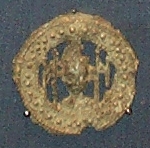
A badge, found in the River Dove in England, collected by a pilgrim to show they had gone to the tomb of St. Thomas Becket. On display in the British Museum.

In 1153 Thomas acted as justice itinerant in three counties. In 1159 he seems to have been the chief organizer of Henry’s expedition to Toulouse, upon which he accompanied him, and though it seems to be untrue that the impost of “scutage” was called into existence for that Occasion (Round, “Feudal England”, 268-73), still Thomas undoubtedly pressed on the exaction of this money contribution in lieu of military service and enforced it against ecclesiastics in such a way that bitter complaints were made of the disproportionately heavy burden this imposed upon the Church.

In the military operations Thomas took a leading part, and Garnier, a French chronicler, who lived to write of the virtues of St. Thomas and his martyrdom, declares that in these encounters he saw him unhorse many French knights. Deacon though he was, he lead the most daring attacks in person, and Edward Grim also gives us to understand that in laying waste the enemy’s country with fire and sword the chancellor’s principles did not materially differ from those of the other commanders of his time. But although, as men then reported, “he put off the archdeacon”, in this and other ways, he was very far from assuming the licentious manners of those around him. No word was ever breathed against his personal purity. Foul conduct or foul speech, lying or unchastity were hateful to him, and on occasion he punished them severely.

He seems at all times to have had clear principles with regard to the claims of the Church, and even during this period of his chancellorship he more than once risked Henry’s grievous displeasure. For example, he opposed the dispensation which Henry for political reasons extorted from the pope, and strove to prevent the marriage of Mary, Abbess of Romsey, to Matthew of Boulogne. But to the very limits of what his conscience permitted, Thomas identified himself with his master’s interests, and Tennyson is true to history when he makes the archbishop say:

I served our Theobald well when I was with him: I served King Henry well as Chancellor: I am his no more, and I must serve the Church.

Archbishop Theobald died in 1161, and in the course of the next year Henry seems to have decided that it would be good policy to prepare the way for further schemes of reform by securing the advancement of his chancellor to the primacy. Our authorities are agreed that from the first Thomas drew back in alarm. “I know your plans for the Church,” he said, “you will assert claims which I, if I were archbishop, must needs oppose.” But Henry would not be gainsaid, and Thomas at the instance of Cardinal Henry of Pisa, who urged it upon him as a service to religion, yielded in spite of his misgivings. He was ordained priest on Saturday in Whitweek and consecrated bishop the next day, Sunday, 3 June, 1162.

It seems to have been St. Thomas who obtained for England the privilege of keeping the feast of the Blessed Trinity on that Sunday, the anniversary of his consecration, and more than a century afterwards this custom was adopted by the papal Court, itself and eventually imposed on the whole world.
Image

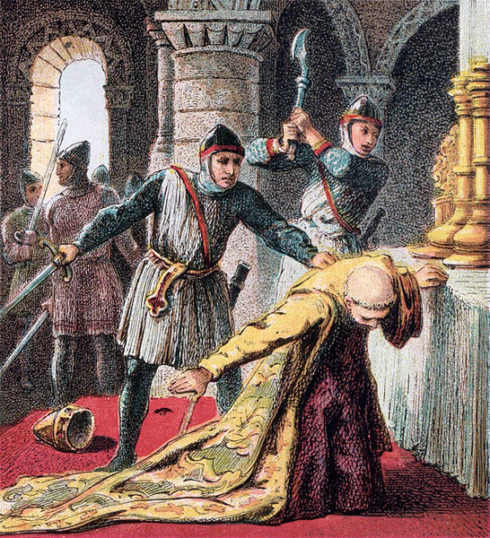
Murder of St. Thomas Becket

A great change took place in the saint’s way of life after his consecration as archbishop. Even as chancellor he had practised secret austerities, but now in view of the struggle he clearly saw before him he gave himself to fastings and disciplines, hair shirts, protracted vigils, and constant prayers. Before the end of the year 1162 he stripped himself of all signs of the lavish display which he had previously affected. On 10 Aug. he went barefoot to receive the envoy who brought him the pallium from Rome. Contrary to the king’s wish he resigned the chancellorship. Whereupon Henry seems to have required him to surrender certain ecclesiastical preferments which he still retained, notably the archdeaconry, and when this was not done at once showed bitter displeasure. Other misunderstandings soon followed. The archbishop, having, as he believed, the king’s express permission, set about to reclaim alienated estates belonging to his see, a procedure which again gave offence. Still more serious was the open resistance which he made to the king’s proposal that a voluntary offering to the sheriffs should be paid into the royal treasury. As the first recorded instance of any determined opposition to the king’s arbitrary will in a matter of taxation, the incident is of much constitutional importance. The saint’s protest seems to have been successful, but the relations with the king only grew more strained.

Soon after this the great matter of dispute was reached in the resistance made by Thomas to the king’s officials when they attempted to assert jurisdiction over criminous clerks. That the saint himself had no wish to be lenient with criminous clerks has been well shown by Norgate (Angevin Kings, ii, 22). It was with him simply a question of principle. St. Thomas seems all along to have suspected Henry of a design to strike at the independence of what the king regarded as a too powerful Church. With this view Henry summoned the bishops at Westminster (1 October, 1163) to sanction certain as yet unspecified articles which he called his grandfather’s customs (avitæ consuetudines), one of the known objects of which was to bring clerics guilty of crimes under the jurisdiction of the secular courts. The other bishops, as the demand was still in the vague, showed a willingness to submit, though with the condition “saving our order”, upon which St. Thomas inflexibly insisted. The king’s resentment was thereupon manifested by requiring the archbishop to surrender certain castles he had hitherto retained, and by other acts of unfriendliness. In deference to what he believed to be the pope’s wish, the archbishop in December consented to make some concessions by giving a personal and private undertaking to the king to obey his customs “loyally and in good faith”. But when Henry shortly afterwards at Clarendon (13 January, 1164) sought to draw the saint on to a formal and public acceptance of the “Constitutions of Clarendon”, under which name the sixteen articles, the avitæ consuetudines as finally drafted, have been commonly known, St. Thomas, though at first yielding somewhat to the solicitations of the other bishops, in the end took up an attitude of uncompromising resistance.
Image

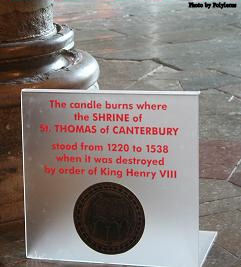
In 1220, St. Thomas Becket’s remains were relocated from this first tomb to a shrine, where it stood until it was destroyed in 1538, by orders of Henry VIII. The king also destroyed St. Thomas Becket’s bones and ordered that all mention of his name be obliterated. The pavement where the shrine stood is today marked by a lit candle.

Then followed a period of unworthy and vindictive persecution. When opposing a claim made against him by John the Marshal, Thomas upon a frivolous pretext was found guilty of contempt of court. For this he was sentenced to pay £500; other demands for large sums of money followed, and finally, though a complete release of all claims against him as chancellor had been given on his becoming archbishop, he was required to render an account of nearly all the moneys which had passed through his hands in his discharge of the office. Eventually a sum of nearly £30,000 was demanded of him. His fellow bishops summoned by Henry to a council at Northampton, implored him to throw himself unreservedly upon the king’s mercy, but St. Thomas, instead of yielding, solemnly warned them and threatened them. Then, after celebrating Mass, he took his archiepiscopal cross into his own hand and presented himself thus in the royal council chamber. The king demanded that sentence should be passed upon him, but in the confusion and discussion which ensued the saint with uplifted cross made his way through the mob of angry courtiers. He fled away secretly that night (13 October, 1164), sailed in disguise from Sandwich (2 November), and after being cordially welcomed by Louis VII of France, he threw himself at the feet of Pope Alexander III, then at Sens, on 23 Nov. The pope, who had given a cold reception to certain episcopal envoys sent by Henry, welcomed the saint very kindly, and refused to accept his resignation of his see. On 30 November, Thomas went to take up his residence at the Cistercian Abbey of Pontigny in Burgundy, though he was compelled to leave this refuge a year later, as Henry, after confiscating the archbishop’s property and banishing all the Becket kinsfolk, threatened to wreak his vengeance on the whole Cistercian Order if they continued to harbour him.

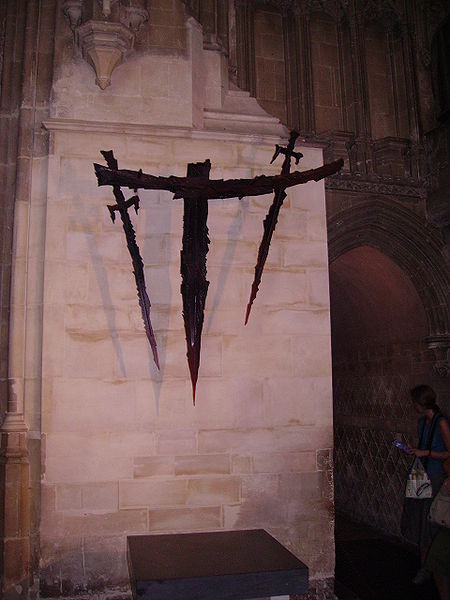
The negotiations between Henry, the pope, and the archbishop dragged on for the next four years without the position being sensibly changed. Although the saint remained firm in his resistance to the principle of the Constitutions of Clarendon, he was willing to make any concessions that could be reasonably asked of him, and on 6 January, 1169, when the kings of England and France were in conference at Montmirail, he threw himself at Henry’s feet, but as he still refused to accept the obnoxious customs, Henry repulsed him. At last in 1170 some sort of reconciliation was patched up. The question of the customs was not mentioned and Henry professed himself willing to be guided by the archbishop’s council as to amends due to the See of Canterbury for the recent violation of its rights in the crowning of Henry’s son by the Archbishop of York. On 1 December, 1170, St. Thomas had brought with him, as well as over the restoration by the de Broc family of the archbishop’s castle at Saltwood. How far Henry was directly responsible for the tragedy which soon after occurred on 20 December is not quite clear. Four knights who came from France demanded the absolution of the bishops. St. Thomas would not comply. They left for a space, but came back at Vesper time with a band of armed men. To their angry question, “Where is the traitor?” the saint boldly replied, “Here I am, no traitor, but archbishop and priest of God.” They tried to drag him from the church, but were unable, and in the end they slew him where he stood, scattering his brains on the pavement. His faithful companion, Edward Grim, who bore his cross, was wounded in the struggle.
Image

Area marking the spot of St. Thomas Becket’s martyrdom in Canterbury Cathedral.

A tremendous reaction of feeling followed this deed of blood. In an extraordinary brief space of time devotion to the martyred archbishop had spread all through Europe. The pope promulgated the bull of canonization, little more than two years after the martyrdom, 21 February, 1173. On 12 July, 1174, Henry II did public penance, and was scourged at the archbishop’s tomb. An immense number of miracles were worked, and for the rest of the Middle Ages the shrine of St. Thomas of Canterbury was one of the wealthiest and most famous in Europe.

The martyr’s holy remains are believed to have been destroyed in September, 1538, when nearly all the other shrines in England were dismantled; but the matter is by no means clear, and, although the weight of learned opinion is adverse, there are still those who believe that a skeleton found in the crypt in January, 1888, is the body of St. Thomas. The story that Henry VIII in 1538 summoned the archbishop to stand his trial for high treason, and that when, in June, 1538, the trial had been held and the accused pronounced contumacious, the body was ordered to be disinterred and burnt, is probably apocryphal.
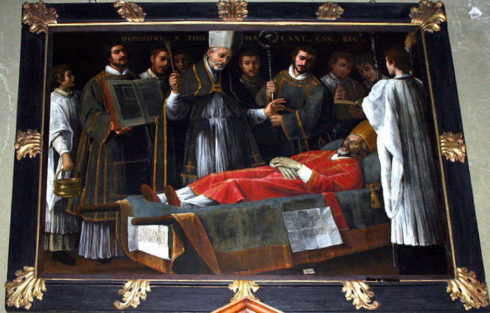
Image

Funeral of St. Thomas Becket

By far the best English life is MORRIS, The Life of St. Thomas Becket (2nd ed., London, 1885); there is a somewhat fuller work of L’HUILLIER, Saint Thomas de Cantorbery (2 vols., Paris, 1891); the volume by DEMIMUID, St. Thomas Becket (Paris, 1909), in the series Les Saints is not abreast of modern research. There are several excellent lives by Anglicans, of which HUTTON, Thomas Becket (London, 1900), and the account by NORGATE in Dict. Nat. Biog., s. v. Thomas, known as Thomas a Becket, are probably the best. The biography by ROBERTSON, Becket, Archbishop of Canterbury (London, 1859), is not sympathetic. Nearly all the sources of the Life, as well as the books of miracles worked at the shrine, have been edited in the Rolls Series by ROBERTSON under the title Materials for the History of Thomas Becket (7 vols., London, 1875-1883). The valuable Norse saga is edited in the same series by MAGNUSSON, Thomas Saga Erkibyskups (2 vols., London, 1884). The chronicle of GARNIER DE PONT S. MAXENCE, Vie de St. Thomas Martyr, has been edited by HIPPEAU (Paris, 1859). The miracles have been specially studied from an agnostic standpoint by ABBOT, Thomas of Canterbury, his death and miracles (2 vols., London, 1898). Some valuable material has been collected by RADFORD, Thomas of London before his Consecration (Cambridge, 1894). On the relics see MORRIS, Relics of St. Thomas (London, 1888); THORNTON, Becket’s Bones (Canterbury, 1900); WARD, The Canterbury Pilgrimages (London, 1904); WARNER in Eng. Hist. Rev., VI (1891), 754-56.

HERBERT THURSTON (1913 Catholic Encyclopedia)

Image

{ 0 comments }

Blessed Margaret Colona

Poor Clare, also known as Margarita Colonna, born in Rome, date uncertain; died there, 20 September, 1284.

Bl. Margaret ColonaHer father, Prince Odo Colonna, and her mother died in Rome when she was still a young girl, and she was left to the care of her two brothers, the youngest of whom was raised to the cardinalate by Nicholas III in 1278. Having resolutely refused the proposal of marriage made to her by the chief magistrate of Rome, she retired to a lonely retreat near Palestrina where she passed her time in practices of piety and penance.

Her charity towards the poor was unbounded, and was more than once miraculously rewarded. Through the influence of her brother, Cardinal Colonna, Blessed Margaret obtained the canonical erection of a community of Urbanist Poor Clares at her family castle in Palestrina, of which she most probably became superioress. Seven years before her death she was attacked with a fearful and painful ulcer which till the end of her life she bore with the most sublime and generous resignation. After the death of Blessed Margaret, the community of Palestrina was transferred to the convent of San Silvestro in Capite. The nuns were driven from their cloister by the Italian Government at the time of the suppression; and the monastery has since been used as the central post-office of Rome. The exiled religious found shelter in the convent of Santa Cecilia in Trastevere, to which place the body of Blessed Margaret was removed.

Santa Cecilia in Trastevere

Santa Cecilia in Trastevere

(cfr. Catholic Encyclopedia)

Image

{ 0 comments }

St. Egwin

Stained glass window of St. Egwin in Worcester Cathedral by glass artist Geoffrey Fuller Webb. Photo taken by, with permission to use, by Robin Croft.

Stained glass window of St. Egwin in Worcester Cathedral by glass artist Geoffrey Fuller Webb. Photo taken by, with permission to use, by Robin Croft.

Third Bishop of Worcester; date of birth unknown; d. (according to Mabillon) 20 December, 720, though his death may have occurred three years earlier. His fame as founder of the great Abbey of Evesham no doubt tended to the growth of legends which, though mainly founded on facts, render it difficult to reconcile all the details with those of the ascertained history of the period.

It appears that either in 692, or a little later, upon the death of Oftfor, second Bishop of Worcester, Egwin, a prince of the Mercian blood royal, who had retired from the world and sought only the seclusion of religious life, was forced by popular acclaim to assume the vacant see. His biographers say that king, clergy, and commonalty all united in demanding his elevation; but the popularity which forced on him this reluctant assumption of the episcopal functions was soon wrecked by his apostolic zeal in their discharge.

Evesham Abbey Bell tower

Evesham Abbey Bell tower

The Anglo-Saxon population of the then young diocese had had less than a century in which to become habituated to the restraints of Christian morality; they as yet hardly appreciated the sanctity of Christian marriage, and the struggle of the English Benedictines for the chastity of the priesthood had already fairly begun. At the same time large sections of England were more or less permanently occupied by pagans closely allied in blood to the Anglo-Saxon Christians. Egwin displayed undaunted zeal in his efforts to evangelize the heathen and no less in the enforcement of ecclesiastical discipline. His rigorous policy towards his own flock created a bitter resentment which, as King Ethelred was his friend, could only find vent in accusations addressed to his ecclesiastical superiors. Egwin undertook a pilgrimage to seek vindication from the Roman Pontiff himself. According to a legend, he prepared for his journey by locking shackles on his feet, and throwing the key into the River Avon. While he prayed before the tomb of the Apostles, at Rome, one of his servants brought him this very key — found in the maw of a fish that had just been caught in the Tiber. Egwin then released himself from his self-imposed bonds and straightway obtained from the pope an authoritative release from the load of obloquy which his enemies had striven to fasten upon him.

Subscription4

It was after Egwin’s triumphant return from this pilgrimage that the shepherd Eoves came to him with the tale of a miraculous vision by which the Blessed Virgin had signified her will that a new sanctuary should be dedicated to her. Egwin himself went to the spot pointed out by the shepherd (Eoves ham, or “dwelling”) and to him also we are told the same vision was vouchsafed. King Ethelred granted him the land thereabouts upon which the famous abbey was founded. As to the precise date of the foundation, although the monastic tradition of later generations set it in 714, recent research points to some year previous to 709. At any rate it was most probably in 709 that Egwin made his second pilgrimage to Rome, this time in the company of Coenred, the successor of Ethelred, and Offa, King of the East Saxons, and it was on this occasion that Pope Constantine granted him the extraordinary privileges by which the Abbey of Evesham was distinguished. One of the last important acts of his episcopate was his participation in the first great Council of Clovesho.

(Catholic Encyclopedia)

{ 0 comments }

St. Melania (the Younger)

Born at Rome, about 383; died in Jerusalem, 31 December, 439. She was a member of the famous family of Valerii. Her parents were Publicola and Albina, her paternal grandmother of the same name is known as Melania, Senior. Little is known of the saint’s childhood, but after the time of her marriage, which occurred in her thirteenth year, we have more definite information. Through obedience to her parents she married one of her relatives, Pinianus a patrician. During her married life of seven years she had two children who died young.

St. MelaniaAfter their death Melania’s inclination toward a celibate life reasserting itself, she secured her husband’s consent and entered upon the path of evangelic perfection, parting little by little with all her wealth. Pinianus, who now assumed a brotherly position toward her, was her companion in all her efforts toward sanctity. Because of the Visigothic invasions of Italy, she left Rome in 408, and for two years lived near Messina in Sicily. Here, their life of a monastic character was shared by some former slaves. In 410 she went to Africa where she and Pinianus lived with her mother for seven years, during which time she grew well acquainted with St. Augustine and his friend Alypius. She devoted herself to works of charity and piety, especially in her zeal for souls, to the foundation of a nunnery of which she became superior, and of a cloister of which Pinianus took charge. In 417, Melania, her mother, and Pinianus went to Palestine by way of Alexandria. For a year they lived in a hospice for pilgrims in Jerusalem, where she met St. Jerome. She again made generous donations, upon the receipt of money from the sale of her estates in Spain. About this time she travelled in Egypt, where she visited the principal places of monastic and eremetical life, and upon her return to Jerusalem she lived for twelve years, in a hermitage near the Mount of Olives. Before the death of her mother (431), a new series of monastic foundations had begun. She started with a convent for women on the Mount of Olives, of which she assumed the maintenance while refusing to be made its superior. After her husband’s death she built a cloister for men, then a chapel, and later, a more pretentious church. During this last period (Nov., 436), she went to Constantinople where she aided in the conversion of her pagan uncle, Volusian, ambassador at the Court of Theodosius II, and in the conflict with Nestorianism. An interesting episode in her later life is the journey of the Empress Eudocia, wife of Theodosius, to Jerusalem in 438. Soon after the empress’s return Melania died.
Saint Melania the Younger

Saint Melania the Younger

The Greek Church began to venerate her shortly after her death, but she was almost unknown in the Western Church for many years. She has received greater attention since the publication of her life by Cardinal Rampolla (Rome, 1905). In 1908, Pius X granted her office to the congregation of clergy at Somascha. This may be considered as the beginning of a zealous ecclesiastical cult, to which the saint’s life and works have entitled her. Melania’s life has been shrouded in obscurity nearly up to the present time; many people having wholly or partially confounded her with her grandmother Antonia Melania. The accurate knowledge of her life we owe to the discovery of two manuscripts; the first, in Latin, was found by Cardinal Rampolla in the Escorial in 1884, the second, a Greek biography, is in the Barberini library. Cardinal Rampolla published both these important discoveries at the Vatican printing-office.

CHARLES SCHLITZ (Catholic Encyclopedia)

Image

{ 0 comments }

St. Marius Aventicus

(Or AVENTICENSIS)

Image

The city of Avenches, with the Church and Château in the background. Photo by Dake.

Bishop of Avenches (Switzerland) and chronicler, born about 530 in the present Diocese of Autun; died at Lausanne, 31 December, 594. Of the events of his life little is known. From an inscription on his tomb in the church of St. Thyrsius in Lausanne (published in the “Monumenta Germ. Scriptores”, XXIV, 795), we learn that he came of a distinguished, rich and probably Roman family, and at an early age embraced the ecclesiastical state. In 574 he was made Bishop of Avenches, took part in the Council of Mâcon in 585, and shortly afterwards transferred his episcopal see from Avenches, which was rapidly declining, to Lausanne. He is extolled as an ideal bishop; as a skilled goldsmith who made the sacred vessels with his own hands; as a protector and benefactor of the poor; as a man of prayer, and as a scholar full of enthusiasm for serious intellectual studies.

Saint-François square in Lausanne.

Saint-François square in Lausanne.

In 587 he consecrated St. Mary’s church at Payerne, which had been built at his expense and through his efforts. After his death he was venerated in the Diocese of Lausanne as a saint, and his feast was celebrated on 9 or 12 February. The church of St. Thyrsius received at an early date the name of St. Marius. A chronicle of his is still preserved, and purports to be a continuation of the chronicle of Prosper Tiro, or rather of the “Chronicon Imperiale”. It extends from 455 to 581, and, although consisting only of dry, annalistic notes, it is valuable for Burgundian and Franconian history, especially for the second half of the sixth century. This explains the fact that, notwithstanding its brevity, it has been frequently published – first by Chifflet in André Duchesne’s “Historiæ Francorum Scriptores”, I (1636), 210-214; again by Migne in P. L., LXXII, 793-802, and finally by Mommsen in “Mon. Germ., Auctores antiqui”, XI (1893), 232-9.

Subscription24

ARNDT, Bischof Marius von Aventicum. Sein Leben u. seine Chronik (Leipzig, 1875); MOMMSEN in his edition, Prœfatio, 227-31; POTTHAST, Bibl. hist. med. œvi, I (Berlin, 1896), 667.

PATRICIUS SCHLAGER (Catholic Encyclopedia)

{ 0 comments }

Three different ways of commemorating Christmas; three varieties of contemplation

Saint of the Day, December 21, 1973
Dr. Plinio

If we imagine an elaborate nativity scene in certain regions of Italy, we can see all the figures taking very emphatic attitudes: the Child Jesus lying in the manger, reaching out to Our Lady; She bent over her divine Son in an attitude of profound but bubbly tenderness which tends to manifest itself in gestures that seem to speak; and if the artist manages to have Our Lady and the Child-God convey such an impression that someone would say, “all that’s missing is for them to speak!,” the artist will be delighted because on this scene, talking and manifesting oneself is the pinnacle of achievement. Also St. Joseph, who is nearby (and who naturally plays a more modest role in the dialogue between the Blessed Virgin and the Divine Child as he is only his legal father) appears in a position which, if not just short of talking, seems about to cry or smile according to one’s interpretation, but is extremely expressive.

Neapolitan crèche

Neapolitan crèche

Clearly, according to this conception religious emotion must be expressed with great vivacity, which in turn must be expressed by thoughts and words. And such thoughts must be lively and expressed in warm and emphatic terms.

The German idea of Christmas night is the exact opposite of the one mentioned above. In order to be sacral, Christmas night has to produce in souls a profound impression, which is common to all peoples. But for the German mentality, since this impression is profound it should not expand because it is located deep in the soul. And the best outward manifestation of it is silence, recollection, and calm.

While for some the words and gestures are the pinnacle of expression, for others the climax of expression is a form of silence and inaction that reveal unsuspected depths of the human soul; and which, by their very silence, indicate the soul’s inability to express everything that it ponders. They indicate a state of mind less exclamatory than pensive and meditative. One would say that it is a recollected, almost philosophical or theological attitude.

However, this calm, which is not of a scientific type, is profoundly tender; a tenderness which indicates such a great affection that the person prefers to be silent rather than to speak. Accordingly, while some have the eloquence of words and gestures, others manifest, as it were, the eloquence of silence and recollection. These are two different positions.

*   *   *

German nativity scene

German nativity set

Which one is the best? I understand that Italians have their own position in this matter, and so do Germans. What would be the Brazilian attitude? That of perfectly understanding and appreciating both positions. This is the typical Brazilian way and it is what I feel in me: a perfect understanding of both Italians and Germans.

As a Brazilian, I would speak less than Italians but remain less quiet than Germans, particularly since by blood I am a Brazilian with the loquacity of Northeasterners.

* * *

These are regional varieties through which God wants to be worshiped by all peoples. So it is not for us to choose but to contemplate the beauty of the various styles.

Subscription16

{ 0 comments }

The Christmas Rose

December 25, 2025

Helleborus niger, aka Christmas Rose.

Helleborus niger, aka Christmas Rose.

The Christmas rose blooms at Christmastime. Really!  The flower pushes up out of the snow. The blooms last for weeks and the plant lasts for years.

It is said that it bloomed outside the stable at Bethlehem, although the plant is not a native of the Holy Land. The rose reminds us of the stable in the snow, the hovering angels, the kneeling donkey and the Magi. The story of the Christmas Rose reminds us of another story the Little Drummer Boy.

A photo of a Christmas Rose peeking through the snow. Photo by Kyllir.

A photo of a Christmas Rose peeking through the snow. Photo by Kyllir.

A little country girl who on visiting the Stable and wept because she had nothing to give the Christ Child. Her tears fell in the snow and a hovering angel landed and showed her the Christmas rose poking through the snow to use as her gift.

Even though the plant is very poisonous, the Christmas Rose is truly a wonderful plant. For one thing, its seeds are spread by, of all things, snails. They eat the oil covering the seed and carry the rest away. It’s certainly no normal plant.  The flowers are literally frozen solid and yet, when the ice falls away, the petals are soft and fresh as spring blossoms.

Subscription16

Short Stories on Honor, Chivalry, and the World of Nobility—no. 556

{ 0 comments }

By Plinio Correa de Oliveira

The secret to the proper organization of earthly life is found in the words the angels sang to the enraptured shepherds on Christmas night: “Glory to God in the highest and peace on earth to men of good will.”

ImageWhen men recognize the plenitude of all perfections in God and glorify Him as a result, their hearts come to possess the good disposition that makes them men of good will.  It is the birth of this disposition in their souls that brings the reign of Christ’s peace to this earth.

We should think of this in these days when, no matter where we turn, we find confusion, discord, hatred, voluptuousness, immorality, dishonesty, and all kinds of other evils multiplying among mankind.

If mankind would but turn to Christ Our Lord, we could have an end of century very different from its beginning, which was already characterize by positivism, agnosticism, and materialism.

Image

Statue of the Holy Family at the Basilica of St. Martin in Italy. Photo by Berthold Werner

Let us remember that Christmas night is a night of mercy and goodness, a night of forgiveness and hope.  Next to the cradle of the Christ Child is Mary, whose supplications before Her Divine Son are omnipotent.  She has the heart of a mother who loves each one of us more than all the mothers of the world would love a single son, and is therefore disposed to obtain from Her Child the forgiveness of our faults, the amendment of our errors, and the firm resolution to follow the law of god in everything.

Thinking of these truths, we will realize that however great the evil, all the gateways of hope are open for us so long as we turned to the Child born in Bethlehem.  That is the consoling hope that I would like to bring to your attention.

ImageWhen the midnight bells announce that Christmas is here, when the faithful calmly had to church, when the families gather to pray before the Nativity scene, remember this great hope and, setting aside the afflictions of our days, seek to understand the words of St. Paul: “Jesus Christ, yesterday and today, and the same forever.”

This Child born in Bethlehem⸺the God-Child, the Second Person of the Holy Trinity made man⸺ is the Alpha and the Omega.  He is the first letter and the last, the beginning and the end of everything.  Through Him we receive all good.

Image

Museum of Sacred Art in São Paulo, Brazil

Kneeling before the crèche, let us ask Him for everything we lack and need.  Let us ask Him, above all, that we will love Him, understand Him, and the united to Him, so that when He calls us one day to render account of our lives, we may look to Him with confidence and see Him open His arms to admit us into eternal beatitude.

Image

{ 0 comments }

St. Peter Nolasco

Born at Mas-des-Saintes-Puelles, near Castelnaudary, France, in 1189 (or 1182); died at Barcelona, on Christmas Day, 1256 (or 1259). He was of a noble family and from his youth was noted for his piety, almsgiving, and charity. Having given all his possessions to the poor, he took a vow of virginity and, to avoid communication with the Albigenses, went to Barcelona.

St. Pedro Nolasco has a vision of Jerusalem. Painting by Francisco de Zurbarán

St. Pedro Nolasco has a vision of Jerusalem. Painting by Francisco de Zurbarán

At that time the Moors were masters of a great part of the Iberian peninsula, and many Christians were detained there and cruelly persecuted on account of the Faith. Peter ransomed many of these and in doing so consumed all his patrimony. After mature deliberation, moved also by a heavenly vision, he resolved to found a religious order (1218), similar to that established a few years before by St. John de Matha and St. Felix de Valois, whose chief object would be the redemption of Christian slaves. In this he was encouraged by St. Raymond Penafort and James I, King of Aragon, who, it seems, had been favoured with the same inspiration. The institute was called Mercedarians and was solemnly approved by Gregory IX, in 1230. Its members were bound by a special vow to employ all their substance for the redemption of captive Christians, and if necessary, to remain in captivity in their stead. At first most of these religious were laymen as was Peter himself. But Clement V decreed that the master general of the order should always be a priest.

cfr. Acta SS.; DE VARGAS, Chronica sancti et militaris ordinis B. M. de Mercede (Palermo, 1619); GARI Y SIUMELL, Bibliotheca Mercedaria (Barcelona, 1875); MARIN, Histoire de l’eglise (Paris, 1909).

Mercedarians (Order of Our Lady of Mercy)

Foundation of the Order of Mercy, part of the center altarpiece of the Cathedral of Barcelona.

Foundation of the Order of Mercy, part of the center altarpiece of the Cathedral of Barcelona.

A congregation of men founded in 1218 by St. Peter Nolasco, born 1189, at Mas-des-Saintes-Puelles, Department of Aude, France. Joining Simon de Montfort’s army, then attacking the Albigenses, he was appointed tutor to the young king, James of Aragon, who had succeeded to the throne after the death of his father, Pedro II, killed at the battle of Muret. Peter Nolasco followed his pupil to his capital, Barcelona, in 1215. From the year 1192 certain noblemen of that city had formed a confraternity for the purpose of caring for the sick in hospitals, and also for rescuing Christian captives from the Moors. Peter Nolasco was requested by the Blessed Virgin in a vision to found an order especially devoted to the ransom of captives. His confessor, St Raymond of Pennafort, the canon of Barcelona, encouraged and assisted him in this project; and King James also extended his protection.  The noblemen already referred to were the first monks of the order, and their headquarters was the convent St. Eulalie of Barcelona, erected 1232. They had both religious in holy orders, and lay monks or knights; the choir monks were clothed in tunic, scapular, and cape of white. These religious followed the rule drawn up for them by St Raymond of Pennafort. The order was approved, first by Honorius III and then by Gregory IX (1230), the latter, at the request of St Raymond Nonnatus presented by St Peter Nolasco, granted a Bull of confirmation and prescribed the Rule of St. Augustine, the former rule now forming the constitutions (1235). St. Peter was the first superior, with the title of Commander-General; he also filled the office of Ransomer, a title given to the monk sent into the lands subject to the Moors to arrange for the ransom of prisoners. The holy founder died in 1256, seven years after having resigned his superiorship; he was succeeded by Guillaume Le Bas.

La Mercè Basilica, in Barcelona, where her incorrupt body reposes on the right side of the altar.

La Mercè Basilica, in Barcelona, where her incorrupt body reposes on the right side of the altar.

The development of the order was immediate and widespread throughout France, England, Germany, Portugal, and Spain. As the Moors were driven back, new convents of Mercy were established. Houses were founded at Montpelier, Perpignan, Toulouse, and Vich. The great number of houses, however, had a weakening effect on the uniformity of observance of the rule. To correct this, Bernard de Saint-Romain, the third commander general (1271), codified the decisions of the general chapters. Subscription8 In the fourteenth century, disputes arose from the rivalry between the convents of Barcelona and Puy, and from the discord between the priests and knights, which ended in the latter’s suppression, disturbed the peace of the order. Christopher Columbus took some members of the Order of Mercy with him to America, where they founded a great many convents in Latin America, throughout Mexico, Cuba, Brazil, Peru, Chile, and Ecuador. These formed no less than eight provinces, whereas they only had three in Spain and one in France. This order took a very active part in the conversion of the Indians. At the beginning of the seventeenth century Father Gonzales, who had made his profession in the convent of Olmedo in 1573, conceived the idea of a reform, at that time necessary. The commander-general, Alfonso de Montoy, at first supported this scheme, but ended by opposing it. In this undertaking, Gonzales was assisted by the Countess of Castellan, who obtained for him the necessary authorization from Clement VIII, and presented him with three convents for the reformed monks (at Viso, Diocese of Seville; Almoragha, Diocese of Cadiz; Ribas). The reform was confirmed at the provincial chapter of Guadelajara in 1603. Father Gonzales took the name of John Baptist of the Blessed Sacrament, and died at Madrid in 1618. Paul V approved his reform in 1606; in 1621 Gregory XV declared it independent of the monks of the Great Observance. Their convents formed two provinces,with houses at Madrid, Salamanca, Seville, and Alcalá, with a few foundations in Sicily.

St. Peter Nolasco

St. Peter Nolasco

Father Antoine Velasco founded a convent of nuns of Our Lady of Mercy at Seville in 1568, of which the first superioress was Blessed Ann of the Cross. This foundation had been authorized by Pius V. The reformed branch also established houses of barefooted nuns, or Nuns of the Recollection, at Lura, Madrid, Santiago de Castile, Fuentes, Thoro, and elsewhere. The female tertiaries go back to the very beginning of the order (1265). Two widows of Barcelona, Isabel Berti and Eulalie Peins, whose confessor was Blessed Bernard of Corbario, prior of the convent there, were the foundresses. They were joined by several companions, among them St. Mary of Succour (d. 31 Decemb., 1281), the first superior of the community. Blessed Mary Anne of Jesus (d. 1624) founded another community of tertiaries, under the jurisdiction of the reformed branch. The Order of Mercy of late years has much decreased in membership. The restoration of the reformed convent at Thoro, Diocese of Zamora, Spain, is worthy of note (1888). At present the order has one province and one vice-province in Europe, and four provinces and two vice-provinces in America, with thirty-seven convents and five to six hundred members. The Mercedarian convents are in Palermo; Spain; Venezuela (Caracas, Maracaibo); Peru (Lima); Chile (Santiago); Argentina (Cordova, Mendoza); Ecuador (Quito); and Uruguay. The Mercedarians of Cordova publish “Revista Mercedaria”.

Mercedarias Descalzas Convent in Santiago de Compostela, Spain

Mercedarias Descalzas Convent in Santiago de Compostela, Spain

Besides the founder, St. Peter Nolasco, the following illustrious members of the order may be mentioned: St. Raymond Nonnatus (d. 1240), the most famous of the monks who gave themselves up to the work of ransoming captives; Blessed Bernard of Corbario, already mentioned; St. Peter Paschal, Bishop of Jaen, who devoted all his energies to the ransom of captives and the conversion of the Musselmans, martyred in 1300; St. Raymond was a cardinal, as also were Juan de Luto and Father de Salazar. It is unnecessary to enumerate the archbishops and bishops. Writers were numerous, especially in Spain and Latin America in the seventeenth century. To mention only a few: Alfonso Henriquez de Almendaris, Bishop of Cuba, who founded a college for his order at Seville, and from whom Philip III received an interesting report on the spiritual and temporal condition of his diocese in 1623; Alfonso de Monroy, who drew up the constitutions of the reform, and who was a bishop in America; Alfonso Ramón, theologian, preacher, and annalist of his order; Alfonso Velásquez de Miranda (1661), who took a considerable part in political affairs; Fernando de Orio, general of the order, who translated and learnedly commented on Tertullian’s treatise “De Poenitentia”; Fernando de Santiago (1639), one of the favourite preachers of his time; Francisco Henríquez; Francisco de Santa Maria; Francisco Zumel; Gabriel de Adarzo (1674), theologian, preacher, and statesman; Gabreil Tellez (1650), dramatic author; Gaspar de Torrez, Bishop of the Canary Islands; Pedro de Ona, whom Philip III sent on important missions both in America and in the Kingdom of Naples.

(1913 Catholic Encyclopedia)

Fr. Francisco Zumel Painting by Francisco de Zurbarán

Fr. Francisco Zumel Painting by Francisco de Zurbarán

{ 0 comments }

Christmas Story Collection

December 25, 2025

ImageOur Lord as the Point of Reference

ImageImageSome Reflections on the Story of the Little Drummer Boy

ImageImageChristmas Preparation

ImageImageThe Count and The Chimneysweep

ImageImageHow did St. Nicholas evolve into Santa Claus and why?

ImageImageFor Christmas Gifts, St. Louis IX of France Gives His Nobles Crusader Crosses

ImageImageSeeking the True Joy of Christmas

ImageImageEmpress Sisi’s Christmas for the poor

ImageImageChristmas in Italy, Germany, and Brazil

ImageImageThe Christmas of a Chouan

ImageImageMarie Antoinette teaches her children to sacrifice themselves for the poor
ImageImageMarvelous Christmas carol composed by St. AlphonsusImageImageHistory’s First Nativity Scene

Image

Christmas in French salons

{ 0 comments }

Christmas in French Salons

December 25, 2025

Image

Photo of the statue of Infant Jesus of Prague in Our Lady Church in Joinville, Haute-Marne, France by Vassil.

Since no door in the town of Bethlehem was opened to the Holy Family, the Infant Jesus was born in a poor stable manger heated only with an ox and ass.

In reparation for such lack of hospitality, every year at Christmas, French noble houses open their doors to the Christ Child, his holy Mother, and to the patriarch Saint Joseph.

In sumptuously decorated rooms, in an ambiance filled with amiability, courtesy, etiquette and elegance, the salon society comes to kneel before a manger that has nothing of a salon.
However, that is where we find the Child-God, along with Our Lady and Saint Joseph, prince and princess of the House of David.
O Jesus, so humbled on our account!
O omnipotent majesty!
Charm, beauty, grace, and wonder – all render homage to the King of Kings.
O little Child, o powerful King, extend Thy reign completely over us!
This is the prayer and submission of the most refined salons on earth to the Divine Monarch Who conquered the whole world from that humble stable manger.
In the heavens, the court of angels rejoices together with the courts of men, glorifying the Divine Child, King and Redeemer.

(Nobility.org translation)

Nobility Book for Christmas

{ 0 comments }

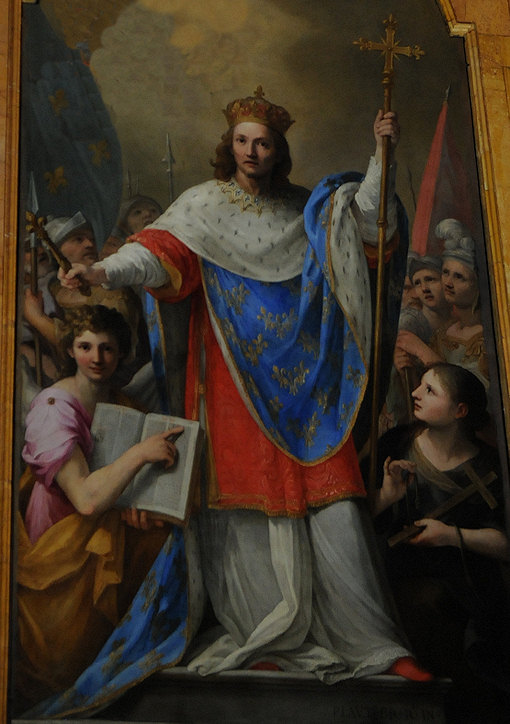
Louis IX occupied himself constantly in carrying his design into execution, and neglected no mean of winning to his purpose all the nobility of his kingdom; his piety did not disdain to employ, for what he considered a sacred cause, all the empire that kings generally possess over their courtiers. . . . After an ancient custom, the kings of France, at great solemnities, gave such of their subjects as were at court, certain capes or furred mantles, with which the latter immediately clothed themselves before leaving the court.
Image

Painting of King St. Louis IX of France in the church Saint Louis of the French in Rome, Italy.

In the ancient comptes (a sort of audits) these capes were called livrées (whence, no doubt, our word livery), because the monarch gave them (les livrait) himself. Louis ordered a vast number of these to be prepared against Christmas Eve, upon which crosses were embroidered in gold and silk. The moment being come, every one covered himself with the mantle that had been given to him, and followed the monarch to the chapel. What was their astonishment when, by the light of the wax tapers, they at once perceived upon all before them,and then upon themselves, the sign of an engagement they had never contracted. Such was, however, the character of the French knights, that they believed themselves obliged to respond to this appeal to their bravery; all the courtiers, as soon as divine service was ended, joined in the laugh with the skillful fisher of men, and took the oath to accompany him into Asia.
Image
Joseph François Michaud, History of the Crusades, trans. W. Robson (London: George Routledge and Co., 1852), 2:349. Stories on Honor, Chivalry, and the World of Nobility—no. 657

{ 0 comments }

According to the British Royal Household:

‘Its always best to let the dough rest, so it’s great if you can make the dough the night before,’ reveals one Royal Pastry Chefs.

‘You can also roll out the dough, cut the shapes and put them in a freezer for an hour. This ensures they keep their shape nicely.’

Once cut into festive shapes, the biscuits can then be decorated using icing. For an extra special touch, you can even personalise each biscuit.

Once the icing is completely dry, you can loop a ribbon through the biscuits and then hang them on the tree as decorations.

To read the entire article at the Royal Household, please click here.

{ 0 comments }

The Legend of St. Dismas

December 25, 2025

by Pauline Sanders

Many years ago, after Jesus was born, the evil King Herod waited for the three kings from the Orient to return to his kingdom with news of the newborn King. When they did not return, Herod grew afraid that this new King would cause him to lose his throne. Because of this, he ordered his soldiers to kill all the babies in Bethlehem, from those newly born up to two years of age.

Now, God the Father could not allow Herod’s men to kill the Infant Jesus, so He sent an angel to speak to Saint Joseph while he slept. The angel told Saint Joseph in a dream to take his family and flee with them to the land of Egypt, where they would be safe. Saint Joseph woke up and prepared in great haste to leave their simple home.

Image

The Massacre of the Innocents by Angelo Visconti.

When the time came to leave, Mary the mother of Jesus woke her Infant, Who wept a little, as might any little child who is suddenly awakened in the middle of the night. But Our Lady soothed Him tenderly, cooing and kissing Him reverently until He became quiet again.

Saint Joseph placed the Mother and the Holy Child on a donkey and set off for Egypt. Now, Egypt could only be reached by crossing a vast desert, which the Holy Family had to cross without much food or drink, for they were very poor. Sometimes, they suffered much from hunger, not having anything to eat the whole day, and at night they had little protection against the bitter cold. Our Lady was sad because the baby in her arms shivered with cold and cried. So it was that the Holy Family suffered terrible hardships on their way to Egypt.

Nevertheless, nature came to their aid time and time again in a miraculous way. Once, when the Holy Family was very hungry, they came to a place in the desert where a fig tree stood, laden with fruit. The fruit was too high for Saint Joseph to reach, so the tree bent its branches so that Mary and Joseph could help themselves to as much fruit as they needed for Jesus and themselves. Another time, when they had gone all day without eating, Our Lady, using her power as queen of the angels, commanded them to help with some nourishment. Thousands of angels rushed to help the Holy Family, bringing them heavenly juices and delicious food. They also walked with the Holy Family during the night, and their brilliance lit up the way as if it were a sunny day!

Image

The Flight to Egypt by Diego Quispe Tito.

One night, after many long days on their journey, the Holy Family came to a very desolate place, one full of great danger, for a gang of thieves hid in nearby caves and assaulted lonely pilgrims. From their lookouts, they watched Holy Family coming closer and closer, and at the opportune moment, pounced on them. However, the minute they looked at the beautiful Child, a bright ray, like an arrow, penetrated the heart of the leader. Strangely moved, the thief had a change of heart. He ordered his fellow robbers not to harm the holy pilgrims and to the gang’s surprise, invited the Holy Family to dine with him at his house. The robber told his wife how strangely his heart had been moved, and while many of the thieves shyly looked on, the woman brought the awe-inspiring pilgrims little rolls, fruits, honeycomb, and juice.

After they had eaten, Our Lady asked the robber’s wife for some water to bathe Her Child. The woman brought a tub filled with water and stood by with her husband as Our Lady tenderly washed the desert dust from the Infant Jesus. The husband and his whole gang of thieves were deeply moved by the appearance of the Holy Family, whose charm, beauty, and goodness wrought a change of heart in nearly all who came into contact with them. Our Lady was so beautiful and queenly that it is said that people came out of their homes to gaze at Her as She walked by. She was not only sweet, and wise, but full of life and holy counsels. Saint Joseph and the Infant Jesus also touched hearts in a similar manner. Imagine what manner of grace and splendor they brought into that dingy den of robbers and sinners!

ImageAt a certain moment the robber whispered to his wife, “This Hebrew Child is no ordinary Child. Ask the Lady to allow us to wash our leprous son in His bath water, for it may do him some good.” Before the wife approached the Blessed Mother with this request, Our Lady turned to her and kindly instructed her to wash her boy in that same water. The poor couple’s son was really terribly afflicted by this horrible disease. At Our Lady’s word, the woman hurried to the darkest corner of the room and lifted her three-year old boy, whose limbs were stiff from the leprosy. As she lowered the child into the basin, she saw the leprous scabs fall from his body as soon as the water touched it. Everyone watched in wonder as the boy became clean and healthy once again. The woman, beside herself with joy, ran to embrace Our Lady and the Infant Jesus, but Mary gently warded her off. She told her to save the water in a hole in a rock for similar future uses, then spoke to her for a long time, counseling her to escape from her home among the thieves at the first opportunity. The woman promised, and in fact, did leave them later on and joined the women at the balsam garden.

Early the next morning, the Holy Family left the den of thieves with their host and hostess leading the way past the snares set up for travelers. When at last, they had to take leave of the Holy Family, the husband and wife expressed their deep feelings, beseeching them, “Remember us wherever you go!” The region where all this took place was called Gaza, the last town before passing into Egypt.

Image

Lithograph of Gaza by Charles William Meredith van de Velde

Thirty years later

Thirty years passed. As the Child grew wondrously in holiness and beauty, the robber’s child also grew, but in wickedness and sin. Then, Savior and the robber found themselves side by side once again on wooden crosses. The One was the Son of God, sinless and innocent, suffering to free us all from the bonds of sin. And the other?

Ah! Poor Dismas, thy first
leprosy was fair
To that which now disfigures
thy poor soul.
No water from His bath will
cleanse thee now,
His blood alone hath power to
make thee whole.
A thousand worlds in one
blood-crimson bath.
With godlike prodigality it pours,
In such strong streams that even crimes like thine
Are borne away in its
irresistible flood!*

Jesus hung between the two thieves, bleeding, silent, dying. His sacrifice had been made. Dismas looked at Him, and his heart was moved as strangely as his father’s had been long ago when looking into the face of the King of kings. He suddenly saw the hideousness of the life he had led and knew that he deserved to hang there on this awful cross. But this other Man, this Jesus who was called the Son of God, He was surely innocent!

Image

Golgotha by Jan Brueghel the Younger. Photograph by Rama

And then he looked down on the beautiful, tear-stained face of the sorrowful mother, her eyes fixed on her dying Son.

He knew that face!

He remembered those sweet eyes looking down on him in that bath so long ago! Now his heart was pierced. Gratitude, that wondrous virtue that dissipates darkness and sin flooded his soul. Suddenly he knew that the leprosy of old was nothing compared to the horrible crimes on his soul. As his blood-shot eyes filled, he suddenly knew Who that Babe had been. He drew in a ragged breath and addressed Jesus: “Lord, remember me when You come into Your kingdom!”

Image

Ah! what strange echoes those familiar words must have rung in Our Lady’s memory! And Jesus, lifting His dying gaze to the face of the thief, promptly offered him this everlasting promise: “This day, Dismas, you will be with me in Paradise!”


Image

(*) A Legend of St. Dismas and Other Poems, Copyright by P. J. Kenedy and Sons. 1927, p. 18.
Illustrations by A.F.Phillips

Short Stories on Honor, Chivalry, and the World of Nobility—no. 571

{ 0 comments }

Christmas Preparation

December 22, 2025

Alphonsus of Aragon, [King Alfonso V of Aragón], whose piety was equal to his greatness, went to visit one of the nobles of his kingdom a little before the festival of Christmas.

ImageThis nobleman, although possessed of much wealth, neglected his religious duties, and was leading a very sinful life. When he heard that his sovereign was about to honour him with a visit, he made great preparations, and received him with all the honour due to his dignity. The King was pleased with these marks of respect, and when about to leave, he said to him: “Most noble lord, you have given me a magnificent reception, and I thank you for it with all my heart; but in a few days a nobler King than I will come and ask you to give Him a suitable welcome. Jesus Christ, the King of kings, on His Christmas festival, will invite you to receive Him into your heart in the Sacrament of the Holy Eucharist. Therefore, I beseech you, go now and prepare your heart to receive Him, and if you adorn it as sumptuously as you have adorned your palace for my reception, you may expect from Him a great share of His heavenly graces.”

Image

The Adoration of the Magi c. 1700, Anonymous

The nobleman took these words to heart, and on Christmas Day had the happiness of receiving his Lord and Master worthily in Holy Communion, to the joy and edification of all the faithful.

Image

The Catechism In Examples, Book IV, by Chisholm, D, pg 149-150

Short Stories on Honor, Chivalry, and the World of Nobility—no. 758

{ 0 comments }

Image

Photo by JJ Harrison

In the seventh century a monk from Crediton, Devonshire, went to Germany to teach the word of God. His name was Saint Boniface. He did many good works there and spent much time in Thuringia, a region later to become the center of the Christmas decoration industry.

Tradition has it that Saint Boniface used the triangular shape of the fir tree to describe the Holy Trinity of God the Father, Son and Holy Spirit. The converted people began to revere the fir tree as God’s tree, as they had previously revered the oak.

By the twelfth century it was being hung, upside-down, from ceilings at Christmas time in Central Europe, as a symbol of Christianity and was referred to as the ‘Tree of Christ’.

The first decorated tree was at Riga in Latvia in 1510.

Image

St. Boniface, Painted by Alfred Rethel

On the more profound meaning of the ‘Tree of Christ’, the late Prof. Plinio Corrêa de Oliveira explains: ‘Each feast of the liturgical calendar brings an effusion of special graces with it. Whether men want or not, grace knocks at the door of their souls in a more sublime, meeker, more insistent way during the Christmas season.’
The Christmas tree, with its beautiful decorations, lights, and star or angel on top, helps to elevate the soul above the materialistic aspects of modern day Christmas. The tip of the tree points to a marvelous world that is Heaven.

To show how the introduction of the custom of the Christmas tree was a gradual process and how it favors the elevation of the ambience, we will tell the story of a Catholic family in Austria written by P. Rosegger in his book Peasant Life in Styria.

Image‘It had long been a great desire of mine to put into practice something I had heard was done in other towns to celebrate Christmas. One should put a small fir tree on the table, affix candles to its branches and place presents for the children underneath, explaining that it had been the Child Jesus who had left them there.

‘So I had the idea to setup a “Tree of Christ” for my little brother, Nickerl. But I needed to do this secretly (part of the procedure) and before my mother entered the kitchen to prepare breakfast.

‘As soon as there was enough light, I went out into the cold. I hid my gaze from those working around the house and when I returned from the forest with a small fir top, I ran to the barn where the horse carts were kept to hide it there.

‘It was soon night. The servants were still busy with the stables and in the bedrooms, where, according to the custom of Christmas Eve, they washed their heads and put on festive clothes. My mother was in the kitchen preparing her typical Christmas sweets. And my Father was with little Nickerl going around the property blessing it with incense, praying all the while. It was necessary to expel the evil spirits and attract angelic blessings to the house.

Image

Cutting the Christmas tree.

‘Thus while everyone was busy with their tasks, I prepared the “Tree of Christ” in the main room. I took my tree from its hiding place and put it on the table. I then cut ten or twelve candles from the wax block and placed them on the branches. Underneath I put some sweetbread.

‘I heard some slow and gentle steps on the floor above. I knew it was my father and my little brother who were there blessing the loft. They would soon be coming to the main room. I lit the little candles and hid behind the stove. The door opened and they entered with the incensor and then stopped…

‘“What is this? My father asked in a low but prolonged voice.”

‘The little Nickerl looked on dumbfounded. In his big, round eyes were reflected the lights of the “Tree of Christ” like little stars.

‘My father advanced slowly to the kitchen door and called in a low voice:

‘“Wife, wife, come and see this.”

‘And when she came, he asked:

‘“Did you do this?”

‘“Mary and Joseph!” my mother exclaimed, “What did you put on the table?”

Image‘The servants soon arrived and were very impressed with the unexpected surprise. So one of them suggested:

‘“Maybe it’s a ‘Tree of Christ’! Could it be that the angels brought this little tree from Heaven?”

‘They all contemplated and marveled at the tree. And the smoke of the incense filled the whole room and formed a delicate veil that rested on the illuminated tree.

‘My mother looked around the room for me:

‘“Where is Peter?”

‘I thought it was the moment to come out of my hiding place. I took Nickerl’s cold hands, who was still dumbfounded and continued rooted to the spot, and took him close to the table. He almost resisted. But I told him in a very solemn tone:

‘“Do not fear my little brother! Look: the dear Child Jesus brought you a ‘Tree of Christ’. It’s yours!”

‘And the young boy was overjoyed and folded his hands like he did when he went to church.’

Image

All gathered around, putting the finishing touches on the Christmas tree.

As we mentioned earlier, the top of a Christmas tree points towards a marvelous world, the world of Heaven. In this light, let us consider an enchanting tale about a Christmas tree. The story elevates one’s spirit to a higher plane, thus satisfying our desire for that which is marvelous.

Pious legend recounts that when the shepherds went to adore the Divine Infant, they decided to take Him fruits and flowers from the area. After this harvest, the plants congratulated themselves on being able to offer something to their newly-born Creator: one had given its dates; another its nuts, and so on.

From the fir tree, however, the shepherds had taken nothing because its needle-like leaves and sharp cones were not presentable gifts.

ImageThe fir tree recognized its unworthiness, and not feeling worthy to participate in the conversation, prayed in silence: ‘My newly-born God, what can I offer You? I offer you my poor and unworthy existence. This I gladly give You in gratitude for having created me in Your wisdom and goodness.’

God was pleased with the humility of the fir tree, and, as a reward, ordered a multitude of little stars to come down from heaven to adorn it. The stars were of many colors: gold, silver, red, blue, etc. When a group of shepherds passed by, they not only took the fruits of the other plants, but they also took the whole fir tree, as such a marvel had never before been seen. Thus the fir tree ended up decorating the grotto of Bethlehem, being placed close to the Child Jesus, Our Lady, and Saint Joseph!

MERRY CHRISTMAS!


Image

{ 0 comments }

St. Eimhin

Abbot and Bishop of Ros-mic-Truin (Ireland), probably in the sixth century.

New Ross in 1832, formerly called Ros Mhic Treoin, is located on the River Barrow, near the border with County Kilkenny.

New Ross in 1832, formerly called Ros Mhic Treoin, is located on the River Barrow, near the border with County Kilkenny.

He came of the royal race of Munster, and was brother of two other saints, Culain and Dairmid. Of the early part of his religious life little is known. When he became abbot of the monastery of Ros-mic-Truin, in succession to its founder, St. Abban, he had been apparently connected with one of the religious houses of the south of Ireland, since it is recorded that a number of monks “followed the man of God from his own country of Munster”. Ros-mic-Truin lies in South Leinster on the bank of the River Barrow, and is distant only eight miles, by water, from the confines of Munster, at the point where the Suir and Barrow meet, and in confluence enter the Atlantic. Although the Abbey of Ros-mic-Truin was founded by St. Abban, it is said to have been colonized by St. Eimhin, and from the number of religious and students belonging to the south of Ireland who dwelt there the place came to be called “Rosglas of the Munstermen”. St. Eimhin is said by some to have been the author of the life of St. Patrick, called the “Vita Tripartita” (ed. Whitley Stokes in R. S.), originally published by Father John Colgan, O.S.F. It contains a greater variety of details concerning the mission of the Apostle of Ireland than any other of the lives extant.

Subscription13

St. Eimhin was famous for many and great miracles. The date of his death has not been recorded; however competent authorities assign it to the earlier half of the sixth century. After St. Eimhin’s death, it is said, his consecrated bell was held in great veneration, and was used as a swearing relic down to the fourteenth century, oaths and promises made upon it being deemed inviolable. Among the MSS. of the library of the Royal Irish Academy, Dublin, is a prose tract entitled “Caine Emine” (i.e. the tribute or rule of Eimhin), also a poem of several stanzas relating to the saint’s bell. St. Eimhin is given in the Irish calendars on December 22.

J. B. CULLEN (Catholic Encyclopedia)

{ 0 comments }

Saint John of Cirita

Memorial: 23 December
Benedictine monk, also known as John Ziritu. Hermit in Galacia. Monk at Toronca, Portugal, which he helped turn into a Cistercian house. Wrote the Rule of the Knights of Aviz (Portuguese: Ordem Militar de Avis).  Died, c. 1164.

Image

Cross of Ordem de Avis (Aviz Order) Photo by Nuno Tavares

The Military Order of St. Benedict of Aviz

A military body of Portuguese knights.

The Kingdom of Portugal, founded in 1128, was not only contemporaneous with the Crusades but conducted one of its own against the Moors. Some crusaders were bound only by temporary vows, and when these expired they would sometimes return to their country although the war was not ended. This accounts for the favour with which military orders were regarded beyond the Pyrenees, in Portugal as well as in Spain; for in them the vow of fighting against the infidels was perpetual, like other monastic vows. Knights Templar were found in Portugal as early as 1128, and received a grant from Queen Teresa in the year of the Council of Troyes, which confirmed their early statutes.

A native order of this kind sprang up in Portugal about 1146. Affonso, the first king gave to it the town of Evora, captured from the Moors in 1211, and the Knights were first called “Brothers of Santa Maria of Evora”.

Image

City of Evora. Photo by Darwinius.

Pedro Henriquez, an illegitimate son of the king’s father, was the first grand master. After the conquest of Aviz the military castle erected there became the motherhouse of the order, and they were then called “Knights of St. Benedict of Aviz”, since they adopted the Benedictine rule in 1162, as modified by John Ziritu, one of the earliest Cistercian abbots of Portugal.

http://commons.wikimedia.org/wiki/File:Centro_Hist%C3%B3rico_de_%C3%89vora_XI.jpg

Évora – part of the old wall. Photo by FlavioGalvao

Like the Knights of Calatrava in Castile, the Knights of Portugal were indebted to the Cistercians for their rule and their habit — a white mantle with a green fleur-de-lysed cross. The Knights of Calatrava also surrendered some of their places in Portugal to them on condition that the Knights of Aviz should be subject to the visitation of their grand master.

Hence the Knights of Aviz were sometimes regarded as a branch of the Calatravan Order, although they never ceased to have a Portuguese grand master, dependent for temporalities on the Portuguese king. At the accession of King Ferdinand (1383) war broke out between Castile and Portugal. When João I, who had been grand master of the Knights of Aviz, ascended the throne of Portugal, he forbade the knights to submit to Castilian authority, and consequently, when Gonsalvo de Guzman came to Aviz as Visitor, the knights, while according him hospitality, refused to recognise him as a superior. Guzman protested, and the point remained a subject of contention until the Council of Basle (1431), when Portugal was declared to be in the wrong. But the right of the Calatravans was never exercised, and the next grand master of the Knights of Aviz, Rodrigo of Sequirol, continued to assert supreme authority over them.

Image

Medals of the Order of Avis

The mission of the military orders in Portugal seemed to fail after the overthrow of Moslem domination, but the Portuguese expeditions across the sea opened up a new field for them. The first landings of Europeans in Africa, the conquest of Ceuta by King João I (1415), the attacks upon Tangier under João’s son Duarte (1437) were also crusades, inspired by a religious spirit and sanctioned by similar papal Bulls.Image

The Knights of Aviz and the Knights of Christ, scions of the Knights Templars, achieved deeds of valour, the former under the Infants Fernando, the latter under Henrique, brother of King Duarte. Fernando displayed a no less heroic forbearance during his six years of captivity among the Moslems, a long martyrdom which after his death placed him among the Blessed (Acta SS.,5 June). This splendid enthusiasm did not last. Soon the whole nation became affected by the wealth that poured in, and the Crusade in Africa degenerated into mere mercantile enterprise; the pontifical Bulls were made a vulgar means of raising money and after the grand mastership of the order (1551) had been vested in the king in perpetuity, he availed himself of its income to reward any kind of service in the army or the fleet. If the wealth of the Knights of Aviz was not as great as that of the Knights of Christ, it was still quite large, drawn as it was from some forty-three commanderies. The religous spirit of the knights vanished, and they withdrew from their clerical brothers who continued alone the conventual life. They were dispensed from their vow of celibacy by Alexander VI (1402), who tolerated their marriage to prevent scandalous concubinage; Julius III (1551) allowed them to dispose freely of their personal properties. Nobility of birth remained the chief requirement of aspirants to the mantle, a requirement confirmed by a decree of 1604. Queen Maria I, supported by Pope Pius VI (1 Aug., 1789), attempted a last reformation and failed. Finally, the military orders were suppressed by Dom Pedro, after the downfall of the Miguelist usurpation (1834).

Read More

{ 0 comments }

December 23 – Duke of Guise

December 22, 2025

HENRI I DE LORRAINE Prince de Joinville, and in 1563 third Duke of Guise, born 31 Dec. 1550, the son of François de Guise and Anne d’Este; died at Blois, 23 Dec., 1588. The rumours which attributed to Coligny a share in the murder of François de Guise hailed in the young Henri de Guise, […]

Read the full article →

December 23 – He Always Held His Soul in His Hands

December 22, 2025

Saint Antônio de Sant’Anna Galvão Born 1739, in the village of Santo Antonio da Vila de Guaratinguetá, Brazil; died 23 December, 1822, at the Convent of Light, São Paulo, Brazil. His father, also named Anthony, belonged to an illustrious Portuguese family and was well educated, as evidenced by his writings. He excelled in business, the […]

Read the full article →

December 24 – Sts. Irmina and Adela

December 22, 2025

Princesses Irmina and Adela were daughters of St. Dagobert II, King of the Francs. Their father had acceded to the throne at the age of seven but had been deposed soon after and had fled to Ireland for safety. During his exile he married the Anglo-Saxon princess, Matilda, and had five children, among them Adela […]

Read the full article →

December 24 – Adam and Eve

December 22, 2025

Adam The first man and the father of the human race. ETYMOLOGY AND USE OF WORD There is not a little divergence of opinion among Semitic scholars when they attempt to explain the etymological signification of the Hebrew word adam (which in all probability was originally used as a common rather than a proper name), […]

Read the full article →

December 24 – Vasco da Gama

December 22, 2025

Vasco da Gama The discover of the sea route to East Indies; born at Sines, Province of Alemtejo, Portugal, about 1469; died at Cochin, India, 24 December, 1524. His father, Estevão da Gama, was Alcaide Mor of Sines, and Commendador of Cercal, and held an important office at court under Alfonso V. After the return […]

Read the full article →

In Society There Should be Princes and Vassals, Proprietors and Proletarians, Rich and Poor, Learned and Ignorant, Nobles and Plebeians

December 18, 2025

In the motu proprio Fin dalla prima, of December 18, 1903, Saint Pius X summarizes the doctrine of Leo XIII on social inequalities: 1. Human society, as God established it, is composed of unequal elements, just as the members of the human body are unequal. To make them all equal would be impossible, and would […]

Read the full article →

December 18 – St. Flannan

December 18, 2025

St. Flannan mac Toirrdelbaig, was the son of Turlough, the King of Thomond in Ireland. He became a monk at the monastery of Killaloe, and at a certain point made a pilgrimage to Rome where Pope John IV consecrated him bishop. He was the first bishop of Killaloe, the diocese becoming one of twenty-four established […]

Read the full article →

December 19 – How Tumultuous Times Reveal Noble Souls

December 18, 2025

Pope Blessed Urban V Guillaume de Grimoard, born at Grisac in Languedoc, 1310; died at Avignon, 19 December, 1370. Born of a knightly family, he was educated at Montpellier and Toulouse, and became a Benedictine monk at the little priory of Chirac near his home. A Bull of 1363 informs us that he was professed […]

Read the full article →

December 20 – Jacob

December 18, 2025

Jacob The son of Isaac and Rebecca, third great patriarch of the chosen people, and the immediate ancestor of the twelve tribes of Israel. The incidents of his life are given in parts of Gen., xxv, 21-1, 13, wherein the documents (J, E, P) are distinguished by modern scholars (see ABRAHAM, I, 52). His name— […]

Read the full article →

December 20 – Isaac

December 18, 2025

Isaac The son of Abraham and Sara. The incidents of his life are told in Genesis 15-35, in a narrative the principal parts of which are traced back by many scholars to three several documents (J, E, P) utilized in the composition of the Book of Genesis (see ABRAHAM). According to Genesis 17:17; 18:12; 21:6, […]

Read the full article →

December 20 – Her church ranks third in Rome

December 18, 2025

St. Anastasia This martyr enjoys the distinction, unique in the Roman liturgy, of having a special commemoration in the second Mass on Christmas day. This Mass was originally celebrated not in honour of the birth of Christ, but in commemoration of this martyr, and towards the end of the fifth century her name was also […]

Read the full article →

December 20 – Abraham

December 18, 2025

Abraham The original form of the name, Abram, is apparently the Assyrian Abu-ramu. It is doubtful if the usual meaning attached to that word “lofty father”, is correct. The meaning given to Abraham in Genesis 17:5 is popular word play, and the real meaning is unknown. The Assyriologist, Hommel suggests that in the Minnean dialect, […]

Read the full article →

December 21 – Doctor of the Church & Second Apostle of Germany

December 18, 2025

St. Peter Canisius Born at Nimwegen in the Netherlands, 8 May, 1521; died in Fribourg, 21 November, 1597. His father was the wealthy burgomaster, Jacob Canisius; his mother, Ægidia van Houweningen, died shortly after Peter’s birth. In 1536 Peter was sent to Cologne, where he studied arts, civil law, and theology at the university; he […]

Read the full article →

December 15 – St. Drostan

December 15, 2025

St. Drostan (DRUSTAN, DUSTAN, THROSTAN) A Scottish abbot who flourished about a.d. 600. All that is known of him is found in the “Breviarium Aberdonense” and in the “Book of Deir”, a ninth-century MS. now in the University Library of Cambridge, but these two accounts do not agree in every particular. He appears to have […]

Read the full article →

December 16 – Saint Judicael ap Hoel

December 15, 2025

Saint Judicael ap Hoel (c. 590 – 16 or 17 December 658) was the King of Domnonée and a Breton high king in the mid-seventh century. According to Gregory of Tours, the Bretons were divided into various regna (subkingdoms) during the sixth century, of which Domnonée, Cornouaille, and Broweroch are the best known; they had […]

Read the full article →

December 16 – Afonzo de Albuquerque

December 15, 2025

Albuquerque, Afonzo de (also Dalboquerque), surnamed “the Great”, b. in Portugal, in 1453; d. at Goa, 16 December, 1515. He was second son of Gonzallo de Albuquerque, lord of Villaverde, and became attached to the person of the king of Portugal. He went to Otranto with Alphonso V in 1480, and made his first voyage […]

Read the full article →

December 17 – St. Olympias

December 15, 2025

Born 360-5; died 25 July, 408, probably at Nicomedia. This pious, charitable, and wealthy disciple of St. John Chrysostom came from an illustrious family in Constantinople. Her father (called by the sources Secundus or Selencus) was a “Count” of the empire; one of her ancestors, Ablabius, filled in 331 the consular office, and was also […]

Read the full article →

December 17 – St. Sturmius and the diocese of Fulda

December 15, 2025

To systematize the work of evangelizing Germany, St. Boniface organized a hierarchy on the usual ecclesiastical basis; in Bavaria the Dioceses of Salzburg, Freising, Ratisbon, and Passau; in Franconia and Thuringia, Würzburg, Eichstätt, Buraburg near Fritzlar, and Erfurt. To facilitate missionary work farther north, especially among the Saxons, he sought a suitable spot for the […]

Read the full article →

Monaco’s Prince blocks bill to legalize abortion

December 11, 2025

h/t The Catholic Herald According to The Catholic Herald: A European Catholic monarch is refusing to sign a bill that would have legalised abortion in his Catholic country. Prince Albert II of Monaco has declined to sign a bill passed by the National Council that would have legalised abortion in the Principality. The proposed legislation, […]

Read the full article →

December 11 – Pope Falsely Accused of Adultery

December 11, 2025

Pope St. Damasus I Born about 304; died 11 December, 384. His father, Antonius, was probably a Spaniard; the name of his mother, Laurentia, was not known until quite recently. Damasus seems to have been born at Rome; it is certain that he grew up there in the service of the church of the martyr […]

Read the full article →

December 12 – Guadalupe: She Who Smashes the Serpent

December 11, 2025

by Cesar Franco Pope Pius XII gave Our Lady of Guadalupe the title of “Empress of the Americas” in 1945. Since December 12 is the feast of Our Lady of Guadalupe, this is a propitious moment to recall how She reigns over our nation from Heaven, protecting and guiding us with Motherly solicitude and tenderness. […]

Read the full article →

December 12 – Tancred

December 11, 2025

Tancred Prince of Antioch, born about 1072; died at Antioch, 12 Dec., 1112. He was the son of Marquess Odo and Emma, probably the daughter of Robert Guiscard. He took the Cross in 1096 with the Norman lords of Southern Italy and joined the service of his uncle Bohemund. Having disembarked at Arlona (Epirus), they […]

Read the full article →

Bad elites hastened the fall of Constantinople

December 11, 2025

Resolved to defend the capital unto the very last breath, Constantine [XII] searched for help on all sides. He first turned his gaze to Rome. Shortly before his death, the Emperor John had distanced himself from unity with the Catholic Church. Constantine implored Pope Nicholas V for assistance and offered to bring about this Union […]

Read the full article →

December 13 – The girl named Lucy, opposite of Lucifer

December 11, 2025

St. Lucy A virgin and martyr of Syracuse in Sicily, whose feast is celebrated by Latins and Greeks alike on 13 Dec. According to the traditional story, she was born of rich and noble parents about the year 283. Her father was of Roman origin, but his early death left her dependent upon her mother, […]

Read the full article →

Saint Lucy candle ceremony video and recipes

December 11, 2025

Saint Lucy Day and Saint Lucy Buns   Sadly, Scandinavia joined the Protestant Reformation in the 16th century and thus lost that link with the Papacy forged in 960 with the baptism of Harald “Bluetooth” Gormsson, king of Denmark and Norway. With Protestantism, devotion to most saints was abandoned, but among the few that remained […]

Read the full article →

December 13 – The Grandmother of the Marquise de Sévigné

December 11, 2025

St. Jane Frances de Chantal Born at Dijon, France, 28 January, 1572; died at the Visitation Convent Moulins, 13 December, 1641. Her father was president of the Parliament of Burgundy, and leader of the royalist party during the League that brought about the triumph of the cause of Henry IV. In 1592 she married Baron […]

Read the full article →

Isabella the Liberator

December 11, 2025

Queen Isabella of Castile and León—the sponsor of Christopher Columbus’s discovery of the Americas—is known in History as “Isabella the Catholic,” but she could also be seen as “Isabella the Liberator.” During the ten-year war to reconquer the Kingdom of Granada and reintegrate it into Catholic Spain, she liberated thousands of Catholic captives reduced to […]

Read the full article →

December 14 – Son of a disinherited noble

December 11, 2025

St. John of the Cross Founder (with St. Teresa) of the Discalced Carmelites, doctor of mystic theology, born at Hontoveros, Old Castile, 24 June, 1542; died at Ubeda, Andalusia, 14 Dec., 1591. John de Yepes, youngest child of Gonzalo de Yepes and Catherine Alvarez, poor silk weavers of Toledo, knew from his earliest years the […]

Read the full article →

The Immaculate Conception: A Marvelous Theme

December 8, 2025

By Plinio Corrêa de Oliveira   In 2004, the Church celebrated the 150th anniversary of the proclamation of the Dogma of the Immaculate Conception which affirmed that Mary was conceived without Original Sin. (Ed. American TFP) For centuries, the Immaculate Conception of Our Lady was defended by saints, theologians and laymen. However, it took centuries […]

Read the full article →

The Immaculate Conception: A Marvelous Theme – Continued

December 8, 2025

Previous Taking a Vow In the sixteenth and especially the seventeenth century, the topic became such a burning issue that “in Spain it became impossible to sustain from the pulpit a contrary opinion [to the Immaculate Conception] since the people would react against such preachers with murmurs, clamor and even violence.” (“A cura di Stefano […]

Read the full article →

December 8 – To overcome his repugnance, he bound himself by vow

December 8, 2025

St. Noel Chabanel A Jesuit missionary among the Huron Indians, born in Southern France, 2 February, 1613; slain by a renegade Huron, 8 December, 1649. Chabanel entered the Jesuit novitiate at Toulouse at the age of seventeen, and was professor of rhetoric in several colleges of the society in the province of Toulouse. He was […]

Read the full article →

The Immaculate Conception: The Celebration of Privilege

December 8, 2025

Wherefore, in humility and fasting, we unceasingly offered our private prayers as well as the public prayers of the Church to God the Father through his Son, that he would deign to direct and strengthen our mind by the power of the Holy Spirit. In like manner did we implore the help of the entire […]

Read the full article →

December 9 – Banker and Saint

December 8, 2025

St. Peter Fourier

Read the full article →

December 10 – To protest the emperor, he paid special honor to images and relics

December 8, 2025

Pope St. Gregory III (Reigned 731-741.) Pope St. Gregory III was the son of a Syrian named John. The date of his birth is not known. His reputation for learning and virtue was so great that the Romans elected him pope by acclamation, when he was accompanying the funeral procession of his predecessor, 11 February, […]

Read the full article →

December 10 – The First Pope to Live in a Palace

December 8, 2025

Pope St. Miltiades The year of his birth is not known; he was elected pope in either 310 or 311; died 10 or 11 January, 314. After the banishment of Pope Eusebius, the Roman See was vacant for some time, probably because of the complications which has arisen on account of the apostates (lapsi), and […]

Read the full article →

December 4 – From a Muslim court, he opposed the Christian Emperor…and won!

December 4, 2025

St. John Damascene Born at Damascus, about 676; died some time between 754 and 787. The only extant life of the saint is that by John, Patriarch of Jerusalem, which dates from the tenth century (P.G. XCIV, 429-90). This life is the single source from which have been drawn the materials of all his biographical […]

Read the full article →

December 4 – Saint Barbara

December 4, 2025

Saint Barbara Virgin and Martyr. There is no reference to St. Barbara contained in the authentic early historical authorities for Christian antiquity, neither does her name appear in the original recension of St. Jerome’s martyrology. Veneration of the saint was common, however, from the seventh century. At about this date there were in existence legendary […]

Read the full article →

December 5 – Noble matron faithful unto death

December 4, 2025

St. Crispina A martyr of Africa who suffered during the Diocletian persecution; born at Thagara in the Province of Africa; died by beheading at Thebeste in Numidia, 5 December, 304. Crispina belonged to a distinguished family and was a wealthy matron with children. At the time of the persecution she was brought before the proconsul […]

Read the full article →

December 6 – Martyr of the Muslims

December 4, 2025

St. Peter Paschal, Bishop and Martyr This saint was born in Valencia, Spain, in 1227, and descended of the ancient family of the Paschals, which had edified the Church by the triumphs of five glorious martyrs, which it produced under the Moors. Peter’s parents were virtuous and exceedingly charitable; and St. Peter Nolasco often lodged […]

Read the full article →

December 6 – Good St. Nicholas

December 4, 2025

Life of Saint Nicholas from Legenda Aurea by Jacobus de Voragine Here beginneth the Life of Saint Nicholas the Bishop. Nicholas is said of Nichos, which is to say victory, and of laos, people, so Nicholas is as much as to say as victory of people, that is, victory of sins, which befoul people. Or […]

Read the full article →