Wednesday recipes and an etiquette poll on nakedness

28 07 2010

It has been a long while since I published a recipe, and for that matter an etiquette poll, but since my blog inspiration in general has come back, I am also more motivated to take up this Wednesday theme! If anybody wants to join in the Wednesday recipe / Etiquette poll, just let me know and I will link you up.

Since the Belgian summer has been so warm and sunny so far (this week a little less even though I can see a blue sky at the moment), I have been making a lot of light and simple salads. Here are two of my favourite ones:

P1100729

Cherry tomato and rucola pasta salad

– cherry tomatoes
– pasta; such as farfalle or torti / fusilli
– a handful of rucola / rocket / arugula
– Optional: some slices of cured ham such as Parma ham or Spanish jamón AND / OR canned artichoke hearts AND / OR feta cheese
– fresh basil
– olive oil, salt & pepper

Haricots verts and potato salad

– new potatoes – boiled and halved if small, otherwise in quarters (I usually boil the potatoes already in small pieces, saves time!)
– fresh haricots verts (string beans) – boiled to desired texture; I like mine crispy, O prefers them more soft…
– cherry tomatoes – halved
– feta cheese – cut in pieces
– Optional: some slices of cured ham such as Parma ham or Spanish jamón
– olive oil, (balsamic vinegar, optional), salt & pepper

As you can see I am going through a feta and jamón period at the moment! I have these phases when I completely focus on one or two ingredients – previous obsessions have included soft-boiled eggs, lemon and gorgonzola. Rucola is another current favourite, probably because I never bought it (only exceptionally found it but in small, expensive packages) in Puerto Rico! And of course – I am eternally obsessed by potatoes, O calls me “Mrs Potatis” (potato in Swedish) 😀

Etiquette Poll on Nakedness:

I read in a Swedish magazine (Damernas Värld, nr 8/2010) a few weeks ago about “the new prudeness” – in the article it was discussed that Swedes (women) have become more prude / liberal and less prone to sunbathing topless, taking a sauna naked or breastfeeding in public than previous generations. It made me think about my own attitude towards nakedness. I have never seen myself as prude, I am after all Swedish but no, I never sunbathe topless, however I wouldn’t wear a swim suit when in an unmixed sauna and I have so far never had to consider whether breastfeeding in public or not.

Nudist beach
Nudist beach, in the winter…

I will never forget the embarrassment of an Italian male friend when on the beach with four Scandinavian girls – the two Danes were sunbathing topless, while my Swedish friend and I had kept our bikini tops on. The poor guy was trying to completely focus on us Swedes and not glance over to the Danish girls… It was probably especially uncomfortable for him as one of the Danish girls was the girlfriend of one of his friends! When I go to the beach in Sweden nowadays it seems, interestingly enough, to be more common among the older generation to be topless than among women my own age.

A few years ago I went to a Belgian spa for the first time for a French friend’s hen party. We were a group of mixed nationalities – mostly French, but also Greek, German, and Swedish. Initially we were a little disappointed by the smallness of the spa until we saw a door saying “No swimsuits”. A bit perplexed we opened the door slightly and discovered a huge area with big swimming pools and jacuzzi … and lots of naked people! It was quite interesting to see how the group split into two; the French girls who took off their swim suits and giggling entered the main part of the spa which was the mixed, nude area and the Greek, German and Swedish contingent that decided to stay in the small, dressed women’s swimming area.

Nudist beach in the winter

Those of us who decided to stay clothed questioned why you would have to be nude in the mixed area and not in the unmixed one? None of us knew that this is apparently the Belgian tradition! I have since then been with a Swedish friend to another Belgian spa with the same division between nude and clothed areas, and we both had the same reaction – why would we want to be naked with male strangers? When I discussed it with some Belgian female friends they just didn’t understand what was the issue. Well, personally I don’t mind being naked among other women, but I just don’t see the point in taking my swim suit off among men. What do you think? How would you react if you had to be nude in a swimming pool / spa?



Wednesday recipe: Un bocadillo español (a Spanish sandwich) and an etiquette question

21 04 2010

What do you say, isn’t it high time for another Wednesday recipe? The last few weeks I have lost count of the days and not realised which day of the week it has been. You might have noticed that I have finally cleaned up the back-log of unanswered comments, dating all the way back to March… It was actually thanks to Bejla and Anna in Stockholm that I got around to reply to the comments, since they both did catch-up reading sessions today and wrote lots of comments (thanks girls!). I think that all comments have been answered now, give me a shout if I have missed any! Thanks for reading and commenting even though I have been so bad with responding lately.

Flying your way

O was supposed to have gone back to Puerto Rico yesterday but his flight was cancelled, and I have to admit that I was quite pleased that I got to keep him in Europe. We are staying with our Greek-French friends Y and S, however Y managed to fly to Greece today so we are keeping S company while her boyfriend visits his family. Fingers crossed that the situation doesn’t get worse again and that he will be able to get back to Belgium on Sunday!

A Spanish-Swedish breakfast at Ikea
A Spanish-Swedish breakfast at Ikea in Zaragoza

It is no secret that O and I love Ikea, but our 4 (yes, f-o-u-r!) visits to the big furniture store in two days (in a row) while we were in Spain recently, was just a bit exaggerated even for me! Especially as we weren’t looking for anything for ourselves but for O’s brother… We did treat O’s father to his first ever Ikea meal and I stocked up on Swedish sweets (Polly and Daim!). The second day we started by having breakfast in the Ikea restaurant, something we have done several times now and it is always surprisingly good (and cheap). To be honest, much better than the meatballs!  

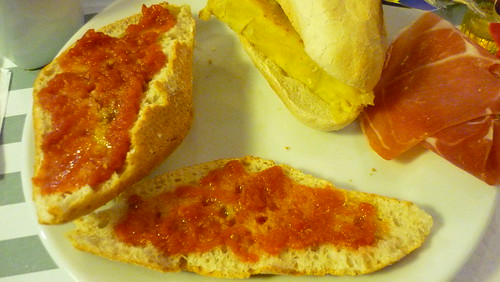
Un bocadillo español (a Spanish sandwich)

This is a typical sandwich that Spaniards eat as a morning snack. Since a Spanish breakfast usually just means a cafe con leche (coffee with milk), and some magdalenas (Spanish-style muffins / cupcakes), I guess most people end up hungry after a few hours… Many cafés serve small tapas, and sandwiches with jamón (ham) or a piece of tortilla (Spanish omelette with potato).

Olive oil on bread
1. Sprinkle some olive oil on a bread roll / slice of white bread (eg baguette or ciabatta)

Spread the grated tomato on bread
2. Spread grated tomato. O has taught me that grating tomatoes is a perfect way to remove the skin. Just grate until you are left with only the skin that you throw away (also great for tomato-based sauces, paella etc).

Bocadillo con jamón y tomate
3. Add a slice of Spanish ham and you have a classic bocadillo español con jamón y tomate

Since it is Wednesday, let’s continue with an etiquette poll:

During our week in Spain I managed to meet up with a Swedish(-Dutch) girl, L who lives in Zaragoza. Her mother and my mother are work colleagues and when they figured out the Zaragoza-link, they thought that it would be nice for us to meet, which we did last year. It was the first time though that we had time to really sit down and talk, we met in a bar / café* where we spent two hours comparing notes on Spanish experiences. It was great to get to know her better and hopefully we will be able to meet next time with our respective Spaniards.

Spanish bar
What do you see in this photo from a Spanish bar / cafe that is not very common to see anymore in other countries

One indication that the two of us are not so Swedish anymore was how we handled the whole “who-should-pay-for-what” thing: When I went to order a coffee at the bar, the waitress asked me if I wanted to pay for everything on the tab, which included my fellow Swede’s coffee and water (I was a little late, another sign of my un-Swedishness**). I said yes, and paid. Later on I ordered a sandwich (incidentally one with tortilla and tomato as seen in the middle of the photo above) and L had something more to drink, and she paid for the two of us. No big deal for either of us, but I am not so sure the same thing would have happened in Sweden… However, in Brussels this is also the way things usually work when you are in a bar / café with friends, and I like it!

Same thing with splitting the bill after a restaurant dinner if everybody has eaten and drunk for more or less the same amount. I do not like it when you are a big group of people that you might not know (when out with friends and their friends) and everybody ends up drinking and eating so much more than yourself (maybe you are on a budget or you just don’t feel like having a big meal) and you feel forced to subsidise their dinner (or look very cheap if protesting!). However, among our friends we usually keep the same level of consumption and in those cases I think that it is an ok way of doing things. What do you think?  

*) Quite a typical phenomenon in Europe that a place acts as both café and bar, serving coffee, alcohol and light food such as tapas, sandwiches and salads
**) Or quite simply due to the fact of being married to a “time optimistic” Spaniard!! (who by the way loves that expression – being a time optimist…)


Wednesday Soup Recipe & Etiquette Poll on Public Transport Politeness

10 03 2010

I have been having computer and internet problems lately; yesterday the new[ish] computer didn’t want to start and I am so happy that we have a few backup laptops to use when that happens. I was (and still am) worried though about all work I have on the computer I use most of the time – most specifically a photobook I worked on for many hours last week, and a family tree that took me two days to fill out 😦 Fingers crossed that I manage to access them – the computer has started up but seems to still have a few issues for the programmes to work…

Anyway, despite all the problems, I would really like to share a recipe and some etiquette thoughts with you since it has been weeks since my last Wednesday post! First of all, a fish soup recipe:

Petchie’s Fish & Spinach Soup
600 – 700 grams of fish – I used cod and mahi-mahi
a handful of shrimp
2 chopped onions (1 if “American size”)
3 garlic cloves
1 fennel (I didn’t have fennel at home so it is optional), cut into strips
1 carrot, cut into strips
5 (2 if “American size”) peeled and cubed raw potatoes
1-1,2 litre water
2-3 cubes of fish stock
1 tablespoon thyme
1 can chopped or whole tomatoes
2 deci-litres dry white wine
a handful of fresh spinach leaves
fresh parsley and / or thyme
olive oil, salt & pepper

Prepare the vegetables, and sauté the onion and garlic in some olive oil. Add the carrot, (fennel) and potatoes + water, stock and thyme. Cut the whole canned tomatoes with a pair of scissors and add. Add more salt if needed and pepper. Boil for about 30 minutes.
Cut the fish in large pieces and boil in the soup for 3-6 minutes, then add the shrimp and spinach. Sprinkle some fresh thyme or parsley and serve.

(Inspired by Svenskfransk fisksoppa from the book “Kärlek, oliver och timjan” by Anna & Fanny Bergenström)
I have a photo of the soup but I can’t find the camera memory thingie to transfer the photos to the old laptop!

UPDATED:
Fish soup with fresh spinach

The Etiquette question:
A few weeks ago I saw on NBC’s (?) New York-edition* of the news that you can get fined if you take up two seats (for example with your bag(s)) in the NYC subway, which I found very interesting! Around the same time I read a few etiquette questions / debates in the Swedish newspaper about how to behave on public transport (this particular question rendered 162 comments!). And then Anna in Stockholm published a funny list of the worst behaviour on public transport

Abandoned metro station

So here’s my question for you (since men hardly ever comment on my blog posts, I just assume that you all are WOMEN – but men are very welcome to prove me wrong!):


(NB. (again) I assume that most of my readers are women in this case, but men are of course most welcome to comment and vote as well!)

And let me tell you a few anecdotes on public transport politeness:

  • Two of our Belgian friends moved to Stockholm around the time we moved to Puerto Rico. The guy S (with a VERY Swedish name!) told me that he thought Swedes very extremely impolite on public transport. Every morning he takes the bus from Nacka to Slussen and then the metro / subway to T-centralen to get to work. It is a constant pushing and shoving getting off the bus, doors slammed in his face when entering the metro station and on top of it all he has been yelled at for attempting to give up his seat to women!
  • Metro train, Brussels
    A not so crowded metro train in Brussels

  • In Puerto Rico it is common practise to give up your seat to the elderly and to women in the guaguas (buses). I have seen young, cool guys with bling-bling and baggy pants give up their seats to middle-aged women! As a Swede I always feel a little embarrassed when asking older people if they want my seat since I am afraid that they will yell “I am not that old!!”** (not unlikely to happen in Sweden but has of course never happened to me in Puerto Rico!)
  • When we were in Spain last year in February; O, his brother J-I and I took the bus downtown in Zaragoza. At a bus stop two older women (70+) got on and looked for seats. J-I and I automatically stood up and they sat down, while we stood by the doors. The women looked over at us and then started apologising profusely for having taken our seats!! They said that they had thought that we were getting off, and how rude of them to “take our seats”! We explained that no, no, we had done it voluntarily (we didn’t say “because you are old”, of course, ha ha) and eventually they accepted and thanked us. I was very surprised to see that apparently it isn’t common practise in Spain either to give up the seat to your elders!?
  • Queuing for the airport bus, Brussels
    Queuing for the airport bus at Schuman, Brussels

  • In Brussels, what I can recall, it is a mix of politeness and indifference. Nobody would start shouting at you if you attempted to give your seat to somebody, and people usually remove their bags if you want to sit down next to them.
How does it work on public transport where you live? Do you think that it is an important gender issue / battle to tackle? Personally, I think that there are more important gender issues at hand (equal pay, opportunities etc) and if you take offence from the fact that somebody gives up his [/ her] seat for you, then don’t complain the day you might find yourself pregnant / sick / old and frail and you are left standing in the bus! I know that there are people who believe that it is these small steps of battling for equality that make the difference but I find it ridiculous to take offence for such “seat-generosity”.

*) We get the New York edition of the news here in PR since they don’t have a special news programme for our island
**) Just today there was another etiquette question in the Swedish newspaper – a young girl who usually tries to offer her seat to the elderly passengers and often gets rudeness back (read more here). What is wrong with the Swedes???


Fruit and veggie section in a Puerto Rican supermarket & etiquette poll on over-night guests

10 02 2010

All the foreigners we have met in Puerto Rico swear allegiance to the Costco tomatoes!

French in a Puerto Rican supermarket
I think they sent the wrong ad to Puerto Rico – it’s in French… Actually it is quite common to see that labels on products in Puerto Rico are in English and French, instead of Spanish! I guess because of Canada (Quebec), but there is definitely more Spanish-speakers in the US than French-speakers in Canada…

A normal Puerto Rican supermarket is quite well-stocked and we can find most of the products that we are used to from Europe. However, without Costco we would never eat tasty [red] tomatoes, cheese that has an actual flavour, fresh-looking meat etc… In this day and age it feels so wrong to buy imported fruits and vegetables, meat and fish, but living in an island where there is very little agricultural activity, we don’t have much choice. It is even difficult to find locally caught fish, despite Puerto Rico being an island.

Pine apples and mangoes

We do try to buy locally produced / grown food stuff when we can. Puerto Rican bananas, pine apples, mangoes, avocados – even though the fruit is sometimes from the Dominican Republic, which is still more local than Canada (where the red tomatoes come from!).

Roots and tuber section in a PR supermarket
Roots and tubers in a Puerto Rican supermarket. NB The Xmas decorations are still up – not an unusual sight in February!

However, there are more Puerto Rican products that we could have tried to learn how to cook and enjoy:

Malanga
Malanga blanca

Two types of ñame, i.e yam
Two types of ñame, i.e yam, from Costa Rica and Puerto Rico

Batata (sweet potato) and plantains
Batata (sweet potato) from the Dominican Republic and green plantains from Puerto Rico

Yautía
Yautía blanca from Ecuador

Apio, ie celery
Apio (celery) from Puerto Rico – I have never seen celery like this! Chayote according to Fran, thanks for the correction!

Huge papayas
Huge papayas from Puerto Rico

Beach chairs above the frozen produce section

At the end of our 2½ years of living in Puerto Rico we will have had over 40 guests! It has been a very interesting and mostly great experience to be able to show family and friends our life in the Caribbean. Nevertheless, it was very interesting to read about other expat Swedes’ experiences of over-night guests in the etiquette column of Margareta Ribbing (for once I read all the comments!) a few weeks ago.

Here are some tips and rules if you are going to be the host / hostess to holidaying friends and family, or if you are going to be staying for an extended period of time at friends’ places – please take note!

  • Explain any kind of “rules” or habits in your home – from which towels to use for the beach to which kitchen ware to use for what (e.g we have glasses, plates etc that belong to the apartment that we don’t use, instead we use our own things), if you take off the shoes by the entrance etc
  • Tell your guests to feel at home, which means that they can make a cup of tea, have a drink or a snack whenever they want and don’t need to wait for your suggestion or preparation
  • Feeling at home also means that you as a host[ess] should not have to entertain your guests 100% of the time (if you don’t necessarily want to); hand out maps with your address marked, show the bus stop and explain how public transportation works (tickets, timetables), provide a few tourist brochures and tips of what to see in the neighbourhood
  • Do NOT: hand out a map with your old address marked – I did that once in Brussels and my poor-at-the-time-pregnant-with-pelvic-pain (foglossning) Latvian sister + family wandered around for hours trying to find my apartment. It is incredible that she actually has forgiven me!!
  • Suggest that your guests take care of cooking a meal at least once during their stay! Maybe they have a signature dish – our Mexican guests cooked a Mexican dinner for us one night when they visited us.
  • Mexican dinner
    A real home-made Mexican dinner

  • If you don’t have time to drive the guests around (or don’t have a car available during the week), don’t hesitate to suggest that they rent a car if they want to see more of the country – they already get free accommodation so they can’t complain…
  • Explain to the guests from the beginning that you might not have time to do everything with them. Regardless whether you work or not, there are things to be taken care of around the home, you are not on a holiday and might not want to spend your days on the beach!

It is great to have guests coming to stay, but what some guests might forget is that yes, it might seem like a B&B but your home is not an all-inclusive resort and it is very welcome to suggest paying for a restaurant meal or maybe the supermarket shopping.

Both my and O’s conclusion after all the visits we have had, is that independent guests are the best. We have enjoyed showing Puerto Rico to everyone, but it can be tiring (and expensive) as well, especially for O who works hard and long hours during the week and then having to play tourist guide on the weekends. Of course we have been very happy to be able to spend time with family and friends when living so far away, and we have felt a little disappointed that some haven’t been able to make it (or haven’t shown any interest at all).

And now I am counting the days to Sunday when my parents and Mrs N[eighbour] arrive from Sweden! O always says that my parents are the easiest guests – just make sure that they have books to read and they will be happy! 😉


Wednesday recipe: Petchie’s delicious sandwiches and an etiquette poll on handshakes

27 01 2010

I don’t know how many times I have referred to O’s yummy sandwiches, and they are really delicious, but recently I have discovered a new favourite, that I make myself. They were inspired by a recipe in Rachael Ray’s Everyday magazine, but as always a little modified to what’s in the fridge and to my taste:

Making sandwiches in the frying pan
Making sandwiches in a non-stick frying pan (no oil) or use a grill pan if you have one

Petchie’s delicious sandwiches
– any kind of bread, we hardly ever have sliced bread at home and “normal” bread works fine; two slices for every sandwich
– 1 egg per sandwich if the slices are rather big, otherwise half an egg per sandwich is fine
– 1-2 slices of ham / turkey
– 1-2 slices of cheese

Fry the egg(s) as you’d like them. I prefer the egg yolks a little runny since I don’t use any butter or margarine for the bread. Assemble the sandwiches with the fried egg, slices of ham and cheese, and then put them back in a frying pan. Heat them up, press down on them slightly while in the pan. Flip them over and make sure that the cheese has melted.

Cut them in half and serve with a fresh salad.

NB. The sandwiches don’t need any butter nor margarine – not on them and not when fried in a non-stick pan. You don’t have to be over-generous with the cheese either since I usually find that melted cheese seem to be “more” than dry cheese! Quite a healthy sandwich in the end, and very delicious! They are even good cold, I made them for a pic-nic a few times.

Cheese-ham-egg sandwiches
Petchie’s yummy egg-ham-cheese sandwiches, served with a salad

And now for the first etiquette poll of 2010:

Do you always shake hands when you meet a new person? Let’s not get into the shake-hands-or-kiss-on-the-cheeks-discussion here, and let’s just stick to handshakes! I think that most Swedes are used to shaking hands the first time they meet somebody, but I have noticed that it is not always the case – especially in the Anglo-Saxon world.

The first time I realised that handshaking was not the norm was in England. I was visiting an English friend, staying with his family, and meeting his friends. The friends I could understand, they were young[er] than I, but I recall being surprised when his parents* didn’t seem to want to shake my hand.

Another time was when I started my first job in the European Commission in Brussels and a colleague did the “rounds” with me, introducing me to all the new people, and very few volunteered their hand. I felt extremely awkward when I realised the most of them didn’t expect to shake hands with me! And these people were French, Belgians, Italians, Spaniards, Greeks – I know that they might be more used to kissing on the cheek, but not with new colleagues on the first day…

Same non-handshaking experience since we moved to Puerto Rico – mostly with Americans actually. I never know when to shake hands and when to just do a little “hi-wave”, especially since shaking hands is such an instinct for me as a Swede. I feel so silly when left with my arm hanging in the air, you know when you have to pull it back discreetly, maybe do the little wave and hope that nobody noticed that you didn’t know the etiquette! I have also noticed this habit of just saying hello and no handshake (maybe a little nod) in TV-series (Desperate Housewives, Gilmore Girls**) and films.

My conclusion is that Swedes are bigger on handshakes than most nationalities, something I would never have thought!!

Oh, and here’s a funny link – detailed instructions on how to shake hands! And if you ever meet my father, make sure you have a firm handshake, he judges people on that first impression!

*) I can’t remember now if it was both parents, or just the [step-]father, who was very friendly and even put on some old ABBA LPs for my sake, so it wasn’t a lack of friendliness or hospitality.
**) Am I weird for noticing stuff like that when watching TV or a film? What is interesting that both these TV-series take place in quite formal environments… 😕


Wednesday recipe: PepparkaksCheeseCake & Etiquette poll: My or Our?

16 12 2009

Since it is that day of the week today, I am taking a break from the cruise stories to give you a Wednesday recipe and a new etiquette poll! I can’t believe that it is Christmas Eve in one week +1 day! We are heading to Spain in exactly one week, flying via Miami to Madrid.

I have been really excited about the cold weather in Spain at the moment (2-4 degrees and chances of snow) but the weather forecast looks depressing for next week – who wants to have THIRTEEN* degrees on Christmas Eve? Oh well, at least I won’t have to worry about bringing long johns to keep warm indoors…

Taxi in Dominica
Taxi in Dominica – God is my guide

So, one week to Christmas and I have finally succumb (how do you conjugate that verb?) and decided yesterday to bring out a few Christmas decorations after all. I was first thinking that it was pointless since we are going away for the holidays. However, we then decided to have a small Christmas dinner next Tuesday with Swedish B, her father and his girlfriend, and of course the home has to be a little Christmassy for that!

So I started looking for Christmas recipes and remembered a yummy cheesecake recipe I made in January with some left-over ginger snaps (pepparkakor). It was more popular than the store-bought cheesecake that some guests brought!!

PepparkaksCheeseCake with Lemon Sauce

Base:
~30 Swedish ginger snaps (I find the brand Annas in Walgreens all year around), smashed into pieces
100 g melted butter
Mix together the crushed ginger snaps with the melted butter (in a food processor if you prefer). Spread in a greased round springform cake tin, wrap some aluminium foil around the base since it might leak a little. Bake 5-10 min. in 200 C / 390 F.

First layer:
400 g Philadelphia cream cheese
3 eggs
1½ dl sugar
Stir into a smooth mixture and add on top of the base. Bake in 180 C / 350 F for 35 minutes. Let it cool.

Top layer:
4 dl crème fraiche / sour cream (not non-fat)
1 table spoon vanilla sugar
1 dl sieved icing / confectioner’s sugar
Mix the ingredients and spread on the cool cake. Bake in 180 C / 350 F for 6-7 minutes. Let the cake cool.

Lemon sauce:
freshly squeezed lemon juice from 1-2 lemons
3/4 dl water
1 egg yolk
1 table spoon Maizena
1½ dl sugar
Simmer while stirring. Add 1 table spoon cold butter and let the sauce cool.

Serve the cake with a few spoonfuls of the lemon sauce.

(inspired by a recipe in “Vinterns goda ting” by Anna & Fanny Bergenström)

I love my Island - St Martin
I love my island-poster in St Martin

The etiquette poll today refers to something that I have noticed people do in all languages and cultures – and regardless of what they refer to; kids or a house (or something else). They always say my kids and my house, even when they obviously share the “ownership” with a husband / wife / partner. Is it just me, or do you also get confused and wonder if they are talking about a child from a previous relationship when people talk about “my daughter” while their partner is next to them? And think that maybe only one of them owns the house they live in (which of course might be the case!)?

Antiguan beer
Our beer in Antigua

Maybe it’s a silly reflection, and I was told many years ago that I referred too much to “we” when I was doing activities with a boyfriend or friend, so maybe I should have written above that I am going to Spain next week? But wouldn’t some of you then wonder if I was going without O? Of course it might depend on the context – I am sure that I do say “my” or “I” in certain situations when I refer to something that belongs to both O and I, or something we will do together.

British Commonwealth poster
We are family – Commonwealth poster in Dominica

Anyway, it is mostly when both persons are present and one keep saying “my” about a child that I react. This happened to me recently when we had Christmas dinner with O’s colleagues and all the women were talking about “mis hijo(a)s” (my children) while the husbands were sitting next to them. Only once did one woman actually correct herself and changed to “nuestras hijas” (our daughters).**

It would be interesting to see how I would express myself if we ever have children!? Maybe not the same thing, but I always refer to the apartment as our home – it is not just mine… (that we don’t actually own it is another issue, ha ha)

And don’t worry, tomorrow I will continue telling you about the cruise!

*) I hope everybody understands that this is a European blog and therefore I ALWAYS talk about Celsius (if not mentioned otherwise) when it comes to temperature  😉
**) This is especially confusing in Puerto Rico where a lot of people actually have children from different relationships – divorce rates are higher than in most countries.

Disney designed maxi taxi
We are one! Taxi-van in St Thomas, driven by a proud scholar and army mom


Wednesday recipe: Chicken with chèvre & tomato sauce and an etiquette poll on party arrival time

2 12 2009

When O comes home and I have cooked a new dish, he always asks me if I have actually followed a recipe or just used it as inspiration. I don’t think that it is “just” to use a recipe as inspiration – it actually asks more of you as a cook than “just” following the recipe to a dot! It is funny, O doesn’t usually use recipes when he cooks, so I never know how to take his comment… I think he is just fascinated by the fact that I LOVE cook books but very rarely actually cook according to a recipe!

Some of my many recipe books
Second book from the right is the “Fast Food”-one, I also love the “Bowl Food. The New Comfort Food for People on the Move*”-book! Who can resist that kind of title?

The other day I used a wonderful little cook book called “Fast Food. Quick and Easy Everyday Ideas for Cooks in a Hurry” to make my lunch, the book is very inspirational and has photos of every dish (important!). Needless to say I only used the recipe as inspiration, and this is my take on the “Stuffed chicken breast with tomato, goat’s cheese and asparagus” as I thought that stuffing the chicken breast would take too long:

Chicken with chèvre & tomato sauce

1 chicken breast per person
~150 grams of French chèvre (goat) cheese (sold in a roll)
½ cube of chicken stock
1 cup of water
2 tomatoes – skinned (boil them quickly to easier remove the skin) and diced
a handful of asparagus (either canned or fresh – if fresh, boil in lightly salted water until crispy, tender or however you prefer your asparagus)
tarragon, cayenne pepper, 1 bay leaf, salt and black pepper
rice

Boil the rice as you usually do. Brown the chicken breast all around in a frying pan with olive oil. Season with salt, pepper and cayenne. Add the chicken stock cube, water, diced tomatoes, bay leaf, and some tarragon. Let it slowly boil under a lid and on low heat.  When almost done, add the goat’s cheese and make sure that it melts into the sauce.

Serve with the rice and decorate with the asparagus on top.

Since it is Wednesday it is also time for a new etiquette poll: When do you arrive to a party? 

Of course this might depend on what kind of party it is – a dinner party or a so-called cocktail party where people mingle randomly…  But think in general, when do you aim to arrive?

Maybe a very simple question if you live in Sweden for example and you know the social rules, but we have troubles in Puerto Rico. For example, we were invited to one of my French friend’s for a birthday party and I thought, she’s European so we shouldn’t arrive too late but O warned me that we would be the first ones to arrive – which we were, 30 minutes after the invited time. What I had forgotten to take into account was that all the other guests were Puerto Rican, as well as the hostess’ boyfriend, who was still in the shower when we arrived! Opps!

Birthday party 2007 - before the guest arrived...
Birthday party in Brussels before the guests had arrived

So last week when we were invited to my Spanish teacher’s parents’ home for Thanksgiving, I asked him when we were expected to arrive – like if he said 2 o’clock, did that mean 3.30? He laughed and checked with sister and then told me that we could come around 2-2.30. Great! Except that I was going with two Spaniards, and even though O is quite disciplined nowadays, the B-I-L No 3 does live in Spain… so we were not at the party until 3.15. Oh well, it is Puerto Rico after all and not the end of the world if you arrive late   😉

By the way, my first encounter with Spanish tardiness was when I studied in Italy with a Spaniard (from Zaragoza, just like O!) who would always arrive late to our lectures with the words “Spanish people hate to be late” – completely confusing, so why are you late if you hate it so much?? I later on lived in Geneva at the same time as my friend from Zaragoza, and among the more punctual friends we decided to always give him an earlier meeting time than the rest. So, let’s say that we were meeting at 20.00, but then we would tell Spanish R that it was at 19.30… He still always managed to arrive after everybody else!!

*) I have already published a recipe inspired by that cookbook – “The best pasta sauce ever“…


Wednesday recipe: Amish Friendship Cake and who pays for a wedding?

11 11 2009

Last Monday my French friend E called me to ask if she could come to drop off a surprise… I was very curious when she gave me a little container with some liquid, and a small bag with three slices of cake. She explained that it was a “Amish Friendship Cake” and that she would email me the instructions on how to take care of it.

She also told me that her mother had received a similar “chain-recipe” back in France a few years ago, but it was for bread and it was called “Herman” for some reason. The funny thing is that when I spoke to my grandmother a few days later, and told her about my cake project, she also knew of “Herman” (actually “Här kommer Herman” in Swedish, which means “Here comes Herman”) and the so-called “starter” liquid that you have to nourish before baking! It reminds me of the sourdough that my mother subscribed to back in the 80’s – she would get it by mail. And coincidentally my friend Erika has today written about the sourdough starter (in Swedish) that she keeps in the fridge.

Amish cake starter in a container

Back to the Amish Cake, there are lots of recipes on this kind of cake on the internet, but below are the instructions that I received. It is very easy, for the first five days you don’t do anything, except “mushing” the bag (or in my case, stirring a little in the container). The liquid starts to become a little inflated and bubbly but that’s just the natural “fermentation” and nothing bad. You add some simple ingredients and then continue “mushing” for another couple of days, before adding some more ingredients, divide the mix in five parts and make your cake with one fifth of the fermented mixture.

If you are interested in starting a “Amish Friendship Cake” for yourself and your friends, check out this link for a “starter recipe”. I think that it is quite a nice idea to share a recipe with your friends and “pass it on”, especially nowadays when everything is supposed to be so “instant” (all those semi-made cakes and cookies in the TV commercials).

Recipe to Pass On
Accompanying these instructions when you make this bread and wish to give it to a friend should be a Ziploc bag of starter. Keep the starter on your countertop.
DO NOT REFRIGERATE!

Day 1: Do nothing
Day 2: Mush bag two times during the day.
Day 3: Mush bag two times during the day.
Day 4: Mush bag two times during the day.
Day 5: Mush bag two times during the day.
Day 6: Add to the bag:
2 Cups flour; 1 Cup of milk; 1 Cup of sugar
Close the bag, letting out as much air as possible. Mush thoroughly.
Day 7: Mush bag two times during the day.
Day 8: Mush bag two times during the day.
Day 9: Clip off corner of the bag and squeeze into a large bowl.

Add to the bowl:
1 Cup flour; 1 Cup of milk; 1 Cup of sugar
Stir thoroughly. Measure out four 1 Cup starters into Ziploc bags.
Give these bags and a copy of these instructions to other to enjoy.

To the small amount of starter left in the bowl, add:
1 Cup oil; ½ Cup milk; 3 eggs; 1 tsp. vanilla
Mix well then add:
2 Cups flour; 1 Cup sugar; 1 ½ tsp. baking powder; 2 tsp. cinnamon; ½ tsp. salt; ½ tsp. baking soda; 1 or 2 small Vanilla instant pudding mixes; 1 Cup chopped nuts (optional)
Mix well. Spray 2 loaf pans with non-stick spray. Sprinkle pans generously with cinnamon and sugar mixture. (1 Tbs. cinnamon & 4 Tbs. sugar) Shake or stir together. Pour batter into pans and sprinkle tops with more cinnamon/sugar mixture generously.
Bake at 325 degrees for 1 hour or until toothpick comes our clean.
Tomorrow starts Day 1 again.

Amish cake starter
Amish cake starters for my friends

Comment: Since I prefer cardamom to cinnamon and didn’t have any “Vanilla Instant Pudding Mix”, I decided to use cardamom and some Belgian dark chocolate (Côte d’Or, 200 grams) instead. Maybe a strange combo but it turned out really tasty!

Speaking of chocolate, I read on a couple of Swedish blogs that it was the “Day of the Swedish Brownie cake” (Kladdkakans dag + recipe on Erika’s blog) last Sunday. However, since I started making Elle’s Chocolate Cake many years ago, I just can’t make a chocolate cake with cacao powder (cocoa), it has to be real chocolate! So call me a brownie snob, but try my recipe in the link above and taste the difference! It contains very little butter (25 grams) but 250 grams of dark chocolate…

Amish cake with chocolate
Amish chocolate cake

And now for the etiquette discussion: One of my friends here in Puerto Rico and I have lately been talking about weddings. Her daugher recently got engaged and now they are starting to plan the wedding. Apparently the future mother-in-law has mentioned that it is custom that the bride’s family pays for the wedding, which we can all agree used to be the custom in most cultures… However, nowadays I would say that, at least in Europe, both families as well as the couple, would share the financial burden of a wedding.

I just asked O if he and his parents would expect my parents to pay for a possible future wedding of ours and he said no (my parents are probably thinking “phew!”). He explained that he thinks that it depends on how many guests the different families are inviting and that there are some expenses that traditionally have been covered by the groom’s family and other ones by the bride’s family. This will be an interesting topic once we decide to organise our “real” wedding…

What do you think? Who paid for your wedding? What is your impression of how it works in other cultures?

Margareta Ribbing, the etiquette expert of the Swedish newspaper DN has written about the same topic here.


Wednesday Food Rant: What’s with the cheese [obsession]? and burger etiquette

4 11 2009

The Wednesday recipe is today substituted by a food rant 😉 However, if you are interested in an inspirational food blog – check out my friend Erika’s Food Blog (in Swedish). She publishes weekly menus and yummy but simple recipes. It is quite fitting that I refer to Erika today as we share an obsession for the Alpine cheese speciality raclette ever since we studied French together in Annecy, France*!

Swiss specialities in Gruyere, Switzerland
Swiss cheese specialities in Gruyère, Switzerland

Standard question in the US: Do you want cheese with that? which often becomes Don’t you want cheese?* Bitchy Petchie thinks “I would have ordered a cheese burger if I wanted cheese with my burger!” However, most of the time you don’t even have a choice; cheesy omelettes, spinach with cheese, cheesy scrambled eggs, mashed potatoes with cheese, artichoke dip with melted cheese, cheesy hash – the list goes on…

Egg and cheese biscuit + a muffin = airplane breakfast
Not the best illustration of a egg-and-cheese-biscuit (since I didn’t open the wrapper) I got as breakfast on the plane last week. I only ate half of the muffin as I had already eaten a proper sandwich at the airport, and didn’t touch the scarily cheesy biscuits…

I read a recipe in Elle Decor (US edition) for Duck-and-egg hash, where it was first of all claimed that “putting potatoes together with meat is distinctly American“, which I would beg to differ – what about the Swedish pyttipanna or the Danish biksemad? But yes, the recipe was distinctly American in the sense that it contained 4 oz of cheddar!

What’s with the cheese obsession in the US? I probably sound like a snobby European, but if you love cheese so much – why don’t you eat the real deal, instead of “cheese”? Processed cheese doesn’t even taste like cheese, and is so full of preservatives and additives. It does seem like there has been a turn lately in the cheese habits of the Americans, at least in the ads on TV it is increasingly common to point out that the pizza is made with “real cheese” or that the cheese is not “processed” but made the traditional way.

I am also fascinated by the little variety of cheese: I head Rachael Ray say once “Gruyère tastes similar to Swiss” – You don’t say, Gruyère IS a Swiss cheese!! And what is “Swiss” cheese anyway, that’s like calling a cheese “French”! Switzerland has 450 types of cheese (and France even more), while the US seems to have American, Swiss, Monterey Jack and cheddar. You would expect a cheese-loving people to demand a little more when it comes to taste, texture and ingredients.

Gruyere cheese in Gruyere
Real Swiss cheese in Gruyère, Switzerland

Don’t get me wrong, I like cheese too, but there’s a time and a place for it! I don’t want cheese in every dish – scrambled eggs are perfectly tasty without cheese, mashed potatoes as well, while I do like a slice of cheese on my morning sandwich. I had breakfast at the hotel in New Jersey last Friday and was a little surprised to realise that there was no cheese on the breakfast buffet. Quite a few types of bread (well, two types of ready-sliced bread, and different kinds of bagels) but only jam, cream cheese and peanut butter. In the end I didn’t have any bread, just some cereal, hash browns and fruit salad.

Cheese drawer in the fridge
Our cheese [and ham] drawer in the fridge – and I do not take any responsibility for the tube of Swedish “Kräftost” (Crayfish “cheese”), nor the slices of “Swiss cheese product”!

In our household we eat our fair share of cheese; O’s yummy sandwiches for breakfast on the weekends, and O loves a snack of the above crayfish “cheese” on a piece of bread. I also do acknowledge that this kind of Swedish “cheese” is not better than American processed “cheese”, but to my excuse I don’t actually eat it. The “Swiss cheese product”, next to the cheese tube in the above photo, was left behind by our youngest visitor – whose mother noted that it was obvious that her daugther was American-born since she had refused to eat “real cheese” when she was in Sweden! O’s family absolutely loves Swedish hard cheese and we always bring a few kilos when we go to Spain from Sweden, while my parents love the Spanish Manchego, a type of sheep’s cheese.

Mexican cheese
Mexican cheese in a Tijuana market

Finally, I also find it interesting that Rachael Ray (who I by the way, do like) will say that a dish that she is making is really healthy because it has a lot of vegetables, and then she pours in a cup or two of cheese!! Oh well, that’s like putting cream on your breakfast porridge, as shown on ads for Reddi Whip***; just another one of those American phenomena I am so fascinated with. Maybe it is just an ad (let’s hope), but the idea of whipped cream on porridge feels like a sacrilege – porridge that can be such a healthy choice for breakfast…

And for an etiquette question, more or less related to cheese:

When you are in a proper restaurant (i.e not a fast-food joint), and you have ordered a hamburger, with or without cheese, do you eat it with your hands or with cutlery? I always eat it with fork and knife, which I realise maybe is completely against the idea of a burger but I don’t like eating stuff with my hands (too messy) and I usually don’t eat the top part of the bread (usually too much bread for me). What about you?

NB. The question refers to eating a burger in a proper restaurant, i.e not in McDonald’s, Wendy’s or Burger King…

*) We also studied in Linköping but that didn’t leave any long-lasting food memory!?
**) Almost comparable to the reaction you get in the  UK when you don’t want milk with your tea!
***) I won’t get started on what I think about whipped “cream” sold in a can – something I have hated since I was a child and I learnt to order “eis ohne sahne” in German!


Wednesday recipe: Salmon & avocado salad + Etiquette poll on toilet lid manners

14 10 2009

It is still Wednesday in my part of the world and here’s a recipe to prove it 😉

Salmon & avocado sallad

Salmon & Avocado Salad
1 piece of salmon filet (~400 grams)
2 tablespoons French Dijon mustard
1 tablespoon olive oil
3 tablespoons dill, parsley or tarragon
1 teaspoon coarse (Kosher) salt
freshly ground black pepper
crispy lettuce (such as Iceberg or romaine)
1 big avocado
1 onion – chopped
1 lemon – juice and peel
a handful of pickled gherkins – chopped

Heat the oven to 200 degrees C (400 degrees F). Mix the mustard, olive oil, black pepper, salt, chopped gherkins and onion, lemon peel and herbs in a small bowl. Spread the mixture evenly on the salmon and bake in the oven approximately 10-15 minutes.
Cut or tear the lettuce and put in a salad bowl. Cut the avocado in small cubes and add to the lettuce, sprinkle some lemon juice on top.
Serve the salad mixed with the oven-baked salmon and some bread.

(Recipe inspired by “Varm laxsallad med avokado” from the book Kärlek, Oliver och Timjan by Anna and Fanny Bergenström)
 

And now to the etiquette poll: Toilet lid manners!

As you know, we have had a lot of visitors to our home here in Puerto Rico, and when you spend time close to family and friends for a while, you notice certain habits… One of the things that has struck me the most is that very few, men and women, put down the lid after using the toilet! The lid, not the ring – which fortunately most men do lower after having done their business…

Toilet for women

I have also noticed that in almost every home shown on my favourite tv channel, HGTV, the toilet lid is always up! This in homes that have been staged, styled and designed to be sold! Am I the only person who thinks that it looks nicer if the lid is closed?? Isn’t that the reason why there is one?

So, I am curious – let me know your thoughts on “toilet lid manners”…

Every time I walk past the guest bathroom and I can see that the lid is up, I have to enter and close it… I am sure a lot of people think it is silly and O is definitely one of them! We have been discussing the “raison d’être” of the toilet lid, and I always try to suggest that it might have been invented so to avoid that people accidentally drop something into the toilet, or so that you can use it as a seat but most of all – it is there to be closed!

Did you forget something?
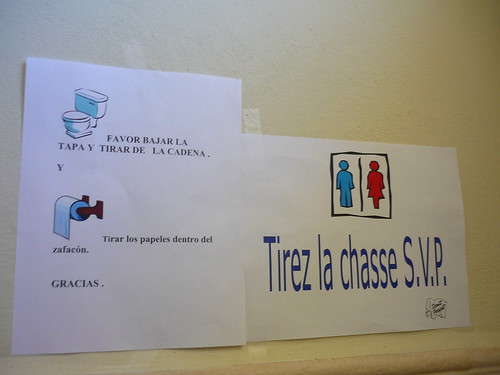
“You haven’t forgotten anything? Did you lower the lid and flush?” (apparently the French speakers only need to be reminded to flush…)

However, it can’t just be me, because I found these signs (above and below) displayed in the toilets* in the Alliance Francaise!

Instructions!
Might seem superfluous to remind the “users” to flush – but after having worked in a hotel as a cleaning lady, I know that a lot of people seem to forget (??) to do this… In many places in Puerto Rico (and in Greece!) you are asked to throw the toilet paper in the trash can (zafacón is Puerto Rican Spanish) because the sewage system is so bad.

Speaking of toilets, I might have mentioned already that the exterior of our building is being renovated and painted – we have now, after ~3 months, reached the painting phase, which means that the construction workers are doing their second round of the four walls. This morning I heard that they were somewhere outside our master bedroom and decided to go to the loo in the guest bathroom instead. Just when I am sitting there, I can hear the “window-cleaner lift” approaching outside… and voilà, it stops right outside the bathroom window!! Fortunately I was behind a shower curtain, but still, needless to say I didn’t feel very relaxed about the situation!

Outside my bathroom window
Outside the bathroom window this morning…

A few minutes later I was sitting in front of the computer in my pj’s when I heard voices behind me – arrggghh, they seemed to be everywhere today! I am starting to feel besieged, and quite frankly tired of having people outside the windows – on the 9th floor!

*) And yes, I am European and I am not afraid of calling a toilet a toilet (or even “loo”) – half-baths, powder rooms etc sound just silly in my ears!


Design a site like this with WordPress.com
Get started