I am working on trying to learn how to score better. How can I turn the things I may play on the guitar or on the keyboard into correct register notes, with the correct rhythmic length, and appropriate rests and dynamic and playing techniques?
I confess that I am not particularly good at this. Not yet. I can usually get the right notes in the correct register, but when it comes to the length of individual notes and whether a note lasts a particular length and is sustaining or whether it ends and there would be a rest before the next note is played, I am clueless. Well, not totally clueless, but I do find it difficult and confusing.
I have been thinking of ways in which to improve this situation. I have a few thoughts and would appreciate anyone else’s ideas in the comments.
Training my ear to detect these things
Greater study of rhythm and rhythmic patterns
Reading and analyzing scores
A deal with the devil
Prayer to the almighty
I am sure there are many other things I cannot think of
The thing I have not mentioned in this list is the thing that I am going to try to aid progression in this area.
I am going to get an instrument, guitar or keyboard, play something – a short phrase or melody – and then I am going to try and notate that on manuscript paper with pen by hand. Then I will put that into Dorico and can check to see if the manuscript that I have entered has the same rhythm and phrasing as I expect.
I am sure that there will be a lot of mistakes, but it seems to me to be a way where I can try to improve my abilities in writing manuscript.
Aside from spending time with my loved ones, I have a few things to try to get sorted out over this period.
My main music computer has been totally misbehaving, and I have to wipe everything and am now unable to get it to install windows 11 properly. It looks like there is some kind of hardware or BIOS configuration problem but tracking that down is a complete and utter nightmare. Hopefully, the Christmas period will give me time to find a solution to this, otherwise it may have to be the repair shop.
I would like to make some progress on my course but cannot since I need the aforementioned computer to be able to run some of the large templates that I need to use to complete sections.
I have been making progress on these but want to put this period to good use by making more progress.
I am also going to spend some time with a guitar or keyboard, manuscript paper and pen, and Dorico on my laptop. I am quite excited about this as I am hoping to be able to relate more between the instruments, hand scored phrases and checking myself using Dorico, whilst at the same time learning more about scoring with Dorico.
So, a few things to try to accomplish, but mostly a restful time with my family.
Happy holidays to everyone. Have a wonderful break
This free tutorial will introduce the idea of triads, what they are, what the use of stacked thirds is, and introduce the different triad qualities. This will then be demonstrated by constructing a major triad. The tutorial for silver members will then continue this by demonstrating the construction of the three remaining triad types with examples and summarize this process.
Triads and what they are
Triads are the foundational building blocks of harmony in Western music. They are specific combinations of three pitches.
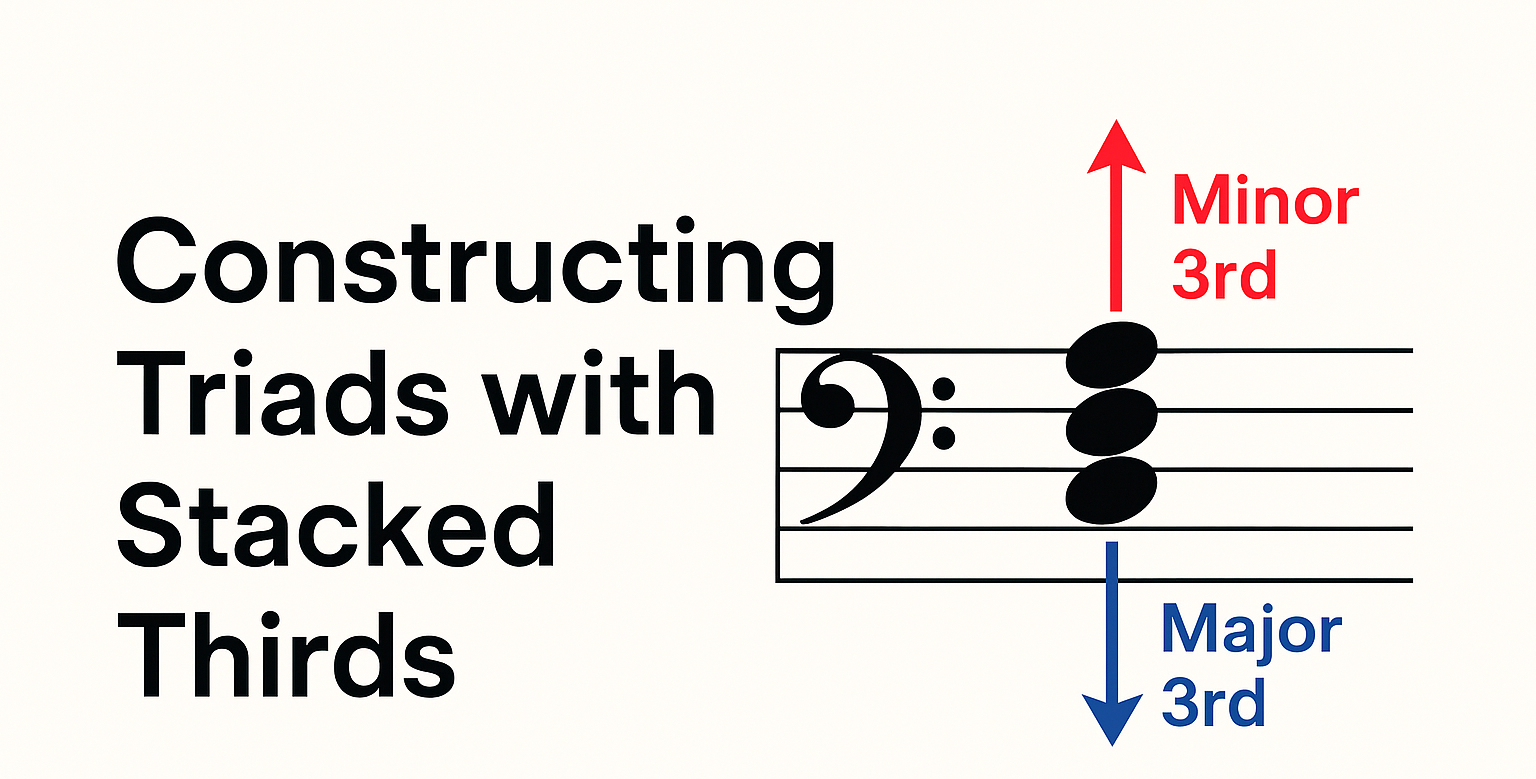
Triads are formed by stacking two intervals of a third on top of a root note. This results in intervals for triads (compared to the root note) of root, third, and fifth,
Depending on the quality of these thirds, we get different types of triads: major, minor, diminished, and augmented.
There are two types of thirds, major thirds and minor thirds.
A minor third (m3) spans 3 semitones – eg: C to E♭
A major third (M3) spans four semitones eg: C to E.
Since we have a combination of two thirds which can be either major or minor, we can have four different combinations of two of these. We can have
M3 m3
M3 M3
M3 m3
M3 M3
These four combinations correspond to the four triad qualities
Major
Minor
Diminished
Augmented
Stacking thirds means putting one third on top of another, for example a Major third above the root note, then a minor third above that note, M3 + m3.
Major Triads
Major triads are constructed by stacking a Major third and a minor third.
M3 + m3
So, for the example of a C major triad we start with the root note, C. We find the note a Major third (4 semitones) above that, which is an E. Then we find the note that is a minor third (3 semitones) above the E, which is a G.
This results in the pitches for our C Major triad being
C – E – G
This same process applies for every major triad starting on any root note.
We can note that the intervals above the root are
Root – major third – perfect fifth
Major triads are generally considered to sound bright, stable, and consonant.
If you would like to see how the other triads – minor, diminished, and Augmented – are constructed and a summary of the different triad qualities and their stacked third formula please sign up for the silver membership.
I was pondering the question of how do you create your own compositional voice, how do you start to sound like you, not an imitation of those that you admire, those that have influenced you musically?
So again, I consulted the oracles and to see what I could find out about this question.
What is your compositional voice?
The oracles tell me that your compositional voice isn’t a single technique, style, or genre. It’s the sum of your instincts, your influences, your values, and the musical decisions you make repeatedly — consciously or not.
Daunting? I think so.
I have been assured that there is good news. Your voice is not something you “invent,” it is something you uncover.
That must mean that we all have one already, it is just hiding away under the surface, waiting to be released from its confines.
What are the steps that one can take to try to build this voice?
There are steps that one can take with intention, curiosity, and craft.
Listen to What You Naturally Gravitate Toward
What intervals feel like home?
Which harmonic colors do you reach for instinctively?
What rhythmic patterns feel satisfying in your hands?
What textures or orchestrations do you return to without thinking?
These patterns are not accidents. They are the early fingerprints of your musical voice.
Study Your Influences — Then Transform Them
Every composer begins by imitating others. It’s how we all learn.
Imitation becomes limiting when you treat it as the final destination
Look to reinterpret these qualities in your own language. Your voice emerges when your influences blend into something unrecognizable as any single source.
Compose Frequently — Even When It Feels Imperfect
Your voice doesn’t appear through inspiration. It appears through repetition.
The more you compose:
the more your instincts sharpen,
the more your habits reveal themselves,
the more your voice becomes audible.
It is a process of developing a physical technique. You don’t discover your sound by waiting for the perfect idea. You discover it by writing, revising, and writing again.
Notice What Feels Authentic (and What Feels Forced)
Your compositional voice isn’t just about what you can do — it’s about what feels aligned.
Which passages feel the most “you”?
Which feel like you’re trying to impress someone?
Which feel effortless?
Which feel like you’re wearing someone else’s clothes?
Your voice lives in the intersection between authenticity and craft.
Embrace Your Musical Quirks
Your quirks are not flaws. They’re the DNA of your voice.
Maybe you:
love parallel motion more than your theory teacher would approve,
gravitate toward modal mixtures,
prefer sparse textures over dense ones,
write melodies that leap instead of step,
use unexpected chord extensions,
favor certain registers or instrument combinations.
These idiosyncrasies are not weaknesses, they are signatures. When you stop sanding down your edges, your voice becomes unmistakable.
Experiment With Constraints
Constraints are one of the fastest ways to reveal your voice.
writing a piece with only two chords,
composing a melody using only leaps,
orchestrating with only three instruments,
limiting yourself to one rhythmic cell,
writing a piece without using your primary instrument.
Constraints force your instincts to surface. They show you what you must do when options are limited — and that’s where your voice lives.
Connect Your Voice to Your Values
Technique shapes your craft. Values shape your voice.
What do I want my music to communicate?
What emotional world do I want listeners to enter?
What do I believe music is for?
What do I want people to feel when they hear my work?
When your music aligns with your values, your voice becomes not just recognizable — but meaningful.
Accept That Your Voice Will Evolve
Your compositional voice is not a fixed identity. It grows as you grow. The harmonic language you love today may feel limiting in five years. The textures you rely on now may become stepping stones to something new. This evolution is not inconsistency. It’s maturity.
The strongest voices are the ones that evolve without losing their core.
Final Thoughts
Your Voice Already Exists — You are just learning to hear It
You don’t create your compositional voice by forcing originality.
You create it by removing everything that isn’t you.
The more you trust your instincts, your quirks, your curiosity, and your values, the clearer your voice becomes. And once you hear it, you’ll realize it was there all along — waiting for you to listen.
This article was written in collaboration with the oracles of the web and A.I.
I think that it provides a good basis from where to start and how to attain that holy grail of composition, your own compositional voice. Your own style.
Why Do We Like Certain Types of Music? The Psychology Behind Our Musical Taste
Music is universal, and ubiquitous in our society.
So why is it that we do not all like exactly the same music, the same sounds.
Why does something sound angelically beautiful to one person and causes another to itch with discomfort?
What is it that defines our musical tastes? Why do certain genres or styles of music see to resonate with our being, penetrate to our very soul as if they were part of us, and others are resigned to the trash can of life.
I thought that considering the book that I am currently reading, (paid link) Musical Emotions Explained by Patrik N. Juslin I would have a think and do some research of my own.
So, what have I come up with after a brief search of the Library of Alexandria and some limited conversations with the Oracle of Delphi at the Temple of Apollo – well, okay, Google?
Modern research in psychology and neuroscience reveals that our musical preferences are anything but random. They’re shaped by a blend of emotional history, personality, cultural exposure, and even the way our brains process sound.
What are the main forces that determine why we like the music we do?
Music Connects to Emotion and Memory
Our Early Environment Shapes What Feels Familiar
Personality Plays a Role — But Not as Much as You Think
Culture and Identity Shape What Music Means to Us
The Brain Loves Patterns — and Each Genre Has Its Own
Music Helps Us Regulate Emotion
Biology and Evolution May Influence What We Like
These are apparently some of the reasons why we like the music that we do but…
Why Do We Like Certain Types of Music?
Because music is personal.
It is emotional, cultural, neurological, and autobiographical.
We often hear the phrase the ‘soundtrack of my life’, we connect deeply with certain types of music and closely equate them with different parts of our life.
It is said that our musical preferences tend to reflect, in the main:
Where we come from
Who we are
Our experiences
How our brains are wired
Who or what we aspire to be
So that is a summary of the things that I found out. It mostly makes sense that our musical tastes and preferences are related to the sum of our life experiences and knowledge, what we were exposed to as we were raised and so forth.
What types of music do you like, and why do you think that is?
I have always had an interest in the music and culture of the sixties, despite not having been born until just after they had ended. (paid link) Rock Odyssey by Ian Whitcomb was a detailed and humorous account of his journey through the sixties. The author was able to relate a very interesting life in a witty and erudite manner.
The author’s contribution to the music of the sixties, ‘You turn me on’, was unknown to me, but I was prompted to check it out on youtube.
This book, of nearly 400 pages, followed his journey through the sixties from Dublin, Ireland to the United States.
Much of the book is from his diary and is filled with honest, funny stories of his navigation of the music business and his travels through America. His observational skills come to the fore as he regales us with non-stop stories of his trials and tribulations.
I found his story of living through the major musical events of the sixties to be fascinating and his talent for recording his observations with an external observer’s eye, whilst being amidst everything was interesting.
I also found the story of his life to be far from ordinary with his promotion of vaudeville and an interest in ukelele music.
I discovered that he died back in 2020 in California having been successful in the music industry, as a radio DJ, and as an author.
(paid link) Rock Odyssey is a great, fun read for anyone wanting to know more about the sixties, its music and culture, and living through those years, between the U.K. and the U.S.
I decided that since I have been having a few Windows issues that I would install (paid link) Cubase 14 Pro on to my (paid link) Apple M1 iMac. I know that it has very limited RAM (8GB) and that may cause an issue when using many tracks, but I thought I would just try it out.
The installation went very smoothly and there were no issues.
I installed Native Access, Kontakt, and the Spitfire Symphony Orchestra Discovery edition so that I would have some orchestral instruments to play with.
I tested this out and everything worked just as expected. In fact it was fantastic.
I then decided that I would try recording some guitar. Rather than mess around with my usual audio interface that is fixed in a rack, I thought I would make use of another audio interface that I had in the drawer.
I plugged in a (paid link) PreSonus Studio24c audio interface. Then I changed it to be the input and output device in the studio setup, created an audio track, plugged the guitar ion and … NO SOUND. Well, not entirely true, there was sound, but it was not registering on the input to the track in Cubase and not recording. Obviously not ideal.
A brief search revealed that there are some issues with privacy and security settings on the Mac.
I had to go to the privacy and security settings and find the microphone and enable Cubase to have access to it, even though I am not using the Mac’s in-built microphone.
As soon as I changed this setting and restarted Cubase the input was received as you would expect and I could record. So I installed Guitar Rig 6 and made lots of noise, not even bothering to record any of it, but at least knowing that I can if I want to.
I was impressed with the (paid link) PreSonus Studio24c audio interface. It was very easy to set up and sounds great. Nice to have as an on the desk addition.
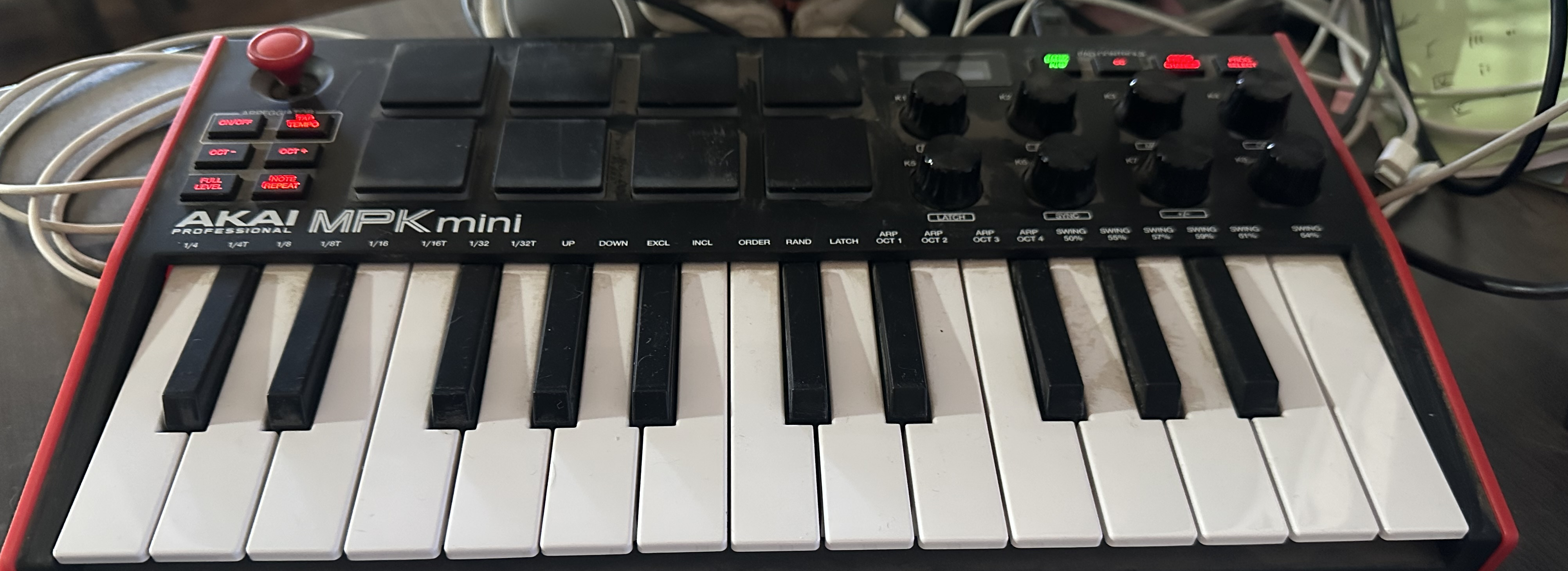
I recently purchased the (paid link) AKAI MPK Mini mk 2 as an additional MIDI keyboard to use with my laptop, mainly as a means of adding a degree of portability to composing.
That being said, I have since been using it with my iMac and Dorico so that I do not have to keep unplugging and plugging in my main MIDI keyboard which is a (paid link) Arturia Keylab Essential 61 mk3.
I have tried the AKAI MPK Mini on Cubase and everything seems to work well. I have also been using it with Dorico on Mac and it works equally well.
It seems a solid piece of kit and very playable, despite the small keys and their limited number. I think it is perfect for the purpose that I had in mind as it is very compact and rugged.
Some of the main features are:
25 Mini Keys
USB interface
8 Backlit Drum Pads
8 Knobs
It is easy to switch the octave up and down, which given the limited number of keys is important.
It comes with a whole raft of software but I have never installed any of it, the intent being to use it as a straightforward MIDI controller and it integrates nicely with Cubase and Dorico. If you want something compact, rugged, and nicely versatile you should perhaps checkout the (paid link) AKAI MPK Mini mk2.
I think that it is time to unveil my secret weapon in the pursuit of my composition goals and my trusty cow pilot on this arduous journey.
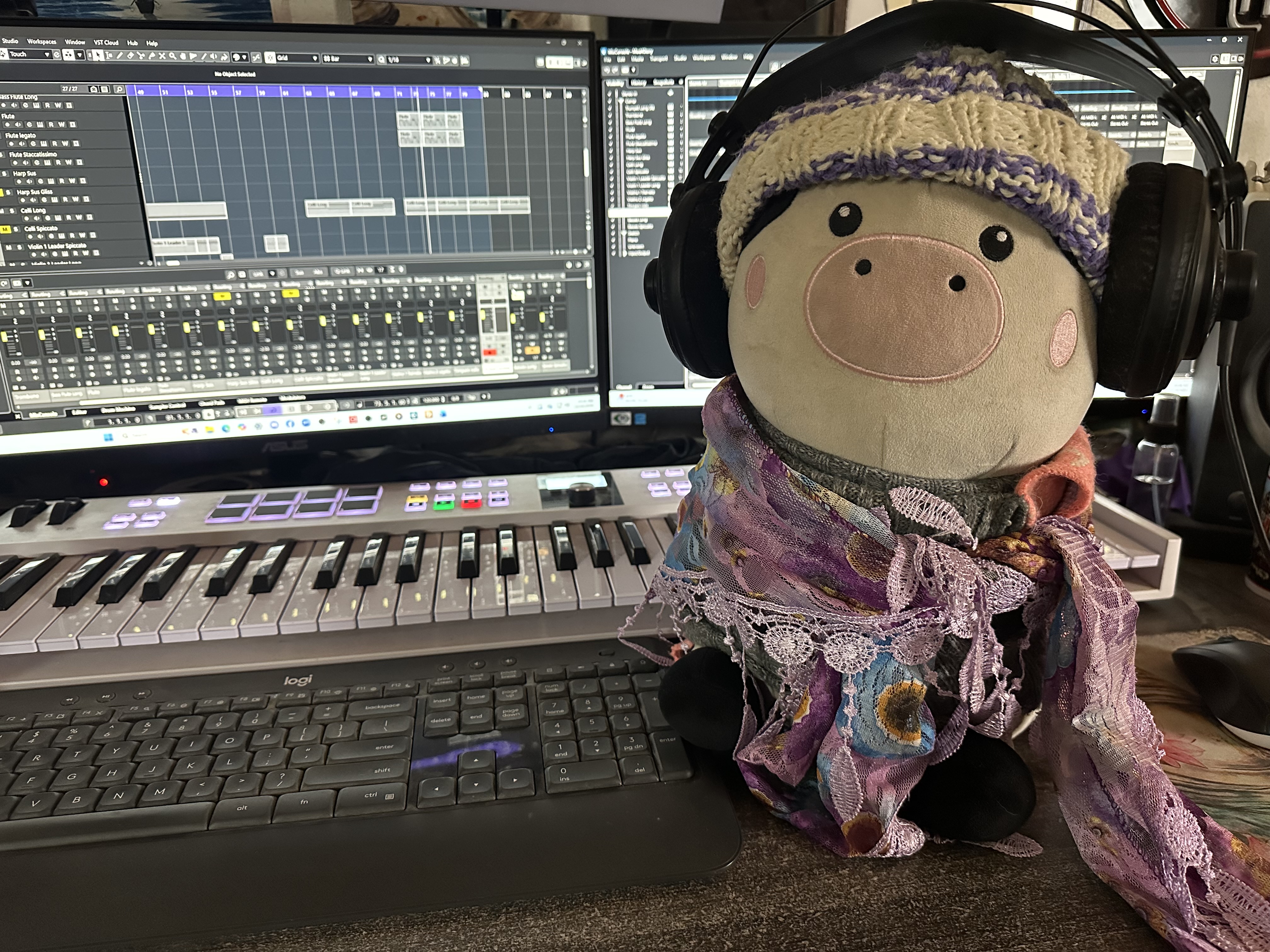
Please meet Cottage Cheese, the Moosical Composition Cow that my wife purchased for me.
She is incredibly moosical and supportive. Every day she is right there ready at the desk for whatever tasks we have ahead of us.
She supports me when studying online courses, and with book work.
She is always there to offer advice and inspiration when working on composition exercises and projects.
She is invaluable in keeping me grounded and is my constant cowpanion.
So, thank you Cottage Cheese for your diligence. She always keeps me motivated and progressing on our moosical journey.
Here she is hard at work.
She also enjoys drinking cowfee and eating cowkies, although it is a constant chore keeping her cowkie crumbs out of the keyboard. She has a very cute hat and scarf to keep her warm whilst she is working.