Friday, December 26, 2025

The Return of Fairwind

A while back devoted listener Snickersnax pointed out that Fairwind denied herself and her daughter the accompaniment of ladies-in-waiting and personal maids; nice catch! I totally missed that.

As the text reads, Fairwind denies herself and Andrella the accompaniment of both Ladies-in-waiting and personal maids. One might assume that this is out of an ascetic religious view--she is a cleric after all. Yet she maintains lavish furnishings in her ridiculously small living quarters, so this seems unlikely. Perhaps the baron is too cheap to pay for maids; that's in keeping with his penurious character and yet another reason that his wife spends her free time bonding with Rasputin while his daughter plots her ascension to the throne of the barony. 

But the text says that it's Fairwind that insists they have no servants or ladies in waiting. A lady in waiting is more like a companion who provides assistance and advice. They're drawn from the aristocratic classes themselves and may be the daughters of other barons or spouses of important ministers or other such aristocratic horseshit. These are the clique of gossiping ladies you see hanging out with the royals in shows like The Great or Olivia Colman's cronies/pool of potential lovers in The Favorite. Why would she deny herself and her daughter such company?  

This is likely an effort on the part of Fairwind to isolate herself and her daughter from outside influences. This may get back to the issue of F'wind being lawful in a chaotic town--she trusts no one. Or it could be  parental control; she wants to ensure that she is the only voice advising her daughter a la Queen Victoria's mum and probably 10,000 other controlling monarchical matrons. This need not be a malicious relationship--though in that direction lies the greater drama. She could be a well-intentioned and loving--if over-protective--mother if that better suits your view of Restenford nobility. 


Wednesday, June 15, 2022

Denizens of Restenford: Fairwind

Ah, yes, the Baroness Fairwind, beleaguered spouse of the tepid Baron Grellus; what do we know about her? From the "castle" roster: she is 42 years old, 5'8" tall and 110 lbs wide--which is not very wide at all--(that's like 1.7 liters and 8 stone for you metric folks out there) and has long brown hair and brown eyes. Though she's a 3rd level cleric--4.8th level in the metric system--and her spells du jour are Detect Evil, Detect Magic, and Chant. We don't get her full stats so we don't know how Strong, Intelligent, Wise, etc., she is. Actually, she has 2 first level spells "memorized"--standard for a 3rd level cleric--so we can assume that her Wis is no higher than 12; otherwise she'd have at least 1 bonus spell. She has a ring of protection and a wand of magic missiles; can clerics use a wand of magic missiles? [Consults DMG... any class can use 'em; how come I never knew that?]

She's a lawful good cleric living in a chaotic town and rumor has it that the populace find her to be a bit haughty. She occasionally goes into town accompanied by her daughter Andrella, a couple of bodyguards, and/or the Baron. She and Andrella tend the gardens at the castle so she has a hobby, which is nice. She also spends at least some of her time down in the dungeons of the castle; we'll get to that in a minute.

Her only mention in the rumor table is that she is lawful good; do people really talk about alignments as if they're ethnicities or congenital diseases? I guess it makes sense in a world where alignment languages are a thing.
Image
Yalta, Spiritual Advisor

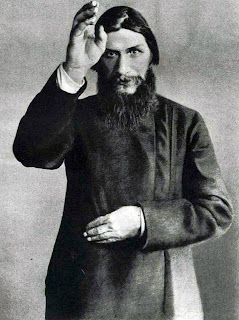
From the village write up (#31 Priest's Home) we learn that this is the home of her "spiritual advisor." His name is Yalta, a priest (C3) with a charisma of 17. For those keeping score at home: the wife of an incompetent nobleman has a highly charismatic spiritual advisor with a Russian name. This raises some questions for the book club: 

  1. Why has Lakofka taken such a circuitous route to inform us that the young baronette Andrella is a hemophiliac? 
  2. Assuming the lyrics of the Boney M song are accurate, does this not confirm what we've all assumed by now: Baron Grellus is not only a figurative cuckold but a literal one as well?
  3. Why is there no mention of Yalta's resistance to poison? 

What other info is there on the baroness? Strangely, even though Rasputin is only mentioned in the text describing his own home he gets full stats while Fairwind, Baroness of Restenford, is deprived of this honor. What gives Lakofka?

According the castle location chart, she is the only person besides Grellus who ventures down to the dungeon level of the "castle." We know that the secret door in the East corridor that provides access to the dungeon proper--where the Baron stashes the treasury--is trapped, but once you've figured it out, you can automatically bypass the trap henceforth. According to the text: 

"The Baron has passed the opening test, though Fairwind has not."

Baron Grellus clearly has not shared this knowledge with the Baroness which more than indicates that there is not a spirit of nuptial cooperation in their relationship. And yet, Fairwind keeps making the effort; likely behind the baron's back. To what purpose? To get at the treasury that the baron refuses to spend?

In conclusion, Fairwind is a slender, middle aged woman married to a wealthy nobleman--not bad so far. Unfortunately, the husband is an incompetent and stingy administrator who has lost the respect of his subjects and his wife. She spends her free time tending the gardens with her daughter and seeking "spiritual advice" from a seductive priest who lives in town for apparently no other reason than to be near her. She also sneaks down to the basement at night in an effort to bypass the trapped door to the dungeon proper where she hopes to locate the treasure. Perhaps once it's found she will use it to overthrow her husband but more likely she hopes to use it to escape from this backwater burg, to run off with Yalta and live a better life somewhere--anywhere--else.


Sunday, March 13, 2022

Pelltar's Property Protection Paranoia

Ages ago, we had a look at Pelltar the Sorceror, most prominent citizen of Restenford. Today we're going to ponder his many properties and the overly protective measures he has put in place to secure them.

Grellus's Pelltar's tower:

First off we have the tower at the castle, to which he has a "deed" guaranteeing him access even in the event that the Baron should die--foreshadowing for the follow up module L2 Assassin's Knot. Because I just received my real estate license from the University of Wikipedia moments ago I profess no expertise on the matter, but I believe a deed essentially means that ownership of the tower has been conveyed to Pelltar. I've already discussed the significance of Pelltar's occupation of the phallus of Restenford, so let's get straight to the security measures:

  • All doors are wizard locked but also locked with conventional locks that are so complex as to inflict a -35% penalty on your thief's lock picking endeavors.
  • If anyone but a tall bearded man enters either the ground level door or the one at the walkway, a magic mouth yells an alert. We know that Baron Grellus is bearded, and is a strapping 6'2" tall, so he can probably pass the mouth unannounced. Pelltar is not given a physical description, but can we assume that he sports a beard and stands somewhere in excess of 6' as well?
  • Pelltar has animated 4 skeletons to attack anyone who enters the tower who is not accompanied by him.  
    • Whose bones are the skeletons made from? Is Pelltar a grave robber? Worse: is he a necrophiliac?
  • The doors are also fire trapped. More on that later.
  • The trapdoor to Pelltar's lab is iron-bound, barred, and wizard locked.
    • If the trap door is left open for more than 10 seconds--enough time for one person to enter safely--a hefty slab of iron will drop on the poor slob who tries to enter next, inflicting 3-30 pts of dmg.
  • His Crystal ball is covered in Dust of Sneezing and Choking: anyone touching it must save or choke to death while sneezing uncontrollably.

Pelltar's Home:

Nothing much here, just Pelltar--when he's not at the castle--and his three assistants Abracus, Fliban, and Gristla scribbling in their spell books. Yawn.

  • all doors are wizard locked and employ complex locks. It doesn't say that these locks are 35% more difficult to pick--like the ones in the tower--but such can probably be assumed.
  • inner hall doors have Explosive Runes scrawled on both the inside and outside.
  • his apprentice MUs all wear magic rings that allow them to pass through the Wizard locks
  • Presumably they also wear magic spectacles that prevent them from inadvertently reading the Explosive Runes

Pelltar's Warehouse: 

The sorceror has secured in this building approximately 7,800 GPs worth of goods including leather upholstered furniture, tapestries, fancy clothing, cutlery, and other assorted fineries. The highlight of the collection is definitely 800 gp worth of hard whiskey (presumably it's American or Irish whiskey and not Scotch or Canadian whisky [or one of those pretentious American liquors that chooses to drop the "e"]). Less impressive: 250 gps worth of Iron Rations; that's 50 weeks at PHB prices. There are also three suits of plate mail that are valued at 300 gp. each, 25% below the going PHB rate. Presumably, unlike almost everything else in here, they are of low quality.

  • Pelltar has hired a security guard to protect his warehouse: Welcar, the same tough but grizzled fighter who infamously faked his own death to give cause to the Lynching of the half orcs on the edge of town.
  • Image
    In the immortal words of Montgomery Burns...
    Welcar is assisted on his patrol by a pair of guard dogs who wear magic collars that offer protection from sleep and charm spells. 
  • lest you try to poison said pooches, they will not eat any food offered them unless it comes from Pelltar or Welcar.
  • Welcar also patrols the other two warehouses nearby. One holds grain and preserved foods; presumably the produce of the surrounding farmland. The other houses the fishing fleet. Baron Grellus "lets the fishermen use it for free" which, as we all know, means that they stopped paying rent on the place years ago and the Baron lacks the huevos to kick them out.
  • The door to the warehouse is triple locked and each lock is Wizard Locked, Explosive Runed, and Fire Trapped. One should note the following per the descriptions of these spells: 
    1. Wizard lock is cast on a door or portal, not on a lock, so one door can be protected by Wizard Lock but once;
    2. Casting Fire trap on a door which is also wizard locked or hold portaled will result in the previous spell being negated. Lest you try to be clever, both spells would be negated if you reversed the casting order, and  
    3. Explosive Runes are cast on a "book, map, scroll, or similar instrument bearing written information," a category which, I would argue, does not include locks (or doors; see Pelltar's house, above). 
      • Further, Explosive Runes detonate when the text in which they are hidden is read, not when the item they are cast on is tampered with. If Pelltar did cast Explosive Runes on, say, the logo of the lockmaker, every time his security guard casually read "MasterLock" or "Schlage" while on patrol, the lock would explode. 
      • 3rd level cleric spell Glyph of Warding is described as "a powerful inscription magically drawn to prevent unauthorized or hostile creatures from passing, entering, or opening" (PHB pg. 47); that sounds like what Lakofka intended, no?
      • Seeing as explosive runes dole out 6d4+6 pts of dmg to the reader with no saving throw, how many watchmen did Pelltar go through before he made illiteracy a job requirement?
      • Are the skeletons guarding his tower the animated remains of these former watchmen?
      • Were the burned half orcs found at the edge of town merely replacement hires (for the temporarily dead Welcar) who failed their illiteracy test?


Thursday, October 21, 2021

Where's the ford?: Etymology of Restenford

If you're the etymologically inclined type and you see a town named Restenford, you might be tempted to assume that the "-ford" suffix denotes the presence of a ford across a river named Resten at this location; see Oxford--a town located where the river Ox could be forded. Of course, you would be horribly incorrect because the name of the river is Restin, not Resten. [Insert gut-busting laughter here]

Image
View of the Restin River from Xerbal Mtn.
Ok, while that statement is true, that is not the thesis of this post. No, the real issue is that there is no ford over the river Restin anywhere near Resty. Indeed, though there is no ford across the Restin, there are two bridges which means that Restenbridge would be a name more suited to the Barony; see Cambridge: a town with a bridge over the River Cam. One could even argue that Restinmouth would be better still.  


But, at last, I've realized something that just might justify why a town with two bridges and no ford would be called Restenford instead of Restinbridge without being a Restenfraud [more gut-busting]. What if the Restin River is  one of them rivers that changes its flow with the tides--like the Hudson in our world. These rivers are called things like tidal estuaries or sunken rivers, but the word most commonly associated with them in some parts of the world is "fjord."  So if we can agree that the Restin River is actually a fjord--at least at its lower reaches--then all we need to do is drop the "j" from fjord and you have "ford," no river crossing required.  

This gains extra traction when you realize that the population of Lendore Island worships Suel deities and therefore it's not such a stretch to say that they might have a Suel linguistic heritage as well. Who else speaks Suel? Them viking-inspired barbarians that inhabit the fjord-ridden Thillronian Peninsula, that's who!

Saturday, May 16, 2020

More maps from F Seran

Image
F Seran, artiste de Lendore, has kindly provided a link to his DeviantArt page where he goes by Fred-le-Nervien. Of particular interest to Lendophiles will be the maps of the Greater Restenford vicinity, Garrotteville, and Lac Farmin. It should be noted that the maps are annotated in the native dialect of the Lendores. These would work wonderfully as player handouts.

Not all of the art is cartographic in nature. There are some cool architectural drawings, military stuff--much of it WWI themed--and some good old fashioned fantasy art as well. Check it out already!


Thursday, February 6, 2020

New Map of Restenford

Image
A one f. Seran has drawn up--by hand--this very nice illustrated map of Restenford. As with all the best maps, it is in French. Extra nice touches include:

    Image
  • a dude getting in some rowing (sculling?) out on the Restin River
  • not one but two sets of gallows (potences?); one at each gatehouse.
  • some jagged rocks to the shoreline south of the Restin mouth. Or maybe they're icebergs?
  • an awesome ship out in the bay waiting for the tide to change so that it can sail into port. Or maybe that's the crew rowing to shore in the nearby skiff.
  • the "burnt out guard station"
Anyway, I think this is a wonderful illustrated map and so should you. Thank you f. Seran for your contribution to the field of Lendorology.

Friday, March 9, 2018

New Maps of Restenford

Image
1. Map of Monmouth, NJ by John Speed.
Years ago, I posted a selection of maps of Restenford that I'd
scrounged from various internet sources. Recently, a budding young cartographer named R.R. Calbick sent me a map of R'ford that he rendered up, modeled after the work of John Speed who, back in the day, made those cool old-timey maps with the buildings rendered into 'em that we all know and love. See figure 1.

Anyway, Mr. Calbick rendered up Restenford for us in a similar style over three separate maps including the original Restenford, a somewhat streamlined Restenford that has suffered the destruction of several buildings, and, in the third map, we see that someone in Restenford finally dips into the treasury to beef up security with improved guard stations, a wall surrounding the north side of the village and, finally, an adequate lighthouse so that the poor gnome can finally ply his trade with his head held high.


Image
2. Antebellum Restenford, by R.R. Calbick

Image
3. Post Antebellum Restenford, by R.R. Calbick. Note the expanded graveyard.

Image
4. Apres post antebellum Restenford by R.R. Calbick
A point of further interest: these maps were sent to me by a one Lenard Lakofka. Yes, that's right, the inspiration for this here blog has finally tracked me down and, rather than slapping me with a cease and desist order or going full-Welcar on me and releasing the hounds, he hooked me up with Mr. Calbick and his awesome maps! Furthermore, he's also provided some other cool resources as well, which I'll get to in a later post. For now enjoy the visual treat of Restenford cartography.