Canonical link: https://siderea.dreamwidth.org/2020/03/08/pandemic-prep-toc.html
( Read more... )
![[sticky entry]](https://www.dreamwidth.org/img/silk/entry/sticky_entry.png) Sticky: Preparing for the Pandemic: Table of Contents [coronavirus2020, COVID-19]
Sticky: Preparing for the Pandemic: Table of Contents [coronavirus2020, COVID-19]
Mar. 8th, 2020 09:06 pm2025 Dec 24: ScienceDaily [press release?]: "Scientists reverse Alzheimer’s in mice and restore memory":
2025 Dec 22: Cell Reports Medicine [peer-reviewed scientific journal]: Pharmacologic reversal of advanced Alzheimer's disease in mice and identification of potential therapeutic nodes in human brain by Kalyani Chaubey et al. (+35 other authors!):
By examining both human Alzheimer's brain tissue and multiple preclinical mouse models, the team identified a key biological failure at the center of the disease. They found that the brain's inability to maintain normal levels of a critical cellular energy molecule called NAD+ plays a major role in driving Alzheimer's. Importantly, maintaining proper NAD+ balance was shown to not only prevent the disease but also reverse it in experimental models.
WARNING WARNING WARNING: Yes, there are OTC supplements for tinkering with your NAD+, but they are apparently/allegedly CARCINOGENIC (cause CANCER) at typical doses. DO NOT run out and do something stupid. Tinkering with your whole-body cellular metabolism has some gnarly failure modes. From this article:
Continuing from the article: Why This Approach Differs From Supplements
Dr. Pieper cautioned against confusing this strategy with over the counter NAD+-precursors. He noted that such supplements have been shown in animal studies to raise NAD+ to dangerously high levels that promote cancer. The method used in this research relies instead on P7C3-A20, a pharmacologic agent that helps cells maintain healthy NAD+ balance during extreme stress, without pushing levels beyond their normal range.
NAD+ levels naturally decline throughout the body, including the brain, as people age. When NAD+ drops too low, cells lose the ability to carry out essential processes needed for normal function and survival. The researchers discovered that this decline is far more severe in the brains of people with Alzheimer's. The same pattern was seen in mouse models of the disease.Note, potential conflict of interest: the head of the lab, Dr Pieper, above, has a serious commercial interest in this proving out:
[...]
Amyloid and tau abnormalities are among the earliest and most significant features of Alzheimer's. In both mouse models, these mutations led to widespread brain damage that closely mirrors the human disease. This included breakdown of the blood-brain barrier, damage to nerve fibers, chronic inflammation, reduced formation of new neurons in the hippocampus, weakened communication between brain cells, and extensive oxidative damage. The mice also developed severe memory and cognitive problems similar to those seen in people with Alzheimer's.
[...]
This approach built on the group's earlier work published in Proceeding of the National Academy of Sciences USA, which showed that restoring NAD+ balance led to both structural and functional recovery after severe, long-lasting traumatic brain injury. In the current study, the researchers used a well-characterized pharmacologic compound called P7C3-A20, developed in the Pieper laboratory, to restore NAD+ balance.
The results were striking. Preserving NAD+ balance protected mice from developing Alzheimer's, but even more surprising was what happened when treatment began after the disease was already advanced. In those cases, restoring NAD+ balance allowed the brain to repair the major pathological damage caused by the genetic mutations.
Both mouse models showed complete recovery of cognitive function. This recovery was also reflected in blood tests, which showed normalized levels of phosphorylated tau 217, a recently approved clinical biomarker used to diagnose Alzheimer's in people. These findings provided strong evidence of disease reversal and highlighted a potential biomarker for future human trials.
The technology is currently being commercialized by Glengary Brain Health, a Cleveland-based company co-founded by Dr. Pieper.The actual research article:
2025 Dec 22: Cell Reports Medicine [peer-reviewed scientific journal]: Pharmacologic reversal of advanced Alzheimer's disease in mice and identification of potential therapeutic nodes in human brain by Kalyani Chaubey et al. (+35 other authors!):
Abstract:Full text here: https://www.cell.com/cell-reports-medicine/fulltext/S2666-3791(25)00608-1
Alzheimer's disease (AD) is traditionally considered irreversible. Here, however, we provide proof of principle for therapeutic reversibility of advanced AD. In advanced disease amyloid-driven 5xFAD mice, treatment with P7C3-A20, which restores nicotinamide adenine dinucleotide (NAD+) homeostasis, reverses tau phosphorylation, blood-brain barrier deterioration, oxidative stress, DNA damage, and neuroinflammation and enhances hippocampal neurogenesis and synaptic plasticity, resulting in full cognitive recovery and reduction of plasma levels of the clinical AD biomarker p-tau217. P7C3-A20 also reverses advanced disease in tau-driven PS19 mice and protects human brain microvascular endothelial cells from oxidative stress. In humans and mice, pathology severity correlates with disruption of brain NAD+ homeostasis, and the brains of nondemented people with Alzheimer's neuropathology exhibit gene expression patterns suggestive of preserved NAD+ homeostasis. Forty-six proteins aberrantly expressed in advanced 5xFAD mouse brain and normalized by P7C3-A20 show similar alterations in human AD brain, revealing targets with potential for optimizing translation to patient care.
Canonical link: https://siderea.dreamwidth.org/1891517.html
When you have health insurance, you have a contract (health plan) with the insurance company that says that for the duration (the plan year) of the contract, you will pay them the agreed upon monthly fee every month (the premium), in exchange for them paying for your health care... some.
How much is "some"? Well, that depends.
To understand what it depends on, you have to understand the three-stage model that health plans are organized around.
This three-stage model is never described as such. It is implicit in the standard terms (jargon) of the health insurance industry, and it is never made explicit. There is no industry term (jargon) for the model itself. There are no terms (jargon) for the three stages. But health insurance becomes vastly easier to understand if you think about it in terms of the three-stage model that is hiding in just about every health plan's terms (agreements).
( Read more: 12,170 (sic!) riveting words about health insurance in the US] )
This post brought to you by the 221 readers who funded my writing it – thank you all so much! You can see who they are at my Patreon page. If you're not one of them, and would be willing to chip in so I can write more things like this, please do so there.
Please leave comments on the Comment Catcher comment, instead of the main body of the post – unless you are commenting to get a copy of the post sent to you in email through the notification system, then go ahead and comment on it directly. Thanks!
This is part of Understanding Health Insurance
- Introduction
- A Health Plan is a Contract
- The Three-Stage Model ⇐ You are here
The Three-Stage Model
When you have health insurance, you have a contract (health plan) with the insurance company that says that for the duration (the plan year) of the contract, you will pay them the agreed upon monthly fee every month (the premium), in exchange for them paying for your health care... some.
How much is "some"? Well, that depends.
To understand what it depends on, you have to understand the three-stage model that health plans are organized around.
This three-stage model is never described as such. It is implicit in the standard terms (jargon) of the health insurance industry, and it is never made explicit. There is no industry term (jargon) for the model itself. There are no terms (jargon) for the three stages. But health insurance becomes vastly easier to understand if you think about it in terms of the three-stage model that is hiding in just about every health plan's terms (agreements).
( Read more: 12,170 (sic!) riveting words about health insurance in the US] )
This post brought to you by the 221 readers who funded my writing it – thank you all so much! You can see who they are at my Patreon page. If you're not one of them, and would be willing to chip in so I can write more things like this, please do so there.
Please leave comments on the Comment Catcher comment, instead of the main body of the post – unless you are commenting to get a copy of the post sent to you in email through the notification system, then go ahead and comment on it directly. Thanks!
Update [me, health, Patreon]
Dec. 12th, 2025 06:49 amSo, I, uh, got my RSI/ergonomics debugged!* I then promptly lost two days to bad sleep due to another new mechanical failure of the balky meat mecha and also a medical appointment in re two previous malfunctions. But I seem back in business now. The new keyboard is great.
Patrons, I've got three Siderea Posts out so far this month and it's only the 12th. I have two more Posts I am hoping to get out in the next three days. Also about health insurance. We'll see if it actually happens, but it's not impossible. I have written a lot of words. (I really like my new keyboard.)
Anyways, if you weren't planning on sponsoring five posts (or – who knows? – even more) this month, adjust your pledge limits accordingly.
* It was my bra strap. It was doing something funky to how my shoulder blade moved or something. It is both surprising to me that so little pressure made so much ergonomic difference, and not surprising because previously an even lighter pressure on my kneecap from wearing long underwear made my knee malfunction spectacularly. Apparently this is how my body mechanics just are.
Patrons, I've got three Siderea Posts out so far this month and it's only the 12th. I have two more Posts I am hoping to get out in the next three days. Also about health insurance. We'll see if it actually happens, but it's not impossible. I have written a lot of words. (I really like my new keyboard.)
Anyways, if you weren't planning on sponsoring five posts (or – who knows? – even more) this month, adjust your pledge limits accordingly.
* It was my bra strap. It was doing something funky to how my shoulder blade moved or something. It is both surprising to me that so little pressure made so much ergonomic difference, and not surprising because previously an even lighter pressure on my kneecap from wearing long underwear made my knee malfunction spectacularly. Apparently this is how my body mechanics just are.
Canonical link: https://siderea.dreamwidth.org/1890494.html
0.
Hey Americans (and other people stuck in the American healthcare system)! Shopping for a health plan on your state marketplace? Boy, do I have some information for you that you should have and probably don't. There's been an important legal change affecting your choices that has gotten almost no press.
Effective with plan year 2026 all bronze level and catastrophic plans are statutorily now HDHPs and thus HSA compatible. You may get and self-fund an HSA if you have any bronze or catastrophic plan, as well as any plan of any level designated a HDHP.
2025 Dec 9: IRS.gov: "Treasury, IRS provide guidance on new tax benefits for health savings account participants under the One, Big, Beautiful Bill"
If you are shopping plans right now (or thought you were done), you should probably be aware of this. Especially if you are planning on getting a bronze plan, a catastrophic plan, or any plan with the acronym "HSA" in the name or otherwise designated "HSA compatible".
The Trump administration doing this is tacit admission that all bronze plans have become such bad deals that they're the economic equivalent of what used to be considered a HDHP back when that concept was invented, and so should come with legal permission to protect yourself from them with an HSA.
Effective immediately, you should consider a bronze plan half an insurance plan.
( Read more [3,340 words] )
This post brought to you by the 221 readers who funded my writing it – thank you all so much! You can see who they are at my Patreon page. If you're not one of them, and would be willing to chip in so I can write more things like this, please do so there.
Please leave comments on the Comment Catcher comment, instead of the main body of the post – unless you are commenting to get a copy of the post sent to you in email through the notification system, then go ahead and comment on it directly. Thanks!
0.
Hey Americans (and other people stuck in the American healthcare system)! Shopping for a health plan on your state marketplace? Boy, do I have some information for you that you should have and probably don't. There's been an important legal change affecting your choices that has gotten almost no press.
Effective with plan year 2026 all bronze level and catastrophic plans are statutorily now HDHPs and thus HSA compatible. You may get and self-fund an HSA if you have any bronze or catastrophic plan, as well as any plan of any level designated a HDHP.
2025 Dec 9: IRS.gov: "Treasury, IRS provide guidance on new tax benefits for health savings account participants under the One, Big, Beautiful Bill"
Bronze and Catastrophic Plans Treated as HDHPs: As of Jan. 1, 2026, bronze and catastrophic plans available through an Exchange are considered HSA-compatible, regardless of whether the plans satisfy the general definition of an HDHP. This expands the ability of people enrolled in these plans to contribute to HSAs, which they generally have not been able to do in the past. Notice 2026-05 clarifies that bronze and catastrophic plans do not have to be purchased through an Exchange to qualify for the new relief.
If you are shopping plans right now (or thought you were done), you should probably be aware of this. Especially if you are planning on getting a bronze plan, a catastrophic plan, or any plan with the acronym "HSA" in the name or otherwise designated "HSA compatible".
The Trump administration doing this is tacit admission that all bronze plans have become such bad deals that they're the economic equivalent of what used to be considered a HDHP back when that concept was invented, and so should come with legal permission to protect yourself from them with an HSA.
Effective immediately, you should consider a bronze plan half an insurance plan.
( Read more [3,340 words] )
This post brought to you by the 221 readers who funded my writing it – thank you all so much! You can see who they are at my Patreon page. If you're not one of them, and would be willing to chip in so I can write more things like this, please do so there.
Please leave comments on the Comment Catcher comment, instead of the main body of the post – unless you are commenting to get a copy of the post sent to you in email through the notification system, then go ahead and comment on it directly. Thanks!
Canonical link: https://siderea.dreamwidth.org/1890011.html
What we call health insurance is a contract. When you get health insurance, you (or somebody on your behalf) are agreeing to a contract with a health insurance company – a contract where they agree to do certain things for you in exchange for money. So a health insurance plan is a contract between the insurance company and the customer (you).
For simplicity, I will use the term health plan to mean the actual contract – the specific health insurance product – you get from a health insurance company. (It sounds less weird than saying "an insurance" and is shorter to type than "a health insurance plan".)
One of the things this clarifies is that one health insurance company can have a bunch of different contracts (health plans) to sell. This is the same as how you may have more than one internet company that could sell you an internet connection to your home, and each of those internet companies might have several different package deals they offer with different prices and terms. In exactly that way, there are multiple different health insurance companies, and they each can sell multiple different health plans with different prices and terms.
( Read more... [7,130 words] )
This post brought to you by the 220 readers who funded my writing it – thank you all so much! You can see who they are at my Patreon page. If you're not one of them, and would be willing to chip in so I can write more things like this, please do so there.
Please leave comments on the Comment Catcher comment, instead of the main body of the post – unless you are commenting to get a copy of the post sent to you in email through the notification system, then go ahead and comment on it directly. Thanks!
This is part of Understanding Health Insurance
- Introduction
- A Health Plan is a Contract ⇐ You are here
- The Three-Stage Model
Health Insurance is a Contract
What we call health insurance is a contract. When you get health insurance, you (or somebody on your behalf) are agreeing to a contract with a health insurance company – a contract where they agree to do certain things for you in exchange for money. So a health insurance plan is a contract between the insurance company and the customer (you).
For simplicity, I will use the term health plan to mean the actual contract – the specific health insurance product – you get from a health insurance company. (It sounds less weird than saying "an insurance" and is shorter to type than "a health insurance plan".)
One of the things this clarifies is that one health insurance company can have a bunch of different contracts (health plans) to sell. This is the same as how you may have more than one internet company that could sell you an internet connection to your home, and each of those internet companies might have several different package deals they offer with different prices and terms. In exactly that way, there are multiple different health insurance companies, and they each can sell multiple different health plans with different prices and terms.
( Read more... [7,130 words] )
This post brought to you by the 220 readers who funded my writing it – thank you all so much! You can see who they are at my Patreon page. If you're not one of them, and would be willing to chip in so I can write more things like this, please do so there.
Please leave comments on the Comment Catcher comment, instead of the main body of the post – unless you are commenting to get a copy of the post sent to you in email through the notification system, then go ahead and comment on it directly. Thanks!
Canonical link: https://siderea.dreamwidth.org/1889543.html
Preface: I had hoped to get this out in a more timely manner, but was hindered by technical difficulties with my arms, which have now been resolved. This is a serial about health insurance in the US from the consumer's point of view, of potential use for people still dealing with open enrollment, which we are coming up on the end of imminently. For everyone else dealing with the US health insurance system, such as it is, perhaps it will be useful to you in the future.
Understanding Health Insurance:
Health insurance in the US is hard to understand. It just is. If you find it confusing and bewildering, as well as infuriating, it's not just you.
I think that one of the reasons it's hard to understand has to do with how definitions work.
Part of the reason why health insurance is so confusing is all the insurance industry jargon that is used. Unfortunately, there's no way around that jargon. We all are stuck having to learn what all these strange terms mean. So helpful people try to explain that jargon. They try to help by giving definitions.
But definitions are like leaves: you need a trunk and some branches to hang them on, or they just swirl around in bewildering clouds and eventually settle in indecipherable piles.
There are several big ideas that provide the trunk and branches of understanding health insurance. If you have those ideas, the jargon becomes a lot easier to understand, and then insurance itself becomes a lot easier to understand.
So in this series, I am going to explain some of those big ideas, and then use them to explain how health insurance is organized.
This unorthodox introduction to health insurance is for beginners to health insurance in the US, and anyone who still feels like a beginner after bouncing off the bureaucratic nightmare that is our so-called health care system in the US. It's for anyone who is new to being an health insurance shopper in the US, or feels their understanding is uncertain. Maybe you just got your first job and are being asked to pick a health plan from several offered. Maybe you have always had insurance from an employer and are shopping on your state marketplace for the first time. Maybe you have always gotten insurance through your parents and spouse, and had no say in it, but do now. This introduction assumes you are coming in cold, a complete beginner knowing nothing about health insurance or what any of the health insurance industry jargon even is.
Please note! This series is mostly about commercial insurance products: the kinds that you buy with money. Included in that are the kind of health insurance people buy for themselves on the state ACA marketplaces and also the kind of health insurance people get from their employers as a "bene". It may (I am honestly not sure) also include Medicare Advantage plans.
The things this series explains do not necessarily also describe Medicaid or bare Medicare, or Tricare or any other government run insurance program, though if you are on such an insurance plan this may still be helpful to you. Typically government-run plans have fewer moving parts with fewer choices, so fewer jargon terms even matter to them. Similarly, this may be less useful for subsidized plans on the state ACA marketplaces. It depends on the state. Some states do things differently for differently subsidized plans.
But all these different kinds of government-provided health insurance still use some insurance industry jargon for commercial insurance, if only to tell you what they don't have or do. So this post may be useful to you because understanding how insurance typically works may still prove helpful in understanding what the government is up to. Understanding what the assumptions are of regular commercial insurance will hopefully clarify the terms even government plans use to describe themselves. Just realize that if you have a plan the government in some sense is running, things may be different – including maybe very different – for you.
On to the first important idea: Health Insurance is a Contract.
Preface: I had hoped to get this out in a more timely manner, but was hindered by technical difficulties with my arms, which have now been resolved. This is a serial about health insurance in the US from the consumer's point of view, of potential use for people still dealing with open enrollment, which we are coming up on the end of imminently. For everyone else dealing with the US health insurance system, such as it is, perhaps it will be useful to you in the future.
Understanding Health Insurance:
Introduction
Health insurance in the US is hard to understand. It just is. If you find it confusing and bewildering, as well as infuriating, it's not just you.
I think that one of the reasons it's hard to understand has to do with how definitions work.
Part of the reason why health insurance is so confusing is all the insurance industry jargon that is used. Unfortunately, there's no way around that jargon. We all are stuck having to learn what all these strange terms mean. So helpful people try to explain that jargon. They try to help by giving definitions.
But definitions are like leaves: you need a trunk and some branches to hang them on, or they just swirl around in bewildering clouds and eventually settle in indecipherable piles.
There are several big ideas that provide the trunk and branches of understanding health insurance. If you have those ideas, the jargon becomes a lot easier to understand, and then insurance itself becomes a lot easier to understand.
So in this series, I am going to explain some of those big ideas, and then use them to explain how health insurance is organized.
This unorthodox introduction to health insurance is for beginners to health insurance in the US, and anyone who still feels like a beginner after bouncing off the bureaucratic nightmare that is our so-called health care system in the US. It's for anyone who is new to being an health insurance shopper in the US, or feels their understanding is uncertain. Maybe you just got your first job and are being asked to pick a health plan from several offered. Maybe you have always had insurance from an employer and are shopping on your state marketplace for the first time. Maybe you have always gotten insurance through your parents and spouse, and had no say in it, but do now. This introduction assumes you are coming in cold, a complete beginner knowing nothing about health insurance or what any of the health insurance industry jargon even is.
Please note! This series is mostly about commercial insurance products: the kinds that you buy with money. Included in that are the kind of health insurance people buy for themselves on the state ACA marketplaces and also the kind of health insurance people get from their employers as a "bene". It may (I am honestly not sure) also include Medicare Advantage plans.
The things this series explains do not necessarily also describe Medicaid or bare Medicare, or Tricare or any other government run insurance program, though if you are on such an insurance plan this may still be helpful to you. Typically government-run plans have fewer moving parts with fewer choices, so fewer jargon terms even matter to them. Similarly, this may be less useful for subsidized plans on the state ACA marketplaces. It depends on the state. Some states do things differently for differently subsidized plans.
But all these different kinds of government-provided health insurance still use some insurance industry jargon for commercial insurance, if only to tell you what they don't have or do. So this post may be useful to you because understanding how insurance typically works may still prove helpful in understanding what the government is up to. Understanding what the assumptions are of regular commercial insurance will hopefully clarify the terms even government plans use to describe themselves. Just realize that if you have a plan the government in some sense is running, things may be different – including maybe very different – for you.
On to the first important idea: Health Insurance is a Contract.
Understanding Health Insurance
- Introduction
- Health Insurance is a Contract
- The Three-Stage Model
Canonical link: https://siderea.dreamwidth.org/1888828.html
Hey, Americans and people living in the US going through open enrollment on the state ACA marketplaces who haven't yet enrolled in a plan for 2026!
Just about every state in the union and DC (but not Idaho) proudly touts an end date to open enrollment sometime in January. This year for most states it ends January 15th, but in CA, NJ, NY, RI, and DC, it's January 31st, and here in Massachusetts, it's January 23rd. (Idaho's is December 15th.) [Source]
That sure sounds like the deadline is sometime in January.
No, it kinda isn't.
( tl;dr: Just assume if you want insurance to start Jan 1, the deadlines are to enroll by Dec 8 and to pay for the first month by Dec 15. Important deets within. [950 words] )
This post brought to you by the 220 readers who funded my writing it – thank you all so much! You can see who they are at my Patreon page. If you're not one of them, and would be willing to chip in so I can write more things like this, please do so there.
Please leave comments on the Comment Catcher comment, instead of the main body of the post – unless you are commenting to get a copy of the post sent to you in email through the notification system, then go ahead and comment on it directly. Thanks!
Hey, Americans and people living in the US going through open enrollment on the state ACA marketplaces who haven't yet enrolled in a plan for 2026!
Just about every state in the union and DC (but not Idaho) proudly touts an end date to open enrollment sometime in January. This year for most states it ends January 15th, but in CA, NJ, NY, RI, and DC, it's January 31st, and here in Massachusetts, it's January 23rd. (Idaho's is December 15th.) [Source]
That sure sounds like the deadline is sometime in January.
No, it kinda isn't.
( tl;dr: Just assume if you want insurance to start Jan 1, the deadlines are to enroll by Dec 8 and to pay for the first month by Dec 15. Important deets within. [950 words] )
This post brought to you by the 220 readers who funded my writing it – thank you all so much! You can see who they are at my Patreon page. If you're not one of them, and would be willing to chip in so I can write more things like this, please do so there.
Please leave comments on the Comment Catcher comment, instead of the main body of the post – unless you are commenting to get a copy of the post sent to you in email through the notification system, then go ahead and comment on it directly. Thanks!
Update [me, health]
Nov. 28th, 2025 04:54 pmVery shortly after I posted my recent request for pointers on 3D printing education – a request which was occasioned by my getting excited over my new and improved typing capability courtesy of my new NocFree ergonomic keyboard and wanting to make it a peripheral – my shoulder/back went *spung* in the location and way I had had a repetitive strain injury a decade+ previously.
*le sigh*
I'm back to writing ("writing") slowly and miserably by dictation, because all of my other forms of data entry aggravate this RSI. (This explains how rambly and poorly organized the previous post was and this one too will be.)
I'm going to try to debug my ergonomics, but it remains to be seen whether I can resume typing.
Thanksgiving came at an opportune time, because it took me away from computers for a day. But I had wanted to get another post out before the end of the month. We'll see what happens.
So, uh, I had been going to post about how I have worked back up to something like 80%, maybe 90%, of my keyboard fluency on the NocFree. Eit.
*le sigh*
I'm back to writing ("writing") slowly and miserably by dictation, because all of my other forms of data entry aggravate this RSI. (This explains how rambly and poorly organized the previous post was and this one too will be.)
I'm going to try to debug my ergonomics, but it remains to be seen whether I can resume typing.
Thanksgiving came at an opportune time, because it took me away from computers for a day. But I had wanted to get another post out before the end of the month. We'll see what happens.
So, uh, I had been going to post about how I have worked back up to something like 80%, maybe 90%, of my keyboard fluency on the NocFree. Eit.
I see that I didn't note last year's Annual Introverts Liberation Feast. Perhaps I wrote a draft that I never got around to posting. It was something of a grueling deathmarch. Because my physical disability makes me largely unable to participate in food prep or cleaning, it almost entirely falls on Mr B to do, and he is already doing something like 99% of the household chores, so both of us wind up up against our physical limits doing Thanksgiving dinner.
But the thing is, part of the reason we do Thanksgiving dinner ourselves to begin with, is we manage the labor of keeping ourselves fed through meal prepping. And I really love Thanksgiving dinner as a meal. So preparing a Thanksgiving dinner that feeds 16 allows us to have a nice Thanksgiving dinner on Thanksgiving, and then allows us to each have a prepared Thanksgiving dinner every day for another seven days. So this is actually one part family tradition, seven parts meal prep for the following week, and one part getting homemade stock from the carcass and weeks of subsequent soups. If we didn't do Thanksgiving, we'd still have to figure out something to cook for dinners for the week.
The problem is the differential in effort with a regular batch cook.
So this year for Thanksgiving, I proposed, to make it more humane, we avail ourselves of one of the many local prepared to-go Thanksgiving dinner options, where you just have to reheat the food.
We decided to go with a local barbecue joint that offered a smoked turkey. It came in only two sizes: breast only, which was too small for us, and a whole 14 to 16 lb turkey, which is too large, but too large being better than too small, that's what we got.
We also bought their mashed potatoes, green bean casserole, and – new to our table this year – baked macaroni and cheese. Also two pints of their gravy, which turned out to be spectacularly good. We also got a pan of their cornbread (also new to our Thanksgiving spread), for which they are justly famous; bizarrely, they left the cornbread off their Thanksgiving menu, but proved happy to add it to our order from the regular catering menu when we called it in.
We used canned sweet potatoes in syrup and grocery store cubed stuffing (Pepperidge Farm). The sweet potatoes were fine but as is traditional I had a disaster which coated half the kitchen in sugar syrup. The stuffing was... adequate. Our big compromise to save ourselves labor was that we didn't do the big stuffing production with the chopped and sauteed fresh veggies. The place we got the prepared sides has a stuffing but it's a cornbread stuffing, which is not the bread cube version I prefer. We did add dried sage to it.
Reheating the wholly cooked smoked turkey did not go great. We followed the vendor's instructions – leave it wrapped in foil, put two cups of water in a bottom of the roasting pan, 300° F for two hours to get the breast meat to 165° F – which turned out to be in Mr B's words, "delusional". We used a pair of probe thermometers with wireless monitor, one in the thigh and one in the breast, and an oven thermometer to make sure the oven was behaving. The oven was flawless. The temperature in the thigh quickly spiked up while the breast heated slowly, such that by an hour in, there was a 50° F difference in temperature between the two. The thigh reached 165 in about 2 and 1/2 hours, at which point the breast was 117 ° F. By my calculations, given how far it had gotten in 2.5 hrs, at that temperature we'd need another hour and a half to get the whole bird up to 165° F (for a grand total of 4 hours) at which point the drumsticks would probably be shoe leather.
There was a brief moment of despair while we entertained heating the turkey for another hour and a half, but then decided to just have dark meat for Thanksgiving.
The turkey turned out to be 1) delicious and 2) enormous. Mr B carved at the rest of the bird for our meal prep and picked the carcass; I broke the carcass and other remains into three batches this year. There is going to be so much soup.
Mr B had the brilliant idea to portion the sides leftovers into the meal prep boxes before the dinner, so we dispensed two servings of each side into the casseroles we were going to warm them in, and portioned out the rest.
I had the brilliant idea of checking the weather and realizing we could use the porch as an auxiliary fridge for all the sides we had sitting there in the crockery waiting for the tardy turkey to be done so they could go in the oven. Also it was wine degrees Fahrenheit out, so that worked great too.
For beverages, Mr B had a beer, and I had iced tea and a glass of wine. Happily, the packie near the caterer's 1) has introduced online shopping for easy pickup, and 2) amazingly, had a wine I have been looking for for something like 20 years, a Sardegnan white called Aragosta, to which I was introduced to by the late lamented Maurizio's in Boston's North End. Why the wine is called "lobster" I do not know, but it is lovely. The online shopping did not work so happily; when we placed the order the day before (Tuesday), we promptly got the email saying that our order was received, but it wasn't placed until we received the confirmation email. Forty minutes before pick up time (Wednesday), since we still hadn't received a confirmation email, Mr B called in and received a well rehearsed apology and explanation that there was a problem with their new website's credit card integration, so orders weren't actually being charged correctly, but to come on down and they would have the order ready for payment at the register.
As is our custom, we also got savory croissants for lunch/breakfast while cooking from the same bakery we also get dessert. As is also our custom, we ate too much Thanksgiving dinner to have room for dessert, and we'll probably eat it tomorrow.
The smoked turkey meat (at least the dark meat) was delicious. I confess I was a little disappointed with the skin. I'm not a huge skin fan in general, but I was hoping the smoked skin would be delicious. But there was some sort of rub on it that had charred in the smoking process, and I don't like the taste of char.
The reason the turkeys I cook wind up so much moister than apparently everybody else's – I've never managed to succeed at making pan gravy, for the simple reason I've never had enough juice in the pan to make gravy, because all the juice is still in the bird – is that I don't care enough about the skin to bother trying to crisp it. There really is a trade-off between moistness of the meat and crispness of the skin, and I'm firmly of the opinion that you can sacrifice the skin in favor of the meat. The skin on this turkey was perfectly crisped all over and whoever had put the rub on it managed to do an astoundingly good job of applying it evenly. It was a completely wasted effort from my point of view, and I'm not surprised that the turkey we got wound up a bit on the dry side.
That said the smokiness was great. I thought maybe, given how strongly flavored the gravy was, it would overpower the smokiness of the meat, but that was not the case and they harmonized really nicely.
The instructions come with a very important warning that the meat is supposed to be that color: pink. It's really quite alarming if you don't know to expect it, I'm sure. You're not normally supposed to serve poultry that color. But the instructions explain in large letters that it is that color because of the smoking process, and it is in fact completely cooked and safe to eat.
(It belatedly occurs to me to wonder whether that pink is actually from the smoke, or whether they treated it with nitrates. You know, what makes bacon pink.)
The cavity was stuffed with oranges and lemons and a bouquet garni, which was a bit of a hassle to clean out of the carcass for its future use as stock.
The green bean casserole was fine. It's not as good as ours, but then we didn't have to cook it. The mac and cheese was really nice; it would never have occurred to me to put rosemary on the top, but that worked really well. The mashed potatoes were very nice mashed potatoes, and the renown cornbread was even better mopping up the gravy.
The best cranberry sauce remains the kind that stands under its own power, is shaped like the can it came in, and is perfectly homogeneous in its texture.
We aimed to get the bird in the oven at 3:00 p.m. (given that the instructions said 2 hours) with the aim of dinner hitting the table at 6:00 p.m. We had a bit of a delay getting the probe thermometers set up and debugged (note to self: make sure they're plugged all the way in) so the bird went in around 3:15 p.m. At 5:15 p.m. no part of the bird was ready. Around 5:45 p.m. the drumsticks reached 165° F, and we realized the majority of it was in not going to get there anytime in the near future. At this point all the sides had been sitting on the counter waiting to go into the oven for over a half an hour, so we decided to put them outside to keep while we figured out what we were going to do. We decided to give it a little more time in the oven, and to use that time to portion the sides into the meal prep boxes. Then we brought the casseroles back inside, pulled the bird from the oven and set it to rest, and put the casseroles in the oven. We microwaved the three things that needed microwaving (the stuffing, which we had prepared on the stove top, and was sitting there getting cold, the gravy, and at the last moment the cornbread). After 10 minutes of resting the turkey, we turned the oven off, leaving the casseroles inside to stay warm, and disassembled the drumsticks. Then we served dinner.
After dinner, all ("all") we had to do was cleaning dishes (mostly cycling the dishwasher) and disassembling the turkey (looks like we'll be good for approximately 72 servings of soup), because the meal prep portioning was mostly done. We still have to portion the turkey and the gravy into the meal prep boxes, but that can wait until tomorrow. Likewise cleaning the kitchen can wait until tomorrow. This means we were done before 9:00 p.m. That has not always been the case.
Getting the cooked turkey and prepared sides saved us some work day of (and considerably more work typically done in advance – the green bean casserole, the vegetable sauté that goes into the stuffing) but not perhaps as much as we hoped.
Turns out here's not a lot of time difference between roasting a turkey in the oven and rewarming one. OTOH, we didn't have to wrestle with the raw bird. Also, because we weren't trying to do in-bird stuffing, that's something we just didn't have to deal with. OTOOH, smoked turkey.
But it was still plenty of work. Maybe a better option is roasting regular turkey unstuffed and shaking the effort loose to make green bean casserole and baked stuffing ourselves a day or two ahead. We were already getting commercially made mashed potatoes. It would certainly be cheaper. OTOOH, smoked turkey.
This was our first year rewarming sides in the oven. We usually try to do the microwave, and that proves a bottleneck. This time we used our casserole dishes to simultaneously rewarm four sides, and it was great. Next time we try this approach, something that doesn't slosh as much as the sweet potatoes in syrup goes in the casserole without a lid.
But I think maybe as a good alternative, if we're going to portion sides for meal prep before we sit down to Thanksgiving dinner, we might as well just make up two plates, and microwave them in series, instead of troubling with the individual casseroles. This does result in our losing our option for getting seconds, but we never exercise it, and maybe some year we will even have Thanksgiving dessert on the same day that we eat Thanksgiving dinner.
But the thing is, part of the reason we do Thanksgiving dinner ourselves to begin with, is we manage the labor of keeping ourselves fed through meal prepping. And I really love Thanksgiving dinner as a meal. So preparing a Thanksgiving dinner that feeds 16 allows us to have a nice Thanksgiving dinner on Thanksgiving, and then allows us to each have a prepared Thanksgiving dinner every day for another seven days. So this is actually one part family tradition, seven parts meal prep for the following week, and one part getting homemade stock from the carcass and weeks of subsequent soups. If we didn't do Thanksgiving, we'd still have to figure out something to cook for dinners for the week.
The problem is the differential in effort with a regular batch cook.
So this year for Thanksgiving, I proposed, to make it more humane, we avail ourselves of one of the many local prepared to-go Thanksgiving dinner options, where you just have to reheat the food.
We decided to go with a local barbecue joint that offered a smoked turkey. It came in only two sizes: breast only, which was too small for us, and a whole 14 to 16 lb turkey, which is too large, but too large being better than too small, that's what we got.
We also bought their mashed potatoes, green bean casserole, and – new to our table this year – baked macaroni and cheese. Also two pints of their gravy, which turned out to be spectacularly good. We also got a pan of their cornbread (also new to our Thanksgiving spread), for which they are justly famous; bizarrely, they left the cornbread off their Thanksgiving menu, but proved happy to add it to our order from the regular catering menu when we called it in.
We used canned sweet potatoes in syrup and grocery store cubed stuffing (Pepperidge Farm). The sweet potatoes were fine but as is traditional I had a disaster which coated half the kitchen in sugar syrup. The stuffing was... adequate. Our big compromise to save ourselves labor was that we didn't do the big stuffing production with the chopped and sauteed fresh veggies. The place we got the prepared sides has a stuffing but it's a cornbread stuffing, which is not the bread cube version I prefer. We did add dried sage to it.
Reheating the wholly cooked smoked turkey did not go great. We followed the vendor's instructions – leave it wrapped in foil, put two cups of water in a bottom of the roasting pan, 300° F for two hours to get the breast meat to 165° F – which turned out to be in Mr B's words, "delusional". We used a pair of probe thermometers with wireless monitor, one in the thigh and one in the breast, and an oven thermometer to make sure the oven was behaving. The oven was flawless. The temperature in the thigh quickly spiked up while the breast heated slowly, such that by an hour in, there was a 50° F difference in temperature between the two. The thigh reached 165 in about 2 and 1/2 hours, at which point the breast was 117 ° F. By my calculations, given how far it had gotten in 2.5 hrs, at that temperature we'd need another hour and a half to get the whole bird up to 165° F (for a grand total of 4 hours) at which point the drumsticks would probably be shoe leather.
There was a brief moment of despair while we entertained heating the turkey for another hour and a half, but then decided to just have dark meat for Thanksgiving.
The turkey turned out to be 1) delicious and 2) enormous. Mr B carved at the rest of the bird for our meal prep and picked the carcass; I broke the carcass and other remains into three batches this year. There is going to be so much soup.
Mr B had the brilliant idea to portion the sides leftovers into the meal prep boxes before the dinner, so we dispensed two servings of each side into the casseroles we were going to warm them in, and portioned out the rest.
I had the brilliant idea of checking the weather and realizing we could use the porch as an auxiliary fridge for all the sides we had sitting there in the crockery waiting for the tardy turkey to be done so they could go in the oven. Also it was wine degrees Fahrenheit out, so that worked great too.
For beverages, Mr B had a beer, and I had iced tea and a glass of wine. Happily, the packie near the caterer's 1) has introduced online shopping for easy pickup, and 2) amazingly, had a wine I have been looking for for something like 20 years, a Sardegnan white called Aragosta, to which I was introduced to by the late lamented Maurizio's in Boston's North End. Why the wine is called "lobster" I do not know, but it is lovely. The online shopping did not work so happily; when we placed the order the day before (Tuesday), we promptly got the email saying that our order was received, but it wasn't placed until we received the confirmation email. Forty minutes before pick up time (Wednesday), since we still hadn't received a confirmation email, Mr B called in and received a well rehearsed apology and explanation that there was a problem with their new website's credit card integration, so orders weren't actually being charged correctly, but to come on down and they would have the order ready for payment at the register.
As is our custom, we also got savory croissants for lunch/breakfast while cooking from the same bakery we also get dessert. As is also our custom, we ate too much Thanksgiving dinner to have room for dessert, and we'll probably eat it tomorrow.
The smoked turkey meat (at least the dark meat) was delicious. I confess I was a little disappointed with the skin. I'm not a huge skin fan in general, but I was hoping the smoked skin would be delicious. But there was some sort of rub on it that had charred in the smoking process, and I don't like the taste of char.
The reason the turkeys I cook wind up so much moister than apparently everybody else's – I've never managed to succeed at making pan gravy, for the simple reason I've never had enough juice in the pan to make gravy, because all the juice is still in the bird – is that I don't care enough about the skin to bother trying to crisp it. There really is a trade-off between moistness of the meat and crispness of the skin, and I'm firmly of the opinion that you can sacrifice the skin in favor of the meat. The skin on this turkey was perfectly crisped all over and whoever had put the rub on it managed to do an astoundingly good job of applying it evenly. It was a completely wasted effort from my point of view, and I'm not surprised that the turkey we got wound up a bit on the dry side.
That said the smokiness was great. I thought maybe, given how strongly flavored the gravy was, it would overpower the smokiness of the meat, but that was not the case and they harmonized really nicely.
The instructions come with a very important warning that the meat is supposed to be that color: pink. It's really quite alarming if you don't know to expect it, I'm sure. You're not normally supposed to serve poultry that color. But the instructions explain in large letters that it is that color because of the smoking process, and it is in fact completely cooked and safe to eat.
(It belatedly occurs to me to wonder whether that pink is actually from the smoke, or whether they treated it with nitrates. You know, what makes bacon pink.)
The cavity was stuffed with oranges and lemons and a bouquet garni, which was a bit of a hassle to clean out of the carcass for its future use as stock.
The green bean casserole was fine. It's not as good as ours, but then we didn't have to cook it. The mac and cheese was really nice; it would never have occurred to me to put rosemary on the top, but that worked really well. The mashed potatoes were very nice mashed potatoes, and the renown cornbread was even better mopping up the gravy.
The best cranberry sauce remains the kind that stands under its own power, is shaped like the can it came in, and is perfectly homogeneous in its texture.
We aimed to get the bird in the oven at 3:00 p.m. (given that the instructions said 2 hours) with the aim of dinner hitting the table at 6:00 p.m. We had a bit of a delay getting the probe thermometers set up and debugged (note to self: make sure they're plugged all the way in) so the bird went in around 3:15 p.m. At 5:15 p.m. no part of the bird was ready. Around 5:45 p.m. the drumsticks reached 165° F, and we realized the majority of it was in not going to get there anytime in the near future. At this point all the sides had been sitting on the counter waiting to go into the oven for over a half an hour, so we decided to put them outside to keep while we figured out what we were going to do. We decided to give it a little more time in the oven, and to use that time to portion the sides into the meal prep boxes. Then we brought the casseroles back inside, pulled the bird from the oven and set it to rest, and put the casseroles in the oven. We microwaved the three things that needed microwaving (the stuffing, which we had prepared on the stove top, and was sitting there getting cold, the gravy, and at the last moment the cornbread). After 10 minutes of resting the turkey, we turned the oven off, leaving the casseroles inside to stay warm, and disassembled the drumsticks. Then we served dinner.
After dinner, all ("all") we had to do was cleaning dishes (mostly cycling the dishwasher) and disassembling the turkey (looks like we'll be good for approximately 72 servings of soup), because the meal prep portioning was mostly done. We still have to portion the turkey and the gravy into the meal prep boxes, but that can wait until tomorrow. Likewise cleaning the kitchen can wait until tomorrow. This means we were done before 9:00 p.m. That has not always been the case.
Getting the cooked turkey and prepared sides saved us some work day of (and considerably more work typically done in advance – the green bean casserole, the vegetable sauté that goes into the stuffing) but not perhaps as much as we hoped.
Turns out here's not a lot of time difference between roasting a turkey in the oven and rewarming one. OTOH, we didn't have to wrestle with the raw bird. Also, because we weren't trying to do in-bird stuffing, that's something we just didn't have to deal with. OTOOH, smoked turkey.
But it was still plenty of work. Maybe a better option is roasting regular turkey unstuffed and shaking the effort loose to make green bean casserole and baked stuffing ourselves a day or two ahead. We were already getting commercially made mashed potatoes. It would certainly be cheaper. OTOOH, smoked turkey.
This was our first year rewarming sides in the oven. We usually try to do the microwave, and that proves a bottleneck. This time we used our casserole dishes to simultaneously rewarm four sides, and it was great. Next time we try this approach, something that doesn't slosh as much as the sweet potatoes in syrup goes in the casserole without a lid.
But I think maybe as a good alternative, if we're going to portion sides for meal prep before we sit down to Thanksgiving dinner, we might as well just make up two plates, and microwave them in series, instead of troubling with the individual casseroles. This does result in our losing our option for getting seconds, but we never exercise it, and maybe some year we will even have Thanksgiving dessert on the same day that we eat Thanksgiving dinner.
3D printing software? [tech]
Nov. 24th, 2025 03:51 pmI want a widget that doesn't exist so I might be stuck designing it for 3D printing. I have never done this before. For design software, I gather both Onshape and TinkerCAD are available for free. Anybody with experience have opinions which I should start with? I have never used any CAD program before, but am not new to drafting. OTOH my drafting experience was all about 40 years ago. Open to other suggestions available for the Mac for free.
Also, I don't have my own 3D printer, so I'll be availing myself of various public-access options. But this means the iterative design feedback loop will be irritatingly protracted. Also I might have to pay money for each go round, so I'd like to minimize that. Also I am still disabled and not able to spend a lot of time in a makerspace. But I am a complete n00b to 3D printing and have zero idea what I'm doing. Does anybody have any recommendations for good educational references online about how to design for 3D printing so your widget is more likely to come out right the first or at least third time? By which I mean both print right and also function like you wanted – I know basically nothing about working with the material(s) and how they behave and what the various options are, while the widget I want to make will be functional not ornamental and have like tolerances and affordances and stuff. So finding a way to get those clues without hands-on experience, or at least minimizing the hands-on experience would be superb.
Also, I don't have my own 3D printer, so I'll be availing myself of various public-access options. But this means the iterative design feedback loop will be irritatingly protracted. Also I might have to pay money for each go round, so I'd like to minimize that. Also I am still disabled and not able to spend a lot of time in a makerspace. But I am a complete n00b to 3D printing and have zero idea what I'm doing. Does anybody have any recommendations for good educational references online about how to design for 3D printing so your widget is more likely to come out right the first or at least third time? By which I mean both print right and also function like you wanted – I know basically nothing about working with the material(s) and how they behave and what the various options are, while the widget I want to make will be functional not ornamental and have like tolerances and affordances and stuff. So finding a way to get those clues without hands-on experience, or at least minimizing the hands-on experience would be superb.
This is a real place [geog, surrealism]
Nov. 23rd, 2025 05:16 amSaw this, blew my mind, thought I'd share. Behold, Lençóis Maranhenses:
2025 Oct 28: PBS Terra [pbsterra on YT]: It Looks Like a Desert. But It Has Thousands of Lakes
When I heard in the video how big it was, I turned on satellite view in Google Maps and popped "Lençóis Maranhenses" into the search bar:
( Image below cut. Content advisory: trypophobes avoid )
2025 Oct 28: PBS Terra [pbsterra on YT]: It Looks Like a Desert. But It Has Thousands of Lakes
When I heard in the video how big it was, I turned on satellite view in Google Maps and popped "Lençóis Maranhenses" into the search bar:
( Image below cut. Content advisory: trypophobes avoid )
Getting a head of things [gastronomy]
Nov. 21st, 2025 03:09 amThe Bostoniensis household's last grocery order included some cucumbers but the delivery service mystifyingly substituted for them a head of cabbage. They were very apologetic when Mr B called to complain, and refunded us the price of the cabbage, so now it's a free cabbage. But it's still here taking up a remarkably large volume of space in our fridge, what with the spherical thing, and it's a week before Thanksgiving.
Cooking a cabbage was not on our plans for this week. But throwing out a perfectly good cabbage seems sad. And I have been complaining about not getting enough veggies to eat. So.
Anybody have a very delicious recipe for cabbage that conforms to the following parameters?:
• Cooked. No raw cabbage.
• Really, really low effort. I am resigned to having to chop the cabbage itself, but maybe minimal other chopping of other veggies or meats. Something where the actual cooking isn't too fussy.
• Not haluski. We love haluski. We have most of the ingredients for haluski. We do not have the time or energy for taking on a project like haluski.
• Not stuffed cabbage. The kind with ground beef and tomato sauce. Neither of us likes it. Possibly because we don't like the taste of cabbage in tomato sauce.
• Not corned beef and cabbage. We love corned beef and cabbage but omg have you seen the price of brisket.
• Relately, maybe no stewing or slow cooking? The smell of slow cooking the corned beef and cabbage is dire, and we don't want to have to flush air we paid to heat. Maybe it would be okay if more heavily seasoned.
• Gotta mostly be cabbage. We have a lot of cabbage to get through.
We like spicy, though it's not required; no cilantro, and probably no coconut. Main dish or side, with meat or without.
Edit: Okay, maybe we'll just buy more cabbages. I am very excited by this harvest of recipes.
Cooking a cabbage was not on our plans for this week. But throwing out a perfectly good cabbage seems sad. And I have been complaining about not getting enough veggies to eat. So.
Anybody have a very delicious recipe for cabbage that conforms to the following parameters?:
• Cooked. No raw cabbage.
• Really, really low effort. I am resigned to having to chop the cabbage itself, but maybe minimal other chopping of other veggies or meats. Something where the actual cooking isn't too fussy.
• Not haluski. We love haluski. We have most of the ingredients for haluski. We do not have the time or energy for taking on a project like haluski.
• Not stuffed cabbage. The kind with ground beef and tomato sauce. Neither of us likes it. Possibly because we don't like the taste of cabbage in tomato sauce.
• Not corned beef and cabbage. We love corned beef and cabbage but omg have you seen the price of brisket.
• Relately, maybe no stewing or slow cooking? The smell of slow cooking the corned beef and cabbage is dire, and we don't want to have to flush air we paid to heat. Maybe it would be okay if more heavily seasoned.
• Gotta mostly be cabbage. We have a lot of cabbage to get through.
We like spicy, though it's not required; no cilantro, and probably no coconut. Main dish or side, with meat or without.
Edit: Okay, maybe we'll just buy more cabbages. I am very excited by this harvest of recipes.
Canonical link: https://siderea.dreamwidth.org/1886696.html
Hey, Americans and other people stuck in the American healthcare system. It's open enrollment on the state exchanges, and possibly through your employer, so I wanted to give you a little heads up about preventive care and shopping for a health insurance plan.
I've noticed from time to time various health insurance companies advertising themselves to consumers by boasting that their health plans focus on covering preventive care. Maybe they lay a spiel on you about how they believe in keeping you healthy rather than trying to fix problems after they happen. Maybe they point out in big letters "PREVENTIVE CARE 100% FREE" or "NO CO-PAYS FOR PREVENTIVE CARE".
When you come across a health insurance product advertised this way, promoted for its coverage of preventive health, I propose you should think of that as a bad thing.
Why? Do I think preventive medicine is a bad thing? Yes, actually, but that's a topic for another post. For purposes of this post, no, preventive medicine is great.
It's just that it's illegal for them not to cover preventive care 100% with no copays or other cost-sharing.
Yeah, thanks to the Obamacare law, the ACA, it's literally illegal for a health plan to be sold on the exchanges if it doesn't cover preventive care 100% with no cost-sharing, and while there are rare exceptions, it's also basically illegal for an employer to offer a health plan that doesn't cover preventive care.
They can't not, and neither can any of their competitors.
( So any health plan that's bragging on covering preventive care?.... Read more [2,270 words] )
This post brought to you by the 220 readers who funded my writing it – thank you all so much! You can see who they are at my Patreon page. If you're not one of them, and would be willing to chip in so I can write more things like this, please do so there.
Please leave comments on the Comment Catcher comment, instead of the main body of the post – unless you are commenting to get a copy of the post sent to you in email through the notification system, then go ahead and comment on it directly. Thanks!
Hey, Americans and other people stuck in the American healthcare system. It's open enrollment on the state exchanges, and possibly through your employer, so I wanted to give you a little heads up about preventive care and shopping for a health insurance plan.
I've noticed from time to time various health insurance companies advertising themselves to consumers by boasting that their health plans focus on covering preventive care. Maybe they lay a spiel on you about how they believe in keeping you healthy rather than trying to fix problems after they happen. Maybe they point out in big letters "PREVENTIVE CARE 100% FREE" or "NO CO-PAYS FOR PREVENTIVE CARE".
When you come across a health insurance product advertised this way, promoted for its coverage of preventive health, I propose you should think of that as a bad thing.
Why? Do I think preventive medicine is a bad thing? Yes, actually, but that's a topic for another post. For purposes of this post, no, preventive medicine is great.
It's just that it's illegal for them not to cover preventive care 100% with no copays or other cost-sharing.
Yeah, thanks to the Obamacare law, the ACA, it's literally illegal for a health plan to be sold on the exchanges if it doesn't cover preventive care 100% with no cost-sharing, and while there are rare exceptions, it's also basically illegal for an employer to offer a health plan that doesn't cover preventive care.
They can't not, and neither can any of their competitors.
( So any health plan that's bragging on covering preventive care?.... Read more [2,270 words] )
This post brought to you by the 220 readers who funded my writing it – thank you all so much! You can see who they are at my Patreon page. If you're not one of them, and would be willing to chip in so I can write more things like this, please do so there.
Please leave comments on the Comment Catcher comment, instead of the main body of the post – unless you are commenting to get a copy of the post sent to you in email through the notification system, then go ahead and comment on it directly. Thanks!
In Defense of Alchemy [sci/chem, hist]
Nov. 8th, 2025 11:53 pmYES YES YES.
SciShow did a collab with Tom Lum and ESOTERICA and delivered a deep dive into the history of the relationship of chemistry and alchemy and the politicization of the distinction between the two: "In Defense of Alchemy" (2025 Oct 17).
I cannot tell you how much I loved this and what a happy surprise this was. It ties into a whole bunch of other things I passionately want to tell you about that have to do with epistemology, science, and politics (and early music) but I didn't expect to be able to tie chemistry/alchemy in to it because I had neither the chops nor the time to do so. But now, some one else has done this valuable work and tied it all up with a bow for me. I'm thrilled.
Please enjoy: 45 transfiguring minutes about the history of alchemy and chemistry and what you were probably told about it and how it is wrong.
SciShow did a collab with Tom Lum and ESOTERICA and delivered a deep dive into the history of the relationship of chemistry and alchemy and the politicization of the distinction between the two: "In Defense of Alchemy" (2025 Oct 17).
I cannot tell you how much I loved this and what a happy surprise this was. It ties into a whole bunch of other things I passionately want to tell you about that have to do with epistemology, science, and politics (and early music) but I didn't expect to be able to tie chemistry/alchemy in to it because I had neither the chops nor the time to do so. But now, some one else has done this valuable work and tied it all up with a bow for me. I'm thrilled.
Please enjoy: 45 transfiguring minutes about the history of alchemy and chemistry and what you were probably told about it and how it is wrong.
I have been dealing with some health stuff. I recently got a somewhat heavy medical diagnosis. It's nothing life-threatening, and of yet I have only had the mildest of symptoms, and seem to be responding well to treatment, but it's a bummer. My new specialist seems to be fantastic, so that's good.
Meanwhile, I have also finally started having a medical problem I've been anticipating ever since my back went wonky three years ago: my wrists have finally started crapping out. Because I cannot tolerate sitting for long, I have been using my laptop on a rig that holds it over me on my bed. But this means I haven't been using my ergonomic keyboard because it's not compatible with this rig. I'm honestly surprised it's taken this long for my wrists to burst into flames again, but HTML and other coding has always been harder on my arms than simple text, and the research and writing I've been doing on Latin American geopolitics has been a lot of that. And while I can use dictation for text*, it's useless for HTML or anything that involves a lot of cut-and-paste. Consequently, I've gotten really behind on all my writing, both here and my clinical notes.
So I ordered a NocFree split wireless keyboard in hopes that it will be gentler on my arms. It arrived last night, and I have been relearning how to touch type, only with my arms at my side and absolutely not being able to see the keyboard.
You would not believe how long it took me to type this, but it's all slowly coming back. Also, I feel the need to share: I'm doing this in emacs. Which feels like a bit of a high wire act, because errors involving meta keys could, I dunno, reformat my hard drive or crash the electrical grid.
Here's hoping I get the hang of this before I break the backspace key from overuse or accidentally launch a preemptive nuclear strike on Russia.
* If, you know, I don't too dearly value my sanity.
Meanwhile, I have also finally started having a medical problem I've been anticipating ever since my back went wonky three years ago: my wrists have finally started crapping out. Because I cannot tolerate sitting for long, I have been using my laptop on a rig that holds it over me on my bed. But this means I haven't been using my ergonomic keyboard because it's not compatible with this rig. I'm honestly surprised it's taken this long for my wrists to burst into flames again, but HTML and other coding has always been harder on my arms than simple text, and the research and writing I've been doing on Latin American geopolitics has been a lot of that. And while I can use dictation for text*, it's useless for HTML or anything that involves a lot of cut-and-paste. Consequently, I've gotten really behind on all my writing, both here and my clinical notes.
So I ordered a NocFree split wireless keyboard in hopes that it will be gentler on my arms. It arrived last night, and I have been relearning how to touch type, only with my arms at my side and absolutely not being able to see the keyboard.
You would not believe how long it took me to type this, but it's all slowly coming back. Also, I feel the need to share: I'm doing this in emacs. Which feels like a bit of a high wire act, because errors involving meta keys could, I dunno, reformat my hard drive or crash the electrical grid.
Here's hoping I get the hang of this before I break the backspace key from overuse or accidentally launch a preemptive nuclear strike on Russia.
* If, you know, I don't too dearly value my sanity.
SNAP [curr ev, US]
Nov. 6th, 2025 03:12 amAmericans, as I hope you know, on Nov 1st, the Federal government, being shut down, did not transmit the money to the states to pay for the Supplemental Nutrition Assistance Program, aka SNAP, aka "Food Stamps". In many states, SNAP money is supposed to hit recipients' EBT cards on the first of the month. It didn't. There is in the SNAP budget funds to cover emergencies, but Trump said he would not release it; lawsuits ensued, and as of right now, partial payments are going to be or have been made.
I commend the following video to you. It's longish - 26 minutes – but worth your time.
2025 Nov 1: Hank Green [![[profile]](https://www.dreamwidth.org/img/silk/identity/user.png) hankschannel on YT]: "This Shutdown is Different"
hankschannel on YT]: "This Shutdown is Different"
Hank Green, of vlogbrothers fame, invites Jeannie Hunter, Tennessee regional director of the Society of St. Andrew (aka EndHunger.org), on to his personal chanenel explain how the US's Supplemental Nutrition Assistance Program, aka SNAP, aka "Food Stamps", actually works.
Hunter turns out to be a great interview subject and the resultant conversation was fascinating. I highly recommend it - not just to understand what's at stake in the goverment shutdown, but for your own simple enjoyment of learning how things actually work, and also so you can more eloquently advocate for this system.
I commend the following video to you. It's longish - 26 minutes – but worth your time.
2025 Nov 1: Hank Green [
hankschannel on YT]: "This Shutdown is Different"Hank Green, of vlogbrothers fame, invites Jeannie Hunter, Tennessee regional director of the Society of St. Andrew (aka EndHunger.org), on to his personal chanenel explain how the US's Supplemental Nutrition Assistance Program, aka SNAP, aka "Food Stamps", actually works.
Hunter turns out to be a great interview subject and the resultant conversation was fascinating. I highly recommend it - not just to understand what's at stake in the goverment shutdown, but for your own simple enjoyment of learning how things actually work, and also so you can more eloquently advocate for this system.
Canonical link: https://siderea.dreamwidth.org/1885137.html
Content Advisory: US government classified and controlled unclassified info leaked to news outlets, within.
[Previously: The Essequibo (Buddy-ta-na-na, We Are Somebody, Oh): Part 1]
I am still desperately trying to pull together Part 2 of this series, but in the meanwhile, more things keep happening. I keep checking in with my focus group, aka, Mr. Bostoniensis, about what he is seeing in the news, because my own algorithms are, uh, rather peculiarly trained at this point, and the answer seems "rock all", so I thought I'd post a news round-up of some of the developments over the last couple of weeks. (Holy crap it's been two weeks.)
( It comes out that the Trump administration has literalized the 'War on Drugs'. [CW: 'controlled but unclassified'] )
( US terminates diplomatic relations with Venezuela )
( Fourth US strike on a boat in Venezuelan waters is announced by Trump admin )
( Venezuela announces it foiled a false-flag plot against the US Embassy in Venezuela )
( Democrats in Senate try to limit Trump's war powers but fail )
( The Venezuelan opposition leader wins the Nobel Peace prize )
( Venezuela requests emergency intervention from the UN Security Council )
( The US asks Grenada, 100 miles off Venezuela's coast, to allow US military installation )
( The Nobel Peace Prize winner dedicates the prize to Trump, confusing a lot of people who haven't been keeping score )
( It comes out that Maduro had been trying to negotiate his way out of US demands for his outster by offering up 'a dominant stake in Venezuela's oil' )
( UN Security Council has emergency meeting per Venezuela's request )
( Maduro closes Venezuela's embassies in Norway and Australia )
( Venezuelan activist and political consultant in exile in Colombia were shot )
( US bombs fifth boat off Venezuela, six killed )
( US announces Admiral in charge of US SOUTHCOM visiting Antigua and Barbuda and Grenada )
Which brings us to today. (Well, it was today when I started writing this.)
( Trump has authorized covert CIA operations in Venezuela [CW: 'highly classified'] )
( Three US Air Force B-52 bombers buzzed Venezuela for four hours; Venezeula scrambles an F-16 in response )
( It comes out that the boat of Colombians bombed in September was not bombed by mistake, but was deliberate )
( Nobel Laureate Machado exhorts Trump to rescue Venezuela from Maduro )
( Trump is musing aloud to the press about airstrikes on Venezuela )
This post brought to you by the 220 readers who funded my writing it – thank you all so much! You can see who they are at my Patreon page. If you're not one
of them, and would be willing to chip in so I can write more things like this, please do so there.
Please leave comments on the Comment Catcher comment, instead of the main body of the post – unless you are commenting to get a copy of the post sent to you in email through the notification system, then go ahead and comment on it directly. Thanks!
Content Advisory: US government classified and controlled unclassified info leaked to news outlets, within.
[Previously: The Essequibo (Buddy-ta-na-na, We Are Somebody, Oh): Part 1]
Now, when looking at these strikes being carried out in the Caribbean, shockingly, I think there's not been a ton of coverage on this. CNN, for one, their Pentagon reporters, have been some of the only ones consistently covering what's happening in Venezuela. CNN and the New York Times right now, I would say, are the two that are kind of all over this and have been for a while. I don't know why it's getting so little coverage elsewhere, but it is. So, normally I would like to look at these, uh, these reports and source them from multiple different outlets and we just don't have that because there's so limited coverage around US military operations in SOUTHCOM right now.— Preston Stewart [PrestonStewart on YT], 2025 Oct 15, "American Bombers Send A Message To Venezuela"
[...] I know that the people of the United States are attentive observers and the people of the United States are very aware of what is being attempted against Venezuela is armed aggression to impose regime change.— Nicolás Maduro, 2025 Oct 3, via Times of India via AP via VTV, "Venezuela Deploys Army & Tanks After Another Deadly U.S Attack, Fighter Jet action"
I am still desperately trying to pull together Part 2 of this series, but in the meanwhile, more things keep happening. I keep checking in with my focus group, aka, Mr. Bostoniensis, about what he is seeing in the news, because my own algorithms are, uh, rather peculiarly trained at this point, and the answer seems "rock all", so I thought I'd post a news round-up of some of the developments over the last couple of weeks. (Holy crap it's been two weeks.)
October 2nd
( It comes out that the Trump administration has literalized the 'War on Drugs'. [CW: 'controlled but unclassified'] )
( US terminates diplomatic relations with Venezuela )
October 3rd
( Fourth US strike on a boat in Venezuelan waters is announced by Trump admin )
October 6th
( Venezuela announces it foiled a false-flag plot against the US Embassy in Venezuela )
October 8th
( Democrats in Senate try to limit Trump's war powers but fail )
October 9th
( The Venezuelan opposition leader wins the Nobel Peace prize )
( Venezuela requests emergency intervention from the UN Security Council )
( The US asks Grenada, 100 miles off Venezuela's coast, to allow US military installation )
October 10th
( The Nobel Peace Prize winner dedicates the prize to Trump, confusing a lot of people who haven't been keeping score )
( It comes out that Maduro had been trying to negotiate his way out of US demands for his outster by offering up 'a dominant stake in Venezuela's oil' )
( UN Security Council has emergency meeting per Venezuela's request )
October 13th
( Maduro closes Venezuela's embassies in Norway and Australia )
( Venezuelan activist and political consultant in exile in Colombia were shot )
October 14th
( US bombs fifth boat off Venezuela, six killed )
( US announces Admiral in charge of US SOUTHCOM visiting Antigua and Barbuda and Grenada )
Which brings us to today. (Well, it was today when I started writing this.)
October 15th
( Trump has authorized covert CIA operations in Venezuela [CW: 'highly classified'] )
( Three US Air Force B-52 bombers buzzed Venezuela for four hours; Venezeula scrambles an F-16 in response )
( It comes out that the boat of Colombians bombed in September was not bombed by mistake, but was deliberate )
( Nobel Laureate Machado exhorts Trump to rescue Venezuela from Maduro )
( Trump is musing aloud to the press about airstrikes on Venezuela )
This post brought to you by the 220 readers who funded my writing it – thank you all so much! You can see who they are at my Patreon page. If you're not one
of them, and would be willing to chip in so I can write more things like this, please do so there.
Please leave comments on the Comment Catcher comment, instead of the main body of the post – unless you are commenting to get a copy of the post sent to you in email through the notification system, then go ahead and comment on it directly. Thanks!
Canonical link: https://siderea.dreamwidth.org/1884180.html
0.
Let us appreciate that the only reason – the only reason – I know about what I am about to share with you is because of that whole music history thing of mine. It's not even my history. My main beat is 16th century dance music (± half a century). But dance music is working music, and as such I consider all the forms of work music to be its cousin, and so I have, of an occasion, wandered into the New England Folk Festival's sea-shanty sing. Many people go through life understanding the world around them through the perspective of a philosophical stance, a religious conviction, a grand explanatory theory, fitting the things they encounter into these frameworks; I do not know if I should be embarrased or not, but for me, so often it's just song cues.
So when I saw the word "Essequibo" go by in the web-equivalent of page six of the international news, I was all like, "Oh! I know that word!" recognizing a song cue when I see one. "It's a river. I wonder where it is?"
And I clicked the link.
That was twenty-one months ago.
Ever since, I have been on a different and ever-increasingly diverging timeline from the one just about everyone else is on.
In December of 2023, Nicolas Maduro, president of Venezuela, tried to kick off World War Three.
He hasn't stopped trying. He's had to take breaks to steal elections and deal with some climate catastrophe and things like that. But mostly ever since – arguably since September of 2023 – Maduro has been escalating.
You wouldn't know it from recent media coverage of what the US is doing off the coast of Venezuela. At no point has any news coverage of the US military deployment to that part of the world mentioned anything about the explosive geopolitical context there. A geopolitical context, that when it has been reported on, is referred to in terms like "a pressure cooker" and "spiraling".
The US government itself has said nothing that alludes to it in any way. The US government has its story and it's sticking to it: this is about drugs.
As you may be aware, the US government is claiming to have sunk three Venezuelan boats using the US military. The first of these sinkings was on September 1st.
To hear the media tell it, the US just up and decided to start summarily executing people on boats in the Caribbean that it feels were drug-runners on Sep 1st.
No mention is made of what happened on Aug 31st.
On August 31, the day before the first US military attack on a Venezuelan vessel, at around 14:00 local time, somebody opened fire on election officials delivering ballot and ballot boxes in the country Venezuela is threatening to invade.
And they did it from the Venezuelan side of the river that is the border between the two countries.
That country is an American ally. An extremely close American ally. An ally that is of enormous importance to the US.
And which is a thirtieth the size of Venezuela by population, and which has an army less than one twentieth as large.
You would be forgiven for not knowing that Venezuela has been threatening to and apparently also materially preparing to invade another country, because while it's a fact that gets reported in the news, it is never reported in the same news as American actions involving or mentioning Venezuela.
Venezuela, which is a close ally of Russia.
You may have heard about how twenty-one months ago, in December of 2023, there was an election in Venezuela which Maduro claimed was a landslide win for him. There was a lot of coverage in English-speaking news about that election and how it was an obvious fraud, and the candidate who won the opposition party's primary wasn't on the ballot, and so on and so forth.
You probably didn't hear that in that very same election, there was a referendum. If you did hear it reported, you might have encountered it being dismissed in the media as a kind of political stunt of Maduro's, to get people to show up to the polls or to energize his base. It couldn't possibly be (the reasoning went) that he meant it. Surely it was just political theater.
The referendum questions put, on Dec 3, 2023, to the voters of Venezuela were about whether or not they supported establishing a new Venezuelan state.
Inside the borders of the country of Guyana.
2023 Dec 4: The Guardian: "Venezuela referendum result: voters back bid to claim sovereignty over large swath of Guyana".
Why?
Eleven billion gallons of light, sweet crude: the highest quality of oil that commands the highest price.
(I can hear all of Gen X breathe, "Oh of course.")
It is under the floor of the Caribbean in an area known as the Stabroek Block.
The Stabroek Block is off the coast of an area known as the Essequibo.
It takes its name from the Essequibo River, which borders it on one side, and it constitutes approximately two-thirds of the land area of the country of Guyana.
Whoever owns the Essequibo owns the Stabroek Block and whoever owns the Stabroek owns those 11B gallons of easily-accessed, high-value oil.
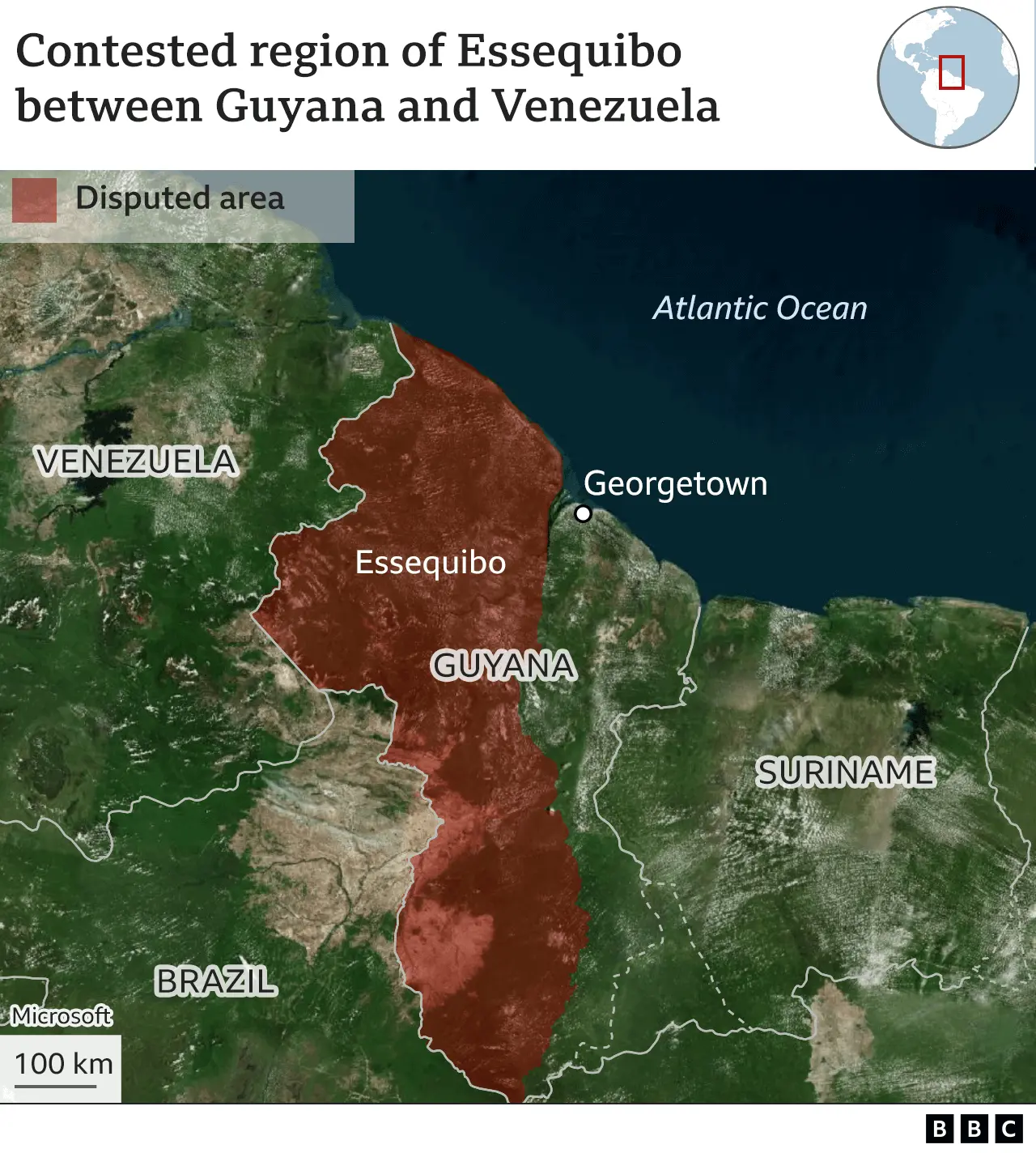
As far as almost everyone outside of Venezuela has been concerned, for the last hundred years Guyana has owned the Essequibo.
Venezuela disagrees. ( Read more [5,760 words] )
This post brought to you by the 219 readers who funded my writing it – thank you all so much! You can see who they are at my Patreon page. If you're not one of them, and would be willing to chip in so I can write more things like this, please do so there.
Please leave comments on the Comment Catcher comment, instead of the main body of the post – unless you are commenting to get a copy of the post sent to you in email through the notification system, then go ahead and comment on it directly. Thanks!
0.
The Essequibo River is the queen of rivers all!
Buddy-ta-na-na, we are somebody, oh!
The Essequibo River is the queen of rivers all!
Buddy-ta-na-na, we are somebody, oh!
Somebody, oh, Johnny! Somebody, oh!
Buddy-ta-na-na, we are somebody, oh!
– Sea shanty, presumed Guyanese
Let us appreciate that the only reason – the only reason – I know about what I am about to share with you is because of that whole music history thing of mine. It's not even my history. My main beat is 16th century dance music (± half a century). But dance music is working music, and as such I consider all the forms of work music to be its cousin, and so I have, of an occasion, wandered into the New England Folk Festival's sea-shanty sing. Many people go through life understanding the world around them through the perspective of a philosophical stance, a religious conviction, a grand explanatory theory, fitting the things they encounter into these frameworks; I do not know if I should be embarrased or not, but for me, so often it's just song cues.
So when I saw the word "Essequibo" go by in the web-equivalent of page six of the international news, I was all like, "Oh! I know that word!" recognizing a song cue when I see one. "It's a river. I wonder where it is?"
And I clicked the link.
That was twenty-one months ago.
Ever since, I have been on a different and ever-increasingly diverging timeline from the one just about everyone else is on.
In December of 2023, Nicolas Maduro, president of Venezuela, tried to kick off World War Three.
He hasn't stopped trying. He's had to take breaks to steal elections and deal with some climate catastrophe and things like that. But mostly ever since – arguably since September of 2023 – Maduro has been escalating.
You wouldn't know it from recent media coverage of what the US is doing off the coast of Venezuela. At no point has any news coverage of the US military deployment to that part of the world mentioned anything about the explosive geopolitical context there. A geopolitical context, that when it has been reported on, is referred to in terms like "a pressure cooker" and "spiraling".
The US government itself has said nothing that alludes to it in any way. The US government has its story and it's sticking to it: this is about drugs.
As you may be aware, the US government is claiming to have sunk three Venezuelan boats using the US military. The first of these sinkings was on September 1st.
To hear the media tell it, the US just up and decided to start summarily executing people on boats in the Caribbean that it feels were drug-runners on Sep 1st.
No mention is made of what happened on Aug 31st.
On August 31, the day before the first US military attack on a Venezuelan vessel, at around 14:00 local time, somebody opened fire on election officials delivering ballot and ballot boxes in the country Venezuela is threatening to invade.
And they did it from the Venezuelan side of the river that is the border between the two countries.
That country is an American ally. An extremely close American ally. An ally that is of enormous importance to the US.
And which is a thirtieth the size of Venezuela by population, and which has an army less than one twentieth as large.
You would be forgiven for not knowing that Venezuela has been threatening to and apparently also materially preparing to invade another country, because while it's a fact that gets reported in the news, it is never reported in the same news as American actions involving or mentioning Venezuela.
Venezuela, which is a close ally of Russia.
You may have heard about how twenty-one months ago, in December of 2023, there was an election in Venezuela which Maduro claimed was a landslide win for him. There was a lot of coverage in English-speaking news about that election and how it was an obvious fraud, and the candidate who won the opposition party's primary wasn't on the ballot, and so on and so forth.
You probably didn't hear that in that very same election, there was a referendum. If you did hear it reported, you might have encountered it being dismissed in the media as a kind of political stunt of Maduro's, to get people to show up to the polls or to energize his base. It couldn't possibly be (the reasoning went) that he meant it. Surely it was just political theater.
The referendum questions put, on Dec 3, 2023, to the voters of Venezuela were about whether or not they supported establishing a new Venezuelan state.
Inside the borders of the country of Guyana.
2023 Dec 4: The Guardian: "Venezuela referendum result: voters back bid to claim sovereignty over large swath of Guyana".
Why?
Eleven billion gallons of light, sweet crude: the highest quality of oil that commands the highest price.
(I can hear all of Gen X breathe, "Oh of course.")
It is under the floor of the Caribbean in an area known as the Stabroek Block.
The Stabroek Block is off the coast of an area known as the Essequibo.
It takes its name from the Essequibo River, which borders it on one side, and it constitutes approximately two-thirds of the land area of the country of Guyana.
Whoever owns the Essequibo owns the Stabroek Block and whoever owns the Stabroek owns those 11B gallons of easily-accessed, high-value oil.

Image from BBC, originally in "Essequibo: Venezuela moves to claim Guyana-controlled region", 2023 Dec 6
As far as almost everyone outside of Venezuela has been concerned, for the last hundred years Guyana has owned the Essequibo.
Venezuela disagrees. ( Read more [5,760 words] )
This post brought to you by the 219 readers who funded my writing it – thank you all so much! You can see who they are at my Patreon page. If you're not one of them, and would be willing to chip in so I can write more things like this, please do so there.
Please leave comments on the Comment Catcher comment, instead of the main body of the post – unless you are commenting to get a copy of the post sent to you in email through the notification system, then go ahead and comment on it directly. Thanks!
Hey, quick temperature check. I've been reading a lot of media I don't expect my readership to read, and now I'm a little disoriented to who knows what.
Poll #33668 Geopolitics awareness check
Open to: Registered Users, detailed results viewable to: Just the Poll Creator, participants: 123
What country do you currently live in?
What is your age?
12-19
2 (1.6%)
20-29
5 (4.1%)
30-39
19 (15.6%)
40-49
33 (27.0%)
50-59
40 (32.8%)
60-69
15 (12.3%)
70-79
8 (6.6%)
80+
0 (0.0%)
To the best of your knowledge, if the US were to go to war tomorrow, against what country would it most likely be?


