
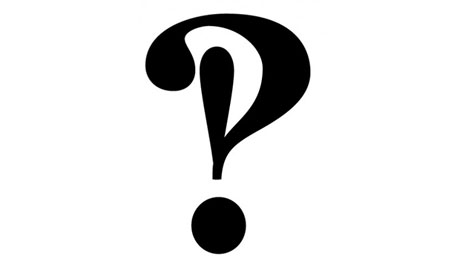
 Tell me — am I the only writer who was unaware of the interrobang? That’s it over there on the right. It is a nonstandard punctuation mark (something else I didn’t know existed) that is used to mark an exclamatory interrogative. You know like “What the heck,” only my seventeen-year-old did not say heck.
It was created in 1962 by Martin Speckter, editor the magazine Type Talks. He dreamed it up for advertising copywriters who needed it for those rhetorical questions they like to write into ads (“What?! Whiter than White?!”). It is to be used in those instances when neither an exclamation point nor a question mark alone convey the full meaning.
Maybe it’s just because I’m a word nerd but I think this is pretty cool. I feel like I’m teetering on the edge of a Frindle moment. In Frindle by Andrew Clements, fifth grader Nick Allen decides to change the English language by getting everyone in his class to call an ink pen a Frindle. His teacher thinks it is nonsense but soon it has spread beyond his class and other people in their town are asking for frindle when they need to sign their name. I have to admit, this is my absolute favorite Clement book.
Now I can only participate in the interrobang revolution if I can figure out how to type one. Fortunately, I’m a researcher so I found out how. I use a Windows driven PC so I hold down ALT and type 8253 and up pops this — ‽.
Now, if you’ll excuse me, I’m going to go interrobang some unsuspecting soul…
–SueBE

 I have to admit — I just don’t understand how some writers view editors. Some see them as mysterious powers on high. Mmm. No. They’re just people although some of them amaze me with their talent. (I can be irritatingly egalitarian, sorry.)
 “I have no idea what your character is feeling?” “Give me more of your character’s thoughts.”
 I know people who won’t bring a manuscript to critique group until it is polished. Me? I’ll bring a much earlier draft. After all, I’m less interested in line edits than I am in knowing if the plot works.
 My new project was humming merrily along as, each evening, I added two new pages. They’d fled, evading capture, and headed off up the mountain. Then, as they approached the area where they would make camp, the story ground to a halt.
 Periodically I mention a post that I’ve written for
  Hand me a book and tell me that it is a mystery set in a major art museum and I’m going to expect two things.
 Writers should listen to audiobooks. It’s one of those things that I firmly believe will help you learn about pacing and the poetry of language. If you want more detail on this, take a look at my post on
  One Writer's Journey
