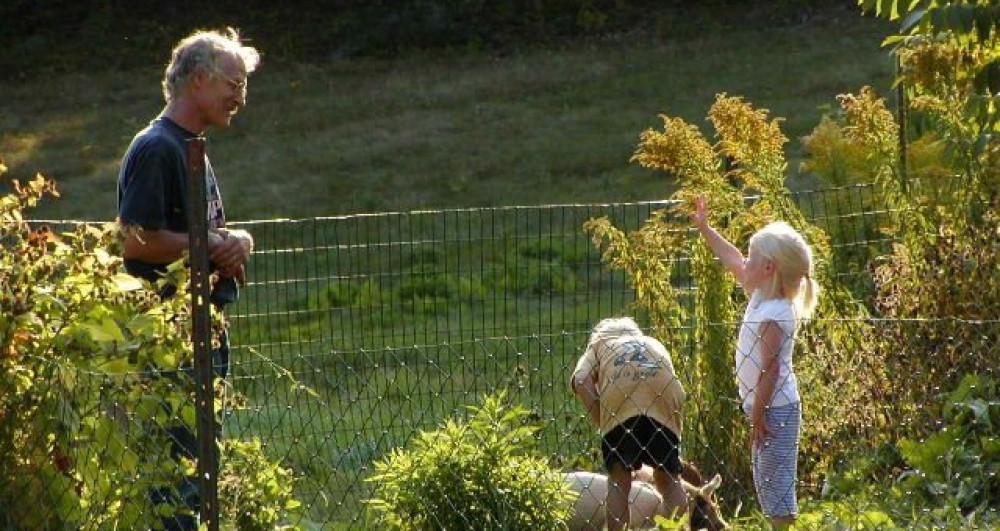
We’ve suffered drought from summer into the fall, but we’ve been spared forest fires, so it only amounts to a whole lot of beautiful weather. It’s hard to complain about sunshine, especially if you have nothing to water. I did get a few things into the garden before I was hospitalized, but a friendly doe brought her twin fawns by to browse everything down to ground level, so I was spared the worry of watering. My daughter-in-law was meanwhile kept very busy with watering her section of the garden, which she had devoted to flowers. She had a plan to sell them. I was skeptical but kept my lip buttoned. Then a little stand appeared at the foot of our drive.

I remained skeptical, as she could not sit by her flowers and hawk her wares, because she had four small children to attend to. Therefore she just put up a sign by the bouquets stating they cost $15.00 each, with a box to put money into. Also she placed the stand where I was in the habit of backing up my vehicles for thirty-five years, and it was only a matter of time before I’d be careless and people would question whether I was getting too old to drive, as there would be a loud “CLUNK” and the poor woman’s flowers would be strewn on the street. But she was rather sweet about my eventual unhelpfulness, and about gathering up the mess and rearranging the bouquets, and also enthusiastic about the fact people had stopped and put money into her box, and she had swiftly paid for the packets of seeds she bought last spring.
And she was just getting started. Car after car pulled over to pick up a bouquet. I think she sold over thirty bouquets, and I told her it was the first time the farm showed any profit (besides Childcare) in around ten years. She was helped by the fact the weather stayed mild and the frosts were late, but the inevitable finally happened, and the happy colors in the garden were laid low and blackened by an abrupt blast from Canada. It promptly warmed up again, but once that first freeze hits, it’s all over for many blooms.
The maples of New England then go through an extraordinary process, not yet fully understood by naturalists, wherein they transform the chlorophyll in their leaves to other enzymes and chemicals and frantically produce sugar. This removes the green from their leaves and turns them red, orange and yellow. The leaves are still hard at work as they take on these colors, as is shown by the fact they are not blown from the trees even in gales and then, when their work is done, they drop from the trees even on a windless morning. Therefore I think to myself, as the landscape of New England becomes radiant with a beauty in the autumn, and people (called “leaf-peepers” by locals) travel from far and wide to see the radiance, that the trees are “making sugar”. Just as farmers harvest, reaping what they sow, trees are harvesting their crop of sugar.
There is a fair amount of mystery about the storage of the sugar. The trees apparently don’t draw it all down to the roots and then pump it back up in the spring, or, if they do, they employ some sort of engineering we don’t understand and therefore deem impossible. More likely is the possibility the sugar is extracted from the sap and stored in twigs and in sapwood, up where it will be needed in the spring, and the tree does not pump much water down at all. When water starts to rise in the usual manner in the spring the sugar is at hand to give maples (and some birches) a head-start over all other trees.
I like this idea as a symbol, because otherwise autumn can be a very depressing season. The growing darkness, the apparent cessation of growth, and even of life, is one reason Halloween has so many skulls and bones and creepy things. As I approach the end of my own life I don’t much like the idea of skulls, and prefer the idea of the creation of sugar for spring.
However this sugar-coating of the onset of winter creates a conflict with a grumpy and pragmatic side of me. In terms of the fable of the grasshopper and the ant, I, as an artist, have too often been the grasshopper, and have faced fall with no harvest other than songs that didn’t sell. I have battled through many winters flat broke, learning the hard way to work like the ants did back in the summer, but working in the cold as the ants happily warmed their toes by fires and consumed the food they stored. Even now, in my decrepitude, I get no pension and work in my feeble way, as the ants have second homes in Florida, and in some cases more than one pension. It seems wiser to be an ant than a grasshopper. Yet…the sugar-coating persists.
We should quake in our boots, for we've no crops.
We don't farm, instead eye-straining indoors
At screens. We've not strung onions at tops
Of our hovels, nor stored roots under our floors.
We've gathered nothing, as days grow shorter
And winds grow cold. We expect to drive warm cars
To stocked stores, but dread a news reporter
Speaking of empty shelves. Reality jars
Our common sense, for through windows we see
A landscape rejoicing. The crimson leaves
Announce maples make sugar for spring. Sweet glee
Defies dark with radiance. Darkness deceives
For it knows only want, ignoring the gold
Which shines in the light true harvesters hold.
One person who was likely aware a pension would do him no good was the poet John Keats. Though he likely hoped for longevity, he likely also knew he was doomed to die young, for he received training as a doctor and surgeon. He cared for his mother as she died of TB, and then his younger brother as he died of the same, and John also knew he had a persistent cough. At one point, coughing a spot of blood into his handkerchief, he apparently stated, “I know this blood. It is arterial blood. This spot is my death warrant.” And indeed he did die of TB before he was 26, and yet his poetry is in many ways a defiance of death. How so? Well, in many ways that is the mystery.
My best guess is that poets get a taste of the good life, when young, and then see it ruined by evil. A happy home gets smashed by death or divorce, and a joyous child is jolted into a posture of longing for what was lost. “You’ve got to pay the dues if you want to sing the blues.”
In the case of John Keats his father ran a prosperous carriage house on a late 1700’s highway, a stable and inn and also tavern, busy with comings and goings and chatter and laughter. Call it a Hilton Hotel of its era. But then the man died in some sort of accident, and the mother had to attempt to run the show alone, although her health was declining, and then she died. So John saw a happy situation become an unhappy one, but in some way he never gave up on the happiness he had lost. Poetry was his defiance. Beauty was his guide.
On September 13, 1819 John sat down and wrote “To Autumn”, which utterly amazes me. First, the rhyme scheme is difficult, but you hardly notice it as it makes the music more musical. (The poem deserves to be read aloud.) Second, his life was full of hardship, but he still whipped the three amazing stanzas off on a single afternoon. Be amazed. Third, it is the best appreciation I’ve seen of how there is a beauty in Autumn which overwhelms the doom and dread of an oncoming winter.
I would leave a link to the poem, but know some are too busy to chase links, and therefore will include the entire poem in this post. I urge people to read it aloud, softly in a secret corner if need be, and also to understand that, due to the petty politics of that time, the poetry publishers and their elite circle had decided John Keats was not worth reading.
TO AUTUMN

Season of mists and mellow fruitfulness,
   Close bosom-friend of the maturing sun;
Conspiring with him how to load and bless
   With fruit the vines that round the thatch-eves run;
To bend with apples the moss'd cottage-trees,
   And fill all fruit with ripeness to the core;
      To swell the gourd, and plump the hazel shells
   With a sweet kernel; to set budding more,
And still more, later flowers for the bees,
Until they think warm days will never cease,
      For summer has o'er-brimm'd their clammy cells.

Who hath not seen thee oft amid thy store?
   Sometimes whoever seeks abroad may find
Thee sitting careless on a granary floor,
   Thy hair soft-lifted by the winnowing wind;
Or on a half-reap'd furrow sound asleep,
   Drows'd with the fume of poppies, while thy hook
      Spares the next swath and all its twined flowers:
And sometimes like a gleaner thou dost keep
   Steady thy laden head across a brook;
   Or by a cyder-press, with patient look,
      Thou watchest the last oozings hours by hours.

Where are the songs of spring? Ay, Where are they?
   Think not of them, thou hast thy music too,—
While barred clouds bloom the soft-dying day,
   And touch the stubble-plains with rosy hue;
Then in a wailful choir the small gnats mourn
   Among the river sallows, borne aloft
      Or sinking as the light wind lives or dies;
And full-grown lambs loud bleat from hilly bourn;
   Hedge-crickets sing; and now with treble soft
   The red-breast whistles from a garden-croft;
      And gathering swallows twitter in the skies.
The zen-like peace of Keat’s transcendental state of mind is attached to rural farms, yet detached from my pragmatic side, which can make a miser out of counting cabbages and a pension from a heap of potatoes. I’m all too aware you can’t take your pension with you when you depart this veil of tears, and remember the allegory Jesus told, involving the farmer who planned to build bigger barns to store up his bountiful harvest so his soul could eat and be merry, but that very night his soul was required of him. It is not the heaps of produce that make autumn so beautiful.
The darkening sneaks up on the summer
Like a lion on a doe born too dreamy
To live long, who sniffs blooms though bees whir
Frantic to gather. Even bugs can foresee
The dark growing cold. The monarchs flitter south
Without maps.  But the dreamy doe lazes
And the lion halts, with opening mouth,
Puzzled by the way nothing fazes
The ludicrous doe. Soon a ludicrous
Lion has forgotten to eat, bemused
And perhaps enchanted. I'll not discuss
What just happened. I'm too confused.
The curtain of darkness descends on an act
With a rare gentleness and softest impact.
C
 Sunrise's Swansong
