Key takeaways
- A skills gap analysis is a process to identify discrepancies between the skills of your current workforce and the skills your business needs.
- To conduct a skills gap analysis, you must determine the scope and stakeholders, choose a rating system, identify your required skills, assess your employees, and analyze the results.
- Performance, skill, and learning management systems can automate skills gap analyses so you can fill talent deficiencies faster.
- Fred Winchar, CEO and co-founder of Max Cash
- Sakhavat Ismayilov, founder of Planly
- Dec. 16, 2025: Hanna Sillo updated this article to add a clearer introduction, refreshed page elements, simplify longer sections for easier reading, and incorporate new data points. She also added nuance in the steps and expanded the FAQ section.
A skills gap analysis is a structured process for identifying the difference between the skills your workforce currently has and the ones your organization needs to meet its business goals. Companies use skills gap analyses to prioritize upskilling, reskilling, and hiring decisions so they can adapt faster, reduce burnout, and remain competitive as roles and technologies change.
How to conduct a skills gap analysis in 6 steps
A skills gap analysis reveals talent deficiencies in your company that lead to stagnation, a lack of innovation, and burnout. Based on the analysis results, you can take appropriate steps to remain competitive and adapt to the changing state of work.
The steps below outline the skills analysis process so you can optimize your organization’s talent needs. And if you’re curious about software that can automate the process for you, browse our Performance Management Software Guide for a full list of options.
1. Determine the skills gap scope and stakeholders
First, clearly define what you are trying to accomplish with a skills gap analysis. “You can’t determine the key skills until you understand the company goals and values,” explains Fred Winchar, CEO and co-founder of Max Cash.
The scope of a skills gap analysis typically falls into one of two categories:
- Individual: Compares an employee’s current skills to role requirements to support professional development.
- Group: Evaluates skill needs across a team, department, or business unit to support broader organizational goals.
Your chosen scope determines who should be involved. Group analyses usually require input from department leaders, managers, and L&D teams, while individual analyses are often handled by the employee and their manager, with HR support as needed.
What can skill gap analyses help you accomplish?
Effective skills gap analyses can help you proactively address changing workplace norms in your industry and support continued innovation. For example, you can use a skills gap analysis to:
- Expand into new markets. Each market is unique, and a skills gap analysis can pinpoint where you need to grow your talent to meet the demands of your new customer base.
- Identify talent for specific projects. Upcoming projects demanding complex talent needs could use a skills gap analysis to pinpoint the best players with the skills to ensure success.
- Prepare for the future. Based on the trends in your industry, you can mark the skills your workforce needs to remain competitive, compare them to your current talent, and start training or hiring appropriately.
2. Choose a rating system
Skills gaps are typically quantitative—not qualitative—scores. Because quantitative measures are easier to translate into data visualization tools like heatmaps, nine-box matrices, and spider charts, you can quickly draw insights on your employees’ competencies.
There are several rating systems you can use, but the best ones are consistent and reduce the risk of rater bias. Below are a few examples:
- Key performance indicators (KPIs): These are quantifiable ways to measure progress toward an objective over time, such as onboarding three new clients by the end of the quarter.
- Skills assessment: These include pre-employment or post-training tests to measure competency in various hard or soft skills.
- Certifications: These are industry or educational certificates that validate your skills, such as a PHR or SPHR for human resources.
- Performance reviews: Any quantitative rating system used during performance reviews, 360-degree feedback, or self-evaluations, such as BARs.
- Custom: These are numerical rating scales based on your criteria, such as a 1–5 scale, with one meaning poor in a skill and five meaning excellent in a skill.
Depending on the skill, the rating scale you choose may be different. However, using the same rating scale for the skill creates consistency and allows you to view skill progression over time.
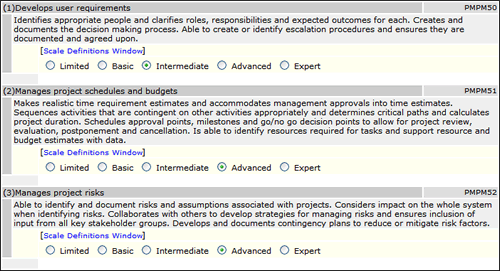
Learning management tools offer rating systems or allow you to customize your own. Avilar, for example, uses a 1–5 rating system to measure skills, but you can change the scale to fit your requirements.
3. Identify required skills and levels
Have your L&D teams collaborate with managers or department heads to determine critical competencies for each role.
Critical vs. non-critical skills
Critical skills are those an employee must have to satisfactorily complete their role or task. Non-critical skills, on the other hand, aren’t necessary to satisfy the job’s minimum expectations, but they may help the employee be more productive or efficient.
In addition, consider what skills your workforce currently needs, plus what skills will benefit the company in five to ten years. Include job descriptions, performance reviews, industry trends, regulatory changes, company values, or cross-departmental focus groups in your research.
Alternatively, you can use some of the questions below to brainstorm:
- What goals will your company achieve in the next 10 years?
- What do your competitors do well that you want to emulate?
- What skills could help employees perform their jobs more efficiently?
- What current or future job roles do we need to fill?
- Are there any industry innovations or technologies our workforce should become familiar with?
- Are there any job roles that will become obsolete because of automation?
Collect the critical competencies and mark their desired level and importance for your team in a spreadsheet. At the beginning, it can be a simple spreadsheet like this example:

Where organizations often stumble
In practice, most organizations struggle most at this stage. Not because they lack data, but because they try to evaluate too many skills at once. Focusing only on role-critical and future-relevant skills makes the analysis far more actionable.
4. Assess employees’ current skills
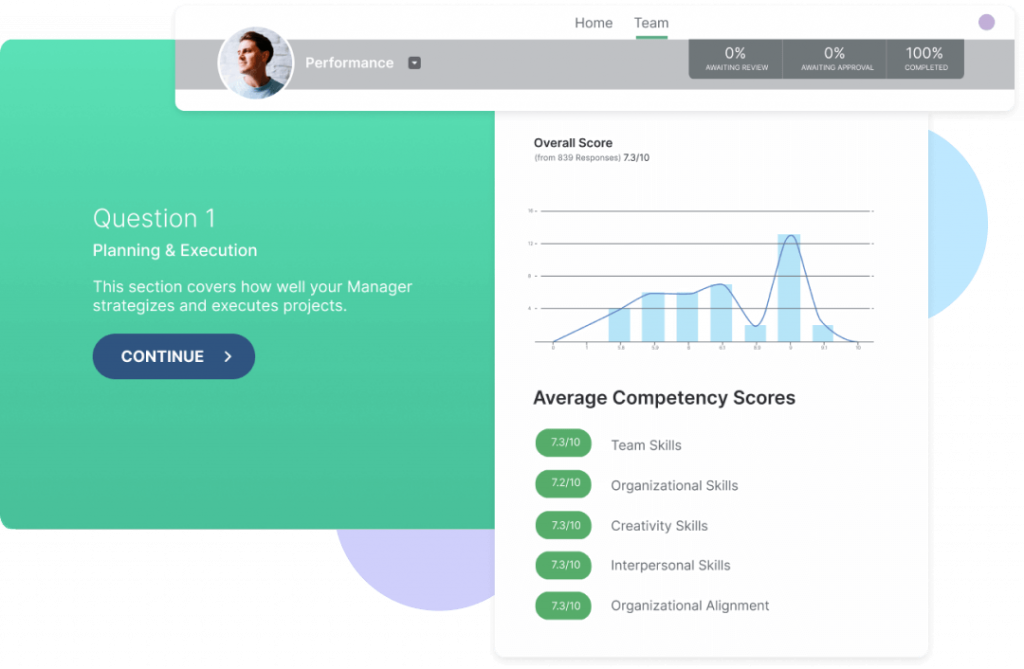
There are many tools that can help you rate and gather your employees’ current skill levels; examples include performance management software, learning and skills management software, surveying tools, and interviews.
Performance management software can track employee progress toward individual, team, or company goals. It also provides a historical look at employee performance from self-evaluations, performance reviews, 360-degree feedback cycles, and one-on-one manager sessions.
PerformYard, for instance, allows you to customize questions and rating frameworks to build competency tracking into your performance review cycles.
Learning management software (LMS) helps you create, distribute, and track employee training and development courses. Skills assessment software, meanwhile, is focused on evaluating whether and to what extent employees can perform a particular skill, often through graded standardized tests or projects.
ProProfs, for example, allows you to develop assessments based on more than 100,000 pre-made questions. You can then compare your employees’ scores against minimum scoring requirements for fairer evaluations of your workforce’s abilities.
Check out how to make quizzes using ProProfs below:
Skills management platforms typically come pre-built with rating scales, competency libraries, and role levels. They also facilitate skills assessments through job descriptions, surveys, and training courses.
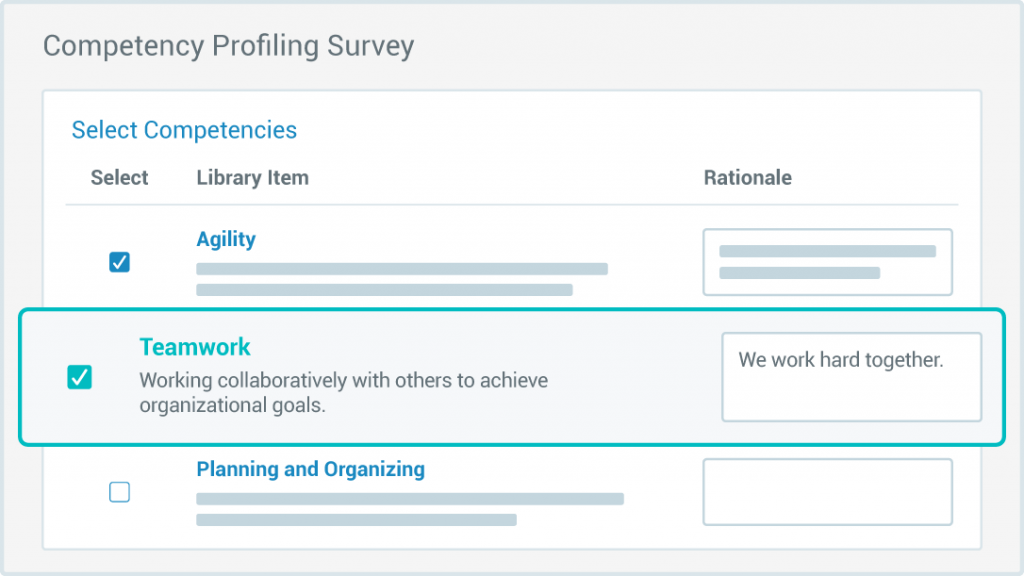
HRSG, for example, provides a library of over 350 competencies in technical and behavioral areas for over 1,000 job titles. You can use its library to send competency profile surveys and quickly gather employee skill ratings.
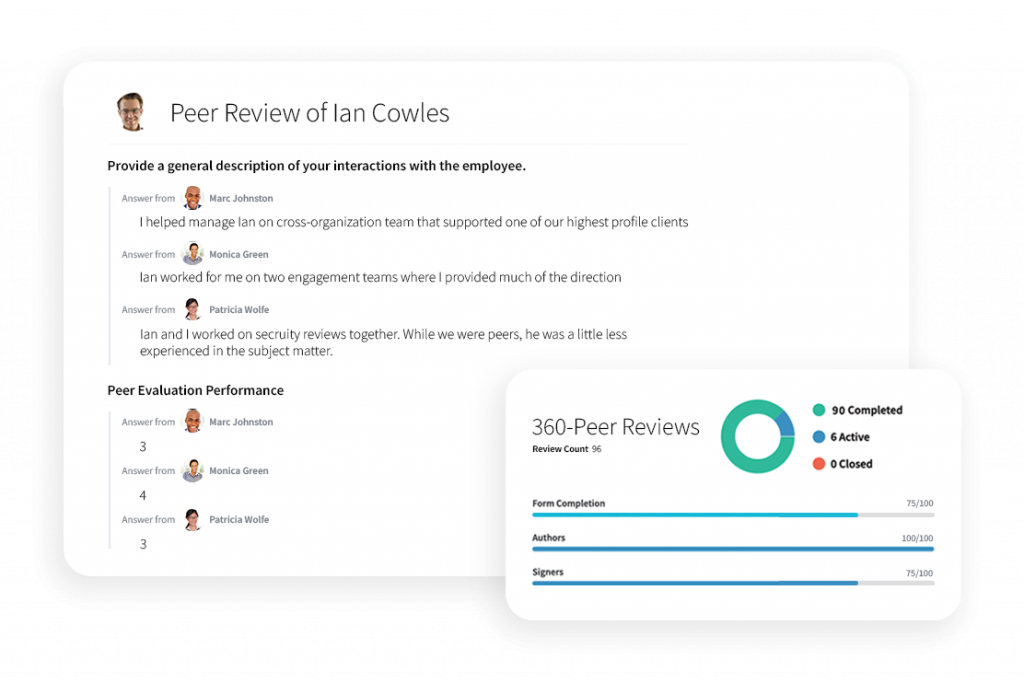
If your company already has an employee engagement or communication platform that includes surveys, you can leverage these tools for collecting and measuring your employees’ skill levels. SurveySparrow, for instance, offers a module dedicated to gathering 360-degree feedback on employee skills through in-depth questionnaires sent to appropriate stakeholders.
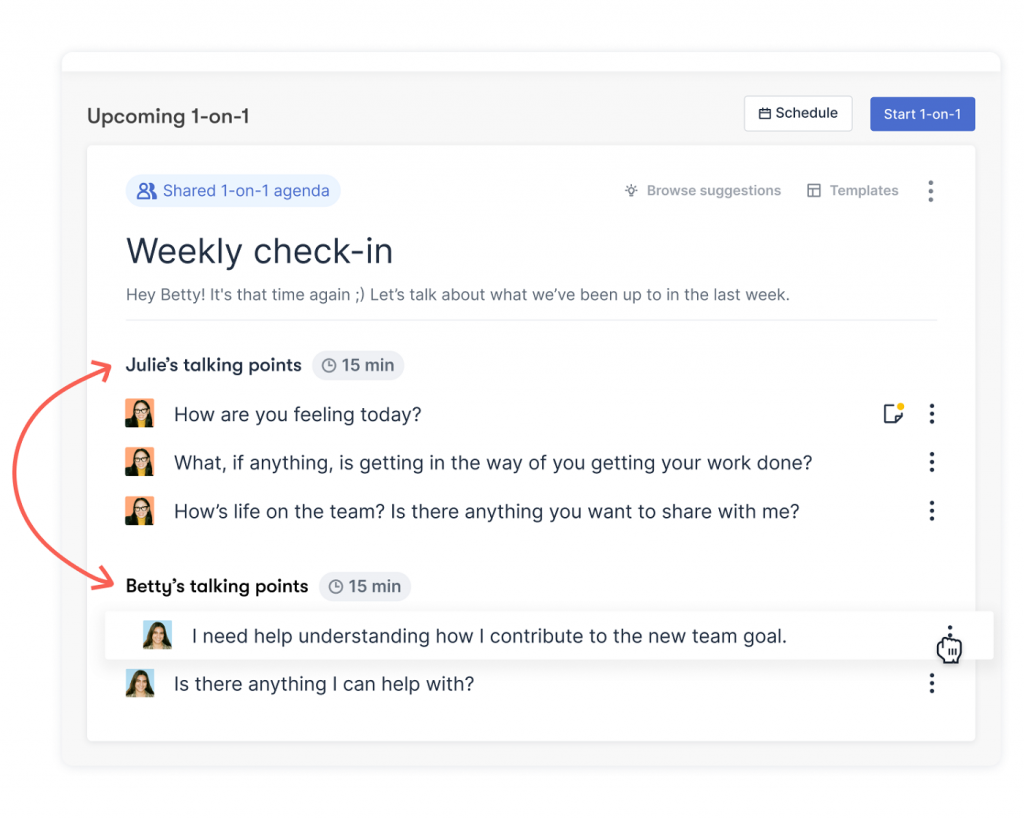
One-on-one interviews with employees can open up a dialogue about which skills they feel confident in, compared to the ones they need more training and support with. Together with their manager, they can reveal the skills they need every day and the skills they hope to develop.
You can manually set up these meetings using your calendar platform of choice. Alternatively, one-on-one meeting software, like Workleap, allows you to create agenda items for a more productive discussion and even keeps track of your conversations.
After you gather your employees’ skills and ratings, enter them into your skills gap spreadsheet. Here, you will calculate the difference between desired and current skill levels to reveal your gaps.

Note: Self-assessments alone often over- or under-estimate proficiency, which is why combining manager input, peer feedback, or objective assessments leads to more reliable results.
5. Analyze the data and plan next steps
Order your data by priority to see if there are any gaps in your essential skills. You can also map the data into useful graphs, like spider charts, to make sense of your findings faster than by sorting or filtering the spreadsheet.
Depending on what the data uncovers, you can train or hire to fill in the gaps, acting first on the gaps associated with the most critical skills. Whatever you decide, you must also communicate with and involve all relevant stakeholders.
Based on the scope of your skills gap analysis, you can begin upskilling or reskilling your existing talent in a few ways:
- Help the employee participate in certification courses and attend industry events with financial and logistical support.
- Craft performance improvement plans (PIPs) or professional development plans (PDPs) to address employees’ weaknesses and help them grow in their career paths.
- Plan training workshops and refresher courses.
- Create eLearning modules and assign them to relevant departments or employees.
- Offer mentoring or coaching programs.
If you are spending too much time on training initiatives that decrease productivity, you may need to revise your recruitment strategies and start hiring for these skills instead. Your skills gap analysis makes it easier to find and assess applicants in the skills areas you lack.
- Hire contingent workers, like consultants, to temporarily fill critical skills or roles while you train or find permanent employees.
- Leverage your applicant tracking system (ATS) or candidate relationship management (CRM) platforms to find silver medalists and engage passive candidates with your missing skill sets.
- Use pre-employment testing software during recruitment to evaluate candidate competencies before hiring.
- Update job descriptions or screening questions to target candidates with the skills your workforce lacks.
6. Repeat as needed
Now that you have performed your first skills gap analysis, you also have version one of your company’s or team’s skills inventory. Your skills inventory will act as a repository of your employees’ skills, experiences, and education. Having this available is a great way to make strategic decisions on company initiatives like succession planning or project skill mapping.
A consistent skills gap analysis cadence, such as every six or 12 months, ensures your skills inventory stays current when employees start, transfer, or leave the company. It can also help you capture additional information, such as education or new skills relevant to your industry, so that your company adapts to the changing future of work.
Free skills gap analysis template
Download our free skills gap analysis spreadsheet to manually track your company’s skills.
Skills gap analysis FAQ
Start upskilling your workforce to close skill gaps
Analyzing your company’s skills gaps is only the first step; once you have a clear direction, your next priority is determining how to fill them. Though 2025 data from SHRM indicates the average cost-per-hire for non-executive roles has decreased to around $1,200 from $1,244 in 2022, you could still save money by upskilling or reskilling your current talent instead of hiring someone new.
Sakhavat Ismayilov, founder of Planly, explains how performing a skills gap analysis helped his organization develop a training program tailored to the specific needs of their employees. After hosting the training through online and in-person courses, Ismayilov noticed significant improvements in employee performance, business productivity, customer retention, and conversion rates.
“Thanks to the skills gap analysis, the number of active users and monthly subscriptions for Planly [rose] by 38.7% within the next eight months,” says Ismayilov. To him, the skills gap analysis allowed his company to continue to innovate and deliver a quality product.
Even a small company can use an LMS to create consistency across the organization, prevent knowledge loss when employees leave, and train employees to fill necessary skill gaps quickly.
Ready to find an LMS that can help you analyze your business’s skills gaps? Watch our video overview of our favorite solutions to get started, then dig into the details in our Learning Management System Software Guide.
Featured partnersFeatured LMS partners