Tag Archives: Ted Mitchell

Charter School Flimflam Documented

31 Dec

By Thomas Ultican 12/31/2025

Charter schooling has a 33-year history. In 1992, the first one opened in Minnesota and it was exactly the kind of school American Federation of Teachers President Al Shankar envisioned when he promoted the idea. It was small, teacher-run within a public district that tested innovative strategies to reach hard-to-teach kids. Almost immediately, that model was highjacked by profiteers. The Network for Public Education (NPE) has published two parts of their planned three-part series. Charter School Reckoning: Declinecame in July. It details the harm charter schools are doing with their legacy of waste, fraud and abuse.

The late Al Shankar’s wife, Edith, claimed,

“Al became increasingly critical of charter schools as they moved further from their original intent. He warned that without well-crafted legislation and public oversight, business interests would hijack the charter school concept, ‘whose real aim is to smash public schools.’”

The reality is that nearly all attempts to create “well-crafted legislation and public oversight” has been thwarted by the industry. More than 50 national and state-based trade associations have lobbied aggressively against reform and oversight. The latest tax filings from 2023 show that the National Alliance for Public Charter Schools (NAPCS) reported over $26.5 million in income and they have $28 million in assets. The California Charter Schools Association (CCSA) reported nearly $13 million in new revenue and more the $17 million in net assets. These charter school advocates are powerful lobbyists working for unlimited charter growth, while fending off oversight and protecting existing charter schools. (Decline Page 2)

Founded in 2003 by Caprice Young and Steve Poizner, the older of the above-mentioned organizations is CCSA. Poizner is a wealthy technology guy from San Jose who as a Republican along with Arnold Schwartzenager was one of the last two Republicans to win statewide election in California. Caprice Young grew up in a foster home in Los Angeles but made her way to Yale. She worked 3 years for LA’s billionaire mayor, Richard Riordan and followed that with serving on the Los Angeles Unified School District board. Since leaving CCSA in 2008 she has been involved with several questionable charter school organization including the Gulan movement’s Magnolia schools.

The foundational years for both CCSA and NAPCS have a surprising number of billionaires and political leaders on their boards. At CCSA the early boards included John Walton (Walmart heir) and later his niece Carrie Penner plus Reed Hastings founder of Netflix. NAPCS, formed in 2004, had on its founding boards Caprice Young (Co-Founder CCSA), Fernando Zuleta (Charter school magnate), Joel Klien (Bloomberg’s education leader), Ted Michelle (New Schools Venture Fund), Whitney Tilson (Co-founder TFA and Democrats for Education Reform) and Margarete Spellings (George W. Bush’s Secretary of Education).

Decline

Released in July, the first NPE report subtitled “Decline” states, “A program originally intended to foster innovation became a vehicle for waste, mismanagement, and fraud.” As a highlight, the paper reports that of the 50 charter schools that have closed in first half of 2025, almost half of them received federal charter school funding as start-ups. That funding totals to $102 million. (Decline Pages 5 and 6)

The history of the federal charter schools’ program (CSP) is a history of failure. Beginning in 1995, CSP’s original funding was $5.4 million for creation of new charter schools. By 2011, CSP funding had rocketed to $226 million and the grift was on.  (Decline Page 6)

Audits confirm that Between 2006 and 2016, 11% of CSP-funded schools never opened. In 2022, the Department of Education’s Office of the Inspector General found that 51% of schools promised by grantees between 2013 and 2016 never opened or expanded. (Decline Page 7)

As the federal government has increased its priming of the charter school pump, the charter growth rate has declined for both new school openings and enrollment. Between 2020 and 2023 charter school enrollment only increased by 0.1%, from 7.5% to 7.6% of total school enrollment. According to the National Center for Education Statistics (NCES) data, the number of charter schools increased by only 11 schools between the 2022-23 and 2023-24 school years. (Decline Page 8)

Even as charter schools are losing their appeal, Secretary of Education Linda McMahon, in conformity to Trump’s anti-public education agenda, pushed the CSP funding to a half billion dollars. It appears lying comes easy to billionaires. In defending this indefensible action, McMahon claimed, “We’ve got about a million students on charter school waiting lists.”

This is a very old lie. In a 2014 policy brief titled Wait, Wait. Don’t Mislead Me scholars Kevin Welner and Gary Miron of the National Education Policy Center identified at least nine reasons to be skeptical of such numbers. Among them: the absence of standardized data, duplicate counting, and self-reported, unaudited figures from charter operators themselves. Texas — one of the few states with detailed charter enrollment data — reported in 2025 that its charter schools had 120,826 vacant seats. (Decline Page 10)

In 2023, NPE produced Doomed to Fail: An Analysis of Charter Closures from 1998–2022, which found that 47% of charter school closures were due to insufficient enrollment. Of the 50 charter schools that announced closures in the first half of this year, 27 (54%) cited low enrollment as the primary reason. (Decline Page 10)

Disillusionment

The second part of the three-part series, Charter School Reckoning: Disillusionmentwas released in December.

For-profit charter school management corporation, Leona Group, founded by William Coats, opened in Michigan in 1996 then rapidly expanded to Arizona where most of its 28 schools are today. Jon Hage founded Charter Schools USA soon after Florida passed its charter law, creating a related real estate company, Red Apple Development. Red Apple builds charter schools and collects the rents. The nation’s largest for-profit management company, Academica, opened its first school inside a real estate development owned by the Zulueta brothers, its founders and owners. (Disillusionment Page 4)

The makeup of boards for some of America’s largest charter school companies include many billionaires who would never consider sending their children to one of these schools. For example, KIPP board members include Emma Bloomberg, daughter of billionaire Michael Bloomberg; Reed Hastings, the billionaire founder of Netflix; and Carrie Walton Penner, the billionaire heiress to the Walmart fortune. (Disillusionment Page 5)

When scandals came to light at the Texas Idea charter chain, CEO Tom Torkelson was fired but still rewarded with a $900,000 buyout. His successor, Joann Gama, was soon ousted as well and she walked away with a nearly half a million dollar golden parachute. (Disillusionment Page 6)

In 2023, Eva Moskowitz, who runs New York City’s Success Academy schools, took home $1,018,977 in compensation. With 15,500 students under her management, Moskowitz took in more than twice that of the Chancellor of the city’s public schools with almost a million students. (Disillusionment Page 6)

The Center for Media and Democracy (CMD) reported this year that the nation’s largest charter chain, KIPP, disclosed over $52 million in unexplained spending in its 2023 IRS filings. The disclosure was buried in the vague category of “all other expenses.” (Disillusionment Page 6)

This Disillusionment paper asserts, “Corruption and mismanagement in charter schools have cost taxpayers nearly one billion dollars in the past few years alone.” By collecting data from news reports between September 2023 and September 2025, the National Center for Charter School Accountability found $858 million that disappeared due to fraud, theft, profiteering or incompetence. (Disillusionment Page 8)

A related-party transaction is a financial transaction between either individuals or corporations with a preexisting business relationship. Public school boards and managements are strictly prohibited from entering into these transactions and they are monitored. In the charter industries these kinds of business practices are common place and mostly legal. (Disillusionment Page 10)

To cite one example, Charter Schools USA (CSUSA) has a complex web of related nonprofit and for-profit entities, including its affiliated real estate arm. It employs Red Apple Development to manage schools and extract profits. By controlling both school operations and property leases, CSUSA sets lease terms, charges inflated rents, and structures agreements that benefit Red Apple and CSUSA. These practices should be illegal but the charter school lobby has so far fended off most common-sense legal oversight. (Disillusionment Page 11)

Final Words

The conclusion of NPE’s three-part series coming in 2026 is called “Charter School Reckoning: Cost.” I am guessing the costs exposed will include monetary, emotional and educational costs.

My personal opinion is that there are some good charter schools out there but their governance should include democratic control by communities. All charter schools within a public-school district’s boundaries should be governed by that elected school district board. Profiteering, theft of public tax dollars, huge management salaries and self-dealing is costing too much for this failed education experiment to continue under its present structure.
Organized to Disrupt

10 Jun Image

By Thomas Ultican 6/10/2020

The New Schools Venture Fund (NSVF) is the Swiss army knife of public school privatization. It promotes education technology development, bankrolls charter school creation, develops charter management organizations and sponsors school leadership training groups. Since its founding in 1998, a small group of people with extraordinary wealth have been munificent in their support. NSVF is a significant asset in the billionaire funded drive to end democratically run public schools and replace them with privatized corporate structures.

1990’s Silicon Valley was a Happening Place

Mark Andreessen had just co-written the world’s first web-browser, Mosaic, before he came to town from the University of Illinois to co-found Netscape. John Doerr left Intel in 1980 to join the venture capital firm Kleiner Perkins where his reputation for picking winners became legendary. His wins include Amazon, AOL, Compaq, Electronic Arts, Google, Netscape and Twitter. Internet search engines were in their infancy when in 1999 Doerr convinced his partners to put $12.5 million into Google. Five years later that investment turned into billions.

Like elsewhere in America, every little strip mall in San Jose, California had a Blockbuster video rental store. In 1997, Reed Hastings and Netflix co-founder Mark Reynolds came up with a disruptive idea that put Blockbuster out of business. For a monthly fee, they offered DVD’s by mail with no late charges. Blockbuster did not adapt fast enough and went bankrupt.

In the Valley, everyone was aware that their business could be just one new technology innovation away from being the next Blockbuster.

“DoWopDon” Shalvey was the superintendent of schools in San Carlos, California a bedroom community about a third of the way up the peninsula between San Jose and San Francisco. When California passed its 1992 charter school legislation, Shalvey’s application for a charter turned into California’s first charter school. It officially opened in August 1994.

Apparently, Don Shalvey was an amateur DJ and very into music. His twitter handle is @dooWopDon.

Shalvey joined with Reed Hastings in writing a statewide initiative for the 1998 ballot that lifted the cap on charter schools and eased restrictions on starting one. At that time, Hastings was made president of Technology Network, a bipartisan lobbying group formed by Silicon Valley CEOs. With their support, the initiative quickly amassed more than a million signatures. Opposition from the teachers union ended as they were also fighting against other education proposals coming from Governor Pete Wilson’s office.

A deal was struck making the initiative unnecessary. Legislative leaders passed a bill containing the initiative’s key ingredients and union leader withheld their objections. The new bill green-lighted an unlimited number of charter schools and just as importantly the bill authorized a single board to oversee multiple charter schools. It was the birth of charter management organizations and a massive acceleration in new charter school development.

When Pete Wilson signed the new bill into law in May 1998, Shalvey and Hastings had $403,000 left in their initiative campaign fund. They decided to shift the money into a non-profit and founded what became the Aspire charter school network.

Meanwhile on the other side of the continent, Ann Smith graduated with a degree in political science and psychology from Columbia University in 1989 and started working for Wendy Kopp and the Teach For America (TFA) founding team. In 1993, she moved to the Silicon Valley area and co-founded the Bay Area Youth Consortium – AmeriCorps. In 1996, she left AmeriCorps to pursue a Masters in Business Administration at Stanford University.

Smith was co-chair of the Stanford business school’s entrepreneur club and she wanted to get Amazon founder Jeff Bezos as a speaker for the club. She asked her friend John Doerr to help and he agreed on one condition. In an education session at Al Gore’s house, the name NewSchools had been created. Doerr wanted her to come up with a use for the name.

Bezos spoke at the club and Smith worked on her assignment. She wrote a two page paper outlining the NewSchools Venture Fund. She had been inspired by what Don Shalvey and Reed Hastings had accomplished and thought to herself, “Why couldn’t entrepreneurial philanthropists come together to create networks of entrepreneurial education organizations?” Smith labeled the paper “Creating CMOs — scaling up with quality — with the help of venture-capital-style philanthropic investing.”

The history at the NSVF web-site says,

“NewSchools Venture Fund was created in 1998 by social entrepreneur Kim Smith and venture capitalists John Doerr and Brook Byers.” (Byers is a colleague of Doerr’s from Kleiner Perkins)

“We were among the first and largest investors in public charter schools and the first to identify and support multisite charter management organizations, which launch and operate integrated networks of public charter schools.”

“NewSchools’ work to support digital learning tools began at our inception in 1998.”

Philanthropy Magazine notes that Reed Hastings helped, “to launch the NewSchools Venture Fund.”

Big Money and Political Connections

LittleSis NSVF Map

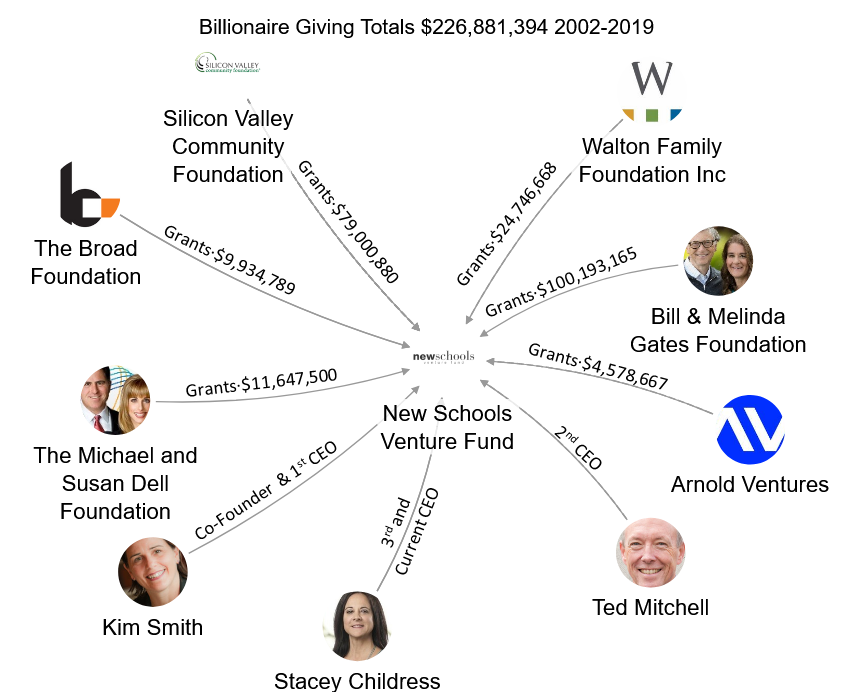
LittleSis Map of NSVF Massive Funding By Billionaires

While there is little doubt the Bill Gates and The Walton Family Foundation are the largest individual donors to NSVF, the $226,881,394 in grants documented in the map above are only a fraction of the total billionaire largess. Besides receiving help from Reed Hastings, over the last 20-years, billionaires John Doerr, Laurene Jobs Powell and John Sackler have served on the board, but there is no information about any of their monetary contributions.

Kim Smith was the founding CEO of NSVF. The second CEO was Ted Mitchell the former President of Occidental College and a founding board member of NSVF. Mitchell replaced Kim Smith as CEO in September 2005 and held the position until 2014. From 2008-2010, he was simultaneously President of the California State Board of Education.

Mitchell has also served on the boards of New Leaders, Khan Academy, California Education Partners, Teach Channel, ConnectED, Hameetman Foundation, the Alliance for College-Ready Public Schools, Silicon Schools, Children Now, Bellwether Partners, Pivot Learning Partners, EnCorps Teacher Training Program, the National Alliance for Public Charter Schools, and the Green DOT Public Schools.

On May 8, 2014 EdSource reported, “Former State Board of Education president Ted Mitchell was confirmed Thursday as under secretary of education, the third-highest ranking official at the U.S. Department of Education.”

NSVF’s 2010 990-tax form had a note that claimed, “To date, the Organization has successfully received support from … the U.S. Department of Education.” From 2003-2007, NSVF reported $5,997,900 in grants from governmental sources. In 2008, the line requiring listing governmental grants separately disappeared from the 990-tax form. There is no longer an easily accessible method for gaining that information.

Contribution Graph

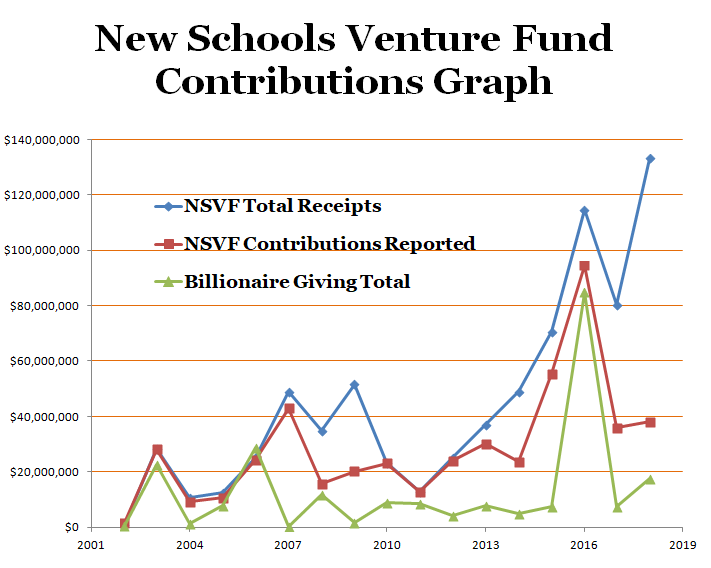
Enormous Grant Amounts Reported by NSVF and Selected Billionaires

In the graph above the billionaire giving in green is for yearly totals from the tax reports by the billionaires in the LittleSis Map above. The 2016 spike occurred because some unknown entity contributed $68,000,000 to NSVF through the donor directed foundation Silicon Valley Community Fund.

In 2016, Reed Hastings created a $100,000,000 fund within the Silicon Valley Community Fund. At the same time, Laurene Jobs Powell was serving on the board of NSVF when her XQ Institute was granted $24,750,000 in 2015 and $57,402,973 in 2016. Either one of them could have made the large contribution or maybe it was someone else.

Every year NSVF hosts a “Summit” in Oakland, California which they state brings together more than 1,200 educators, entrepreneurs, community leaders, funders, and policy makers to share ideas on how to “reimagine learning.” These “Summits” are a must attend for the disrupter community and they drive contributions.

To replace Mitchell as CEO when he left for the Department of Education in 2014, NSVF brought in Stacey Childress from the Bill and Melinda Gates Foundation. Childress earned an MBA from Harvard Business School in 2000. Afterwards, she spent a year co-founding an enterprise software sales company and then returned to Harvard where she was a Senior Lecturer and Executive Director. In 2010, Childress became Deputy Director of the Gates Foundation. She has been CEO of NSVF since arriving in 2014.

Both Mitchell and Childress have received NSVF salaries in excess of $500,000. The 2018 NSVF tax-form explanation of their compensation method reads,

“The organization obtained compensation studies from several independent sources to compile information used as a metric for salary increases … A subcommittee of the Board of Directors (BOD) conducts the review of the CEO and develops a recommendation for the full BOD.”

This is similar to the method that has ballooned executive pay in corporate America while line worker wages have stagnated. It is a method that justifies those at the top getting an ever greater share.

Investing in Privatization and Education Technology

NSVF claims they have invested in 117 Ed Tech companies, 187 charter schools and 55 diverse leaders programs.

Among their Ed Tech investments are Class Dojo, EdSurge, LearnZillion, Phet Interactive Simulations and Education Elements. When NSVF makes a major investment in an Ed Tech startup, they require a position on the companies governing board.

One of NSVF’s founding board members, Dave Whorton, is also the founder of Tugboat Ventures. When NSVF invested in Education Elements so did Tugboat Ventures. Dave Whorton was made a member of Education Elements Board of Directors where he efficiently keeps an eye on funds from both Tugboat and NSVF.

When first founded, NSVF invested heavily in Aspire Public Schools because of their plan to create a charter management organization. In 2001, they granted $1,095,000 of their total of $2,468,000 in giving to Aspire.

As their wealth grew the grants to charter schools became very similar to the grants their funders were making. They have funded DC Prep, Phalen Leadership Academy, Rocketship Education, Success Charter Network, Yu Ming Charter School and almost 200 more.

The Yu Ming Charter is essentially a private Mandarin immersion school that has just submitted a material revision to their expansion plan that was rejected in December. It has been alleged the Yu Ming does not want new students above the kindergarten level. A parent comment on the Berkeley Parent Network says, “The teachers seem reluctant to admit kids who aren’t quite up to par in Mandarin as it can be really overwhelming for students to be new and they don’t want to see them struggle and be under water from the get-go.” To which Oakland Educator Jane Nylund responded,

“Real, authentic public education is hard; we deal with struggling students every day as expected, standard educational practice. We don’t find a way to reject them because they are ‘struggling’. This honest assessment by an involved parent is just more evidence of a ‘public school’ in name only, and not in practice.”

NSVF’s diverse-leaders investing is aimed at replacing quality teacher education at universities with for profit organizations that have very limited expertise. It is also aimed at selling the privatization agenda. NSVF invested in Branch Alliance for Education Diversity, edfuel, MindWorks Collaborative, National Charter Collaborative, School Board Partners, TNTP and fifty more organizations.

School Board Partners came out of Education Cities when The City Fund was established. They appear to want influence over school board members by offering training; a function every state already provides. They are a part of selling the privatization agenda.

TNTP was rolled out of TFA by Wendy Kopp and Michelle Rhee. Before the billionaire driven push to privatize public education a “non-profit” company like TNTP would have gotten no consideration for training teachers because they are unqualified.

Final Comments

Kim Smith staid on the board at NSVF and in 2011 co-founded Bellwether Education Partners. The next year she founded the Pahara Institute where she is the CEO. Her 2016 pay reported on tax forms signed by her was $419,576. (Update: Smith recently stepped down as the Pahara CEO.)

DoWopDon (Don Shalvey) is now Deputy Director of the College Ready Team at the Bill and Melinda Gates Foundation.

NSVF along with scores of billionaire funded Foundations has been spending staggeringly large amounts of money to privatize public education and monetize it. This spending has been going on for decades now. So, why are about 90% of America’s students still attending public schools? The answer is simple.

The “disrupter” products are bad and Americans are not buying what their selling.