A series of 5 minute daily podcasts for the Octave of Christmas.
I rant for a while about St. Thomas of Canterbury, and Church and State and … shepherds.
Yesterday’s podcast HERE.
A series of 5 minute daily podcasts for the Octave of Christmas.
I rant for a while about St. Thomas of Canterbury, and Church and State and … shepherds.
Yesterday’s podcast HERE.

Please remember me when shopping online and use my affiliate links. US HERE – WHY? This helps to pay for health insurance, utilities, groceries, etc.. At no extra cost, you provide help for which I am grateful.
TODAY’S WORDLE: 4
Magnus Carlson won the 2025 FIDE World Blitz Chess Championship, but he stumbled on Day 1 of the BLITZ Championship. Leading in Blitz are Arjun Erigaisi, Maxime Vachier-Lagrave, and Fabiano Caruana with six rounds left in the Swiss portion. The drama! My guy Wesley So is presently #8. He is a Blitz beast.
Richard Burton & Elizabeth Taylor while he was filming Becket pic.twitter.com/ktC1iof2fX
— Benedict Kiely (@benedict_kiely) December 29, 2025
White to move and mate in 4.
NB: I’ll hold comments with solutions ’till the next day so there won’t be “spoilers” for others.

End of year giving? Causes I trust.

CLICK!
SUPPORT CHAPLAINS!
Holy Church considers many Old Testament figures to be saints.
Today when you open your trusty copy of the 2005 Martyrologium Romanum you will find, just below the St. Thomas Becket, this interesting entry:
2. Commemoratio sancti David, regis et prophetae, qui, filius Iesse Bethlehemitae, gratiam invenit ante Deum et oleo sancto a Samuele propheta unctus est, ut populum Israel regeret; in civitatem Ierusalem Arcam foederis Domini transtulit ac Dominus ipse mox ei iuravit semen eius in aeternum mansurum esse, eo quod ex ipso Iesus Christus secundum carnem nasciturus esset.
You readers can come up with your renderings of the Latin original, either in a smoother version or perhaps in a slavishly literal way.
Changing tracks slightly, in the Metropolitan Museum of Art there is a series of paintings of Old Testament figures, including King David. These are elements from an altar piece by Florentine painter Lorenzo Monaco (known also as Piero di Giovanni +1422).
Moses is at the top left. Next to him is Abraham. Below him on the bottom right is Noah with his ark.

By thy way, since I took that photo, the paintings have been rearranged… in case you go looking.
Here is David, holding a psaltery. Greek psallo means “to pluck”. While there are also bowed psaltery, this one is plucked by the fingers rather than bowed or struck with a pick or plectrum.

When you get the audio guide at the Met and listen to experts talk about the works, sometimes you get a sample of period music. In this case, you get to hear some music played on a psaltery.
You can hear, below, a sample of a plucked psaltery in a Medieval Lament for Tristan, which would have been in vogue at the time the painter was working on the altar piece.
Listen as you do your translation!
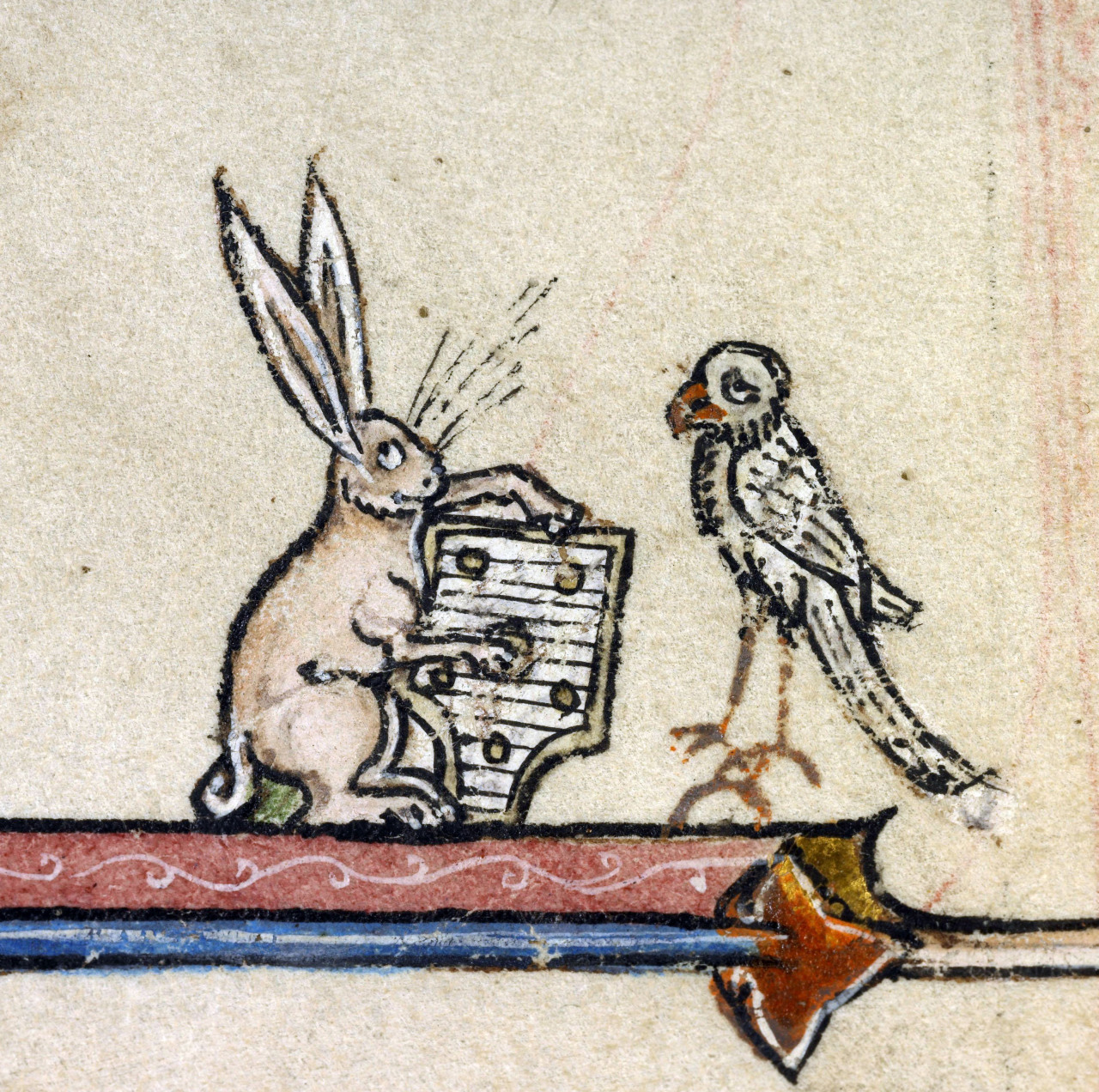
And, just for fun… here is another image of a psaltery bunny from a late 13th c. French manuscript. He even had the audience moved to sorrow.
And a psaltery cat!


Thursday was Christmas.
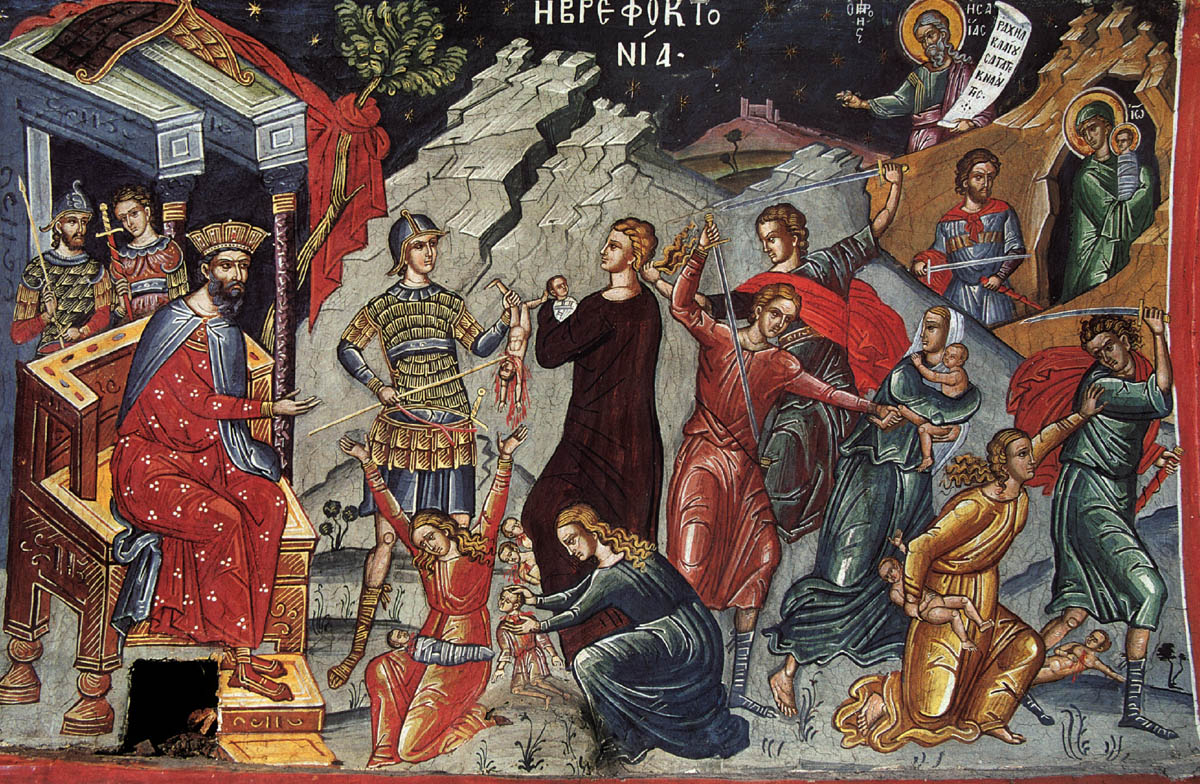
Today, along with it being the Sunday in the Octave, it is Childermas, the Feast of the Holy Innocents.
The “Coventry Carol”, a lullaby of mothers to doomed children, dates to the 16th century. It was part of a Mystery Play, “The Pageant of the Shearmen and Tailors”, about chapter two of the Gospel of Matthew.
The carol is about the Massacre of the Holy Innocents.
Lully, lulla, thou little tiny child,
By by, lully lullay, thou little tiny child,
By by, lully lullay.
O sisters too, How may we do
For to preserve this day
This poor youngling,
For whom we do sing,
By by, lully lullay?
Lully, lulla, thou little tiny child,
By by, lully lullay, thou little tiny child,
By by, lully lullay.
Herod, the King, In his raging,
Charged he hath this day
His men of might,
In his own sight,
All young children to slay.
Lully, lulla, thou little tiny child,
By by, lully lullay, thou little tiny child,
By by, lully lullay.
That woe is me, Poor child for thee!
And ever morn and day,
For thy parting
Nor say nor sing
By by, lully lullay!
We could sing it on every street corner.
The carol came to greater popularity after the BBC broadcast it at Christmas of 1940, after the Bombing of Coventry: it was sung in the ruins of the bombed Cathedral.
Here’s a modern reworking of Lully Lulla Lullay by Philip Stopford which might quite simply make you choke up and then, at the descant about 3:30, completely lose it.
 There is sometimes attributed (wrongly) to St. Augustine a quote about the Holy Innocents with some beautiful imagery. Here it is… mind you, attributed to the Doctor of Grace:
These then, whom Herod’s cruelty tore as sucklings from their mothers’ bosom, are justly hailed as “infant martyr flowers”; they were the Church’s first blossoms, matured by the frost of persecution during the cold winter of unbelief.
Lovely, no? Augustine didn’t say that. It was Caesarius of Arles who preached:
Quos herodis impietas lactantes matrum uberibus abstraxit; qui iure dicuntur martyrum flores, quos in medio frigore infidelitatis exortos velud primas erumpentes ecclesiae gemmas quaedam persecutionis pruina decoxit. [s. 222, 2 in CCL 104]
Literally: Whom the impiety of Herod dragged from their mothers’ breasts; who rightly are called the flowers of the martyrs, whom, having sprung up in the midst of the cold of infidelity, bursting forth as the Church’s first jewels, a certain frost of persecution wasted.
or
Whom the ungodliness of Herod dragged as nursing babies from their mothers’ breasts; who rightly are called the flowers of martyrs, whom the frost of persecution cooked up, grown up in the midst of the cold, bursting forth as the first buds of the Church.
 Some interesting things are going on in the Latin. First, you need to know that gemma isn’t just “gem”, but can also be “bud, blossom”. In Latin there are two related verbs, lacto, lactare, “to contain milk, to give suck”, and lacteo, lactere, “to suck milk, to be a suckling”. However, in all periods they swap meanings. We could use one English verb for both, “to nurse”. This is also why we for the famous line “out of the mouth of infants and of sucklings” both “ex ore infantium et lactentium” and “ex ore lactantium”.
By the way, if you like this drilling into Latin, try Latin Synonyms, with Their Different Significations, and Examples Taken from the Best Latin Authors, by M. Jean-Baptiste Gardin Dumesnil, translated into English, with additions and corrections, by the Rev. J. M. Gosset. US HERE – UK HERE
Decoquo is “to waste” or “to reduce by boiling”. I found an interesting reference in Suetonius how Nero made a icy-cold drink decoction, a decocta. Pliny uses decoctum as a medicinal drink. Note the juxtaposition of the heat indicated in decoquo and the cold of frost. The cold heat of persecution brought forth flowers before their day.
Here is the Collect from the 1962 Missale Romanum:
Deus, cuius hodierna die praeconium Innocentes Martyres non loquendo, sed moriendo confessi sunt: omnia in nobis vitiorum mala mortifica; ut fidem tuam, quam lingua nostra loquitur, etiam moribus vita fateatur.
O God, whose public heralding the Innocent Martyrs professed this very day not by speaking but by dying; mortify in us every ill of vices; so that (our) life might confess Your Faith, which we speak with our tongue, also by (our) morals.
Look at the not-so-subtle change made to the Collect by the cutters and pasters who glued together the Novus Ordo:
Deus, cuius hodierna die praeconium
Innocentes Martyres non loquendo,
sed moriendo confessi sunt:
da, quaesumus, ut fidem tuam,
quam lingua nostra loquitur
etiam moribus vita fateatur.
Can you spell “bowdlerize”?
LITERAL VERSION:
O God, whose public heralding the Innocent Martyrs
professed this very day not by speaking but by dying;
grant, we implore, that (our) life might confess Your Faith,
which our tongue declares,
also by (our) morals.
That lingua nostra could, I suppose, be ablative, but it is probably the nominative subject of loquitur. I originally swerved that into “which we speak with our tongue”. There is a strong temptation to reconstruct these clauses when rendering it into English.
NEW CORRECTED VERSION:
O God, whom the Holy Innocents confessed
and proclaimed on this day,
not by speaking but by dying,
grant, we pray,
that the faith in you which we confess with our lips
may also speak through our manner of life.
Did the translator not get that fateor is deponent? The subject is vita, no? Accusative fidem is the object, not the subject.
What a mess.
St. Thomas Aquinas dealt with the question of how the Innocents could be considered martyrs if they didn’t yet have use of their free will so as to be able to choose death in favor of Christ and if they were not baptized.
The Angelic Doctor answered that God permitted their slaughter for their own good and that their slaying brought them the justification and salvation that would also come from baptism.
This was a “baptism of blood”. In their deaths they were truly martyrs. And they were indeed for Christ, since Herod, fulfilling the prophecy of Jeremiah 31:15, killed them from ill-will for the new-born Christ.
Did you like the Stopford version?
A series of 5 minute daily podcasts for the Octave of Christmas.
Pius Parsch talks about the six throne of Jesus.
Dom Prosper Guéranger on the wonder of adoption.
At the end, a taste of the heartrending Coventry Carol in honor of the Feast of the Holy Innocents.
Yesterday’s podcast HERE.

Too many people today are without good, strong preaching, to the detriment of all. Share the good stuff.
Was there a GOOD point made in the sermon you heard at your Mass of obligation for this Gaudete Sunday, the Sunday in the Octave of Christmas
Tell us about attendance especially for the Traditional Latin Mass.
Any local changes or (hopefully good) news?
A taste of what I offered at 1 Peter 5 this week:
[…]
The Latin Collect reminds us that God has a plan for each of us. From before time and the universe was created, God knew each one of us. Of all the possible universes He could have created, He chose to create this one, into which He called us into existence at the precise moment He foresaw we would be needed in His plan. Along with existence, He gives us work to do. Our Lord, the Incarnate Word, framed this well for us when He taught that we must love both God and our neighbor.
[…]
 From a reader…
QUAERITUR:
You usually give your readership an annual reminder for the blessing of wine on St. John’s Day.
The Rituale says “Benedicere… hunc calicem vini et CUJUSLIBET POTUS”- so presumably any hard beverage could be blessed with that blessing? Whiskey would be acceptable right?
Right! Whiskey is “another beverage”.
I hope that you will get organized for this great day and wonderful blessing. First, contact your priest and make sure he is one board. To get him on board, it might be a good idea to to assure him that you will be leaving behind a goodly portion of the large quantity of the “other beverage” you want blessed:
“Hey Father! I have a little too much Laguvulin 16 right now. Could I leave some for you after you bless it? I’d be much obliged.”
That sort of thing.
How did this blessing develop? There was an attempt on the life of St. John the Evangelist by poisoning. He blessed the cup and the poison crawled out in the form of a serpent. You often see St. John depicted this way in art.
Here are a couple texts.
BLESSING OF WINE
on the Feast of St. John, Apostle and EvangelistAt the end of the principal Mass on the feast of St. John, Apostle and Evangelist, after the last Gospel, the priest, retaining all vestments except the maniple, blesses wine brought by the people. This is done in memory and in honor of St. John, who drank without any ill effects the poisoned wine offered to him by his enemies.
P: Our help is in the name of the Lord.
All: Who made heaven and earth.
P: The Lord be with you.
All: May He also be with you.
Let us pray.
If it please you, Lord God, bless + and consecrate + this vessel of wine (or any other beverage) by the power of your right hand; and grant that, through the merits of St. John, apostle and evangelist, all your faithful who drink of it may find it a help and a protection. As the blessed John drank the poisoned potion without any ill effects, so may all who today drink the blessed wine in his honor be delivered from poisoning and similar harmful things. And as they offer themselves body and soul to you, may they obtain pardon of all their sins; through Christ our Lord.All: Amen.
Lord, bless + this creature drink, so that it may be a health- giving medicine to all who use it; and grant by your grace that all who taste of it may enjoy bodily and spiritual health in calling on your holy name; through Christ our Lord.All: Amen.
May the blessing of almighty God, Father, Son, + and Holy Spirit, come on this wine (or any other beverage) and remain always.All: Amen.
It is sprinkled with holy water. If the blessing is given privately outside of Mass, the priest is vested in surplice and stole and performs the ceremony as given above.4. ANOTHER FORM FOR BLESSING WINE
on the Feast of St. John, Apostle and EvangelistAt the end of Mass, after the last Gospel, the following is said:
Psalm 22
(for this psalm see Rite for Baptism of Children)After the psalm: Lord, have mercy. Christ, have mercy. Lord, have mercy. Our Father (the rest inaudibly until:)
P: And lead us not into temptation.
All: But deliver us from evil.
P: Save your servants.
All: Who trust in you, my God.
P: Lord, send them aid from your holy place.
All: And watch over them from Sion.
P: Let the enemy have no power over them.
All: And the son of iniquity be powerless to harm them.
P: Then if they drink anything deadly.
All: It will not harm them.
P: Lord, heed my prayer.
All: And let my cry be heard by you.
P: The Lord be with you.
All: May He also be with you.
Let us pray.
Holy Lord, almighty Father, everlasting God, who willed that your Son, co-eternal and consubstantial with you, come down from heaven and in the fulness of time be made flesh for a time of the blessed Virgin Mary, in order to seek the lost and wayward sheep and carry it on His shoulders to the sheepfold, and to heal the man fallen among robbers of his wounds by pouring in oil and wine; may you bless + and sanctify + this wine which you have vintaged for man’s drink. Let all who taste or drink of it on this holy feastday have health of body and soul; by your grace let it be a solace to the man who is on a journey and bring him safely to his destination; through Christ our Lord.All: Amen.
Let us pray.
Lord Jesus Christ, who spoke of yourself as the true vine and the apostles as the branches, and who willed to plant a chosen vineyard of all who love you, bless + this wine and empower it with your blessing; so that all who taste or drink of it may, through the intercession of your beloved disciple John, apostle and evangelist, be spared every deadly and poisonous affliction and enjoy bodily and spiritual well-being. We ask this of you who live and reign forever and ever.All: Amen.
Let us pray.
God, who in creating the world brought forth for mankind bread as food and wine as drink, bread to nourish the body and wine to cheer the heart; who conferred on blessed John, your beloved disciple, such great favor that not only did he himself escape the poisoned potion, but could restore life by your power to others who were dead from poison; grant to all who drink this wine spiritual gladness and everlasting life; through Christ our Lord.All: Amen.
It is sprinkled with holy water.
By the way, St. John the Evangelist is recognized as a martyr, not because he was actually killed but for his willingness to be martyred while the Romans were actively working on killing him. He was miraculously preserved form harm when they put him into a vat of boiling oil. They were too afraid to try anything else, so Domitian exiled him to Patmos. There is a tiny church by the Porta Latina (that I’ve never been in) called San Giovanni in Oleo. The Feast Day of St. John’s “Martyrdom” is called St. John at the Latin Gate.


A series of 5 minute daily podcasts for the Octave of Christmas.
About the Beloved Disciple from Advent and Christmas with the Church Fathers: a seven week Retreat on the Mystery and the Meaning of the Incarnation.
John received three gifts from the Lord corresponding to the three “states” Christ experienced, life, death and life and death mingled.
Yesterday’s podcast HERE.
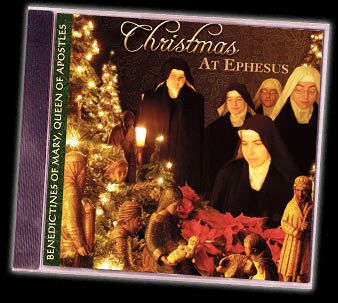
Also, The wonderful Benedictines of Gower Abbey have beautiful Christmas music albums.


A change of pace.
Please remember me when shopping online and use my affiliate links. US HERE – WHY? This helps to pay for health insurance, utilities, groceries, etc.. At no extra cost, you provide help for which I am grateful.
And this… you cannot separate Our Lord from the Cross…
Wow spoilers lol pic.twitter.com/wGldp3fhJ8
— Classical Studies Memes (@CSMFHT) December 26, 2025


Coat of Arms by D Burkart

 Dad of Six on It’s time to stop being “inappropriate”!: “Two quick thoughts- A lack of Marian devotion seems to be a common thread with too many appointees of the…”
 on It’s time to stop being “inappropriate”!: “They really want to confuse us with so much clarification that we just give up and be protestant.”
 on 28 Dec – Holy Innocents – Childermas: “They were the Church’s first blossoms”: “Some scholars estimate that as few as six boys would have fulfilled the criteria, if you went with some of…” on 28 Dec – Holy Innocents – Childermas: “They were the Church’s first blossoms”: “St. Luke doesn’t say that all the toddler boys in all the kingdom were killed. Lk. 2:16 says “in Bethlehem…”
 on 28 Dec – Holy Innocents – Childermas: “They were the Church’s first blossoms”: “Herod didn’t have every male child in his kingdom killed. Whom he did have killed was every male child from…”
 on 28 Dec – Holy Innocents – Childermas: “They were the Church’s first blossoms”: “Do some research on what sort of guy Herod was.”
 on It’s time to stop being “inappropriate”!: “We should be more charitable and show some sympathy to those members of the clergy who don’t understand these titles…”
 on IMPORTANT ASK FATHER: Blessing wine on 27 December – St. John’s Day… or “another beverage”?: “@Loquitur: That is a good catch. The Latin says: … et de sacratissima Virgine Maria in hoc tempore plenitudinis incarnari…”
 on 28 Dec – Holy Innocents – Childermas: “They were the Church’s first blossoms”: “It’s always struck me as a story that seems unlikely. Killing every male child in a kingdom seems like a…”
 on 28 Dec – Holy Innocents – Childermas: “They were the Church’s first blossoms”: “I am so very touched by the illustration of the terrified mother holding her baby, with her hand to his…”
 on 28 Dec – Holy Innocents – Childermas: “They were the Church’s first blossoms”: “The carol is so beautiful.”
 on Your Sunday Sermon Notes – Sunday in the Octave of Christmas: “While we are horrified by the actions of Herod, the killings of the children in Judea pale in comparison to…” on 28 Dec – Holy Innocents – Childermas: “They were the Church’s first blossoms”: “Before mass yesterday (Sunday) our choir sang both the traditional and the Stopford versions. Talk about choking up, I almost…”
 on 28 Dec – Holy Innocents – Childermas: “They were the Church’s first blossoms”: “Baptism was not necessary until after Our Lords Death and Resurrection. Heaven was closed. The Holy Innocents went to Limbo…” on ASK FATHER: Must we do penance, abstain from meat, on Friday in the Octave of Christmas?: “In Germany, St. Stephen falling on a Friday is the once-in-seven-years occasion of the new Code being more demanding than…”

 Loading ...


A Daily Prayer for Priests


They find you a pro-life agent in your area who commits to giving a portion of the fee to a pro-life group!

PLEASE subscribe via PayPal if it is useful. Zelle and Wise are better, but PayPal is convenient.
A monthly subscription donation means I have steady income I can plan on. I put you my list of benefactors for whom I pray and for whom I often say Holy Mass.
In view of the rapidly changing challenges I now face, I would like to add more $10/month subscribers. Will you please help?
For a one time donation...
 Loading ... Loading ...
Use my code for a discount

Help Monks in Wyoming (coffee – UPDATED LINK) and Norcia (beer) and the wonderful "Soap Sisters" of Summit, NJ!


Please follow me on Twitter!








Visits tracked by Statcounter
since Sat., 25 Nov. 2006: