Here are the reviews posted during March. Please note, this is not a comprehensive list of books I read in March, but rather the books I had the time to review before month's end.
Looking for suggestions for a Twitter chat on feminist/queer/outsider cyberpunk I'm co-moderating a Twitter chat with @bleedingchrome on October 9th on the topic so I'd love lots of participation and suggestions. I've read some things (Scott, Cadigan, Pollack, etc.) of course, but don't think I've run across much international cyberpunk and virtually nothing by writers of color.
You can see the full schedule of feministsf twitter chats here. Https://twitter.com/#!/search/realtime/%23FeministSF
Say Yes to Gay YA Rachel Manija Brown (rachelmanija) and Sherwood Smith (sartorias) were told by a literary agent that their Young Adult novel would be represented -- if they made a gay character straight or wrote him out altogether.
They refused.
They have written a blog entry about the gatekeepers of publishing who may be keeping gay characters out of young adult fiction, and are asking you to help change the status quo.
UK-based Zimbabwean author Masimba Musodza has written the first science fiction novel in ChiShona, the native language of the Shona people of Zimbabwe and Southern Zambia. And it tells the story of native beliefs clashing with corporate mad science. MunaHacha Maive Nei is also the first chiShona novel available on the Kindle. According to the ImageNations blog, this is a huge step forward in a region where English, or a pidgin version of English, is still considered the "most common form of communication." Musodza, who's also the author of some detective novels and the novel The Man who turned into a Rastafarian, has lived in England since 2002. (ChiShona is a common enough language in England that it's used on official forms.)
Here's how Musodza's press release describes the novel:
MunaHacha Maive Nei weaves issues of greed & corruption, sustainable development, international corporate intrigue and concerns around bio-technology. Chemicals from a research station conducting illegal experiments begin to seep in to the local ecosystem, causing mutations in the flora and fauna. When a child is attacked by a giant fish, the villagers think it is an affronted mermaid-traditional custodian of the ecology- and seek to appease it according to the prescription of folk-lore. However, the reality of what is happening soon becomes evident, a reality more terrifying than any legend or belief.
"This is a long way of saying that On Beauty was the end of all that for me – of trying to get people’s approval by writing myself IN to this English tradition. I just don’t care any more. All I can do is continue to work very hard on my little projects, taking in any influence I feel like, and not fearing subjects that interest me. 19th century Jamaica interests me. The 70’s Black Power movement in London interests me. The feminist lesbian movements of the 60’s and 70’s interest me. At the moment, sci fi, speculative fiction, interests me enormously. I’m so excited now about the next decade. I feel free!"
Under an Emerald Sky by Olukemi Amala There's a review of Under an Emerald Sky by Olukemi Amala at the F-Word and it sounds magical realist or possibly even fantasy so might interest whileaway readers:
Mod note Due to recent spam comments, I've turned on Captcha and screening for anonymous comments for the community. whileaway members, please unscreen anonymous replies from non-spammers when you get them on your entries if need be -- you can do it yourselves without help from moderators (see the LJ FAQ), but contact us as usual if you get trolls or flames that need further action. Thanks.
there's no reason women can't do everything men can [except for a telling blind spot he has regarding participation in and leading of the armed forces];
there's no reason the various British colonies shouldn't form a British empire;
there's no reason we shouldn't eliminate poverty [on the grounds that a) it's easy enough to give everyone basic sustenance and lodging, and b) this won't eliminate ambition but rather stoke it because ambition increases the higher up the foodchain you get, and the poorest people are actually too poor to have energy for ambition].
In which a woman appears to have invented time travel... or not This story is presumably bunkum but I thought it might be amusingly relevant to whileaway members' interests. De-bunk at will, or not, in comments. I'm thinking of starting a conspiracy theory that Connie Willis' agent planted the 'shopped film clip to virally market her time travel stories to Charlie Chaplin fans.... ;-)
Has Belfast film-maker found time travel evidence?
A Belfast film-maker has posted a video on the internet showing what he says could be evidence of time travelling. George Clarke from east Belfast has been puzzled for more than a year by a scene in a film which appears to show a woman talking on a mobile phone. The unusual thing is that the movie was made by Charlie Chaplin in 1928 - long before mobile phones were invented. In the eight days since George posted the clip on Youtube - more than 1.5m people have viewed the video online. Even the US talk show host Jay Leno created his own spoof version.
I've been asked to prepare some texts for a two week slot on gender for the 2nd year theory course at my university next year. I'm confident that I can put the theory stuff together, but I'd like to set some science fiction to go with it. So, I'm looking for suggestions for feminist/gender-aware science fiction (preferably short stories). Obviously, I'm starting with the Tiptree lists, but I need work primarily by British* authors. Thoughts?
*Any Anglophone lit should be ok, but I'll struggle to get American/Canadian lit through the teaching and learning committee - academic politics eh?
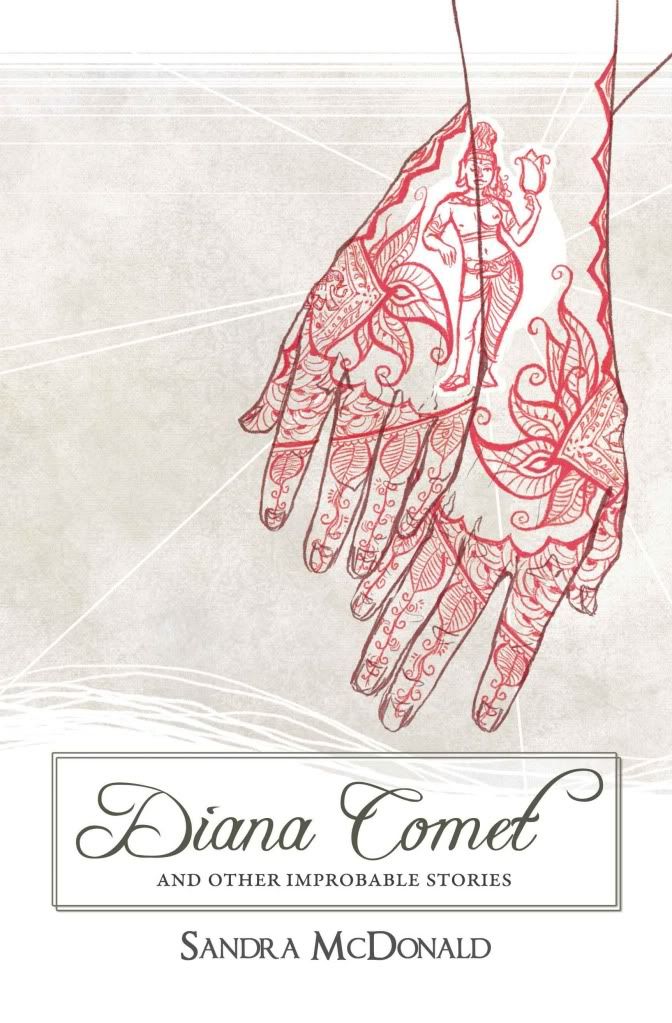
The premise: ganked from the back cover: A writer of whimsy and passion, Sandra McDonald has collected her most evocative short fiction to offer readers in Diana Comet and Other Improbable Stories. A beautiful adventuress from the ancient city of New Dalli sets off to reclaim her missing lover. What secrets does she hide beneath her silk skirts? A gay cowboy flees the Great War in search of true love and the elusive undead poet Whit Waltman, but at what cost? A talking statue sends an abused boy spinning through a great metropolis, dodging pirates and search for a home. On these quests, you will meet macho firefighters, tiny fairies, collapsible musicians, lady devils and vengeful sea witches. These are stories to stir the heart and imagination.
Must Have: How can you say no to a collection that explores gender issues, sexuality issues, racism, and so much more? McDonald's book is a cross between Catherynne M. Valente's themes and Charles de Lint's world-building, which stories that really linger long after you're finished. While some are serious, some are whimsical, and all are unifying not just by themes, but by setting and characters. The stand-outs for me were "Diana Comet and the Lovesick Cowboy," "The Goddess and Lieutenant Teague" (really loved this one), "The Fireman's Fairy" (this is will make you sad), and "Kingdom Coming." I also loved the fake historical vibe to this collection, a kind of alternate history that isn't obviously alternate history, but rather a riff on our own. All in all, it's a great collection, and I'm thankful I got my hands on it. I really think this deserves to at LEAST make the Tiptree shortlist, because if it doesn't, I can't imagine what would.
Review style: I have few notes and a ton of sticky tabs all over this book. I want to talk about the unifying element to each of these stories, some of the themes the book touches on, as well as single out which stories were really powerful for me. No spoilers (save for a teeny-tiny one that's clearly marked), so if you're interested in the full review at my LJ, just click the link below. As always, comments and discussion are most welcome. :)
DON'T MISS OUT: Want a chance to win a free copy of the short story collection that deserves a Tiptree nod? Diana Comet and Other Improbable Stories by Sandra McDonald definitely fits the bill! Interested? Click here.
ALSO:
Book club selections @ calico_reaction. Hop on over! We'd love to have you!
The premise: ganked from BN.com: Mattie, an intelligent automaton skilled in the use of alchemy, finds herself caught in the middle of a conflict between gargoyles, the Mechanics, and the Alchemists. With the old order quickly giving way to the new, Mattie discovers powerful and dangerous secrets--secrets that can completely alter the balance of power in the city of Ayona. This doesn't sit well with Loharri, the Mechanic who created Mattie and still has the key to her heart--literally.
Worth the Cash: I wanted to see a certain improvement from The Secret History of Moscow, which had a lot going for it anyway. I saw that improvement, and there's just a lot to savor and enjoy about this novel. It's character driven, and the politics start to dictate the story by the end, but really, given the world Sedia's created, it's a given, as is the ending if you're paying attention. There's a load of beauty in this book, and it makes me look forward to her next title, The House of Discarded Dreams, which is due in July 2010. I've said before that Sedia has the potential to reach the literary heights of Catherynne M. Valente, of Charles de Lint, of Neil Gaiman, and I still believe that. This book is a step closer in that direction, and Sedia doesn't shy away from big issues, not from feminism nor God, and the book, while it has its fun moments, gives you plenty to think over long after it's over.
Review style: Being that it's a Book Club selection, expect spoilers. If you haven't finished reading or haven't even read the book yet, simply skip to the "My Rating" section and come back when you have read it. There shall be discussion of the book's feminist leanings, how politics both help and hinder the story, the various works of literature this book alludes too, and all kinds of other goodies, including some of my favorite moments of the story.
The full review, if you're interested, may be found in my LJ. As always, comments and discussion are most welcome. :)
DON'T MISS OUT: Here's your chance to win a signed copy of Karin Lowachee's arctic fantasy, THE GASLIGHT DOGS. To enter, click here. Deadline to enter: 5/12
ALSO:
Book club selections @ calico_reaction. Hop on over! We'd love to have you!
Fumi Yoshinaga, Ooku: The Inner Chambers, volumes 1 & 2 (VIZ Media 2009)
Greer Gilman’s book, Cloud and Ashes: Three Winter Tales, prompted much jury discussion on its way to winning the Tiptree. It is a slow read -- a dense, poetic, impressionistic book, heavy with myth. Many of its images and elements are drawn from folk tales and ballads of the British Isles; patterns repeat, but also mutate in kaleidoscopic fashion and then mutate again. The language was especially difficult. Sometimes we felt we were floating through it; sometimes drowning.
It is a paradoxical work. To enter the novel you must give up on understanding every word. You have to read the book on an instinctual level, yet the effect of the book is almost entirely intellectual. Power shifts about, much of it gender-based; time eats itself like a mobius strip. These are stories about Story in a world in which power seems to belong to the male but reality to the female.
We on the jury admired Cloud and Ashes for its originality and found it a beautiful and highly memorable work.
We chose Fumi Yoshinaga’s Ooku, Volumes 1 and 2 as our Tiptree winner with some trepidation. No one on the jury has read much manga; no one is an expert in Japanese history. What we fell in love with was the detailed exploration of the world of these books -- an alternate feudal Japan in which a plague has killed 3/4s of Japan’s young men. In Ooku, the shogun and daimyo are women and much of the story takes place among the men in the Shogun's harem.
The first volume (set in a later time period than the second) shows us a world in which men are assumed to be weak and sickly, yet women still use symbolic masculinity to maintain power. The second volume focuses on the period of transition. Through-out the two books, Yoshinaga explores the way the deep gendering of this society is both maintained and challenged by the alteration in ratios.
The result is a fascinating, subtle, and nuanced speculation with gender at its center.
The Future Fire is currently seeking submissions of Feminist Science Fiction until the end of 2009. They have a link to one of their editorials explaining why and also emphasize that they are always open to Feminist fiction, not just for their specially-themed upcoming issue.
I recently recieved this notice on a forum and wanted to pass is on. Feminist SF The Blog and Feminist SF wiki are collecting data on women spec fic writers and their short story publications to be added to a monthly pubs list that wil be included on their sites.
Here is a link http://ow.ly/kaid to the form to submit pub news of short fiction from August 2009 onward.
Writers, editors and readers are encouraged to add to the list.