Walk into my parlour

Image

Lady Susan
by Jane Austen (1794),
(in Northanger Abbey, Lady Susan, The Watsons and Sanditon).
Oxford World’s Classics, 2008 (1871).

Will you walk into my parlour?” said the Spider to the Fly,
‘Tis the prettiest little parlour that ever you did spy;
… Oh no, no,” said the little Fly, “to ask me is in vain,
For who goes up your winding stair can ne’er come down again.”

This was my July 2013 review of Austen’s Lady Susan, reposted just as a film adaptation arrived in cinemas (though rebranded with a completely different Austen title as Love & Friendship – written when she was in her teens).

Are tweets a modern equivalent of Lady Susan‘s letters? And if so, how would public responses be written if, instead of handwritten letters, the emails of Lady Susan Vernon and other contemporaries were published piecemeal on the internet for general titillation?

It’s worth noting that, back in 2013, each tweet (as they were then called) was limited to 140 characters.

Continue reading “Walk into my parlour”

The Alchemical Master

Image
‘Love Locked Out’ by Anna Lea Merritt (1890), Tate Britain.

What’s Bred in the Bone (1985)
by Robertson Davies,
No 2 in The Cornish Trilogy.
Penguin Books, 2011 (1991).

‘That alchemy is a pretty kind of game
Somewhat like tricks o’ the cards to cheat a man
With charming.’
— ‘The Alchemist’ (1610) by Ben Johnson.

This, the absorbing central title in Robertson Davies’s Cornish Trilogy, follows The Rebel Angels (1981) before the series is completed with The Lyre of Orpheus (1988). Like the preceding volume it deals with the fallout from the death of Francis Cornish on his 72nd birthday in 1981, and some of the dilemmas faced by the three trustees of the Cornish Foundation for the Promotion of the Arts and Humane Scholarship.

We meet the trustees, all of whom had appeared in The Rebel Angels – nephew Arthur Cornish, Arthur’s wife Maria (née Theotoky), and Professor the Reverend Simon Darcourt – of Toronto’s University of St John and the Holy Ghost – who’s also the executor of Frank Cornish’s will.

However there’s a problem: Darcourt is trying to write an official biography of the deceased, a man of great renown in Canada and Europe as an acknowledged art expert; but there are lacunae in Frank’s career and whispers about forgery, and nobody living seems to know much about his upbringing or what really motivated him.

Continue reading “The Alchemical Master”

A Rabelaisian romp

Image
A close up of the Episkopon Tower, Trinity College, the University of Toronto (Guy Grant Taylor, 2015)

The Rebel Angels
by Robertson Davies
in The Cornish Trilogy,
Penguin Books, 2011 (1981).

‘Wit is something you possess, but humour is something that possesses you.’ — Clement Hollier.

John Aubrey, filth therapy, Franz Liszt, Romany lore, François Rabelais, academic feuding, Paracelsus, a bequest – all this and more are part of the ferment amongst certain of the scholars of Davies’s fictional Canadian college, fomenting the events that ultimately result in murder.

The college of St John and the Holy Ghost, known colloquially as Spook, is in some ways the equivalent of Rabelais’s Abbey of Thélème, where the motto was Fais ce que tu voudras – ‘Do what you will’; naturally, since the Greek θέλημα means ‘wish’ or ‘strong desire’, various strong wills at Spook strive to achieve what they most want, with consequences that may differ from what’s intended.

Central to the action is Maria Theotoky, a postgraduate student around whom two pairs of opposing academics battle for ascendancy, along with Arthur Cornish, whose uncle’s death and bequest helps precipitate the action of the whole drama.

Continue reading “A Rabelaisian romp”

A being darkly wise

Roadside Picnic
by Arkady Strugatsky and Boris Strugatsky.
Translated by Olena Bormashenko,
foreword by Ursula K Le Guin,
afterword by Boris Strugatsky, 2012.
Gollancz, 2012 (1972).

Know then thyself, presume not God to scan;
The proper study of mankind is man.

From ‘An Essay on Man: Epistle II’ by Alexander Pope

Superficially a speculative thriller, the Strugatsky brothers’ Roadside Picnic for me turned out to be a deeply philosophical novel under its science-fictiony veneer. For the most part it focuses on a character called Redrick, a chancer who lives for the pleasures of alcohol, tobacco, gambling and occasional sex, living at some unspecified future time somewhere in North America. So, initially, a not very edifying tale.

The ostensible premise is that extraterrestrial visitors have touched down at six points on the Earth’s surface and then just as mysteriously departed, leaving behind their detritus in what turn out to be highly dangerous, disturbance-filled Zones. It is for this debris that Redrick and others enter the Zone adjacent to Harmont, to retrieve alien junk for the black market.

But there are deeper matters to think about than mere cupidity. At the central point of the novel we find ourselves listening to a conversation about the implications of this First Contact, implications that should matter to all humankind but which if ever considered are soon forgotten. In its underhand way Roadside Picnic encourages us to quietly consider those implications.

Continue reading “A being darkly wise”

Godforsaken paths

Image
The third temptation of Christ: Christ and the devil on a pinnacle of the temple.’ Coloured chromolithograph after John Martin. Wellcome Collection.  (CC BY 4.0)

One Billion Years to the End of the World
by Arkady and Boris Strugatsky,
translated by Antonina W Bouis (1978).
Penguin Classics Science Fiction, 2020 (1977).

“I was told that this road
would take me to the ocean of death,
and turned back halfway.
Since then crooked, roundabout, godforsaken paths stretch out before me.”

Yosano Akiko (attributed)

A physicist, a biologist, an engineer, an orientalist and a mathematician walk into an astrophysicist’s apartment. No, it’s not the start of a joke but essentially the main action of this immersive novella by the Strugatsky brothers, also translated as Definitely Maybe: A Manuscript Discovered Under Unusual Circumstances.

Set in 1970s St Petersburg, then known as Leningrad, most of the action takes place in astrophysicist Dmitri Malianov’s apartment while his wife and son escape the city’s hot and humid July oppressiveness in Odessa on the Black Sea. Here he seems to be on the brink of discovering a link between stars and interstellar matter which he dubs ‘Malianov cavities’.

But he is constantly being interrupted, by phone calls, a delivery from the deli, even a visit from one of his wife Irina’s schoolfriends. And he is not the only specialist who isn’t able to settle to achieving a breakthrough — which is where the physicist, biologist, engineer, orientalist and mathematician come in. What is there to link their inability to progress their work, and who or what is causing it?

Continue reading “Godforsaken paths”

Lexical paradoxes

Image

Wandering among Words 13: Incongruity

incongruous (adj.)
from Latin incongruus, inconsistent, not agreeing, misfit, unsuitable.

Call me sad if you like but I’ve always liked puns, Christmas cracker riddles and dad jokes, however groanworthy they indubitably are. For instance, ‘What do you get when you cross a policeman with a skunk?’ – ‘Law and odour.’

Okay, I’ll accept the inevitable sigh that must’ve followed. But what about the unintended puns or confusing messages that come from public notices, the ones that result from carelessness, a lack of proofreading, or simple ignorance of grammar?

I’ll talk about how such unintentional wordplay may work, but how about we first look at some examples.

Continue reading “Lexical paradoxes”

Gimmickry

Image
Gizmo’ (word coined 1943) on SF shelves in Addyman’s Books, Hay-on-Wye © C A Lovegrove

Wandering among Words 12: the 1948 show

Normally in this ‘Wandering among Words’ feature I explore a group of words or phrases related through meaning, sense and/or etymology. This time, however, I’m going to resort to a gimmick, by examining words and phrases which first appeared in print seventy-five years ago – in 1948. (Not without coincidence this was the year I was born.)

Incidentally, the word gimmick has an American origin, appearing in the first decade of the 20th century. Meaning a trick or device to attract attention, it could be derived from gimcrack (a trifle or knick-knack) – though apparently there’s a faint possibility it’s an anagram of magic.

And as it so happens the first appearance in print of a derived word, gimmickry, does indeed date from 1948 – according to the Merriam-Webster Dictionary time-traveler webpage, whence I’ve selected the terms that have most tickled my fancy … and maybe yours too!

Continue reading “Gimmickry”

Bibliophages, unite!

Image
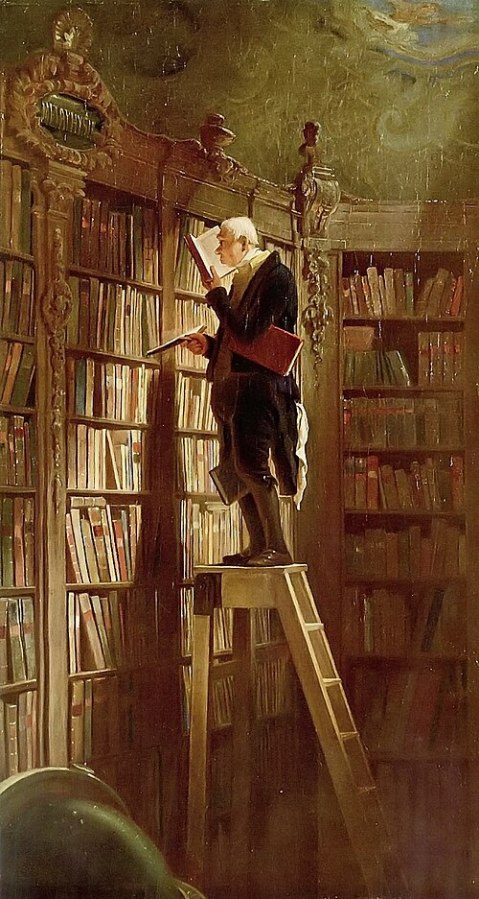
‘Der Bücherwurm’ (1850) by Carl Spitzweg

Wandering among Words 11: Bookworm

bookworm (n.)
1590s, “person devoted to study;” by 1713 in reference to the larvae of certain insects that eat holes in the bindings and paper of old books.

etymonline.com

We all know the term bookworm, don’t we, and doubtless judge ourselves each to be a representative of that particular genus.

Forget that it also means the lifeforms that basically ruin books by munching their way through the paper – we’re not at all the destructive kind, are we?

But have you ever wondered how and when we bibliophiles were somehow labelled as bibliophagist, literally ‘book-eating’ types? I have, and as a result have done some exploring – here’s some of what I’ve discovered.

Continue reading “Bibliophages, unite!”

Icons and eye cons

Image
2nd-century CE funeral portrait of a Roman Egyptian officer wearing a gold wreath (detail). Faiyum, Egypt.

Wandering among Words 10: Pupil

What’s the link between a celebrity and a chrysalis, between a student and a pet, and between a marionette and a metaphorical apple? And, indeed, what are the links between them all?

Let’s take a closer look at this; and for looking we need an eye, and something to look at. So I shall start with the notion of the icon, and then range widely between observers and the observed. And where better to start than with one of the funerary portraits from Faiyum in Egypt, a painting done from life to be placed with the mummified body after death?

Here then is an exemplar of the Greek word eikon, meaning a likeness, image, or portrait; and like many portrait icons from later Christian traditions the subject gazes frankly out at the viewer with dark, dilated pupils. The look is almost mesmerising, reminding one of the proverb that the eyes are the window to one’s soul. Or, as Charlotte Bronte wrote in Jane Eyre, “The soul, fortunately, has an interpreter – often an unconscious but still a faithful interpreter – in the eye.”

We try to judge character from such icons, don’t we; but even though these days ‘icon’ usually has one of two popular meanings — a digital symbol used on social media, or an object or indeed celebrity judged to have ‘iconic status’ — both of course are visually presented, requiring the eye of the observer to appreciate them.

Continue reading “Icons and eye cons”

Warning!

Image

Wandering Among Words No 9: Exclamation!

I came across an interesting neologism the other day which, as usual, had me musing — and I thought, again as usual, I would share them with you.

Here it is, courtesy of the popular BBC TV panel show QI and its busy QI elves on Twitter: Bangorrhea.

Hint: it’s not a kind of flightless bird from the town in North Wales or its counterpart in County Down, Northern Ireland.

Continue reading “Warning!”

At the margins

Image
Obscured view looking northeast to the Black Mountains in Wales, beyond which lies England.

Wandering among Words 8: March

No, this is not a post about the month marking the start of spring in the northern hemisphere. Nor is it about walking determinedly from A to B. So what am I referring to?

I’m talking about a liminal space. ‘March’ in this sense is related to the Latin margo, “edge”, giving us the words “margin”, “marginal”, and so on: it can be a buffer, a No Man’s Land or Demilitarised Zone between two states; rulers of such spaces were typically termed margrave, marchese, marqués, marquis or marquess in medieval Europe.

Marches fascinate me. It helps that I live in the Welsh Marches, the lands that straddle the centuries-old fluctuating border between Wales and its bigger neighbour, England. Just like Scotland with its Borders and Ireland with The Pale the Welsh Marches have a long history of disputed control, first between the Britons and the incomers of Anglo-Saxon Mercia (“the land of the border people”) and later with powerful Norman lords asserting themselves against both the king of England and independent Welsh princes.

Here was built the mighty earthwork of Offa’s Dyke to demarcate Mercian territory from Wales; here briefly flourished the heroes who fought against English rule, historic figures like Owain Llawgoch and Owain Glyndŵr, here nestle sites traditionally associated with the legendary King Arthur.

Continue reading “At the margins”

Magic spells

Image
Image credit: WordPress Free Media Library

Wandering Among Words 7: Gramarye

If, as Alice Hoffman is everywhere quoted, “Books may well be the only true magic,” then she is only following a tradition that has been acknowledged in all literate cultures: writing is magic, and magic is the written word.

We can point to the beginning of St John’s gospel to see this concept expounded:

In the beginning was the Word, and the Word was with God, and the Word was God.

Without getting into a theological discussion of what exactly John meant by Logos (‘the Word’), I just want to point out that the spoken word (and later the written word) is seen as the act of creation, and the creative act is magic, in its purest form.

All our language surrounding the concept of words, spoken or written, is closely bound up with magic.

Continue reading “Magic spells”

Awe, or just plain Aw?

Image
© C A Lovegrove.

Wandering among Words 6: Awe

I’m no etymologist but I do like exploring the genealogies of words: quite often these interrelated family trees reveal the real power of both the spoken and the written word, a kind of magic that’s so much stronger than the weak usage ancient roots are treated to over time.

I’ve already looked at some loose groupings of words and phrases and their meanings: (1) Water, (2) Corvid,
(3) Time, (4) Strangers, and (5) Upside Down. I now come to awe.*

The word ‘awe’ — meaning a kind of reverence shading from wonder to fear — has, in various combinations, assumed different weightings.

Continue reading “Awe, or just plain Aw?”

Downside Up

Image

Wondering among Words 5: Upside Down

A witty and amusing post by the Polish photo blogger who calls himself Rabirius was titled ‘Upside Down’: it showed two wheelie bins side by side, one arranged the correct way and the other … not.

It got me wondering: why do we in English call topsy-turvy things ‘upside down’ and not ‘downside up’? Why the bias? And do other Western languages do the same?

A little searching brought out a mixed bag of results.

Continue reading “Downside Up”

Strangers in their own land

Image

Wandering among Words 4: Strangers

What links a popular American TV series set in the 1930s, the 2016 UK referendum, and the End of the World?

There will be a bit of wandering in this post while I follow words migrating around Europe (and further afield), all in an attempt to demonstrate those links.

But first, I shall start at the end. Land’s End in fact.

Continue reading “Strangers in their own land”