Nobel Prize in Physics 2025: Who/What/Why

Image I started a tradition a little while back where every year we have a special departmental colloquium entitled “The Nobel Prize in Physics: Who/What/Why”. This year my job in finding speakers was made easier by having 2/3 of this years newly-minted Nobel Prize winners in physics in the Department! (Michel Devoret and John Martinis.) So our room was a bit more well-attended than normal…(hundreds and hundreds rather than dozens and dozens). Here is a recording of the event, which I was delighted to host, and there’s a celebration afterwards too. (Pls share widely!)

-cvj

Fantastic Collaboration!

ImageWell, I can now officially mention that I’ve been part of the filmmaking team (in a way) working hard to bring you an enjoyable and interesting Fantastic Four movie! I think it has been about two and a half years (?) since this all began. This was a nearly perfect model of how science consulting can work in film. I worked with everyone, wherever I was needed, with the director, writers, producers, director of photography, VFX teams, set design, and so on. They made me feel welcome and part of whatever creative team I was talking to, which was great. They were open to lots of ideas right from when they were starting out thinking about tone, story ideas, and so forth, right through to final (key) tweaks right at the end of the process as recently as mere weeks ago.

It began early on with with having great conversations Matt Shakman and his writing team about the fact that Reed Richards is first and foremost a curiosity-driven physicist (and so quite different from the engineer we have in Tony Stark that we see RdJ bring out so well), and how things like his dedication to his work (and his outlook on things that comes from such work) might play out in terms of family dynamic, personal relationships, etc., – Without it turning into the tedious cliches about scientists somehow not being able to navigate the world of human relationships. Obviously, I could speak to this as a physicist who works on precisely the things Reed works on, as well as a family man, and as well as someone who remembers that it’s still all about telling a story. And there are so many stories to tell at that intersection… Anyway, I think these early conversations (as well as suggestions I made in many sets of notes along the way) helped inform (even if only a little bit? who knows?) what Pedro Pascal brought to the character. This aspect of the film is one of the things I’m most pleased about seeing up on screen.

Beyond that, you’ll see lots of things I gave them that I’m also delighted to see made it to the film, in many scenes. This includes (but not limited to!):

  • Yes, you can look closely at the chalkboards because there’s story-relevant detail in nearly all of them. I was on speed dial across eight timezones when a lot of Reed’s lab work and work at the board was shot, so there was a lot of blurry-eyed writing of board-fulls of equations, suggestions for board performance, things to mutter (as many of us do) while writing and doing science activities, and so forth. (I may have stuck in an equation with more relevance to my own research at one point. More on that another time, but experts can look out for it…)
  • A really big action sequence that I’ll not say anything about for now so as not to spoil anything. (I pitched it to them early on and hardly dreamt it would get made! I was sure everyone would forget it came from me but then I ran into the writers at the premiere and they, unbidden, mentioned the meeting where they remember me pitching it!)
  • A number of actual computations were done for various plot points. Some of the computations made it to the boards, but sadly much of that did not make it to the movie, so you don’t see it discussed in the final version. That’s ok!
  • This might seem like a minor thing to you, but it’s a triumph for me: A certain kind of science-inspired SF object is spherical instead of circular! The MCU has, despite my previous efforts (e.g. in Thor:Ragnarok), missed out on the visual beauty of choosing one over the other. Perhaps I’ll expand on this later.
  • Aspects of the overall look of certain things: Sue’s force fields, space, space travel, the ship, the other ship, Kirby-Krackle!, various astrophysical objects, etc. Throughout the months (and years!) it was a delight to talk with intelligent curious people (the folks in VFX, the amazing director Matt Shakman, the fantastic Director of Photography Jess Hall, and others) and others about things like this and help them sort through the many choices involved in finding how they wanted to visually tell the story.

I could say more, but I’ve got some pressing matters to attend to, so I’ll stop for now.

I had a great time at this movie. Not just as a person a little bit involved in how it got made, but as a fan of movies, classic Marvel, and of a fun time out as part of an audience! Go see it!

–cvj

The Power of the String Equation

Image

[More technical post follows.] I’ve been working on this project with (UCSB postdoc) Maciej Kolanowski on and off for a while now, but only in the last couple of weeks did I have the time to hunker down and help push the writing of the results to the finish. For your Sunday reading pleasure, it is already up on the arXiv here (it came out Thursday but I’ve been too busy to pause to post about it – partly because I’ve begun work on writing up the next paper in the backlog). The title is “Extended JT supergravity and random matrix models: The power of the string equation”, and it is co-authored with Maciej Kolanowski.

In a way, it is a natural continuation of work I’ve described here from 2023 and 2024, described here and here. At a meeting at the Institute for Advanced Study in December 2023 I described in a talk (YouTube video here, look in particular from minute 35) something miraculous I’d discovered concerning capturing certain special supergravity (and black hole) behaviour using a random matrix model. The effective physics is two dimensional and the resulting model is one with N=2 extended supergravity. The spectrum of the relevant models has a continuum part associated with non-BPS states, which begins at some threshold energy E=E0. Additionally there’s a delta function at E=0 where there is some number of BPS states. Supergravity consistency Click to continue reading this post

Super-Fun!

image of completed paper, with pencil[A more technical post follows.] In January 2024 I wrote a paper showing how to define the Supersymmetric Virasoro Minimal String* (SVMS) as a random matrix model, compute many of its properties, and indeed predict many aspects of its physics. This was the first time the SVMS had been constructed. Despite that, a recent paper found it necessary to specifically single out my paper disparagingly as somehow not being a string theory paper, in service of (of course) their own work trying to formulate it. Odd – and disappointingly unkind – behaviour. But I’m used to it.

Anyway, since it remains the case that there is no other working definition of the SVMS out there, I thought I’d revisit the matter, clean up some unpublished work of mine (defining the 0B version) and develop the whole formalism much more. Might be useful for people pursuing other approaches. What I thought would be at most a 10 page paper turned into a 19 page one, packed with lots of fun results.

In particular it is now clear to me how the type 0A vs 0B choices, usually done at the level of perturbative worldsheet CFT methods, show up fully at the level of matrix model string equation solutions. It is often said that random matrix model methods can rather obscure issues like worldsheet supersymmetry, making it unclear what structures pertain to what features in other approaches. That can be true, so these new observations clear show that this is not always the case. (This is true quite generally, beyond this particular family of models.)

Also (and this is lots of fun!) I demonstrate that the basic loop observables of the SVMS (the single asymptotic boundary loop, and the trumpet) are computing 2D SCFT partition functions (or characters), suggesting that there’s a 3D chiral supergravity dual of all of this! In certain SVMS quantities, there’s a deceptively simple plus sign where a minus sign was for the ordinary VMS. I noticed this back in 2024 and wondered about its origin. A guess was that it might make more sense in some analogue of the known VMS connection to a 2D CFT and 3D chiral gravity. I hoped the plus would relate to fermionic characters and… it turns out to be true. The matrix model is secretly computing Tr(-)^F (in the NS sector) in a 2D SCFT that I conjecture is dual to a 3D chiral supergravity theory (where there should also be 0A and 0B choices mirroring the ones I found above). The whole thing lives on a solid torus and the SCFT is on its boundary (see figure), and naturally is in terms of the channel depicted as the big loop.

drawing of a solid torus
This channel is S-dual to the one following boundary of the disc shown – that’s the disc that becomes the disc in JT (super)gravity in a classical limit, by the way (another reason this whole chain of relationships, first found for the VMS, is exciting) – and off one goes to connections to black hole thermodynamics, and so on.

Such supergravity setups have yet to the constructed, and the matrix model results (which should compute the same observables) give a clear roadmap for how they ought to look. By virtue of the fact that my way of constructing the matrix models gives a natural fully non-perturbative definition as well, I am fascinated by the idea that the sum over topologies (in this 3D gravity context – not generally) is given a non-perturbative completion by them. So much to explore! Anyway, I should stop here and let you read the paper.

Of course, I’ll be amused to see what lengths my esteemed colleagues will go to in order to sideline my contribution this time.

To appear today on the ArXiv.

-cvj

(*It’s a supersymmetric version of a new, special kind of string theory –Virasoro Minimal String– that was introduced in 2023 by Collier, Eberhardt, Muhlmann, and Rodriguez.)
A New Equation?

Some years ago I speculated that it would nice if a certain mathematical object existed, and even nicer if it were to satisfy an ordinary differential equation of a special sort. I was motivated by a particular physical question, and it seemed very natural to me to imagine such an object… So natural that I was sure that it must already have been studied, the equation for it known. As a result, every so often I’d go down a rabbit hole of a literature dig, but not with much success because it isn’t entirely clear where best to look. Then I’d get involved with other projects and forget all about the matter.

Last year I began to think about it again because it might be useful in a method I was developing for a paper, went through the cycle of wondering, and looking for a while, then forgot all about it in thinking about other things.

Then, a little over a month ago at the end of March, while starting on a long flight across the continent, I started thinking about it again, and given that I did not have a connection to the internet to hand, took another approach: I got out a pencil and began mess around in my notebook and just derive what I thought the equation for this object should be, given certain properties it should have. One property is that it should in some circumstances reduce to a known powerful equation (often associated with the legendary 1975 work of Gel’fand and Dikii*) satisfied by the diagonal resolvent {\widehat R}(E,x) {=}\langle x|({\cal H}-E)^{-1}|x\rangle of a Schrodinger Hamiltonian {\cal H}=-\hbar^2\partial^2_x+u(x). It is:

4(u(x)-E){\widehat R}^2-2\hbar^2 {\widehat R}{\widehat R}^{\prime\prime}+\hbar^2({\widehat R}^\prime)^2 = 1\ .

Here, E is an energy of the Hamiltonian, in potential u(x), and x is a coordinate on the real line.

The object itself would be a generalisation of the diagonal resolvent {\widehat R}(E,x), although non-diagonal in the energy, not the Click to continue reading this post

Valuable Instants

Image

This week’s lectures on instantons in my gauge theory class (a very important kind of theory for understanding many phenomenon in nature – light is an example of a phenomenon that is described by gauge theory) were a lot of fun to do, and mark the culmination of a month-long theme on topological objects and non-perturbative effects. I always enjoy teaching this stuff, including the history!

–cvj

93 minutes

Image

Thanks to everyone who made all those kind remarks in various places last month after my mother died. I’ve not responded individually (I did not have the strength) but I did read them all and they were deeply appreciated.

Yesterday would’ve been mum‘s 93rd birthday. A little side-note occurred to me the other day: Since she left us a month ago, she was just short of having seen two perfect square years. (This year and 1936.) Anyway, still on the theme of playing with numbers, my siblings and I agreed that as a tribute to her on the day, we would all do some kind of outdoor activity for 93 minutes. Over in London, my brother and sister did a joint (probably chilly) walk together in Regents Park and surrounds.

I decided to take out a piece of the afternoon at low tide and run along the beach. It went pretty well, Click to continue reading this post

A Long Goodbye

I’ve been very quiet here over the last couple of weeks. My mother, Delia Maria Johnson, already in hospital since 5th November or so, took a turn for the worse and began a rapid decline. She died peacefully after some days, and to be honest I’ve really not been myself since then.

My mother Delia at a wedding in 2012

There’s an extra element to the sense of loss when (as it approaches) you are powerless to do anything because of being thousands of miles away. On the plus side, because of the ease of using video calls, and with the help of my sister being there, I was able to be somewhat present during what turned out to be the last moments when she was aware of people around her, and therefore was able to tell her I loved her one last time.

Rather than charging across the world on planes, trains, and in automobiles, probably being out of reach during any significant changes in the situation (the doctors said I would likely not make it in time) I did a number of things locally that I am glad I got to do.

It began with visiting (and sending a photo from) the Santa Barbara mission, a place she dearly loved and was unable to visit again after 2019, along with the pier. These are both places we walked together so much back when I first lived here in what feels like another life.

Then, two nights before mum passed away, but well after she’d seemed already beyond reach of anyone, although perhaps (I’d like to think) still able to hear things, my sister contacted me from her bedside asking if I’d like to read mum a psalm, perhaps one of her favourites, 23 or 91. At first I thought she was already planning the funeral, and expressed my surprise at this since mum was still alive and right next to her. But I’d misunderstood, and she’d in fact had a rather great idea. This suggestion turned into several hours of, having sent on recordings of the two psalms, my digging into the poetry shelf in the study and discovering long neglected collections through which I searched (sometimes accompanied by my wife and son) for additional things to read. I recorded some and sent them along, as well as one from my son, I’m delighted to say. Later, the whole thing turned into me singing various songs while playing my guitar and sending recordings of those along too.

Incidentally, the guitar-playing was an interesting turn of events since not many months ago I decided after a long lapse to start playing guitar again, and try to move the standard of my playing (for vocal accompaniment) to a higher level than I’d previously done, by playing and practicing for a little bit on a regular basis. I distinctly recall thinking at one point during one practice that it would be nice to play for mum, although I did not imagine that playing to her while she was on her actual death-bed would be the circumstance under which I’d eventually play for her, having (to my memory) never directly done so back when I used to play guitar in my youth. (Her overhearing me picking out bits of Queen songs behind my room door when I was a teenager doesn’t count as direct playing for her.)

Due to family circumstances I’ll perhaps go into another time, Click to continue reading this post

Magic Ingredients Exist!

Image

I’m a baker, as you probably know. I’ve regularly made bread, cakes, pies, and all sorts of things for friends and family. About a year ago, someone in the family was diagnosed with a severe allergy to gluten, and within days we removed all gluten products from the kitchen, began to be very selective about restaurants we ate at, and generally had to rethink a number of aspects of our lives as a family.

This had a big impact on my baking, to put it mildly. With the aid of some excellent gluten-free general purpose flours (mostly the ones made by Bob’s Red Mill) certain kinds of things could be readily made the way I used to make them (more or less – you quickly notice you have to increase moisture content a bit because such flours are more absorptive), such as scones, biscuits (American), and basic pastry, but other things really needed to be seriously re-thought, or abandoned altogether rather than make a terrible facsimile of it (particularly yeast breads, especially light fluffy loaves or buns, light cakes, anything that needs the structure gluten provides to rise and form a crumb, etc…)

For almost a year I just removed a lot of the baking I do from regular rotation, and resigned myself to not making certain kinds of things any more. It was a very painful goodbye (I’ve been baking breads and cakes for many decades), but I was fine with it, given the life-threatening health issues I’d seen gluten cause, up close.

At the same time, I began to be increasingly stunned by the situation concerning gluten-free bread and bread-like products you can find on sale. While some good breads can be found (with persistence), so very much of it is entirely, in the eating, devoid of joy, much of it is sometimes like eating solidified ash. But still they charge you huge amounts of money for it. I’ve seen all kinds of mediocre loaves of bread up or near (sometimes beyond!) the $20 price point, and people buy it without (it seems) batting an eyelid. Why? Because it is hard to find, and (I thought!) hard to make.

Click to continue reading this post

Hope

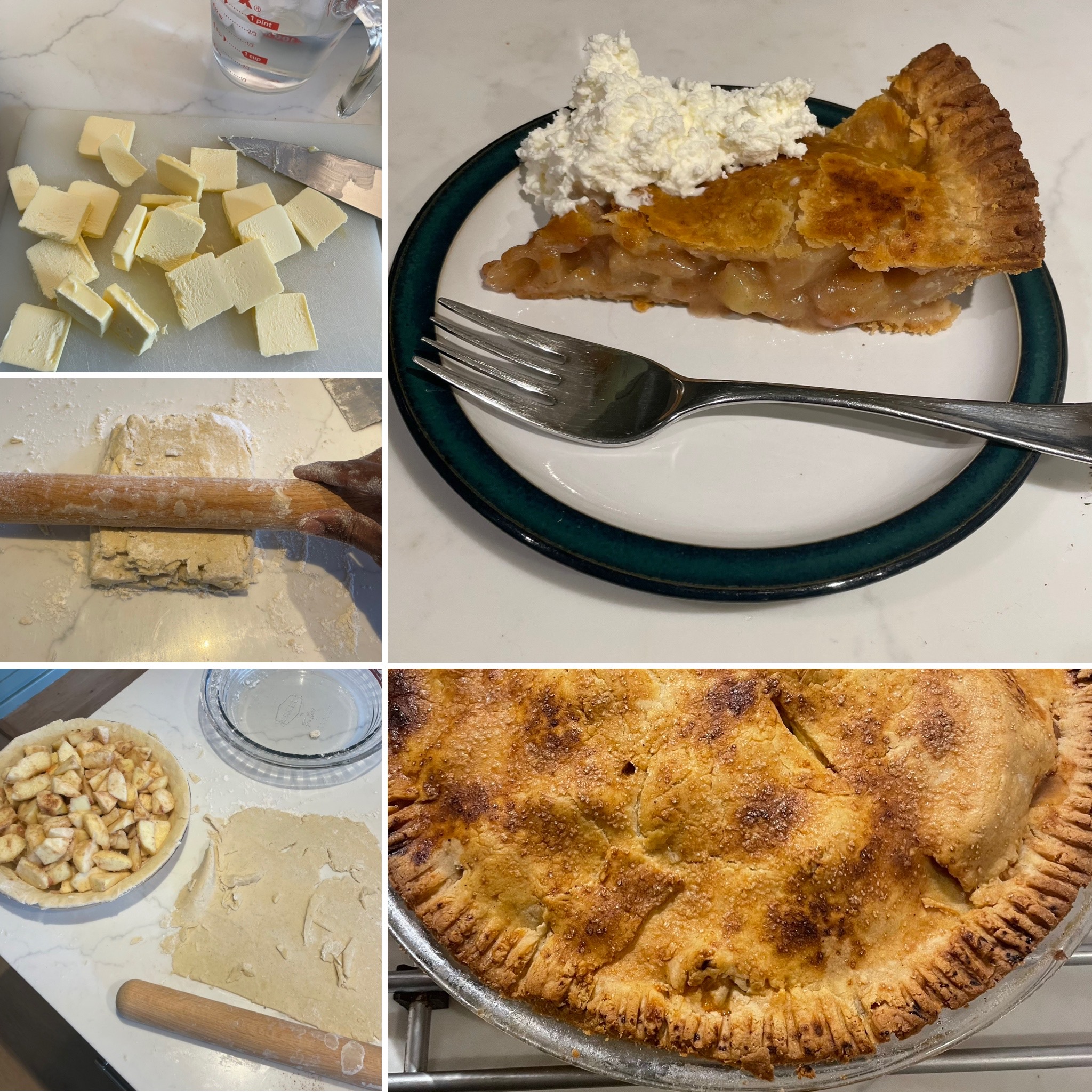
The delicious chaos that (almost always) eventually tames into a tasty flaky pastry crust… it’s always a worrying mess to start out, but you trust to your experience, and you carry on, with hope. #thanksgiving

Image
Rolling out gluten-free flaky pastry dough…

Decoding the Universe!

I realised just now that I entirely forgot (it seems) to post about an episode of PBS’ show Nova called “Decoding the Universe: Cosmos” which aired back in the Spring. I thought they did a good job of talking about some of the advances in our understanding that have happened over the last 50 years (the idea is that it is the 50th anniversary of the show) in areas of astrophysics and cosmology. I was a contributor, filmed at the top of Mount Wilson at the Observatory where Hubble made his famous discoveries about the size of the universe, and its expansion. I talk about some of those discoveries and other ideas in the show. Here’s a link to the “Decoding the Universe” site. (You can also find it on YouTube.)

If you follow the link you’ll notice another episode up there: “Decoding the Universe: Quantum”. That’s a companion they made, and it focuses on understanding in quantum physics, connecting it to things in the everyday world. and also back to black holes and things astrophysical and cosmological. It also does a good job of shining a light on many concepts.
Image
I was also a contributor to this episode, and it was a real delight to work with them in a special role: I got to unpack many of the foundational quantum mechanical concepts (transitions in atoms, stimulated emission, tunnelling, etc) to camera by doing line drawings while I explained – and kudos Click to continue reading this post

Bluesky!

For those of you who keep up with my social media posts, you’ve probably been expecting that I’d eventually announce that I’m transitioning from Twitter to something else… and it is Bluesky. I’ll stay on Twitter for a bit longer while I settle in (and while I wait for people to see the change, etc.), but consider following @asymptotia.bsky.social asap. (I’ll continue posting at the Facebook and Instagram accounts for now.)

This change fits nicely with the fact that I have plans to somewhat increase my post frequency here on the blog – as time allows – and so I’ll post links to them on the new social media platform, and maybe welcome some new communities too. Truth be told, for the longest while I’ve been very tied up with too many projects (some of which I can’t tell you about yet!) to be as frequent a poster as I’d like to be, but I’ll do what I can.

-cvj

Westminster Wonders

ImageNever toured the inside of the Houses of Parliament before, seeing all the red and green colour coded areas (lords and commons – look at the benches next time you see debates in either place) and busts and statues of some of the shapers, for better or worse, of much of the fabric of UK democracy. (Thanks to my sister for this wonderful opportunity on Friday!) BTW, most of the interesting stuff I saw was off limits to photos, sorry!

–cvj