A defining quality of good fiction, and especially good science fiction, is that it makes the familiar strange and the strange familiar. Detective fiction goes a bit further by seeking to make significant that which is (seemingly) ordinary and to make clear that which is (temporarily) opaque. Asimov, in this sequel to another futuristic detective novel (Caves of Steel), expertly combines those feats of literary alchemy into a lively, thought-provoking entertainment.
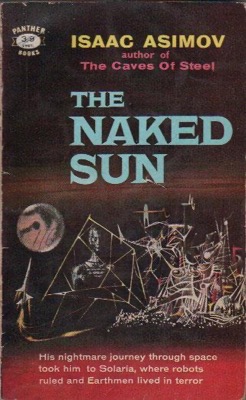 Many centuries hence, a murder occurs on the Outer Worlds planet of Solaria, where crime is practically nonexistent—and so is any kind of police force. Peculiar facts about the killing raise the need for a serious inquiry. Whoever killed Rikaine Delmarre bludgeoned him at close range, but no weapon turned up in the initial search of the crime scene. Evidence supplied by robots establishes that the only other human near that scene was the victim’s wife, Gladia, yet she fell unconscious around the time of the murder and had no chance to dispose of a weapon. Faced with this quandary, the Solarian powers-that-be deign to invite a mere Earthman to work the case on their behalf. Elijah Baley, a “plainclothesman” from New York City, thus finds himself traveling millions of miles to a planet known for its “naked sun.” (In the Earth of this imagined future, people live in subterranean “caves of steel” and have no direct experience of the star that lights their galaxy.) There, Baley reunites with Daneel Olivaw, a “positronic” robot who served as his sidekick in the previous adventure. Soon after Baley and Olivaw begin their probe, someone attempts a second murder. As the two detectives communicate via holographic projection with Hannis Gruer, the planet’s head of security, they watch him suddenly lurch into convulsions after sipping from a glass of water. Clearly, the glass contains poison. But who could have administered it, and how? Like other Solarians, Gruer lives alone on a vast estate; only his robots are able to come anywhere near him, and robots are hard-wired to avoid causing harm to their human masters.
To read this book during the 2020–2021 pandemic is to experience a shock of recognition—a glimpse of the present as foreshadowed by a decades-old vision of the future. The people of Solaria, like those of plague-scarred Earth in the time of Covid-19, interact with other humans almost entirely by remote means. Asimov posits a technology that enables what Solarians call “viewing,” and his descriptions of that practice suggest a three-dimensional version of the screen-mediated forms of engagement (Zoom meetings and the like) on which people today increasingly depend. Solarians, who descend from human Earthlings, differ from present-day humans in that they prefer viewing to its in-person alternative, which they call “seeing.” In effect, Solarians have replaced the need for human contact with a reliance on legions of supremely advanced robots. That feature rings a contemporary bell, too. Denizens of Earth do not have high-functioning anthropomorphic machines to assist them during long months of pandemic isolation. But, like their counterparts on Solaria, they struggle to understand and manage the devices (smart and not-so-smart) that they have made.
The peculiar conditions of Solaria are a critical factor in the crimes of apparent impossibility that Baley must solve. These puzzles, in fact, are keenly satisfying because they arise from—and hinge on—those very conditions. Each actual or attempted murder appears to lie outside the realm of the possible because (and only because) it takes place amid a cluster of social customs and logistical circumstances that are unique to the world that Asimov has constructed. For example, the visceral aversion that Solarians (most of them, anyway) have to sharing physical space with other humans creates a situation in which the killing of Delmarre and the attack on Gruer seem to defy explanation. Likewise, the Three Laws of Robotics, which are part of a system that Asimov has built into this world, set precise limits on the kinds of violence that robots can either perpetrate or allow to happen in their vicinity. To crack the mysteries at hand, Baley must tease apart the implications of these and other features of Solarian civilization.
Asimov manages the mystery plot with high professionalism, and he deals competently with adult themes that involve matters of human intimacy and human destiny. Even so, Naked Sun displays traces of a juvenile sensibility that was fairly common in mid-20th-century science-fiction writing. 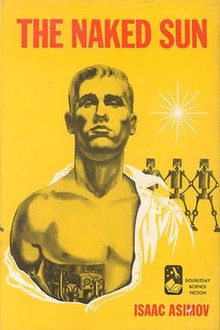 Too often, a gee-whiz tone overtakes Asimov’s otherwise serviceable prose, and his lead character, Baley, comes across as an earnest, boringly upright fellow—less as an heir to Philip Marlowe than as a law-enforcement version of Buck Rogers. In addition, there is a subplot that concerns the threat of intergalactic war, and although Asimov handles that story line with some complexity, its presence here brings a pulpy space-opera element into what should be (and mostly is) a tightly focused tale of investigation and discovery.
Like the best science fiction of its era, the novel also explores big ideas in a big, none-too subtle way. As the tale unfolds, Asimov presents a series of conversations between the Earthman sleuth and several of the Solarian suspects, including a sociologist, a roboticist, and the erstwhile assistant of the first victim, who had been the planet’s foremost “fetal engineer.” These conversations teem with anxious speculations about parenthood and family life, about population growth and the fate of nations (or, indeed, of entire planets), about humanoid machines and the humans who create them—preoccupations that were bubbling just under the surface of American culture during the 1950s. To reach Solaria, Baley spans many lightyears in a space capsule. Asimov, meanwhile, brings something else back from his fictive journey: a time capsule.
[ADDENDUM: A recent column in The New York Times by Paul Krugman spurred me to read this book at this time. Krugman flags the somewhat uncanny way that Asimov prefigured life under semi-lockdown. Naked Sun features “a society in which people live on isolated estates, their needs provided by robots and they interact only by video,” the columnist writes. “The plot hinges on the way this lack of face-to-face contact stunts and warps their personalities.”
So my review here steals just a bit from Krugman. It also steals a bit from myself. Looking back at my piece on the prequel book, Caves of Steel, I see that that I’ve touched on some of the same themes again—the science-fiction-as-time-capsule idea, the motif of using futuristic conditions (such as “laws” that govern robot behavior) to drive an impossible-crime plot. So I’m less original in this instance than I could be. Then again, the same is true of Asimov.]
 Clara Gamadge has rented a summer place in Connecticut. As she readies the house for guests, she and her housekeeper catch spectral glimpses of a woman on the edge of the property. The figure wears an old-fashioned purple dress and a matching bonnet, and Clara soon discovers eerily similar garments in the attic of the house. Those items had belonged to a woman who died a year ago, and in a baroque sequence of events that includes another ghost sighting and a horse-and-buggy accident, that woman’s sister falls victim to a murderer while the sister is under Clara’s watch. The narrative register then shifts with the arrival of Clara’s husband, Henry, who conducts an even-keeled investigation that effectively exorcises the book’s HIBK atmospherics.
 The four aging bloodhounds who make up the eponymous club evoke the trope of a ragtag band of heroes, each with quirks and qualities that complement those of their comrades. The leader of the pack is Elizabeth, a no-nonsense professional whose pre-retirement profession looms as a thinly veiled secret. (She knows her way around a police report, and she demonstrates a keener knack for surveillance craft than a nice Englishwoman should have.) Ibrahim, quiet and prim, is a psychiatrist, with a room full of patient files that inform his encyclopedic understanding of mental dysfunction and human sorrow. Ron, Ibrahim’s temperamental opposite, was a rabble-rousing labor leader in his heyday; even in his declining years, he’s a man of urgent emotion and ready action. The club’s newest recruit is Joyce, a retired nurse whose warm, fluttery personality obscures her sharp medical acumen. Occasional excerpts from Joyce’s diary add color, and a few surprises, to the book’s tart, omniscient narrative.
 But on her return to the house, Bundle latches onto signs that a sinister plan lay behind that death. For one thing, someone had neatly arrayed a set of seven alarm clocks in the room of the deceased man, and then thrown an eighth clock onto the lawn at Chimneys. For another, the dead man had left a draft letter—discovered by Bundle—that alluded cryptically to something called Seven Dials. A second odd death, involving another bloke who was at the Cootes’ house party, puts her curiosity into overdrive. With help from a few other young blades who attended the party, Bundle plunges into an amateur investigation with the same disregard for personal safety that characterizes her approach to driving along narrow country lanes in her Hispano car.
  The area is now a twee urban nook, full of soap shops and artisanal eateries, all located on a series of narrow streets that converge in seven points around a traffic circle. In the center of the circle stands a monument—a reproduction of a similar structure from the 17th century—that features seven sundials. The monument wasn’t in place during Christie’s time, and that absence of a tangible referent perhaps gave the name
  From these indicators, along with other data points related to a quartet of killings, Maclain deduces the identity of a culprit as well as the method by which the perpetrator transformed brute homicidal intent into a series of apparent miracle crimes. A violent death at the beginning of the novel marks the pattern: Blake Hadfield, a cold-hearted banker who had alienated business associates and family members alike over many years, tumbles from an eighth-floor interior balcony at the Miners Title and Trust Building in Lower Manhattan. Ostensibly, only Seth Hadfield, Blake’s estranged son, had the opportunity to pitch the victim into the building’s atrium; otherwise, the floor was empty, and the building nearly so. Seth proclaims his innocence, and Maclain believes him. But Maclain, a genius amateur sleuth of the classic variety, also rejects the suicide theory put forth (at least initially) by his sparring partner in detection, Inspector Davis of the NYPD Homicide Squad. Two similar deaths follow—in each case, a man falls from a great height with no one in the vicinity who could have provided a helpful heave-ho—and another suspicious death, from six years earlier, looms over the whole affair. The book has just eight chapters, but Kendrick necessarily devotes the last of them to a long disquisition by Maclain on the killer’s bravura scheme and his own bravura effort to unravel it.
 Like any proper fictional detective, Maclain has a distinguishing feature that sets him apart from the common herd, and from most other fictional detectives: He is completely blind. Yet his blindness is no mere gimmick. Kendrick rhapsodizes at length and with real subtlety about the compensatory talents that allow his hero to glean truths that other people are too jaded by sight to see: “Maclain was subject to no distractions that afflict the normal person in a world of light. … Many normal people intent on concentration have to close their eyes. Maclain’s were always closed.” Before the case reaches an end—it’s a satisfying conclusion, albeit one with more tendrils of complication than it probably needs—Maclain will test not only his powers of perception and intuition, but his physical and moral courage as well. Blindness, we come to understand, is at least as much a gift as it is a handicap.
 From the title, a reader-to-be might expect this book to offer a tale of through-the-looking-glass antics in the tradition of Lewis Carroll. If told that it’s a biblio-mystery that features a precious, newly discovered manuscript, the reader might expect Carroll to be the author of that literary treasure. Yet, while there is some madcap (pun intended) business with stolen hats, the novel only vaguely echoes the logic-addled playfulness of Carroll’s work. The (apocryphal) manuscript, meanwhile, was penned by Edgar Allan Poe—a quite different 19th-century author—and Carr, although he infuses several scenes with moody gusts of London fog, does little to emulate the brooding quality that we associate with Poe. In fact, the author to whom Carr most clearly pays homage here is a 20th-century contemporary of his:
  By contrast, an unbreakable alibi situation posits that one or more suspects couldn’t have committed the crime at a particular time. Carr, in this novel, proves to be as ingenious at deploying one sort of trick as he is at the other. Fortunately, he narrates the breaking of an alibi in a much less plodding way than Crofts. Not so fortunately, he does it in a harried fashion that tests a reader’s ability to absorb either the details of the alibi or the process of breaking that alibi.
 Among the central players in the drama are Francis Xavier Benedik, a partner in a London investment firm; his son, Anthony Xavier Benedik, who is also a partner; a third partner, Samuel Rickworth; and Rickworth’s daughter, Petronella (“Peter”), who is Anthony’s fiancée. Supplementing the cast are assorted clerks, secretaries, and servants who work either at Rynox House, where the investment firm keeps its offices, or at the Benedik home in Mayfair. (
 As is typical of
 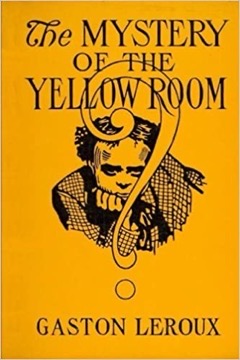 In its setting and its setup, the
 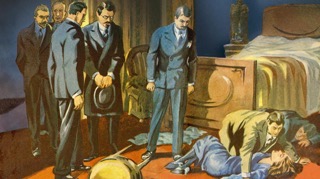 Solving this conundrum requires both painstaking analysis and bold intuition. (“We have to take hold of our reason by the right end,” Rouletabille notes.) But Leroux, having contrived this feat of deception, proceeds to swaddle it in layers of over-embroidered, shoddily sewn story material. As a result, when the time comes to explain this sleight of hand, what should be an adroit revelation becomes a labored and almost impossible-to-follow disquisition.
 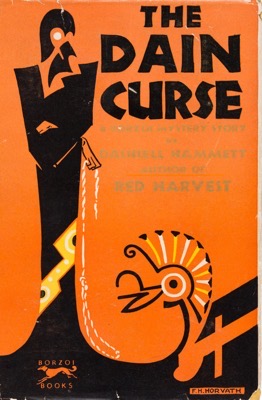 Many corpses accumulate along the way, and the only factor that appears to link these deaths is Gabrielle. A possible explanation for all of this violence—though not one that the Op accepts—is a curse that supposedly afflicts the Dain family, from which Gabrielle and her mother descend.
 Only Detect
