
The Marilyns
A Marilyn is a hill of any height with a prominence or a drop of 150 metres (nearly 500 ft) or more on all sides.
Marilyns are one of the classes of Relative hills. You can separately view The Irish and Manx Marilyns. Note that from June 2025, the Manx Marilyns are excluded, consistent with the publication of The Revised Relative Hills of Britain: The Marilyns by Alan Dawson.
You aren't signed in. Login or Register to log or view hills climbed.
View Help for reasons for automated sign-out.
Register and sign in to log and view your ascents
Select countries to display for The Marilyns
The Marilyns by topographic area
Click on a hill total in the right column of the table below for a map showing hills and totals you have climbed from this list in the corresponding area.
Display map of The Marilyns with all alternative geographical area types ▶
About The Marilyns
Show a panel explaining who created the list and why, relevant books, plus the latest updates:
Why was this list created?
 The Marilyns were devised by Alan Dawson.
They were originally published in The Relative Hills of Britain, published by Cicerone Press in 1992
A new edition was published in 2025.
How are these hills defined?
Hill prominence refers to the relative height compared to surrounding hills. The Relative Hills Society has adopted several Hill Lists which are based on the prominence of the hills relative to adjacent hills. This explanation of hill prominence describes how a Marilyn, sometimes known by the shorthand P150 compares to other types of relative hills in the UK.
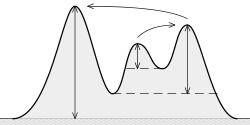 If you’re wondering why the 150m (c 490 ft) threshold was selected by Alan Dawson, it’s because it’s similar to the 500 ft prominence criteria selected by J. Rooke Corbett when he compiled his list of Scottish Hills between 2500 feet and 3000 feet.
Alan Dawson has also listed the Submarilyns. These are hills that just fail (by up to 10m) to qualify on the drop rule, i.e. drop of 140m to 149m on all sides.
League tables
Here are the latest Marilyn League Tables amongst members of Hill Bagging.
You can see the latest Marilyn Hall of Fame, showing the number climbed by different people on the Relative Hills Society site.
View League tables for The Marilyns
For Relative Hills including Marilyns, Humps, Tumps and Simms Halls of Fame are published each year.
Latest changes to this list
View the Change Register, the registry of changes to the Marilyn’s list.
List of The Marilyns and ascents
Register and sign in to log and view your ascents
Note that if you sort by date and see dates of '01/01/1900', this indicates that when you logged or imported data for this hill, no date or an invalid date was assigned for this ascent e.g. '00/00/0000'. The 1900 date is used in this table since it's required for the correct sort order. You can edit the ascents to the correct date or year, if known, to avoid this and to get correct annual totals in 'My Progress'.
My Progress
User not signed in. Login.
Register (FREE) to log hills climbed. Our community of hill walkers share tips on the best routes and use league tables to compare progress.
My Progress — check your progress for all popular hill lists.
League Tables — compare your progress with other site members.
Site Status — check the latest hill changes, ascents, updates and bugs. Latest updates: 22/10/2025.
Map and list information
For map clarity, larger hill lists with more than 500 hills present blue clusters on small scale maps. The clusters are a tool to navigate around the map — click the cluster nearest your area of interest to re-centre and expand the map.

 map button, ALL relative hills are shown for convenience as circles with transparent background to show summit and size indicating prominence for relative hills:
- Marilyns >=150m
- Humps > 100m
- Tumps > 30m
- Other < 30m

For Hill list pages accessed via the top menu, you can set colour coding and sizing of triangles to show summits reached using hill display preferences.
Hill Bagging and DoBIH are run by a team of volunteers, but there are significant hosting costs. If this site has helped you, please contribute.
