
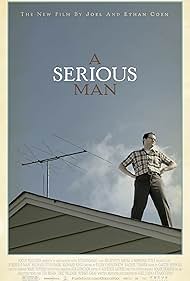

Larry Gopnik, a Midwestern physics teacher, watches his life unravel over multiple sudden incidents. Despite seeking meaning and answers amidst his turmoils, he seems to keep sinking.Larry Gopnik, a Midwestern physics teacher, watches his life unravel over multiple sudden incidents. Despite seeking meaning and answers amidst his turmoils, he seems to keep sinking.Larry Gopnik, a Midwestern physics teacher, watches his life unravel over multiple sudden incidents. Despite seeking meaning and answers amidst his turmoils, he seems to keep sinking.
- Directors
- Writers
- Stars
- Nominated for 2 Oscars
- 17 wins & 80 nominations total


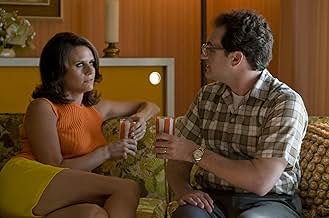


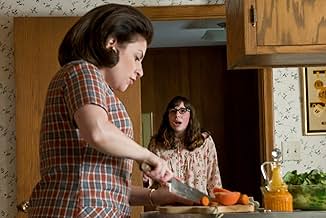
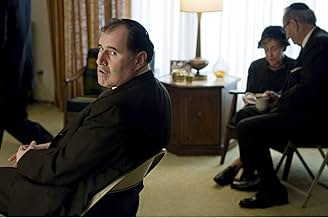


- Directors
- Writers
- All cast & crew
- Production, box office & more at IMDbPro
Featured reviews
It's a humble project for the Coens, but don't ever underestimate what they can do. A Serious Man is a serious picture that makes you laugh and squirm at the misfortune of Larry Gopnik. An average mid-western Jewish man searching for reason in a time where there is none. Tested is he to make peace with HaShem when all around him is moral decay and temptation. The Coens strength is in their characters, which in this film are as rich as they've ever been. I was fascinated by Arthur Gopnik, a borderline autistic man who discovers a map of the universe while tending to his sebaceous cyst. Perhaps my favorite character was Sy Ableman, a self proclaimed "serious man" from the community who Larry's wife is cheating on him with. His purposely affected anglo-saxon accent nearly killed me. It's the littlest eccentricities of people that the Coens always explore and exploit and it's eternally delightful.
Those who expect life to be a series of plausible outcomes, logically following some kind of cause and effect order are always disappointed by honest works of art, not to mention life itself. One of the very themes of this film are those kinds of people and their need to cling to some sort of tradition, structure, and belief in order to deny their fear.
Another theme was perspective and perception. That what may seem mundane and meaningless may be filled with the most profound meaning and that which we place so much value in may be worth absolutely nothing.
"Receive with simplicity everything that happens to you."
If you can enjoy a movie that leaves you with questions as much as one that attempts to provide answers then I highly recommend a viewing.
It helps to be familiar with the paradox of Schrodinger's cat, a staple of quantum physics, which can be found on Wikipedia, before you go see this film. You might also want to understand the quantum concept of duality.
The entire movie examines Gopnick and his world==and to a lesser extent that of his teenage son--in light of these aspects of quantum mechanics. I could not find a single scene that did not address uncertainty and/or duality. The attempt to discern traditional religious meaning in this world is humorous in itself. The opening presents the paradox and is crucial to the rest of the film.
Unlike the local review for the film which described this as a "typical Coen Brothers film" and "weird" and "no closure at the end", I found this film to be quite literal and true to the principles of uncertainty and duality. The two major characters both find closure, and in retrospect, there is clearly a beginning, middle and end to the story the brothers wanted to tell.
But the movie continues after the closure, just as life continues on a daily basis, setting up another expectation of continual uncertainty.
Not being Jewish, I no doubt missed some of the double entendre and humor in the tradition. I would have liked to understand the Hebrew passage of the bar mitzvah ceremony, for example, and how it relates to the core theme of the film. But the movie is universal in its appeal, if you understand the basic concept of quantum mechanics upon which the film is based.
I rate this as one of their best films due to its intellectual foundation. Much more important to me than No Country.
Once again Joel and Ethan delve into ancient texts to tell a modern parable about the disconnect between religion and science using the Book of Job as their mirror tale. Each tragedy shows us how Larry is torn between his profession and his heritage. Stuhlbarg's interpretation of this character is the strongest part of this film; little nuances of touching himself and, a definite sense of discomfort throughout made me empathise with Larry in every scene. Even the facial movements of Larry illustrates the strain being placed upon this man.
The dialogue in the film could be poetic at times, but there was a constant drive towards narrative, and it left me feeling removed from connecting with anyone but Larry. The scene where Larry is being told by his wife's lover that he has to move out felt comic but cold, and the majority of other scenes kept this tone. And since the plot was a bit episodic, this made the tragedies feel unreal and repetitive.
The Coen's direction also felt tired compared to their other films. Typical Coen brother tracking shots, their usual portrait shots, action shots contained to one characters reaction; nothing new. The care and inventiveness that I would usually expect wasn't there. I suppose it being the fourth film from the two in a three year period, they just didn't seem wholly engaged in it. One particular scene where they are tracking a shot down a hall to a crying woman as her crying gets louder, it didn't add any further character development and wasn't interesting but felt like a "Coen" shot.
Thematically the film was alright, and there are some interesting things that could be analysed, but it was was underwhelming and at times a bit vague in what they were actually trying to say. The ending of the film was indicative of this; 2 interwoven scenes concluding two plots, adding more tragedies to Larry's life but giving nothing to the audience except these tragedies and a feeling of resignation. Being this direct in the treatment of your subject can be dull, and I was left unsatisfied.


Did you know
- TriviaThe names of the characters who ride the school bus with Danny Gopnik are the names of children that the Coen brothers grew up with.
- GoofsIn the final scenes where Larry changes Clive's failing grade, you can clearly see the erasure marks of the new grade before he erases the old one. This could denote the film makers needing several takes to get the right shot. Yet, it could also have been chosen to be included on purpose to show that Larry struggled many times with the morality of passing Clive, going so far as to update his grade, but had changed his mind.
- Quotes
Rabbi Nachtner: You know Lee Sussman.
Larry Gopnik: Doctor Sussman? I think I - yeah.
Rabbi Nachtner: Did he ever tell you about the goy's teeth?
Larry Gopnik: No... I- What goy?
Rabbi Nachtner: So... Lee is at work one day; you know he has the orthodontic practice there at Great Bear. He's making a plaster mold - it's for corrective bridge work - in the mouth of one of his patients, Russell Kraus. The mold dries and Lee is examining it one day before fabricating an appliance. He notices something unusual. There appears to be something engraved on the inside of the patient's lower incisors. He vav shin yud ayin nun yud. "Hwshy 'ny". "Help me, save me". This in a goy's mouth, Larry. He calls the goy back on the pretense of needing additional measurements for the appliance. "How are you? Noticed any other problems with your teeth?" No. There it is. "Hwshy 'ny". "Help me". Son of a gun. Sussman goes home. Can Sussman eat? Sussman can't eat. Can Sussman sleep? Sussman can't sleep. Sussman looks at the molds of his other patients, goy and Jew alike, seeking other messages. He finds none. He looks in his own mouth. Nothing. He looks in his wife's mouth. Nothing. But Sussman is an educated man. Not the world's greatest sage, maybe, no Rabbi Marshak, but he knows a thing or two from the Zohar and the Caballah. He knows that every Hebrew letter has its numeric equivalent. 8-4-5-4-4-7-3. Seven digits... a phone number, maybe? "Hello? Do you know a goy named Kraus, Russell Kraus?" Who? "Where have I called? The Red Owl in Bloomington. Thanks so much." He goes. It's a Red Owl. Groceries; what have you. Sussman goes home. What does it mean? He has to find out if he is ever to sleep again. He goes to see... the Rabbi Nachtner. He comes in, he sits right where you're sitting right now. "What does it mean, Rabbi? Is it a sign from Hashem, 'Help me'? I, Sussman, should be doing something to help this goy? Doing what? The teeth don't say. Or maybe I'm supposed to help people generally, lead a more righteous life? Is the answer in Caballah? In Torah? Or is there even a question? Tell me, Rabbi, what can such a sign mean?"
[pause as the Rabbi drinks his tea]
Larry Gopnik: So what did you tell him?
Rabbi Nachtner: Sussman?
Larry Gopnik: Yes!
Rabbi Nachtner: Is it... relevant?
Larry Gopnik: Well, isn't that why you're telling me?
Rabbi Nachtner: Okay. Nachtner says, look. The teeth, we don't know. A sign from Hashem? Don't know. Helping others... couldn't hurt.
Larry Gopnik: No! No, but... who put it there? Was it for him, Sussman, or for whoever found it, or for just, for, for...
Rabbi Nachtner: We can't know everything.
Larry Gopnik: It sounds like you don't know anything! Why even tell me the story?
Rabbi Nachtner: [chuckling] First I should tell you, then I shouldn't.
Larry Gopnik: What happened to Sussman?
Rabbi Nachtner: What would happen? Not much. He went back to work. For a while he checked every patient's teeth for new messages. He didn't find any. In time, he found he'd stopped checking. He returned to life. These questions that are bothering you, Larry - maybe they're like a toothache. We feel them for a while, then they go away.
Larry Gopnik: I don't want it to just go away! I want an answer!
Rabbi Nachtner: Sure! We all want the answer! But Hashem doesn't owe us the answer, Larry. Hashem doesn't owe us anything. The obligation runs the other way.
Larry Gopnik: Why does he make us feel the questions if he's not gonna give us any answers?
Rabbi Nachtner: He hasn't told me.
[Larry puts his face in his hands in despair]
Larry Gopnik: And... what happened to the goy?
Rabbi Nachtner: The goy? Who cares?
- Crazy creditsAt the end of the credits is a line advising that "No Jews were harmed in the making of this motion picture."
- ConnectionsFeatured in The Rotten Tomatoes Show: Surrogates/Pandorum/Fame (2009)
- SoundtracksSomebody to Love
Written by Darby Slick
Performed by Jefferson Airplane
Courtesy of The RCA Records Label
By arrangement with Sony BMG Music Entertainment
Details
- Release date
- Countries of origin
- Official site
- Languages
- Also known as
- Un hombre serio
- Filming locations
- Czech Republic(scenes before opening credits)
- Production companies
- See more company credits at IMDbPro
Box office
- Budget
- $7,000,000 (estimated)
- Gross US & Canada
- $9,228,768
- Opening weekend US & Canada
- $251,337
- Oct 4, 2009
- Gross worldwide
- $31,431,652
- Runtime
- 1h 46m(106 min)
- Color
- Sound mix
- Aspect ratio
- 1.85 : 1

