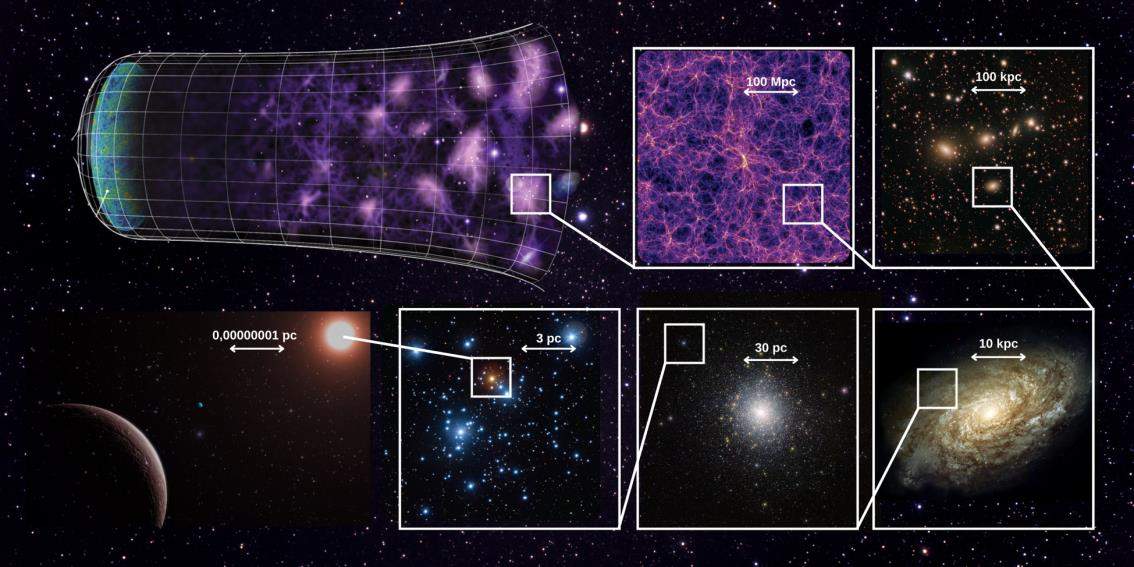
Astrophysics is witnessing a golden era with a number of breakthrough discoveries achieved in the last decade or so, and a large variety of new instrumentation and programs planned for the next decade. Nonetheless, a comprehensive understanding of the formation and evolution of structures in the Universe is still missing.
Many key quests in modern astrophysics and cosmology are still in their infancy:
- Is the accelerated expansion of the Universe due to an unknown form of energy or to a modification of General Relativity on large scales?
- What is the interplay between dark, stellar, and gaseous material in galaxies and how does primordial and metal-enriched gas flow in and out of galaxies at various scales?
- What is the detailed formation history of our own Galaxy, the Milky Way and of its satellites?
- What is the origin of the various chemical elements that are crucial to trace galactic evolution?
- What are the conditions that drive the formation and evolution of extra-solar planets?
- What are the extreme physics conditions that govern transient events (explosions, eruptions, and disruptions)?
- What do gravitational waves tell us about neutron star physics, heavy element production, and cosmology?
A vital element to answering these questions will be the availability of vast all-sky spectroscopic datasets of nearby and distant astrophysical sources at medium and high resolution delivering quantitative measurements of key physical parameters: examples include the redshift of galaxies, the kinematics of galaxies and stars, the physical and evolutionary properties of galaxies, the metal content and detailed chemical composition of stars. WST will be an innovative spectroscopic facility to provide this essential capability to the astronomical community.