Pride Was Born Out of Protest
June 22, 2026 — There was a time when being perceived as queer could be dangerous, often resulting in a night spent in jail or being brutalized with very little to no access to recourse. State sodomy laws, federal hiring bans, and immigration restrictions were once considered the default when it came to recognizing LGBTQ+ people. Stonewall Inn was a place of refuge as much as a place of resistance. When existing is illegal and safe places are scarce, being who you are is a radical act. Homosexuality was a criminal offense in 1969, and laws attempting to prohibit queer spaces from operating littered municipal, state, and federal policy. Police raids were commonplace at LGBTQ+ spaces across the country. It was June 28, 1969 a little after 1am that Stonewall was raided by NYPD officers in plain clothes. Interrogations ensued, but a routine raid on a queer space was not what anyone found that night. Transgender and gender non-conforming patrons were targeted and ordered to be detained by Inspector Seymour Pine. This wasn’t surprising – what was different was that this time, after countless raids, people not only resisted, they rebelled. Instead of lining up to be detained, arrested, or brutalized in the midst of a raid, the frustration of patrons and onlookers broke. Yelling began, then object throwing, and by the following afternoon, the city was abuzz with what had happened in the early morning. By the next week, so was the country. The following year, The first Christopher Street Liberation Day March, what we now recognize as the first Pride Parade, took place to commemorate the rebellion at Stonewall. This attracted thousands of participants, shocking organizers. This march solidified Stonewall's place in the LGBTQ civil rights movement and history. In the decades that followed Stonewall, it has been mythologized. Accounts vary from participants and news coverage, while more than typical when it came to LGBTQ+ stories at the time, it wasn’t exhaustive. What we know came undoubtedly from Stonewall is a sense of unity in the queer community. The first gay activist organization, The Gay Liberation Front (GLF), was founded, which then led to the Gay Activists Alliance (GAA), The Human Rights Campaign (HRC), GLAAD, and more. Pride was born from the celebration and community that lives at the center of protesting. The Month of June signifies a celebration of LGBTQ+ people, history, and life. It demands visibility for people who were criminalized for existing and reminds all of us that living authentically is a radical act. We are lucky enough to benefit from the advocacy of Marsha P. Johnson, Sylvia Rivera, Stormé DeLarverie, Miss Major Griffin-Gracy, Dick Leitsch, Craig Rodwell, Tommy Lanigan-Schmidt, Martin Boyce, Raymond Castro, and so many more who made Pride possible. Pride is rooted in connection. To find community, check out this non-exhaustive list of resources: It Gets Better Center for Black Equity Familia: Trans Queer Liberation Movement (Familia:TQLM) The National Queer Asian Pacific Islander Alliance Trans Lifeline LGBT National Help Center
Read More
Finding Community When You Need It Most
June 22, 2026 — A little over a year and a half ago, I performed in drag for the first time. I remember the way time seemed to slow down as I stepped through the curtain into the bar, the rush of the spotlight glowing on my face, and the feeling that this was something I was truly meant to be doing. But, just as importantly, I remember the outpouring of support I felt from the community around me after the performance was over; people coming up to talk to me, older performers offering me kind words and advice. This, to me, is the most important thing about drag. Don’t get me wrong, I love the makeup, the glamorous costumes, the spotlights, the chance to transform into another version of myself for a night–but more than anything, I love the community that comes with it. When I did that first drag number, I had been going to local shows around my city for over a year. The first time I went to a drag show was also my first time in a gay bar, and I vividly remember the feeling of stepping into a space surrounded almost exclusively by other queer people and immediately feeling so incredibly at home. That feeling has only grown stronger. Drag is, and has always been, a space for queer people to find community and family. Experienced drag performers will often “adopt” newer performers and become drag parents, a tradition with roots in the ballroom scene; mentor figures who are there to teach you which rhinestones to use and how to style a wig properly, but also very often become extremely close, chosen family. Not only do I have a drag mom, but several drag aunts, a self-proclaimed drag godmother (who happens to be the very queen I reached out to for that first open-stage), and, since my partner is also a performer, a huge collection of drag in-laws. My partner and I often joke that the patio at the club feels like a family reunion–one of us might get lectured for taking tips badly or having our wigs glued down wrong, but we’re surrounded by people we consider to be close family, people who are often older than us who we can look up to and learn from. It's a space full of love. My local drag scene has quickly become a space where I feel safe, cared for, and uplifted, where I can be the fullest version of myself, whether I’m on or offstage. This type of chosen family can be incredibly important for the mental health of queer people, especially those who don’t have support from the families they grew up in, and is, to me, one of the most beautiful things about the queer community. Finding people who you can see yourself in, who share your experience, can be life-changing. When you surround yourself with people who can truly see and understand you, you feel less alone. When everyone around you is the weird gay one, you don’t feel like the odd one out anymore. You feel like a part of something. I urge anyone who feels like they need closer queer relationships in their lives to find the community spaces around them. Pride events are amazing, but there are so many welcoming queer spaces that exist year-round. Look for your local gay bars or sober queer spaces like coffee shops and art collectives. Look at social media or flyers around town for queer events that continue past June, maybe for a specific identity or a group that you’re a part of. Find your local drag shows and show venues–hey, maybe even pick up a wig yourself. It might change your life for the better. Get Involved Ever thought about how your mental health journey could be the blueprint someone else needs? Tell your story on our blog and show the world what mental health mobilization looks like today. Find out how to submit your story on our website.
Read More
Words as Foundation
June 8, 2026 — The first gift we’re ever given is a word — our name. When life gets in the way of words it’s difficult to process emotions in relation to the environment. I would argue words are the most basic structure of communication, even more than the alphabet since we learn the alphabet after our first words and letters/characters across languages don’t necessitate a definition or feeling. Words are so necessary to connection that there are countless ways to communicate them both textually, verbally, and physically. New words are coined by culture to bridge gaps, fill a niche, and document society. From anthropocene to google to touch grass language is preeminent in the identification of people and time. With broadness and dependency of connection on words it makes sense that the practice of journaling becomes a tool for mental health management. There is no required application to follow in the pursuit of journaling. From pen and paper to voice notes, journaling in its integrity is meant to be an outlet for all the thoughts, feelings, perspectives, etc. that cannot be captured until put into words. Whether a free write or prompt inspired, the practice of putting words to life is as old as humanity. Music without lyrics has written rhythmic cues like aria, allegro, ritardando, dolce. Fine art is paired with artist statements both personally and relationally oriented. We think, dream, feel in words – it's when words fail that anxieties spike. Journaling is said to strengthen problem solving skills, emotional resilience, self-compassion, and self-regulation whilst also identifying patterns in thoughts, moods or behaviors. Doctors and mental health professionals recommend journaling because of its low cost high reward model, with institutions like NAMI encouraging and formatting suggested prompts for reflection. Physiological wellbeing has always in some way been associated with stress. In 1997 James W. Pennebaker developed the Emotional Disclosure Theory, which inspired more formal scientific recognition for the benefits of journaling. It postulates that the suppression of emotions requires significant physical efforts which weakens the immune system and increases the risk of illness. It is through writing about emotionally charged, traumatic events that they can be organized and mental clarity can be improved. In 2022 the National Library of Medicine published a study that found “a journaling intervention resulted in a greater reduction in scores on patient health measures." While there is still very limited scientific data measuring the effects of journaling, it is a rational assumption that processing emotion, exercising mindfulness, and self-reflection are all conducive practices facilitated through journaling. This elicits the question: if we can feasibly infer the benefits of journaling why have we not empirically tested it more? Data driven analysis informs how we can better care for ourselves and gives mental health providers, researchers, and organizations the information they need to best pursue equitable action and recommendation. Journaling Prompts: Body Check In: Where are you physically feeling your emotions? What is the sensation? 3 - 2 - 1 Method: What are 3 things you noticed, 2 things you enjoyed, and 1 thing to focus on for tomorrow? High/Low: What was your high and what was your low of the day? How did each event inform the rest of your day thereafter? Control Inventory: What today has been within your control and what has been without? Fact vs Fiction: What is the anxiety informed worst-case scenario and what is the realistic outcome? Bonus: Check in after the event and log what happened, how did it compare to your initial thoughts?
Read More
When I Decided Not To Die
June 8, 2026 — As an autistic girl growing up, I didn't care what others thought of me, even if I had no friends. So, I didn't hesitate to stand up and fight for another girl who was being bullied by our classmates. But the bullying escalated for almost two years, becoming increasingly vicious and eventually directed at me. They called me the "Shihori Virus" and treated me like a piece of garbage. Even though I had a strong mind, I was gradually drained, and at one point, I began to consider taking my own life. One day, I wrote down the names of the bullies and exactly what they did to me in a notebook, seeking revenge. But after simulating that worst-case scenario in my head, I realized that dying wouldn't be the revenge I had imagined. They would just forget about me and live happily without me. So, I decided not to die. Instead, I decided to become a singer. I thought that would be the ultimate payback. What if the girl they treated like a dirty virus became a star? What if they heard her music and her voice on TV or the radio, and were accidentally saved by her message? I knew that would be the most humiliating thing for those heartless kids. I was also really fortunate that I was going to an exclusive cram schools after elementary school, which meant I wouldn’t have to see my bullies again. I started to make friends who were emotionally and intellectually more mature. I was so excited to see my new friends. Having a new community outside of the local, tiny community where I was born expanded my perspective a lot and gave me a safe place. At that point, I realized that my school was not the only world I had to live in. As my world expanded, I realized that I didn't need to stay in that tiny, limited community forever. There are people out there who will accept exactly who you are; you can explore anywhere to find them. And who knows? They might be looking for you, too! I stopped living for my bullies, and I started living for myself. Back then, I could only see darkness in my future, but I still wrote a letter to my future self: "Have you made your dream come true?" I will never forget looking up at the smoky blue sky from my window, throwing my desperate wishes into the universe. Yes, I did, girl. I became a professional singer-songwriter. My voice has been on TV and radio, and my songs have hit the top of the Japanese charts many times. Those kids have probably heard my music without even realizing it. I remind myself, all of this happened because you chose to live, girl. You saved my life. You proved them wrong, and you proved that there was never anything wrong with you. You are my savior, and I can't thank you enough for making that incredibly brave decision. After walking many rocky roads to reach my dreams, I am releasing my new single, "When I Decided Not To Die," on June 5th. I forgave them long ago when I graduated from elementary school. I still have scars in my heart, but they are my scars of honor. They used to hurt deeply, but they nurtured the core message of my life: "LOVE WHO YOU ARE." Today, I even thank those hardships for guiding me onto this path—to empower people through my music.
Read More
Advocacy on Capitol Hill: Mental Health Awareness Month Briefing Day
May 27, 2026 — Leadership begins with youth and young adults. This is a foundational truth for Active Minds – our organization runs on the advocacy built by youth and young adults. Whether through chapters, run/walk clubs, webinars, the institute, and more. To kick off Mental Health Awareness Month, five young leaders attended Capitol Hill championing the necessity of federally backed mental health support for youth and young adults led by youth and young adults to legislators. On May 5, Ayaan Moledina, Amy Senkerik, Naomi Hines, Michael Landu, and Carson Domey sat on a panel together in the Rayburn Building sharing their experiences in advocacy to House of Representative staffers and legislators. They spoke out in support of the Campus Lifeline Act, an Active Minds-authored bill dedicated to strengthening mental health support on college campuses across America through the expansion of mental health crisis resources by including the 988 Suicide & Crisis Lifeline on newly-issued student ID cards alongside increased federal investment in youth-informed mental health strategies. Panelists 17-year old Ayaan Moledina running for school board in his home county of Rock Round in Texas and director of SEAT, Students Engaged in Advancing Texas, shared his lived experiences with mental health as he passionately spoke to the expansion of suicide prevention efforts. “You can’t make effective mental health policy for young people without young people… Students are the ones closest to the problem,” Moledina said during the panel as he shared his story of being diagnosed with depression at age 10 and his trajectory into organizing grassroots efforts dedicated to education and mental health competency. Carson Domey, a Massachusetts native, said that his medical challenges “prepared him for the real chapter of [his] advocacy in mental health.” Since 12 he has advocated for the accessibility of telehealth care and found his passion for mental health advocacy after the loss of a friend to suicide in 2018. This led to his efforts in redefining physical education standards to include mental health and spreading awareness of the 988 Suicide & Crisis Lifeline. As CEO and founder of the Acts of Kindness Project, Naomi Hines seeks to uplift underserved communities. The soon to be graduate of Bowie State University is a certified mental health first aid provider with the ambition of becoming a pediatric speech language pathologist. “Why suffer alone when you have these resources around you? But we need to figure out a way to connect students to that and make students feel more comfortable even utilizing a big resource like that,” Hines said about the need for resource expansion and the necessity of destigmatizing mental health. Miachael Landu is a devoted advocate to mental health resource accessibility and passionate about destigmatizing the use of psychiatric prescriptions to be treated with the same acceptance as medications for high blood pressure. His advocacy stems from his personal journey with mental health and diagnosis with Major Depressive Disorder (MDD). “We all have the potential to inspire each other, I am really inspired by 988,” said Landu. “988 would have been a really helpful resource for me back when I didn’t know it existed.” Amy Senkerik is inspired by the loss of her best friend who died by suicide to ensure no student goes without access to the 988 Suicide & Crisis Lifeline. “When we make help easier to find we give people a better chance…Putting 988 on student IDs isn't a complicated solution.” She is an undergraduate student at Arizona State University, the largest public university in the country, where she successfully advocated for the addition of the 988 Suicide & Crisis Lifeline to be included on digital student IDs. “They don’t have to google anything, they don’t have to remember where to look, the option is right in front of them. Clear, immediate, and accessible,” she said in reference to the importance of accessibility to the lifeline in a time of crisis. Campus Lifeline Act Get involved now by supporting the Campus Lifeline Act! Reach out to your representative to show your support, it takes less than 3 minutes to click the link and urge your member of Congress to support this bipartisan bill that aims to expand access to campus mental health resources, and increase visibility of the 988 Lifeline among young adults. Youth and young adults deserve a seat at the table when it comes to policymaking because no one knows better what young people need than themselves. Policy should reflect who it is created for. These panelists are an exemplary model of the necessity of youth and young adult perspectives when it comes to making policy for youth and young adults.
Read More
5 Ways to Fund Your Trip to the Active Minds Mental Health Conference
May 12, 2026 — So you want to come to Active Minds Hill Day + Mental Health Conference 2026? That is amazing! Whether you're a first-time attendee or a returning advocate, the experience of being surrounded by hundreds of young people who care deeply about mental health is genuinely unlike anything else. However, we do recognize that a possible hurdle, especially as a student on budget, is having the financial resources to attend. The good news is that there are funding possibilities available to you that may not be on your radar. Here are four ideas for finding the resources needed to make the trip happen: 2. Tap Your School's Student Activity Fund Here's something a lot of students don't realize - your tuition might already include a student activity or co-curricular fee. That money goes into a fund specifically designed to support student development, including attending conferences. Most schools have a formal process for requesting these funds, often through a student government office or dean of students. You'll typically need to submit a short proposal explaining what the conference is, what you'll learn, and how it connects to your campus community. The Active Minds Hill Day + Mental Health Conference checks every one of those boxes. Start early, since these requests often have deadlines and review periods. 3. Ask Your Academic Department Your major department likely has a student development or professional development budget and attending a nationally recognized conference absolutely qualifies. Reach out to your department chair, academic advisor, or a faculty member you're close with. Frame it around how the conference connects to your field of study, whether that's psychology, public health, social work, education, or really any major that intersects with student wellbeing. You don't need to have it all figured out. A simple, genuine email asking about available funding goes a long way. 4. Connect With Your Campus Active Minds Chapter or Wellbeing Club If your campus has an Active Minds chapter, this is your first call. Campus organizations receive institutional funding, and many use it specifically to support members in attending conferences related to their mission. If there's no Active Minds chapter, reach out to any mental health, wellness, or advocacy club on your campus as the overlap is strong, and they may be able to sponsor your registration or co-fund your travel. This is also a great way to build relationships before you arrive and potentially coordinate a group trip (which comes with a 20% group registration discount for five or more people). 5. Look Into Crowdfunding and Community Support Don't underestimate the people around you. Platforms like GoFundMe make it easy to share your story and raise money from friends, family, and your broader community. If you explain why you're going and your passion for mental health advocacy, what you hope to bring back to your campus or community, people often want to help. You can also reach out to local businesses, community organizations, or mental health nonprofits in your area that might sponsor a student attendee. A brief, heartfelt pitch about your advocacy work and the impact of attending can open more doors than you would expect. Funding a conference trip takes a little effort and some planning, but the resources are out there. The Active Minds Hill Day + Mental Health Conference 2026 is worth it and we hope to see you there. To learn more about the Active Minds Hill Day + Mental Health Conference 2026, visit activeminds.org/conference.
Read More
Mindfulness as Resilience
May 12, 2026 — I still remember how uncomfortable silence used to feel whenever mental health came up around me, especially after losing someone I loved to suicide, because even when people cared, there was this strange hesitation in conversations where everybody seemed afraid of saying the wrong thing and so instead they said almost nothing at all. I carried that silence for a long time. A lot of my early understanding of mental health was shaped by watching people continue functioning through grief without ever really discussing what grief was doing to them privately, and I think because of that, I became very good at acting emotionally “fine” in ways that looked convincing from the outside. I knew how to keep showing up to school, work, meetings, community events, and responsibilities even when internally everything felt disconnected and heavy, and for a while I genuinely thought that was what strength was supposed to look like. Looking back now, I think I spent years trying to make difficult experiences appear smaller so other people would feel more comfortable around them. Even writing this now, I still catch myself wanting to soften certain details before saying them directly. Some habits stay in your body longer than you expect them to. Mental Health Awareness Month feels different to me now because I have seen what happens when people stop editing themselves quite so heavily around each other. Over the last few years, especially through community health work, advocacy spaces, and student conversations, I have watched people slowly become more willing to say things out loud that they used to keep hidden behind jokes, overworking, isolation, or constant busyness. I have sat with students making therapy bags while somebody quietly admitted they had not been okay for months. I have had conversations outside campus buildings at night where someone suddenly shares something deeply personal and then immediately changes the subject because vulnerability still feels unfamiliar to them. I have watched people pause mid-sentence like they are deciding in real time whether they are allowed to tell the truth. Those moments stay with me more than any polished campaign language ever does because they feel human in a very specific way. Not inspirational. Not perfectly resolved. Just honest for a second. I think losing someone changed the way I listen to other people too. Before, I often approached conversations thinking I needed to have the “right” response ready, something comforting or useful or carefully worded, but grief taught me that people usually remember presence more than perfection. Sometimes what stays with somebody is not advice, it is simply the fact that another person did not immediately pull away from their pain or rush to make it easier to digest. That realization changed me slowly. I became more honest about my own mental health. I became less interested in appearing endlessly capable all the time. There are still moments where I struggle with vulnerability, especially because being “the supportive person” can quietly become its own role that feels difficult to step outside of, but I no longer feel the same pressure to package every painful experience into something motivational before I am allowed to speak about it. Some experiences do not become neat lessons. Some things just change you permanently and then life continues around that fact. A few things I keep thinking about this Mental Health Awareness Month: people are often carrying much more than what is visible in public there is a difference between somebody hearing your story and somebody making you feel safe enough to tell it emotional exhaustion can hide itself inside productivity for a very long time some of the most important conversations happen after events technically end, when people linger instead of leaving healing can look extremely ordinary sometimes (eating something, replying to a message, sitting outside for ten quiet minutes because your room suddenly feels too small) I have become gentler with myself than I used to be, although honestly, I am still learning how to do that consistently When I think about the power of our story now, I do not think about perfectly written narratives or inspirational speeches. I think about the smaller moments that change the feeling of a room almost invisibly. Somebody said ‘me too’ very quietly. Somebody admitting they are tired in a way sleep cannot fix. Somebody finally using words for something they have carried silently for years. Those moments matter to me because they remind people that they are not strange for struggling and they are not failing for being overwhelmed. I think stories become powerful the moment another person recognizes themselves inside them (even briefly) because once honesty enters a room people tend to breathe differently afterwards. (: Get Involved Ever thought about how your mental health journey could be the blueprint someone else needs? Tell your story on our blog and show the world what mental health mobilization looks like today. Find out how to submit your story on our website.
Read More
What Loss Inspires: A Mental Health Advocacy Institute Story
April 27, 2026 — Loss has a way of reshaping not only how we see the world, but also how we choose to move through it. During my freshman year of college, a friend died by suicide, an experience that fundamentally altered my sense of purpose. As co-captains on the basketball team, she taught me how to advocate for others and lead with purpose. Grieving her loss, I simultaneously felt a profound need to aid and prevent others from experiencing similar tragic losses. This became the foundation of my commitment to mental health advocacy. In the time that followed, I sought out ways to turn that commitment into action. I joined my university’s counseling services outreach program, where I worked to connect students with mental health resources and decrease stigma surrounding mental health. The next year, through the Active Minds Mental Health Advocacy Institute, I expanded my involvement to a broader level, engaging in initiatives that addressed both access and policy. Through these experiences, I learned that advocacy often begins with small, intentional steps. Mental health is still surrounded by stigma, and many individuals struggle in silence. I came to understand that simply asking someone how they are really doing can be powerful. Creating spaces where people feel seen and heard is not always easy, but it is essential. One of the most meaningful aspects of my time with the Institute has been updating the 988 Suicide and Crisis Lifeline on student mobile IDs, increasing access for 194,000 students. Being part of an initiative that resulted in a tangible, lasting impact showed me that advocacy can extend beyond conversation and into real systemic change. My work in outreach also revealed how barriers such as lack of awareness, fear of judgment, and limited access to care prevent many students from seeking help. These experiences reinforced my belief that education and accessibility are key components of prevention. At the same time, my involvement in national advocacy efforts highlighted the importance of addressing structural issues, including cost, provider shortages, and cultural stigma. Advocacy is not a separate part of my life; it has become the lens through which I approach everything I do. It shapes how I interact with others, how I respond to challenges, and how I define meaningful impact. My friend’s legacy continues to guide me, reminding me why this work matters. If you are considering getting involved in mental health advocacy, start where you are. You do not need to have all the answers to make a difference. What matters is your willingness to listen, to learn, and to act. Your voice has the power to create change. 🩷💚 Apply to this cycle of the Active Minds Mental Health Advocacy Institute by May 25, 2026, for the upcoming 2026-2027 academic year!
Read More
Mental Health Advocacy Institute: Change Starts with You and Happens Here
April 27, 2026 — Young people are defined by change; the first 25 years of a person's life are hallmarked by moving grades, starting different schools, learning what you like, realizing what you don’t, and experiencing the world, all while growing into yourself. Change is hard, and making change can be harder, but who is more qualified to do it than dedicated youth and young adults? When mobilizing for mental health, it’s young people at the forefront of the movement; they are the visionaries behind a kinder, more empathetic world where resources are available, and stigma has been dismantled. How can we help young people turn their ideas into action? Active Minds created the Mental Health Advocacy Institute with the purpose of supporting college students in practically implementing their big ideas when it comes to mental health on their campuses. This is a paid, year-long virtual mental health advocacy program for 70 students from colleges and universities across the country, under the guidance of Active Minds and the direction of an on-campus steering committee. The Fall is focused on using evidence-based strategy to formalize an action plan that addresses a mental health issue facing their campus, and the Spring is for implementation. Challenges facing campuses can include a lack of existing resources, and underutilization of resources, disparities, academic pressure, loneliness, and more. Active Minds connects students with strategies that are proven to be effective, from peer education to skills training interventions for stress management. With the Active Minds Mental Health Advocacy Institute, you can start creating change. Apply to this cycle of the Active Minds Mental Health Advocacy Institute by May 25, 2026, for the upcoming 2026-2027 academic year! Eligibility Requirements Between 18-25 years of age Currently enrolled at a U.S. college or university and located within the United States Graduating no sooner than May 2027 Not studying abroad from September – December or from February – April during the program Have been enrolled at their current institution for at least one full academic year
Read More
How to Stay Calm and Focused During Finals Week
April 9, 2026 — Finals week can feel like everything hitting at once. Multiple exams, large amounts of material, and pressure to perform can quickly become overwhelming. When stress builds, it becomes harder to focus, easier to procrastinate, and tempting to push mental health aside. What helps most is not a perfect routine; it is having a few simple tools you can use in the moment to stay calm and keep moving forward. Break Studying Into Smaller Targets One of the biggest reasons students feel overwhelmed during finals is that they look at everything they have to do at once. “Study for biology” or “review all of history” feels too large to start. Instead, break your work into smaller, specific targets. For example: Review two chapters Complete ten practice problems Rewrite one set of notes This reduces the mental friction of starting. Once you begin, it is much easier to continue. Breaking work into smaller goals also prevents last-minute cramming, which can be one of the biggest sources of stress during finals. Use a Breathing Reset When Stress Spikes During finals, stress can build quickly, especially when you feel stuck or overwhelmed. In those moments, trying to push through can often make things worse. A simple reset can help. One of the most effective techniques is a breathing method called the cyclic sigh: Take a deep inhale through your nose Immediately take a second short inhale Slowly exhale through your mouth until your lungs are empty This type of breathing helps calm your nervous system and reduce stress in seconds. Research from Stanford found that short, structured breathing practices can significantly reduce anxiety and improve mood, with cyclic sighing showing particularly strong effects. As a co-founder of StayMindful, a mental health app designed for students, I’ve seen similar results. In student testing, after a short guided breathing exercise, over 100 students reported feeling 4 out of 5 calmer on average, from not calm to extremely calm. Study in Focused Rounds, Not Endless Marathons Many students try to study for hours without stopping, especially during finals week. This often leads to burnout and reduced focus. Instead, work in focused rounds. Choose one task, give it your full attention, and then take a short reset. During that break: Stand up Walk around Stretch Do a quick breathing exercise Avoid turning breaks into long periods of scrolling, which can make it harder to return to work. Working in structured rounds allows you to maintain higher focus and get more done in less time. Protect Your Mood During Finals Week Finals week is not just a test of knowledge; it is also a test of consistency and mindset. When students start to feel discouraged or overwhelmed, it becomes much harder to stay productive. Small positive inputs can make a difference: A short reset A reminder that you are making progress A moment to step back and breathe At StayMindful, we send daily motivational quotes and short mental health content to help students stay consistent with these habits. The goal is not to eliminate stress completely, but to make it manageable so you can keep moving forward. It is also important to remember that your grades do not define your worth. Active Minds emphasizes that students are more than their academic performance, especially during high-pressure times like finals week.
Read More
What Emotional Resilience Looks like To Me
April 9, 2026 — I’ve always loved Solange Knowles. Not just for Cranes In The Sky (though that song plays like gospel when I’m in my feelings), but because of the raw, unfiltered truth she delivers through her music. In Cranes, she sings about trying to drown out pain through every coping mechanism we’re taught to idolize: shopping, working, crying, even changing her hair. She did it all. And still, she felt everything. It wasn’t numbness she was singing about; it was exhaustion. A bone-deep kind of weariness that isn’t necessarily big, but still weighs down your chest. I didn’t expect that to hit me the way it did. But emotional pain? It’s quiet like that. It doesn’t always arrive in sobs or breakdowns. Sometimes, it just lingers. A sort of ineffable type of feeling. And eventually, like Solange, you realize that healing doesn’t come from running. It comes from stopping. From feeling. From rebuilding, piece by piece, breath by breath. That’s what resilience has looked like for me, and trust me, it wasn’t cute. I was born in Washington D.C., but I was raised in Italy, and eventually I moved from Italy to rural Georgia when I was eight. I didn’t know the language. I didn’t understand the culture. And for a long time, I didn’t even recognize the version of myself I had to become to survive. I was the only African boy in a sea of Southern drawls and tight-knit friend groups that spanned years. People laughed at my accent, butchered my name (as if pronouncing Dom-uh-NICK Mim-uh-BANG is the hardest task in the world), and asked me if I was “really American.” I remember reading aloud in class and hearing snickers when I tripped over words. Not because I didn’t know what they meant, but because I had only ever seen them written, never said aloud. I stayed quiet for years. Even after I learned the language, I couldn’t shake the shame that had already dug itself in. That’s the thing about resilience: when it starts forming in silence, it hardens differently. I thought the only way to prove I belonged was to overperform. To show up everywhere—to be louder, better, more prepared, more impressive. I joined every club, led every project, and tried to become undeniable. I ran for leadership in an organization that quite literally shaped who I am today. Not once. Twice. And I lost both times. Not quietly, either. I campaigned at conferences with thousands of attendees and read a speech out to those same attendees. And both times, I had to clap for someone else as the room erupted in applause for them. It was public. It was humbling. And it was painful. But here’s the thing: I kept going in the organization and stayed involved, regardless of whether or not I was on the state board for it. And that’s resilience. Not perfection. Not ever failing. Just... refusing to stay down. So what is emotional resilience, really? According to the American Psychological Association, resilience is “the process and outcome of successfully adapting to difficult or challenging life experiences.” It’s not something that you’re naturally born with; it’s something you build over time (APA, 2022). So if you've ever felt like a mess after a rejection or a failure, guess what? You’re not broken, you're human. Here’s how I started building mine: Feel First, Fix LaterI used to think I had to “bounce back” instantly. Now I know better. Resilience starts with sitting in your feelings. Labeling them. Talking about them. According to the National Institutes of Health, acknowledging emotions and processing them (instead of bottling them up) is linked to better long-term mental health outcomes (NIH, 2021). It’s okay to say, “This really hurts.”That’s not weakness. That’s step one. Build a Soft LandingThere’s a myth that strong people are self-sufficient. That we “tough it out” alone. But Harvard research says otherwise. One supportive relationship—a teacher, a parent, a friend—can be the biggest predictor of a young person’s ability to recover from adversity (Harvard, 2021). My bounce-back crew includes my AP Literature teacher, Miss Davenport, my mom, and my unserious but wise friend Akshaaya. Together, they’ve talked me off more metaphorical cliffs than I can count. Find your people. Let them in. Redefine What "Losing" MeansThose elections I lost? At first, they felt like public proof that I didn’t belong. But eventually, they became reminders that worth isn't tied to a title. I learned how to organize, how to connect with people, and how to speak from the heart without a script. I learned to lead without a title. And weirdly enough, I’ve had more impact from the sidelines than I ever thought possible. Resilience taught me that worth doesn’t come from applause. It comes from the “why” behind the work. Let Humor Heal YouThere’s science to back this up: researchers from the Mayo Clinic say that laughter reduces stress, improves mood, and even strengthens your immune system (Mayo Clinic, 2021). And sometimes? The only thing between you and a breakdown is a well-timed meme. I’ve made Canva powerpoints titled “Why I Shouldn’t Have Trusted the Process” and voice-noted myself mid-cry just to laugh at it later. It works. (Not always. But more often than not, it does.) Resilience isn’t linear. Some days, you feel like you’re floating above it all — like the cranes in Solange’s sky. Other days, you’re stuck in the mud of everything going wrong. But you are still here. And that’s enough. So if you’re in the middle of your own comeback story, I hope you take this as permission to feel everything, rest when you need to, and keep rising: quietly or loudly, slowly or all at once. Your bounce-back era isn’t coming. It’s already in motion. And when you look back, you’ll be proud you didn’t give up.
Read More
Built on Compassion: How Louisville High School is Growing Its Mental Health Community
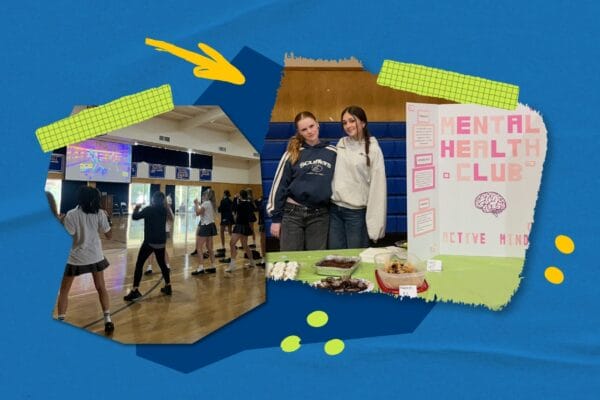
March 23, 2026 — This month, our Chapter of the Month shines a light on how the Active Minds Louisville High School Chapter is creating a space where mental health conversations are real, open, and stigma-free. Since launching in 2023, the 80-member group has been all about supporting each other, speaking up, and making campus feel a little lighter. Louisville’s Chapter has quickly grown into a vibrant community of almost 100 members dedicated to advocating for student well-being. Rooted in the school’s mission of empowering young women to drive meaningful change, this student-led group is building a more compassionate campus through creative programming, peer support, and a shared commitment to making mental health a priority for all. From high-energy stress relievers to meaningful moments of reflection, Louisville’s Active Minds chapter keeps mental health support both engaging and accessible, finding small but impactful ways to help students manage stress and feel supported. Discover how they’re changing the game through our Q&A. Tell us about your school and chapter. Louisville High School is an all-girls College Prep Catholic high school founded in 1960. As part of Louisville’s mission of envisioning a world where women initiate change to enrich their communities, Active Minds/Mental Health Awareness Club has been a great addition to our campus climate. Our chapter was started with the main goal of advocating for the betterment of student’s mental health in our Louisville Community. Share something your chapter has done recently that you are proud of. We are proud of the range of activities and awareness we have provided to our school community. One of the more successful Wellness Wednesday events was when we hosted a “Just Dance” activity in partnership with the Counseling Department as a midweek mood boost to shake off some stress. We also implemented the “I wish Campaign” to our chapter and our student body so students could express their feelings to know their voice matters and to build a more compassionate community. Most recently, some of our chapter members hosted a booth at our school event “Louchella” as a fundraiser to donate back to Active Minds. At the fundraiser, we provided fidget coil rings and calming strips as a tool to support their mental health. Why is mental health important to your chapter and school? Mental health is important at our school, as stress can affect students differently, and we want to help students process their feelings in a healthy way. We want to create a sensitive and open environment for students to share their feelings without fear of judgement. How is your chapter making a difference on campus? Our chapter is making a difference on campus by providing students with initial breaks and methods to cope with stress by participating in the Wellness Wednesdays in collaboration with the Counseling Department. In addition to providing some tools, we spread mental health awareness to break the stigma by sharing quotes and educational videos. What advice would you give to someone thinking about joining or starting a chapter? Do it! Get involved and try to be routine in going to Chapter meetings. But don’t overwork yourself, your mental health matters just as much! What is a mental health mantra your chapter lives by? Aside from schoolwork and extracurriculars, students have other components of their lives that may be impacting their mental health, so lead with some grace. Acknowledging that mental health is important and how even though some mental illnesses are not seen, they matter just as much!
Read More