

Download the free Kindle app and start reading Kindle books instantly on your smartphone, tablet, or computer - no Kindle device required.
Read instantly on your browser with Kindle for Web.
Using your mobile phone camera - scan the code below and download the Kindle app.

Follow the author
OK
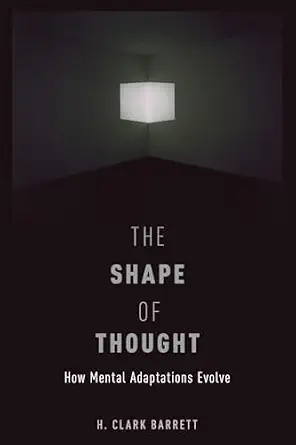
THE SHAPE OF THOUGHT: How Mental Adaptations Evolve (Evolution And Cognition Series)
Purchase options and add-ons
The Shape of Thought: How Mental Adaptations Evolve presents a road map for an evolutionary psychology of the twenty-first century. It brings together theory from biology and cognitive science to show how the brain can be composed of specialized adaptations, and yet also an organ of plasticity. Although mental adaptations have typically been seen as monolithic, hard-wired components frozen in the evolutionary past, The Shape of Thought presents a new view of mental adaptations as diverse and variable, with distinct functions and evolutionary histories that shape how they develop, what information they use, and what they do with that information.
The book describes how advances in evolutionary developmental biology can be applied to the brain by focusing on the design of the developmental systems that build it. Crucially, developmental systems can be plastic, designed by the process of natural selection to build adaptive phenotypes using the rich information available in our social and physical environments. This approach bridges the long-standing divide between "nativist" approaches to development, based on innateness, and "empiricist" approaches, based on learning. It shows how a view of humans as a flexible, culturally-dependent species is compatible with a complexly specialized brain, and how the nature of our flexibility can be better understood by confronting the evolved design of the organ on which that flexibility depends.
- ISBN-100199348316
- ISBN-13978-0199348312
- Edition1st
- PublisherOxford University Press
- Publication dateJanuary 16, 2015
- LanguageEnglish
- Dimensions1.2 x 6.1 x 9.1 inches
- Print length407 pages
![]() |
Frequently bought together

Similar items that may deliver to you quickly
ADAPTED MIND: EVOLUTIONARY PSYCHOLOGY: Evolutionary Psychology and the Generation of CultureTOOBYPaperback$3.95 shippingOnly 1 left in stock - order soon.
Thought in a Hostile World: The Evolution of Human CognitionHardcoverFREE Shipping by AmazonGet it as soon as Wednesday, Jul 1
The Semantic Architecture of Mind: How minds generate, organize, and stabilize meaning.PaperbackFREE Shipping on orders over $35 shipped by AmazonGet it as soon as Wednesday, Jul 1
The Rational Animal: How Evolution Made Us Smarter Than We ThinkHardcoverFREE ShippingOnly 3 left in stock - order soon.
Consciousness and the Social BrainPaperbackFREE Shipping on orders over $35 shipped by AmazonGet it as soon as Wednesday, Jul 1Only 4 left in stock (more on the way).
Customers also bought or read
- The Selfish Gene: 40th Anniversary Edition (Oxford Landmark Science)
Paperback$16.26$16.26Delivery Wed, Jul 1 - ADAPTED MIND: EVOLUTIONARY PSYCHOLOGY: Evolutionary Psychology and the Generation of Culture
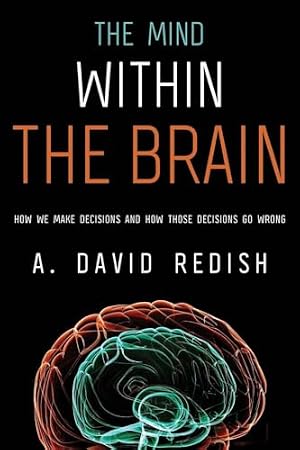
Paperback$66.19$66.19$3.95 delivery Fri, Jul 3 - The Mind within the Brain: How We Make Decisions and How those Decisions Go Wrong
Paperback$19.79$19.79$3.99 delivery Jul 6 - 9
Editorial Reviews
Review
--Metapsychology
Book Description
About the Author
Product details
- Publisher : Oxford University Press
- Publication date : January 16, 2015
- Edition : 1st
- Language : English
- Print length : 407 pages
- ISBN-10 : 0199348316
- ISBN-13 : 978-0199348312
- Item Weight : 1.15 pounds
- Dimensions : 1.2 x 6.1 x 9.1 inches
- Part of series : Evolution and Cognition
- Best Sellers Rank: #460,128 in Books (See Top 100 in Books)
- #116 in Physical Anthropology (Books)
- #216 in Cognitive Psychology (Books)
- #269 in Anthropology (Books)
- Customer Reviews:
About the author

Discover more of the author’s books, see similar authors, read book recommendations and more.
Customer reviews
- 5 star4 star3 star2 star1 star4 star61%0%0%0%39%0%
- 5 star4 star3 star2 star1 star3 star61%0%0%0%39%0%
- 5 star4 star3 star2 star1 star2 star61%0%0%0%39%0%
Customer Reviews, including Product Star Ratings help customers to learn more about the product and decide whether it is the right product for them.
To calculate the overall star rating and percentage breakdown by star, we don’t use a simple average. Instead, our system considers things like how recent a review is and if the reviewer bought the item on Amazon. It also analyzed reviews to verify trustworthiness.
Learn more how customers reviews work on AmazonTop reviews from the United States
- 5 out of 5 stars
Seminal work in cognitive evolution
Reviewed in the United States on March 16, 2021This is among the very best books written on the topic of cognitive evolution by a world expert on this topic. I use it to teach a graduate class on cognitive and cultural evolution, and couldn't recommend it more highly. Truly outstanding!
4 people found this helpfulSending feedback...Sending feedback...HelpfulThank you for your feedback.Sorry, we failed to record your vote. Please try againThanks, we'll investigate in the next few days.Sorry, We failed to report this review. Please try again - 1 out of 5 stars
Sort of not useful
Reviewed in the United States on March 5, 2019This is a brilliantly argued, wonderfully informative, book that is as comprehensive as it is useless. Over 300 pages and nothing more useful than I found on the Wikipedia article. Though hundreds of examples and even more citations the author make the case that evolution shaped the mind, piling on one mental adaptation upon another without any interest in an "end". The author states in the first 200 pages the party line as it were of cognitive phycology. Evolution looks for a good enough solution to a problem and there are problems of "bets" that things will be a certain way, that the problem of visual representations on the mind, that mental frames affect our thinking, social evolution is mediated by representations of others.
3 people found this helpfulSending feedback...Sending feedback...HelpfulThank you for your feedback.Sorry, we failed to record your vote. Please try againThanks, we'll investigate in the next few days.Sorry, We failed to report this review. Please try again - 5 out of 5 stars
An essential review of evolution's role in psychology
Reviewed in the United States on February 10, 2015Clark Barrett's The Shape of Thought is a lucid and important work that formulates a modern approach to studying the mind by taking seriously the consequences of viewing the mind as the product of evolution and seeing what this entails. This approach inevitably requires abandoning long-held naïve conceptions of mind--still prevalent in psychology and neuroscience--that essentially approach the mind in a dualistic fashion. Barrett shows that this dualism results in biologically implausible hypotheses that unjustifiably divide the mind into a set of two opposing processes: domain-specific ones, which are responsible for behavior that is evolved and therefore innate or instinctive, and domain general processes, which are learned and therefore responsible for flexibility and higher cognitive functions. Barrett exposes this simplification as unrealistic; the products of evolution are created by the process of development, which requires two-way interactions between genes and the environment. Learned, then, should not necessarily be seen as opposed to evolved. For example, it may be (and certainly in many cases is) the case that evolution uses environmental input in the form of learning as part of the stimulus required to produce its target phenotype. Barrett further shows that the flexibility of the human mind is unlikely to be purely the result of a single general-purpose learning mechanism. Instead he shows how flexibility can arise from the interactions of multiple specialized components and that in many cases this is more consistent with what we know about how evolution works, as well as with the current evidence we have from developmental biology and neuroscience. Showing the flaws in this dualistic approach to the mind is the crux of Barrett's argument, but the book is not limited to this. It also contains fascinating discussions of theory of mind, answers questions about cultural evolution, shows why the "gene shortage" argument is incorrect, and shows how moving targets are not the evolutionary problem many researchers think they are. The Shape of Thought is an excellent refutation to many critics of evolutionary psychology and is an essential read for anyone looking to understand how the mind is likely to have evolved.
15 people found this helpfulSending feedback...Sending feedback...HelpfulThank you for your feedback.Sorry, we failed to record your vote. Please try againThanks, we'll investigate in the next few days.Sorry, We failed to report this review. Please try again - 5 out of 5 stars
Deeply informative and thought-provoking
Reviewed in the United States on June 2, 2023Barrett's "The Shape of Thought" is perhaps the best book that is available on the evolution of the human mind
One person found this helpfulSending feedback...Sending feedback...HelpfulThank you for your feedback.Sorry, we failed to record your vote. Please try againThanks, we'll investigate in the next few days.Sorry, We failed to report this review. Please try again - 5 out of 5 stars
Must-read for the student of human behavior
Reviewed in the United States on May 17, 2021Barrett argues for the importance of evolutionary reasoning applied to human behavior in this book. While the topic is extremely dense, Barrett's conversational tone makes it as easy as possible to digest. Any student of human behavior should read this book; I promise they will think about things in a new light after being exposed to this book.
One person found this helpfulSending feedback...Sending feedback...HelpfulThank you for your feedback.Sorry, we failed to record your vote. Please try againThanks, we'll investigate in the next few days.Sorry, We failed to report this review. Please try again - 5 out of 5 stars
Highly recommended.
Reviewed in the United States on November 14, 2015Full of new ideas about the evolution of the mind. Will challenge your preconceptions about why we think the way we do. A fresh take on evolutionary psychology that is incisive, readable, and unconventional. Highly recommended.
7 people found this helpfulSending feedback...Sending feedback...HelpfulThank you for your feedback.Sorry, we failed to record your vote. Please try againThanks, we'll investigate in the next few days.Sorry, We failed to report this review. Please try again