
Discover, collect, analyze your games
Played
64.7M
Games
365K
Ratings
39.2M
Reviews
4.46M
Lists
788K
or log in if you have an account




Recently trending
What is Backloggd?
Backloggd is a place to virtually track your game collection. Keep your backlog updated, rate the games you've played and add those upcoming to your wishlist. Share your gaming journey with your friends by following each other to keep up-to-date on your latest play sessions.
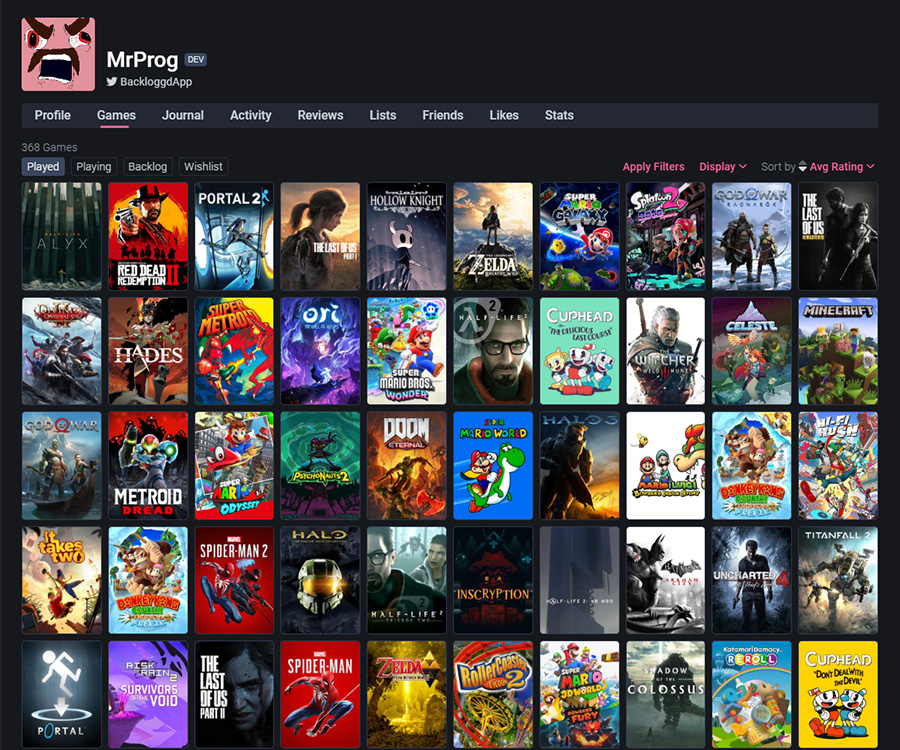
Track your personal game collection
Log any and every game you've played, are currently playing, and want to play. Be as detailed as you want with features such as time tracking, daily journaling, platform ownership and more.
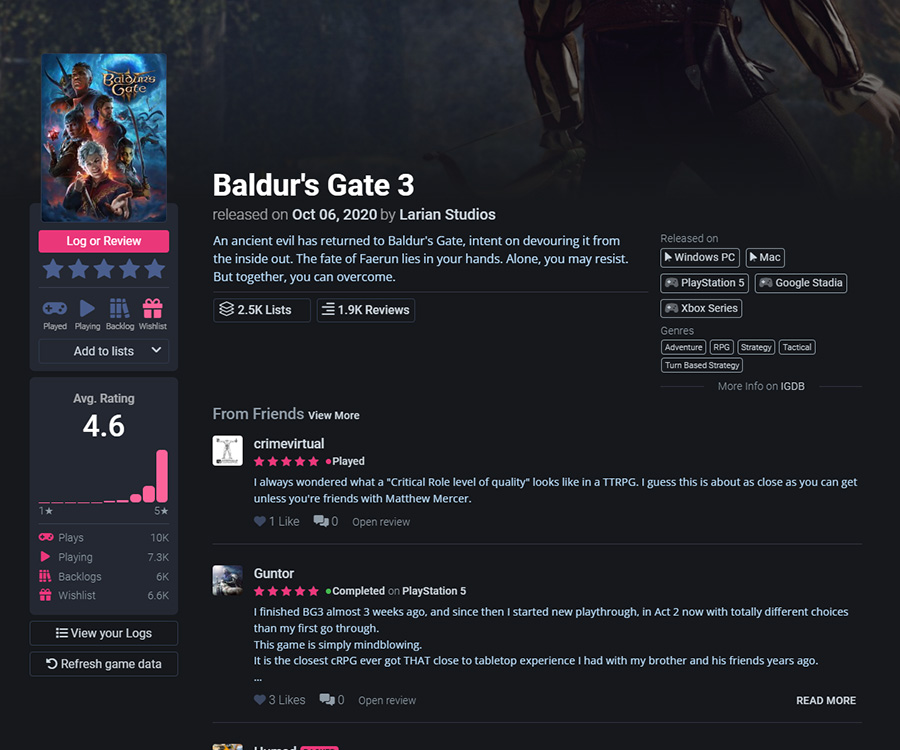
Express your thoughts with reviews
See what everyone is thinking with reviews. Every game has an average rating comprised of everyone's rating to give you a quality score from a glance. Then once you're ready, add your review to define what the game means to you.
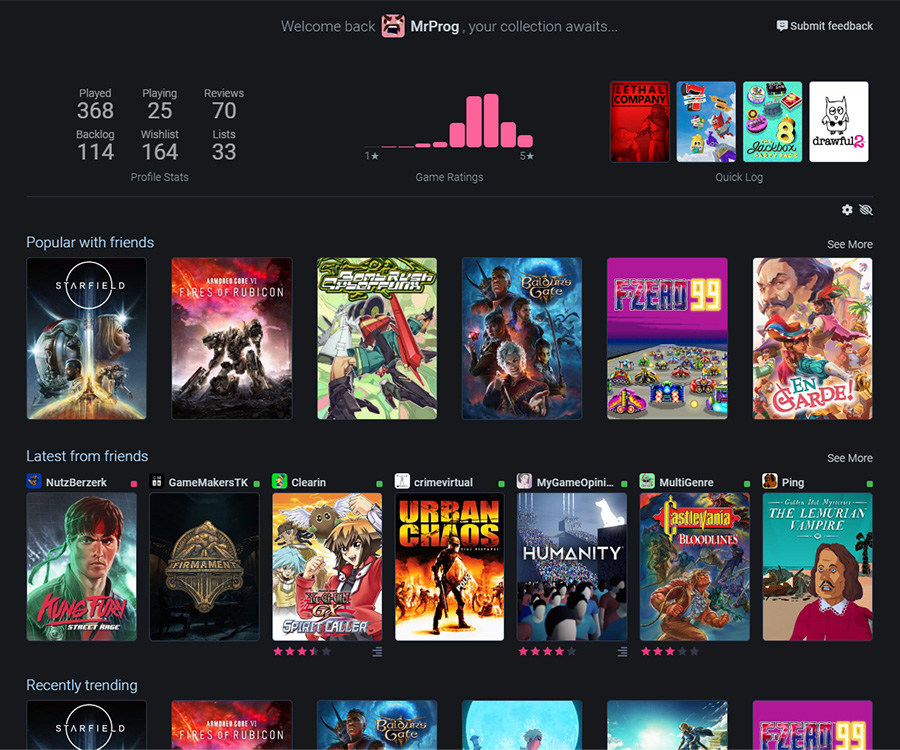
Keep up with the latest from friends
Follow others for an all-in-one activity feed that will keep you updated with their latest gaming progress. Games, reviews, and lists from friends appear directly on your home page so you don't miss a thing.
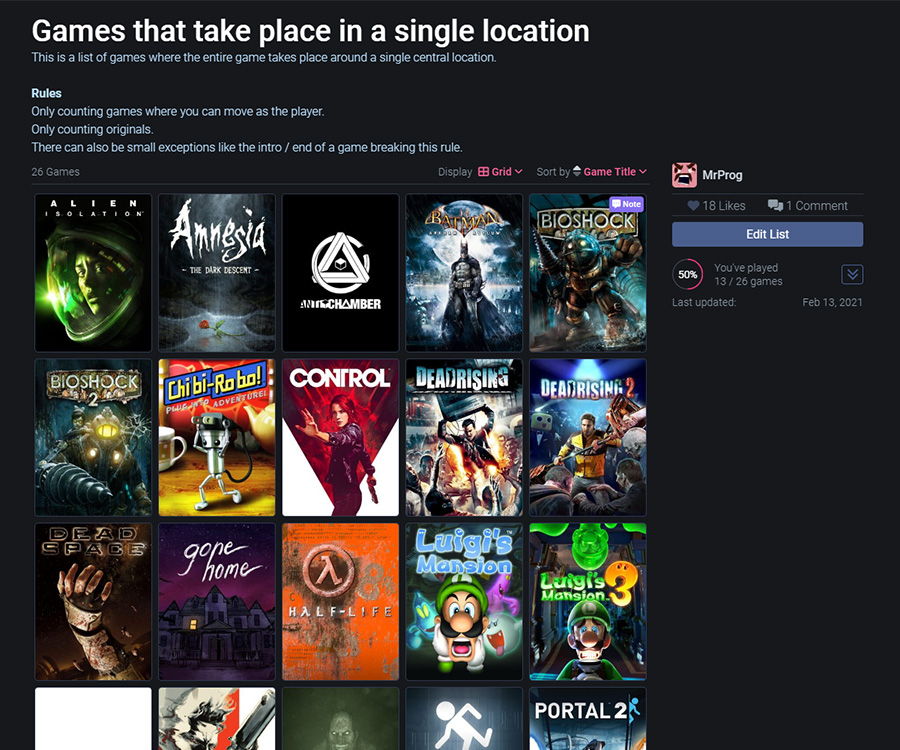
Create and organize games with lists
Lists allow you to create a custom collection of games with options such as tracking your progress or enabling rankings. You can then decide to share your list with the community or keep it private to yourself.
Popular reviews
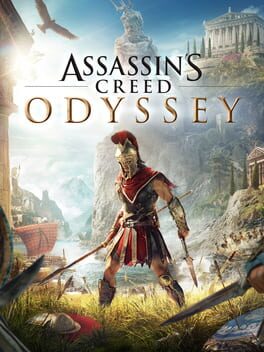
A ambientação é o ponto mais forte sem discussão. A Grécia Antiga é belíssima, com cidades marcantes, ilhas cheias de personalidade e paisagens que tornam a exploração recompensadora por si só. O sistema de builds complementa bem essa experiência: especializar o personagem em diferentes estilos de jogo adiciona uma camada estratégica que os títulos anteriores simplesmente não tinham.
O combate é divertido, embora os confrontos possam se arrastar mais do que o necessário. O stealth é onde o jogo mais se afasta da identidade clássica da franquia: a detecção é rigorosa, os recursos são escassos e muitos alvos simplesmente sobrevivem ao assassinato furtivo.
A narrativa fica abaixo do potencial do cenário. A história consegue prender a atenção, mas o elenco é pouco marcante, prejudicado por uma dublagem inconsistente e diálogos rasos que diminuem o impacto de momentos importantes.
O excesso de conteúdo é o defeito mais persistente. O mapa está repleto de atividades criadas apenas para estender a campanha, e mecânicas como o Culto de Kosmos e as batalhas de conquista — que realmente trazem variedade — acabam sendo exceções em meio à repetição. Ainda assim, poucos jogos recriaram um período histórico com tanto cuidado. A Grécia que Odyssey construiu continua sendo um dos mundos abertos mais fascinantes da franquia.
This review contains spoilers
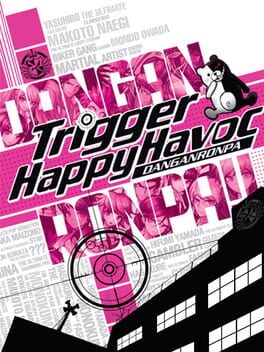
surprisingly so in fact. I've had a complicated relationship with this series, first starting as something I absolutely adored, then slowly liking it less and less, until in mid 2022 when I made my account, I had settled on the games being kind of bad. as time went on however, I became less and less certain of my opinions, simply because it had been longer and longer since I played them. so, I've finally decided to satisfy my curiosity and dive back in to the series, to hopefully have a somewhat definitive opinion on them.
and so, it comes as a shock to me that I actually think this game is pretty good. however, it is very flawed at the same time, and so the good parts can be rather hard to notice amongst all of the noise. beyond the one giant elephant in the room - which we will get to, don't you worry - Danganronpa is an experience of highs and lows, with the lows making it difficult to appreciate the highs, and the highs trying to hide themselves behind a façade of irony and edginess.
given that it's a visual novel, the bulk of the discussion will be centered around the game's writing, so I'd first like to talk about everything else before we get to the main subject. Danganronpa is a game where a lot of the style is the substance. it's a spin on Ace Attorney, inspired by the presentation of Persona 3 and Persona 4, with a tone and style veering very close to Suda51's (at the time) later games, like killer7 and No More Heroes. a lot of focus is put on the UI and UX of the game, especially during the Class Trials. words break apart as you shoot them with Truth Bullets then the entire screen shatters, and the discussion text box reappears with digital beeps. there's a lot of care to make things as stylish as possible and give a lot of impact and weight behind everything. it's very obviously building on the foundation laid by Ace Attorney, but made snappier and with its own unique twist. the words of the people during the debates fly all over the screen, spin around, overlay each other, so you have to literally cut through the noise to find the true contradiction.
Danganronpa also has a very distinct atmosphere. It’s a sort of hyperreality where everything is just off enough to be uncanny. Obviously, there’s the way the environments assemble themselves each time you enter a room, with the characters themselves being 2D sprites, which makes everything feel like a pop-up book. A large part of the game’s visual style is that all of the blood is a bright pink, a form of censorship and stylization, that adds to this feeling of hyperreality. Despite the game’s dark tones, a lot of the environments are very saturated, with bright poppy colors and unnaturally colored lights. Again, it creates a sense that the setting is on the verge of reality, at the time bordering on being wacky, but the game always keeps one steady foot in realism to make sure everything still has weight and gravitas when it needs to. the soundtrack also plays a large part in creating the game's unique style. it's composed by Masafumi Takada, who also did the soundtrack for all of Suda51's games from Moonlight Syndrome all the way to No More Heroes, and you can definitely feel it. I lack the knowledge to properly identify what makes the OST so good, all I know is that it sounds good and I love listening to it.
alright, with the preamble out of the way, it's time to talk about the meat and potatoes of Danganronpa: the writing. given how it's divided into 6 chapters, I'll be talking about my feelings on each one in detail, so spoiler warning.
chapter 1:
I've always felt this was a very strong introductory case, and that remains true. this chapter is a very good tone setter for what the game is. Sayaka dying might be a bit obvious, given how much focus she gets in the chapter, but the fact that she tried to kill someone first and was planning to frame Makoto - the main character - for it is a good twist that gives the case more depth. I don't think it's super evident that the killer is Leon, but it's not unrealistic for someone to come to that conclusion on their own, given that you have all the necessary clues. Junko being killed due to breaking the rules also makes Monokuma a much more concrete threat and shows why the characters can’t fight back against him.
...so, 11037 right? everyone and their mother always talks about it's so obvious, in let's plays I've watched the person always immediately figures out that you just have to just turn the image 180° to see that it's LEON and not 11037. it's something that everyone will figure out unless they only speak Japanese.
so yeah anyway on my first playthrough I didn't figure it out until the game spelled it out for me. granted, I was not even 14 yet, but still. I can't really say if I would've gotten it if this was my first time playing, so I can't speak as to obvious 11037 is, but yeah I was the one non-japanese speaking person to not immediately understand it.
chapter 2... we'll save that one for later, I have a lot to talk about.
chapter 3:
this is generally regarded as the bad case of DGR1, and... look I don't entirely disagree, but it's not as bad as people make it out to be. the mystery itself, with Celeste working with Hifumi to kill Taka, and then Hifumi pretends to be dead so he can move Taka's body, and then Celeste betrays and kills Hifumi, and trying to unravel all that? I actually like it. the problem is more so the character writing in the chapter, before the murders. Taka going beast mode is just kind of strange; it's built on Mondo and Taka's sudden (and rushed) friendship from the previous chapter, and by the end it doesn't even go anywhere. the beef between him and Hifumi over Alter Ego feels weird and contrived in a way that the game generally avoids otherwise. it's just not a very pleasant chapter, and while I like the mystery and Celeste's breakdown, it's not enough to save it for me.
chapter 4:
probably the best case in the game? I also really like case 5 but it's technically not complete until case 6, so by itself case 4 is likely the best one. I love how at first it seems like it was either Byakuya, Toko, or Yasuhiro, but then turns out it was neither. then, suspicions falls on Hina, but it slowly becomes more evident that it wasn't her, leaving the only option to be that it was a suicide, which is what actually happened. not only is the mystery itself compelling, but the character dynamics here are what makes it so interesting. Hina tried to frame herself for murder so everyone would vote wrong and they'd all die, because she got tricked by the fake suicide note that Monokuma wrote, so she thought that Sakura hated everyone, and thus Hina thought that by dying, they'd atone for their mistreatment of Sakura. meanwhile Byakuya, who is originally so confident and sure of himself, is genuinely taken aback because he didn't figure out it was a suicide, but Makoto and Kyoko did. he just didn't think that Hina would act based on her emotions rather than pure pragmatism, which is what led him to miss the truth of the case. seeing Byakuya panicking, and even actually apologizing for being rude, is a delight because for the first time ever, he's on the backfoot.
chapter 5:
this one is also really interesting, because the circumstances surrounding the "murder" here are all very strange, and something feels decidedly off. the only two suspects possible are Kyoko and Makoto, but we know it couldn't have been Makoto, and while the evidence seems to point to Kyoko, it doesn't feel quite right, and there's never any conclusive proof. The entire trial has a weird aura which I find to be really cool, since it hints at the fact that there’s more going on behind the scenes, but you don’t know what yet. The trial even ends abruptly without the usual closing argument, and Makoto is even voted as the culprit, and Monokuma blatantly lies about him having done it, and even tries to execute Makoto, though he survives thanks to Alter Ego.
I feel this chapter is where Makoto reveals himself to be more interesting character than previously thought. chapter 4 also started this, but this is where it becomes apparent. he stops having to rely on Byakuya and especially Kyoko for clues and information, especially given that now Makoto and Kyoko are in direct opposition. in general, I actually really like Makoto, and he's definitely nowhere near as dumb as people make it out to be. I think a lot of that reputation comes from having to wait for him to put the pieces together for the trials themselves, instead of during the investigation. Once he’s in the class trials however, he is surprisingly clever, and only gets better and better at solving cases as the game goes on. He’s also just a nice, optimistic guy, which goes a long way in making the game more pleasant. He’s a cool guy! He has puppyboy energy, and I like his dynamics with the others characters, mainly the back and forth him and Byakuya have. Byakuya on some level respects Makoto, since he’s the only one alongside Kyoko to consistently solve the cases; at the beginning he sees Makoto as a threat, but by the end they’re more so friendly rivals, even if it would kill Byakuya to admit he has any friends. Kyoko and Makoto also have a dynamic I really like, cause there’s no awkward romance between the two and instead they’re just friends who solve crimes together, with the very emotional Makoto being a good contrast to the stoic Kyoko, and in turn Kyoko begins to let her emotions show around him. I also think Toko is fine, she’s a girlfailure (complimentary) and reeks of repressed lesbian, but most of my appreciation for her comes from UDG and not specifically Danganronpa 1. Aoi and Yasuhiro are kinda whatever, I like Aoi’s role in case 4, but aside from that they’re mostly kinda bland and I think the other 4 characters are way more interesting.
chapter 6:
This is a big one, as it’s essentially two cases in one. The first half is a continuation of the previous case, where we have to prove that the mastermind murdered Mukuro Ikusaba, the 16th student, the one they call the “Ultimate Despair”, and who they are. I really like this part, as we have all the information necessary to figure it out, including the fact that the report card has the height, weight and breast size of every student, and we can see that one student has the same physical characteristics as Mukuro’s, though the game never draws attention to it, you have to make the connection yourself which I appreciate. That student is of course, Junko Enoshima, who Mukuro had disguised herself as before the start of the killing game, while the real Junko had been controlling everything behind the scenes. Then, Junko appears in the class trial, and this is where the real meat of the chapter lies. See, up until now it’s been unclear as to what Danganronpa is actually about, its message, or if it even had one at all. However, this is where the game reveals its hand and finally lets us in on what it wants to say: Danganronpa is a game about the 2008 financial crisis and ensuing recession. No I’m serious.
The game presents us with a world that “fell into despair” following “the biggest, most awful, most tragic event in human history”, also known as The Tragedy. The details are kept vague, but The Tragedy was a massive man-made disaster, which caused everyone to lose hope and fall into anarchy and despair. Despair, we’re told, spread like a virus, across the world due to the Tragedy, the economy was eviscerated, the world ended. Although there are still people who cling to hope, so Junko hatched a plan to force the 15 high school students at Hope’s Peak, the next generation, meant to inspire hope in the population, to kill each other and broadcast it to the entire world – Junko calls the television a great way to spread despair worldwide.
So like, the entire thing with the Tragedy and its repercussions are an hyperbolic allegory for the 2008 financial crisis right? Obviously the world didn’t completely end after 2008, but I don’t need to tell you that the world was in a dire state, one that we’re still feeling the effects of to this very day. This recession hit Japan particularly hard, since after the Lost Decade that was the 90s, the economy was slowly getting better, until the 2008 recession happened. Everyday it seemed like everything was getting worse, people were losing their jobs, losing their homes, and thanks to the television making sure you could learn all about it in your own home, it was impossible to ignore. The recession also hit the young generation very hard, basically killing their future without them being able to do anything about it.
Danganronpa saw all of this and filtered it through its hyperreality killing game. I did not expect this at all before replaying it, but like the final case is very blatant about what it’s trying to say. Its ultimate message then, is one of hope. The world might have ended, but that’s not a reason to lose hope. On the contrary, it’s more important than ever to have hope and keep moving forward. Even if you only have hope in your heart, that’s all that matters to keep on living. Despair is contagious, but so is hope, and so if you continue to live, continue to hope, then hope will ultimately triumph over despair.
So that’s Danganronpa, a pretty good murder mystery visual novel with a great sense of style and a surprisingly good message. Yep. That’s it.
Alright fine, let’s finally address the elephant in the room.
I still stand by every compliment I gave to Danganronpa prior to this section, but there’s ultimately two big things that keep me from outright recommending the game to other people, and that its treatment of Toko Fukawa and Chihiro Fujisaki, and they both occur in the game’s second chapter, which I avoided mentioning up until now.
CW: Ableism, transmisogyny.
First, let’s talk about Toko, not only because this is the subject I have less familiarity with, but also because it’s the way more obvious one of the two. So, in the second chapter, Chihiro has been killed and her body has been propped up to look like she was a victim of an infamous serial killer, Genocide Jack/Genocider Syo. However, this was done by Byakuya after he found the body to expose Syo’s real identity, and also fuck with the investigation to make it more interesting. During the Class Trial, Byakuya reveals that Genocider Syo is actually Toko Fukawa, and she was able to hide this because Toko has Dissociative Identity Disorder (DID), and Syo is her alter. Glossing over the fact that the English localization has you spell out “Schizo” in the Hangman’s Gambit prior – schizophrenia and DID are two very different disorders actually – I think it’s very obvious what the problem is: this just perpetuates the stereotype of people with DID having an evil murderer alter, and thus being dangerous to society. It’s a stereotype that the game plays completely straight, and even brings attention to as a way to lampshade the fact that they’re just doing it. In addition, the way Toko and Syo switch is by sneezing; people with DID do not have a visible, physical signifier to let people know that a different alter switches to be the one in charge, it just kind of happens, cause you know it all happens in the person’s brain. The thing with DID is that there is already a lot of misinformation and harmful portrayals out there in fiction, portraying all of them as being secretly serial killers, and I don’t think you need me to tell you why demonizing a mental illness – especially one born from extreme childhood trauma – is a bad thing. It’s just very gross thing to do. I do like Toko and Syo, but it’s an affection that comes with a huge asterisk since they’re born from a harmful stereotype. For the sake of transparency, it is important to let you know that I myself do not have DID, my best friend does, and I ran this section by it before posting just to make sure I didn’t accidentally say anything stupid. I've also linked to her own thoughts on Toko so go read that
Now, it’s time to talk about the case of Chihiro Fujisaki. During chapter 2, the characters get access to a swimming pool, although to get in they have to enter locker rooms separated by gender. Chihiro’s dead body is found in the girls’ locker room, where it’s suspected she was killed, but it’s revealed that “she was actually a guy” and “only pretending to be a girl by dressing up like one”. This is revealed by having Kyoko pause the Class Trial and making Sakura touch Chihiro’s crotch despite the fact she’s dead. We get the wonderful sentence “ ‘she’ was actually a ‘he’.” From there on, everyone starts using he/him for Chihiro and calling her a guy. After the trial, we get Chihiro’s backstory: Chihiro was born a guy, but people kept harassing her for being weak, so she decided to “pretend to be a girl” by “dressing like one”, so people would stop bullying her, but this only made her even more insecure. However, when Monokuma threatened to reveal this, she decided to become stronger by working out so she could “stop pretending to be a girl”.
Where do I begin with this. First things first, I think we need to agree on the fact that we need to stop having “twists” where a character was “pretending” to be the opposite gender, because 99% of the time it’s going to lead to disaster. Now, can I just say that this whole thing is horribly transmisogynistic? It plays into the rhetoric that trans women are just insecure cis men, who are lying to themselves and being weak by “pretending to be a woman”, and that if they stop being insecure, they will stop calling themselves women, because men can never be women. Chihiro’s gender identity being revealed by having someone violate her dead body and touch her genitals is absolutely terrifying, especially since it’s the thing that makes people start gendering her as a man. Do I need to explain why the idea that if a woman has a penis, that means she’s actually a man is transmisogynistic? And it needs to be said, but much like when transphobes make this point about real people, but “a man being insecure so he starts identifying as a woman because he thinks it’d be easier that way” is very obviously not a thing that happens in the real world???? It’s a pure fabrication meant to discredit trans women as a concept, and it’s essentially saying “you’d be so much happier as an effeminate cis man!” which just makes me want to puke. It’s why the entire fandom defending this plot point as being somehow a tasteful way to address men’s insecurities in relation to masculinity, or people saying “actually it’d make more sense to headcanon him as a trans man and not a trans woman” pisses me off so much. It’s fucking not!!!! What the fuck are you talking about???? It’s just transmisogyny!!! Fuck you!!! I’m taking custody of Chihiro away from Kodaka. She’s mine now. She’s my cool transgender OC.
This is why I cannot in good conscience wholeheartedly recommend Danganronpa. In order to get to the great stuff, you have to get through the transmisogyny and ableism chapter, and that sucks! Because aside from that, I think there’s genuinely a lot to love about this game, and I think it has a very good message at the end. But it’s hampered by the fact that chapter 2 offends me on a personal level, and that’s not something I can just ignore.
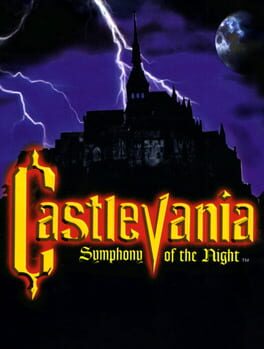
Nearly 30 years since it's release, and i'm amazed by how ahead of it's time this game is. An absolute masterpiece of it's genre, STILL better than a lot of metroidvanias of recent times. That halfway twist was absolutely incredible.
ofc by being a 1997 game it has some gameplay jank and rather weird difficulty in terms of goofy aah enemy attacks but i think it's kinda mandatory to overlook such stuff when talking about a game this old.
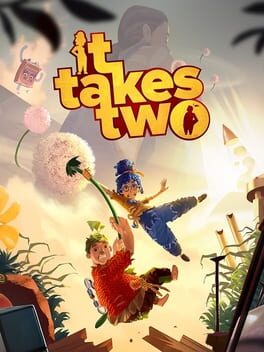
First of all, the story really isn't all that great, even illogical at times, with a very average conclusion, but honestly, I don't really care since the rest of the game is so good. Aside from that, the game is beautiful, except for the human models which are borderline creepy. Like I said, the game does an awesome job varying the gameplay—there's always something new and you never get bored. And even if not all the zones are excellent, they're mid at best. As for the powers, though, I personally saw a huge imbalance. I played as May, and frankly, people who had to play as Cody must have had way less fun, because his powers are worse than May's every single time.
Another flaw, which is also the game's greatest quality, is the fact that you can only play it with 2 players, and exclusively with 2 players. Personally, I'm currently studying, so it's really complicated to find someone around me who hasn't played the game yet, who is also on playstation, who has the time and wants to play it, and to find times when we're both free. As a result, we had to stretch the game over 8 months. Frankly, putting a bot in place of the second player wouldn't have been impossible, even if I get that it's complicated at times.
Huge plus, on the other hand, is that only one copy of the game is required—even more surprising when you see that the publisher behind the game is EA, like, what the fuck happened to them???
This review is probably going to be super short, but this time around, It Takes Two is a game that I genuinely enjoyed playing, sure, but I don't have much to say about it. It's very rare for a game to leave me with such a bad case of writer's block. It's very good at everything without being truly excellent at anything; it doesn't have any major flaws to really point out. I think it's the best co-op experience available today—maybe behind Split Fiction? I'll have my answer once I play that one.
In short, It Takes Two is a good experience, though maybe not memorable enough, and that might be its main flaw. I remember that 2021 was a pretty dry year for video games, but even then, I have to say It Takes Two doesn't feel like it has GOTY caliber. And since, much like what I had to say about the game, I don't know how to conclude this review, I'm just going to stop it very abruptly like this.

Popular lists


Coming soon
Recently anticipated
Sleeper hits
Avg 4.2★
Avg 3.7★
Avg 3.4★
Avg 3.9★
Avg 3.3★
Avg 3.3★
