

Ur
ancient Mesopotamian city-state  | |||||
| Upload media | |||||
| Instance of | |||||
|---|---|---|---|---|---|
| Part of |
| ||||
| Culture |
| ||||
| Location | Dhi Qar Governorate, Iraq | ||||
| Present in work |
| ||||
| Has part(s) | |||||
| Heritage designation |
| ||||
| Inception |
| ||||
| Dissolved, abolished or demolished date |
| ||||
| Area |
| ||||
| Different from | |||||
| Said to be the same as | Ur Kaśdim | ||||
 | |||||
 | |||||


|
This place is a UNESCO World Heritage Site, listed as “Ahwar of Southern Iraq”. |
- 𒋀𒀕𒆠
-
 name
name -
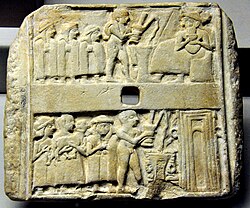 Wall plaque from Ur, c. 2500 BC; the British Museum


Society and culture
[edit].jpg)
Lizard-headed nude woman nursing a child, from Ur, Ubaid period, c. 4500–4000 BC; Iraq Museum

Enthroned King Ur-Nammu (c. 2047–2030 BC)
Standard of Ur mosaic (c. 2600 BC)


The Standard of Ur mosaic, from the royal tombs of Ur, is made of red limestone, bitumen, lapis lazuli, and shell. The "peace" side shows comfort, music, and prosperity. The "war" side shows the king, his armies, and chariots trampling on enemies.
Early Bronze Age
[edit]-

-
 Empire of the Third Dynasty of Ur. West is at top, north at right.
 -
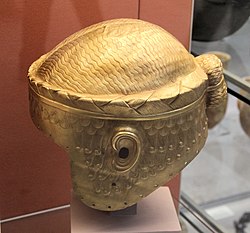 Gold helmet of King of Ur I Meskalamdug, c. 2600–2500 BC
 -
 Mesopotamian female deity seated on a chair, Old-Babylonian fired clay plaque from Ur
 -
 Sumer and Elam circa 2350 BC. Ur was located close to the coastline near the mouth of the Euphrates.
 -
 Plaque with woman's face, BM 122113


Identification with the Biblical Ur
[edit](Ur of the Chaldees)
-
 "Abraham's House"

Archaeology
[edit]-
 Carved stone with integral handle
 -
 Foundation cone of A'annepada for Inanna, British Museum, BM 90951
 -
 Aerial photograph of Ur in 1927


_but_2500_-_6000_y.o..JPG)
Bitumen "mortar" among Ur's mudbricks
_(14767185992).jpg)
Circular groups of bricks excavated in 1900
The Royal Tomb Excavation
[edit]-
 Rawlinson's March 1854 letter to The Athenaeum announcing his reading of the Nabonidus cylinders which connected Muqeyer or "Um Qeer" with the name Ur.
 -
 Reconstructed Sumerian headgear and necklaces found in the tomb of Puabi in the "Royal tombs"


